Adelaide Festival review: Perle Noire – Meditations For Joséphine
This imaginative song cycle uses jazz, poetry and sublime singing to remind us urgently that the injustices of the past are not yet over.
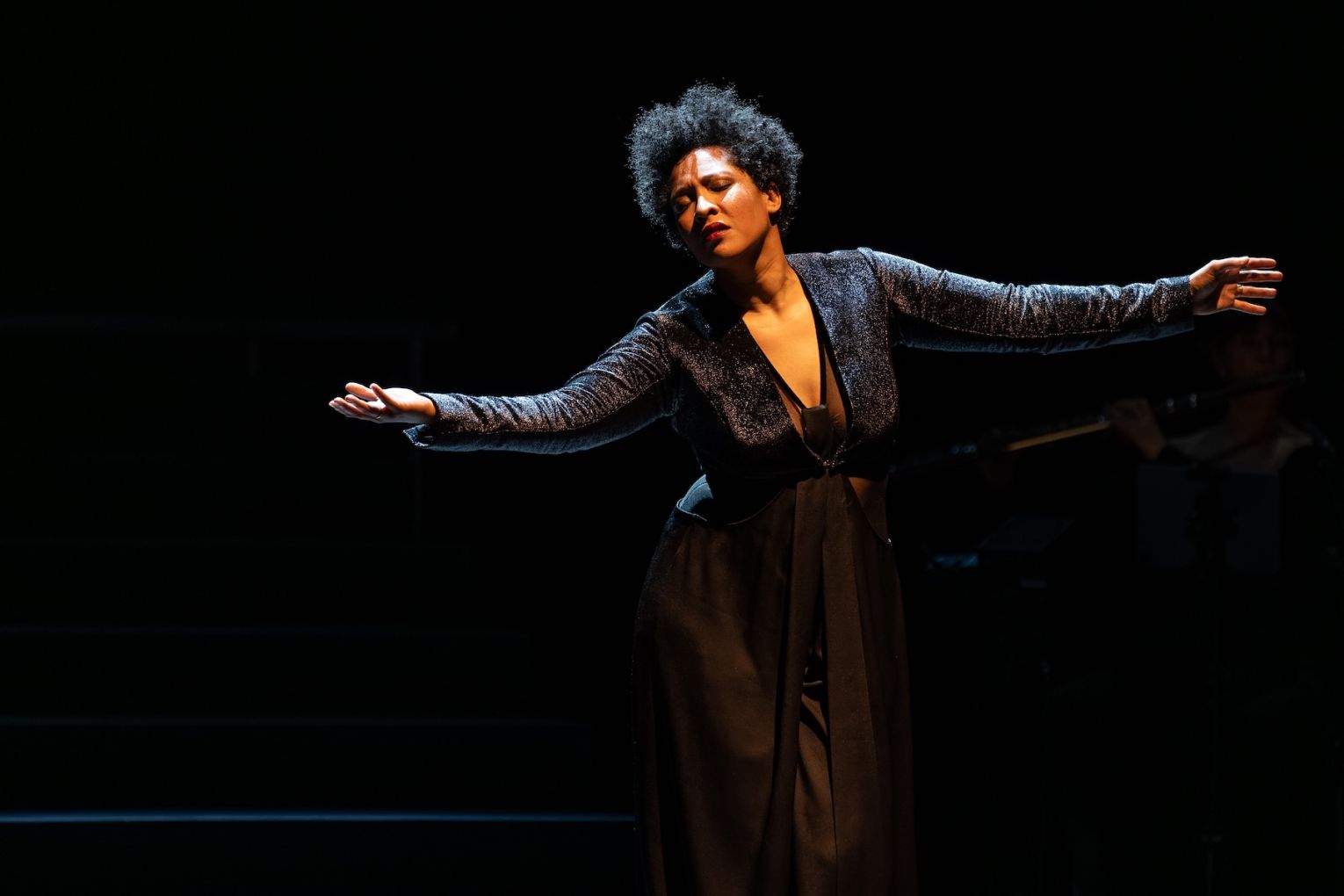
The more time passes, the more extraordinary Joséphine Baker becomes. Born in St Louis, Missouri in 1906, she moved to Paris at the age of nineteen and was star of the Folies Bergere by 21. As her popularity and celebrity expanded in France she broke all barriers.
At her peak, she was not only the highest paid woman performer, and the highest paid Black performer, but the highest paid performer in the known world. All of this, happening far from the Jim Crow segregation and persecution in the United States.
Baker became a French citizen and was awarded the Medal of Honour by President de Gaulle for her valour in World War II. Back in the US, she gained prominence when she walked with Martin Luther King in the March on Washington in 1963. Extraordinary accomplishments for a young woman famous for dancing in a costume consisting of artificial bananas.
It is all these aspects of her life which are the driving force behind Perle Noire: Meditations for Joséphine, a project begun in 2016 by director – and onetime Adelaide Festival artistic director – Peter Sellars, recent Juilliard graduates Julia Bullock and Tyshawn Sorey, and poet Claudia Rankine.
But this powerful one movement song cycle is not a biography of Baker. Nor does it exalt her rise to fame, or construct a chronological narrative of rising and falling fortunes. Instead, it is an operatic fantasia imagining, and often castigating, the paradoxes and turmoil of a success based on being exoticised, eroticised, and objectified.
As Claudia Rankine writes in one of her vivid poems in Baker’s voice:
You might like
“I understand that I am a package / That’s been ripped open and devoured / Like a box of chocolates.”
Perle Noire explores Baker’s uncertain self-image and personal doubt. But more significantly it highlights and dramatises her implacable resistance and anger towards racism and injustice.
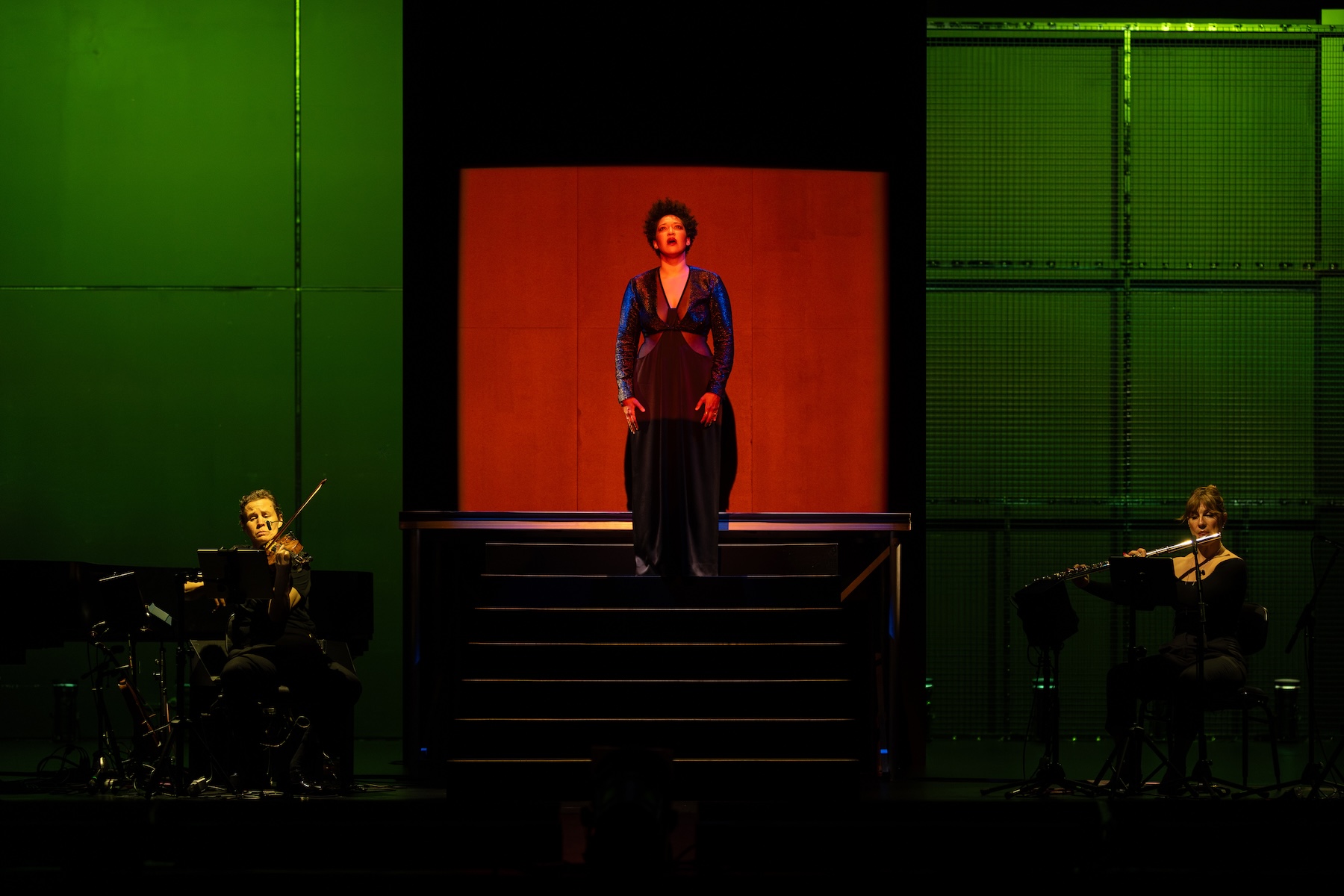
Boldly lit by James F. Ingalls, a staircase leading to a raised platform divides the stage at Her Majesty’s. On each side are the musicians from the International Contemporary Ensemble. Composer and musical director Tyshawn Sorey is on stage left with his piano, drum kit, percussion and a thunderous gong.
Violinist Jennifer Curtis is beside him while guitarist Dan Lippel is seated at the stage edge. On the other half are more musicians. Flautist Alice Teyssier, Rebekah Laplante on bassoon and Travis Laplante on saxophone.
Claudia Rankine’s poetic monologues – some of which appear in the program – establish the tone, style and purpose of the production when she channels Joséphine Baker:
Subscribe for updates
“On stage the body they saw / Didn’t have me in it / Is emptiness a thing to behold? / I try to contain it with costumes/ I turn my skin into a costume / I walk on to the dark stage / And they say my nakedness shimmers savage”
Meditations like this are powerfully enunciated by Julia Bullock who maintains a commanding presence for the full 110 minutes of the performance. Significantly she is neither an impersonator nor a bystander. Instead, she is Joséphine Baker’s guardian and advocate.
The events and principles, the racial transgressions and disgrace, are personal and political for Julia Bullock and this commitment, as in all of director Peter Sellars’ works, is key to the impact and integrity of the production.
The opening song ‘Bye Bye Blackbird’, the jazz standard by Mort Dixon and Ray Henderson, has been completely and brilliantly dismantled by Tyshawn Sorey and his fellow musicians. Bullock in splendid voice repeats the word ‘Blackbird’ while Sorey plays his flawless cascading piano, joined by the flute, then the bassoon in gravelly mode, while the saxophone adds a welcome lyrical promise. It is only near the end that ‘Bye Bye’ appears – more cryptic than familiar.
‘Sous le Ciel Afrique’ (Under African Skies) offers a homeland idyll in contrast – again featuring celebratory sax and crooning bassoon while Bullock sits on the stairs bathed in red light.
Other songs mark the shifting moods and polemics of the cycle. ‘Si J’etais Blanche’ (If I were White) examines race and identity while ‘C’est Lui’ is a glimpse into the lousy men in Baker’s more torrid and unhappy private life.
There are upbeat contrasts when Bullock spins and twirls – choreographed by Michael Schumacher with silhouette effects from Ingalls’ lighting. ‘Madiana’ captures the festive eclecticism of 1920’s dance music and the lullaby ‘Doudou’ celebrates Baker’s devotion to her huge clan of adopted children.
‘Terre Seche’ (The Dry Land) is a slow ballad of duress and exhaustion, Bullock in mournful voice and the musicians providing funereal obsequies to the prone singer at centre stage.
But it is ‘My Father How Long’, a spiritual from the 1867 anthology of Slave Songs of the United States which concludes this intriguing, inventive and beautifully presented chamber work. A prayer for rescue and salvation from nearly 160 years ago still speaks to the present with grim relevance. ‘How long will our people suffer?’ it asks, ‘When will there be happiness on Earth?’ That final line brings an audible gasp (and a shout) from the audience before the applause.
Director Peter Sellars, writer Claudia Rankine, the brilliant Julia Bullock, gifted composer and improviser, Tyshawn Sorey and the excellent International Contemporary Ensemble have not only produced a series of meditations for a great African American woman, they have expressed the urgency, disappointment, and anger at the racial injustice of present times. Not only in the United States, but for those of us in this Adelaide audience, much closer to home as well.
Perle Noire: Meditations for Joséphine plays at Her Majesty’s until March 4 as part of Adelaide Festival

Want to see more stories from InDaily SA in your Google search results?
- Click here to set InDaily SA as a preferred source.
- Tick the box next to "InDaily SA". That's it.
Free to share
This article may be shared online or in print under a Creative Commons licence