Adelaide Festival review: The Cherry Orchard
Simon Stone moves his shrewdly faithful version of Chekhov’s The Cherry Orchard to contemporary South Korea and the result is a rich mix of exuberant human foible, sadness, and manifest destiny.
“What turned out isn’t a drama” Anton Chekhov wrote to a friend in 1904, “but a comedy, in places even a farce…” He was referring to The Cherry Orchard, the last of his four great final plays, completed just before his untimely death later that year.
Chekhov has always puzzled and teased directors faced with staging his works. Stanislavsky, his important first explicator, designed a whole new approach to acting just to manage the psychological and sensory implications of his texts.
Over time Chekhov’s plays, mischievously labelled by him – comedy in the case of The Seagull (which ended in a suicide), drama in reference to Three Sisters, and comedy again for The Cherry Orchard – still pose challenges. For 120 years, interpretations have veered widely between tragedy and absurdism, comedy and pathos.
It is hardly a revelation to say that Chekhov contains all these multitudes. The task still remaining, though, is how to navigate these wild mood swings, the emotional and comic waxing and wanings which characterise human behaviour both in and out of extremis?
Director Simon Stone in his splendid new production of The Cherry Orchard has surpassed his 2013 version for Melbourne Theatre Company by moving the play right out of the Anglosphere altogether.
“I developed this obsession with Korean actors,” he explained to InReview in a recent interview. “Because they have this thing that is hard to achieve; they move so effortlessly between so-called ’serious acting’ and ‘comedic acting’. They’ll find the gag and then they’ll break your heart a second later – there‘s no announcement that the genre has changed.”
Stone has long made a study of South Korean cinema – singling out Parasite as a particular inspiration. But in this production he has not only discovered the means of presentation, but he has delved the text for meanings outside pre-Revolutionary Russia.
The relocation of the play in contemporary South Korea and the entrenched, and increasingly decadent, chaebol dynastic families is inspirational. The chaebols – the name for wealth clans or financial cliques, controlled and tightly run by family dynasties imbued with social prestige and political prominence, comprise all but three of the top fifty Korean companies listed on their stock exchange.
You might like

They include familiar powerhouses – Daewoo, Samsung, Hyundai, LG – but over time for many, nepotism and cronyism has consolidated into corruption, complacency, unquestioned privilege and corporate decline.
So instead of Lyubov Ranevskaya and her daughter Anya returning from Moscow to their bankrupt family estate, Doyoung Song, and her daughter Haena, return from five years in the US to their modernist designer house in Seoul with its adjacent cherry plantation.
The dilettante Russian brother, Gaev has become Jaeyoung Song, and Lopahkin, the son of a serf who becomes a prosperous merchant is, in the Korean equivalent, Doosik Hwang, a wealthy investor in new tech and other thriving start-ups, with an urgent recovery business plan which falls on deaf and obstinate ears.
With his own script, written in English and then translated into Korean, Simon Stone has more than adapted Chekhov; he has re-ignited his text with innovation and an assurance and aptness that is exceptional. The often used term “re-imagining” — to describe half-baked cliché and theatrical plunder – has no place here. I hope, somewhere, Chekhov is smiling.
On stage at the Festival Theatre, opening the 2026 Adelaide Festival, Stone’s production is formidable. Only last year we were astonished by his production of the late Kaija Saariaho’s opera Innocence, with its towering set design by Chloe Lamford.
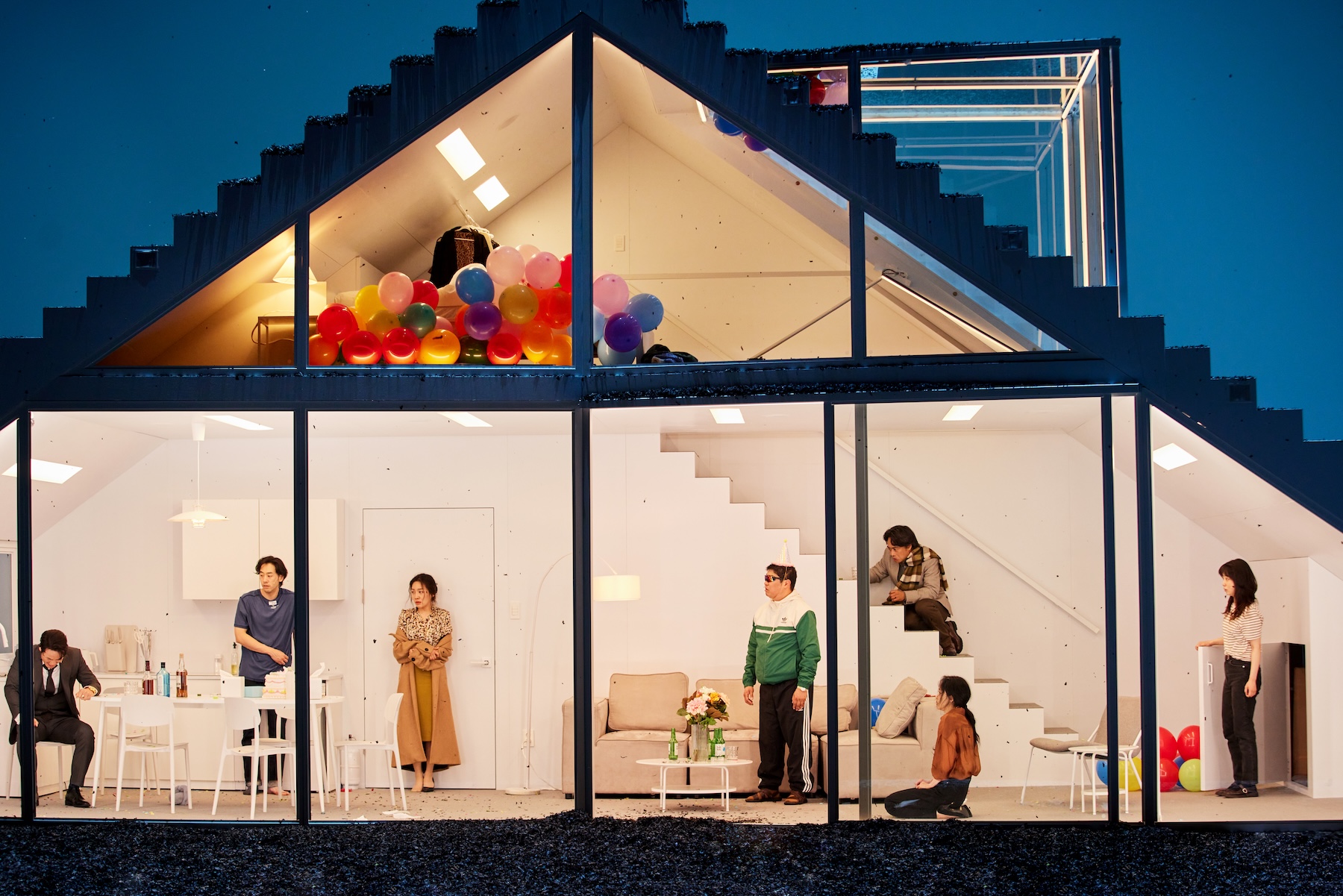
Here, subtly lit by James Farncombe, in all-encompassing pastel washes, set designer Saul Kim has built a glass and steel framed ziggurat through which we view the kitchen and lounge where the extended family and hangers-on gather – boasting, belittling, laughing, snarling, reconciling, weeping, drinking, shouting, and frequently falling down in stupor.
The set has a mezzanine for bedroom scenes, a high peak for ‘message from the mountain top’ speeches, and on one side the roof is a huge, descending staircase as if to amplify rapid descents into torpor and exaggerated despair.
The performances from the ten-person ensemble – in Korean, with Stone’s script as surtitles, are uniformly terrific.
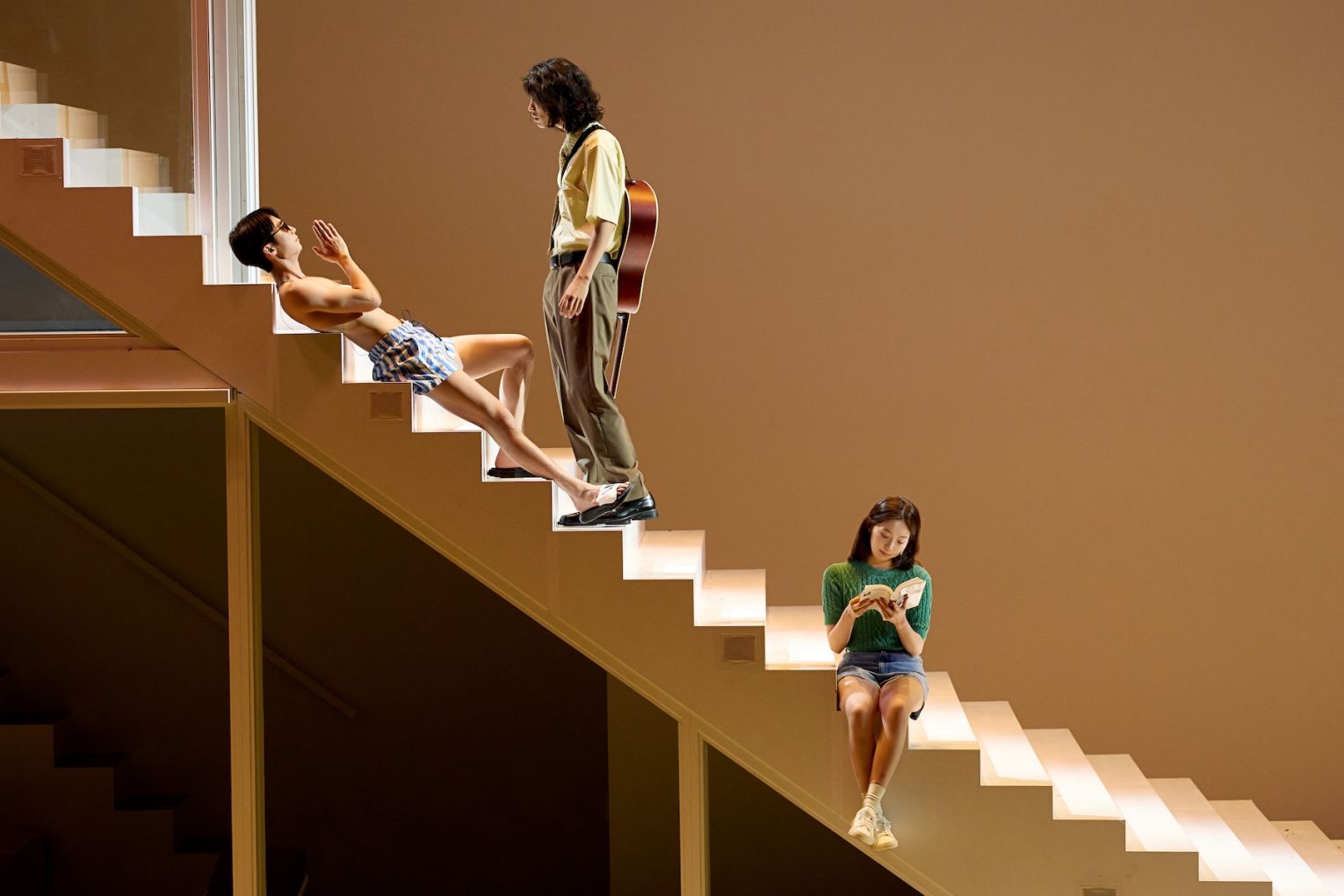
And, because there no small roles in Chekhov, every little bit helps. Sejun Lee as Yebin Shin, the shy chauffeur, also has a cameo as a gormless guitarist, serenading the absent Doona Jung (Chekhov’s Dunyasha), vibrantly played by Heejung Park.
Subscribe for updates
As the aloof and opportunistic underling, Joodong Lee (Chekhov’s Yasha) Juwon Lee excels, and as a composite of the Russian spongers and sycophants, Byunghoon Yoo’s Youngho Kim, perpetually sloppy drunk, and on the cadge for handouts, gives a glimpse of how the family fortunes have melted away.
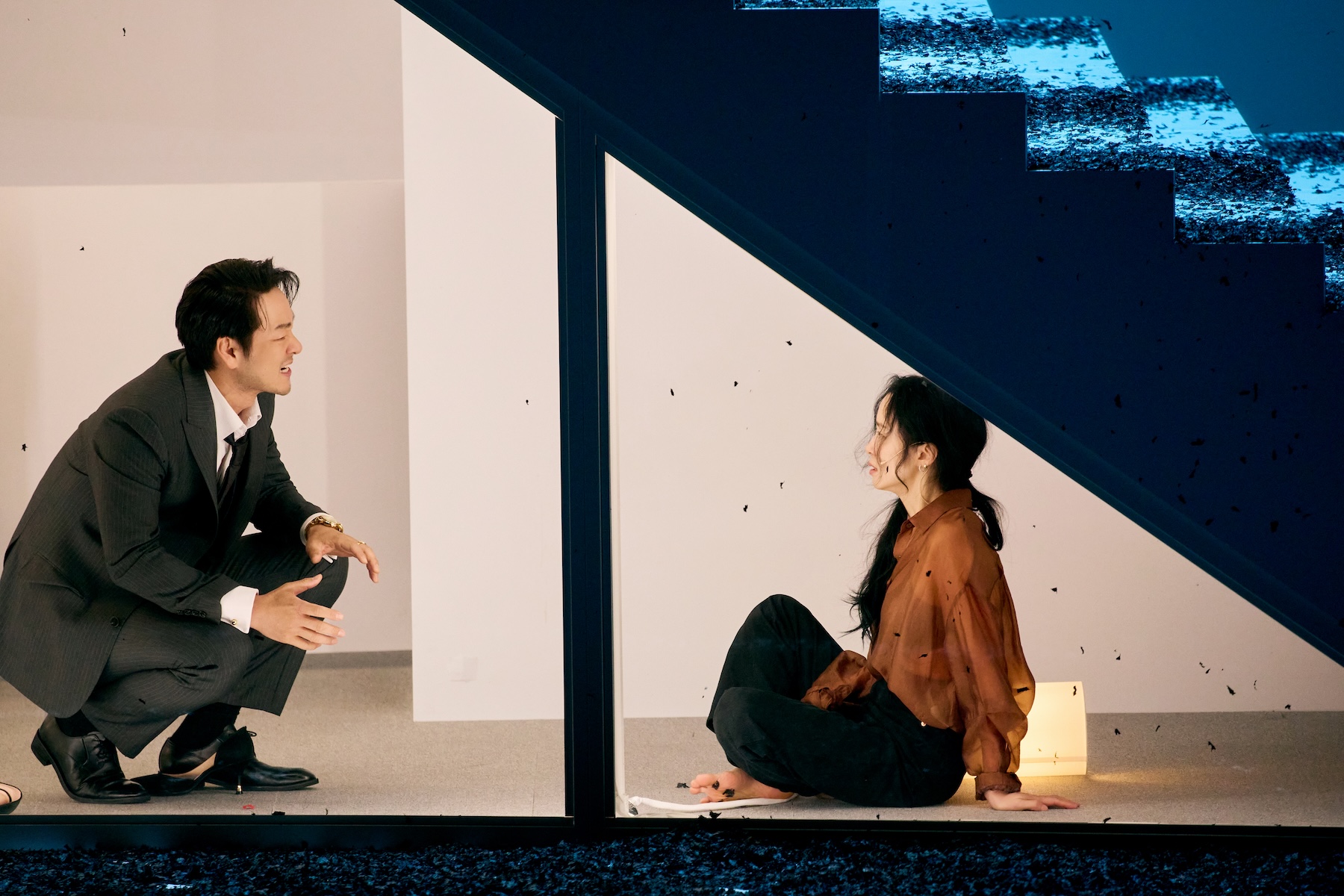
Doyoung Song’s two daughters, Hyunsook Kang and Haena Kang (Varya and Anya) are memorably played by Moon Choi and Jihye Lee. The complex, often dissonant relationship they have with their careless, self-preoccupied, alcoholic mother is poignantly captured in Stone’s text, as are their often-vexed love interests. The theatre program has a haywire diagram of the various enmeshed connections of the heart in the play. As in all Chekhov – everyone is in love, but invariably mismatched, thwarted or unrequited.
In the case of Doyoung’s ineffective brother, Jaeyoung, (Chekhov’s Gaev) Stone turns up the satire on privileged incompetence. Sangkyu Son is excruciating in his rejection of reports of the dire financial state of the corporation, and arrogantly rejects any remedies. His manic, regressive panegyric to his childhood record player is both funny and disturbingly hysterical.
And, as for the leads – Korean screen favourite Doyeon Jeon as Doyoung Song and Haesoo Park (of Squid Game fame) as Doosik Hwang (Chekhov’s Lopahkin) – they are the fulcrum of the play.
Jeon’s portrait of an other-worldly, habitually entitled woman is a perfect instance of the serious and the comedic. When she has a vision in the darkened cherry grove of her dead son Haejun (which turns out to be the former tutor and perpetual student of life, Donglim Byum, energetically played by Yunho Nam) we understand the tragedy underlying her giddy, restless search for distraction.
Her renewed contact with Doosik Hwang very early in the play establishes an important thread. Doosik, the son of the drunken chauffeur dismissed by the family long ago, has made good and is eager to thank Doyoung for a long-forgotten kindness in his otherwise miserable childhood. In her careless way she has no recollection of him, and when he proposes a rescue for the foundering chaebol, she resorts, along with her brother, to frivolous rejection: “You are ruining my party.”
Doosik is a well-intentioned man, whose only real friend in the play is the diametrically opposed but cordial Donglim. When Hyunsook farewells him she says, “You have a soft soul, do not let it harden.” But momentarily it does when Doosik, leveraged to the hilt, buys out the corporation and announces, “I bought your future and your past”, reminding the family that he now even owns their name. He is here to help but wants payback for the family’s pompously blithe dismissal as well.
The final scene of the closing-up of the house, in readiness for demolition, is both true to Chekhov and a measure of Simon Stone’s bold theatrics. As the last suitcases are collected there is ruthless surge of activity from Joodong Lee and Doona Jung, armed with leaf blowers clearing the stage (of what looks like potting mix) in an impatient blizzard of contemptuous despatch.
Youngkyu Jang‘s music, gently ambient at the play’s opening, closes in a terrifying cacophony of engine noise. Someone in a hard hat with a megaphone barks, “It is time for a new age. It starts today.”
It was bad before. Now there is worse to come.
The Cherry Orchard plays at the Festival Theatre until March 1 as part of Adelaide Festival

Want to see more stories from InDaily SA in your Google search results?
- Click here to set InDaily SA as a preferred source.
- Tick the box next to "InDaily SA". That's it.
Free to share
This article may be shared online or in print under a Creative Commons licence