Adelaide Festival review: History of Violence
Schaubühne Berlin’s History of Violence dissects memory and trauma under a forensic light
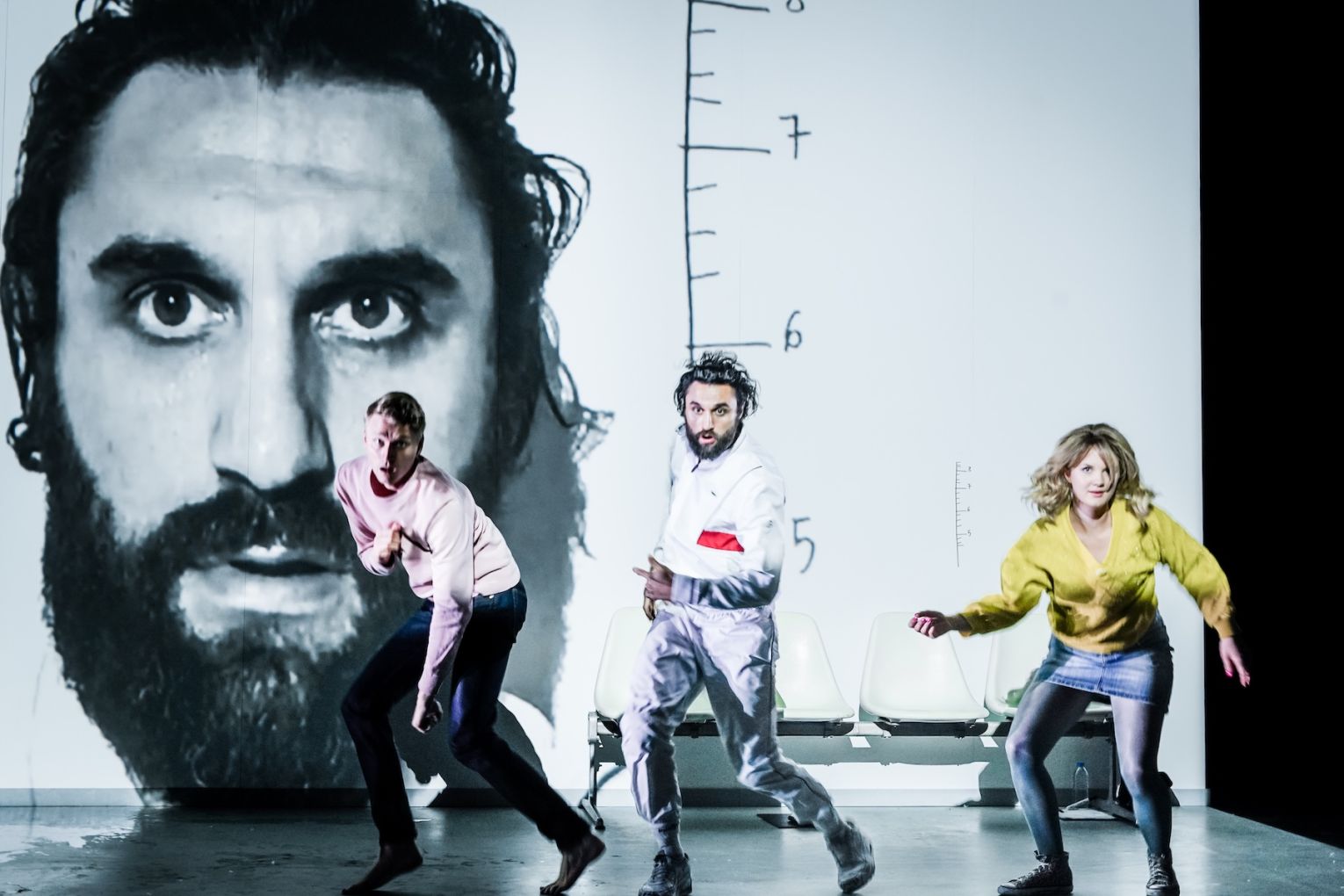
The audience file in to see a Dunstan Playhouse stripped to its bones. A huge white screen forms the back wall. A drum kit and small keyboard sit stage left and a small tea station perches on a bar fridge stage right. Two microphone stands, a row of plastic chairs with a bus station vibe and in a tight spotlight, a young man stares out at us as we take our seats.
Director Thomas Ostermeier does not ease us in. History of Violence begins as a crime scene. Three figures in biohazard suits enter with evidence markers, clinically analysing what has been termed an “attempted murder”. One investigator films the stage with a handheld camera, projecting the action in enormous black-and-white clarity onto the rear screen as the young man begins to speak. What unfolds over the next two hours is an autopsy not simply of an attack, but a dissection of how we tell stories.
Adapted from Édouard Louis’ autobiographical novel of the same name, Ostermeier’s production returns to the Adelaide Festival with this powerful and provocative piece that epitomises why Schaubühne Berlin has become one of the most influential theatre companies in the world. Delivered in German, with English surtitles, the language barrier in no way dilutes or obstructs the power of this meticulously constructed examination of memory and violence.
With the percussionist’s snare drum echoing the sound of forensic dusting for fingerprints, Édouard begins to tell his story, his voice rising into panic as he recounts the aftermath of a Christmas Eve encounter in Paris that spiralled into rape and attempted murder.
Édouard (Laurenz Laufenberg) is all velocity at first, his words tumbling over each other in raw, breathless reaction. He speaks of the smells on his body, the sheets that must be washed, the compulsive need to scrub himself clean. The drumbeat crescendos with his fractured narration.
You might like


Seeking refuge, Édouard visits his sister (Alina Stiegler) in the country. He recounts the story in the car, only to overhear his sister retelling it to her husband (Christoph Gawenda). This is where we have our first glimpse into the layered storytelling that structures this piece. Édouard’s sister’s version, coloured by assumptions about her brother’s sexuality, their rural upbringing, their depressed mother and her punishing job, begins to distort the account Édouard had initially presented. Humour flickers in these conversations between the sister and her husband, offering welcome flashes of earthy wit that ease a fraught dynamic between the working-class sister and the now bourgeois Édouard.
Alina Stiegler’s sister is magnetic: affectionate, spiky and quietly envious of Édouard’s escape to Paris. Through her performance we are introduced to the key theme – that stories mutate almost instantly. Even one degree of separation is enough to warp the “truth”.
At the police station, another version emerges. Stiegler and Gawenda are now police officers who fixate on descriptors. That the perpetrator was “North African” seems to tell them far more than ethnicity. Édouard insists his attacker was Kabyle – Berber – resisting any racial shorthand. Police questioning reshapes his story yet again. Then we are in the emergency department where Édouard’s experience is reshaped once more by both shock response and medical scrutiny.
The devices used throughout each of these versions of the story amplify the layered effect. The handheld camera cleverly magnifies tiny gestures into distorted prominence, just like memory, while the microphone delivers interior thought as intimate confession, each device reminding us that narration is always slanted and reframed. Musician, Thomas Witte, keeps a firm grip on the emotional tempo throughout, the live score of percussion and keyboard tightening the noose of tension.
Subscribe for updates
When the production finally replays the encounter and attack – Édouard meeting Reda (Renato Schuch) in Paris, flirting, then inviting him up to the apartment – the layering becomes almost unbearable. Renato Schuch’s Reda is charismatic, charming, yet his intimacy always edged with volatility. In close-up projection, their conversation in bed feels disarmingly tender as Reda speaks of migration, of a Kabyle father reinventing himself in Paris. Beneath this layer of the story, we glimpse a situation that defies the neat binary of monster and victim to reveal something more complicated – a story tangled up with class, migration, masculinity, desire and shame.
The sister and a police officer hover at the edges of this scene, interjecting, interrogating and reinterpreting. We witness, in real time, how questions can alter recollection and retelling. And we also see Édouard holding back, refusing to surrender everything by keeping silent fragments for himself.
The climactic violence, when it comes, is confronting and explicit. The clinical phrasing that opened the production of ‘attempted murder’ now feels grotesquely inadequate, like a euphemism hiding something far more chaotic.
The ensemble move fluidly between roles – sibling, officer, doctor – reinforcing how easily perspective can shift. The live video refuses to give any distance; the camera’s gaze is invasive and forensic and without an interval, the production offers no release valve.
Thomas Ostermeier’s direction is confident and intellectually stimulating, refusing any resolution or simple binary between good and evil. The violence is messy, the trauma is complicated. It’s uncomfortable territory, forcing the audience to sit with ambiguity rather than certainty. This is a production that will be playing in audience’s heads for days.
History of Violence is searing, politically powerful theatre, interrogating race, queerness and class without didacticism and insisting on complexity. Most unsettlingly, it asks what “truth” means once a story leaves our mouths and enters the world. And survival, this production suggests, may depend on how we choose to tell the stories – and retell them – to ourselves. What lingers is not simply the brutality of the attack, but the uneasy recognition that every retelling carries power.
History of Violence is playing at the Dunstan Playhouse from February 27 – March 2 as part of Adelaide Festival

Want to see more stories from InDaily SA in your Google search results?
- Click here to set InDaily SA as a preferred source.
- Tick the box next to "InDaily SA". That's it.
Free to share
This article may be shared online or in print under a Creative Commons licence