Adelaide Festival review: Tyshawn Sorey
In town to perform in Adelaide Festival’s Perle Noire: Meditations for Joséphine, for one night only multi-instrumentalist Tyshawn Sorey showcased his prodigious – if at times confounding – jazz talent.
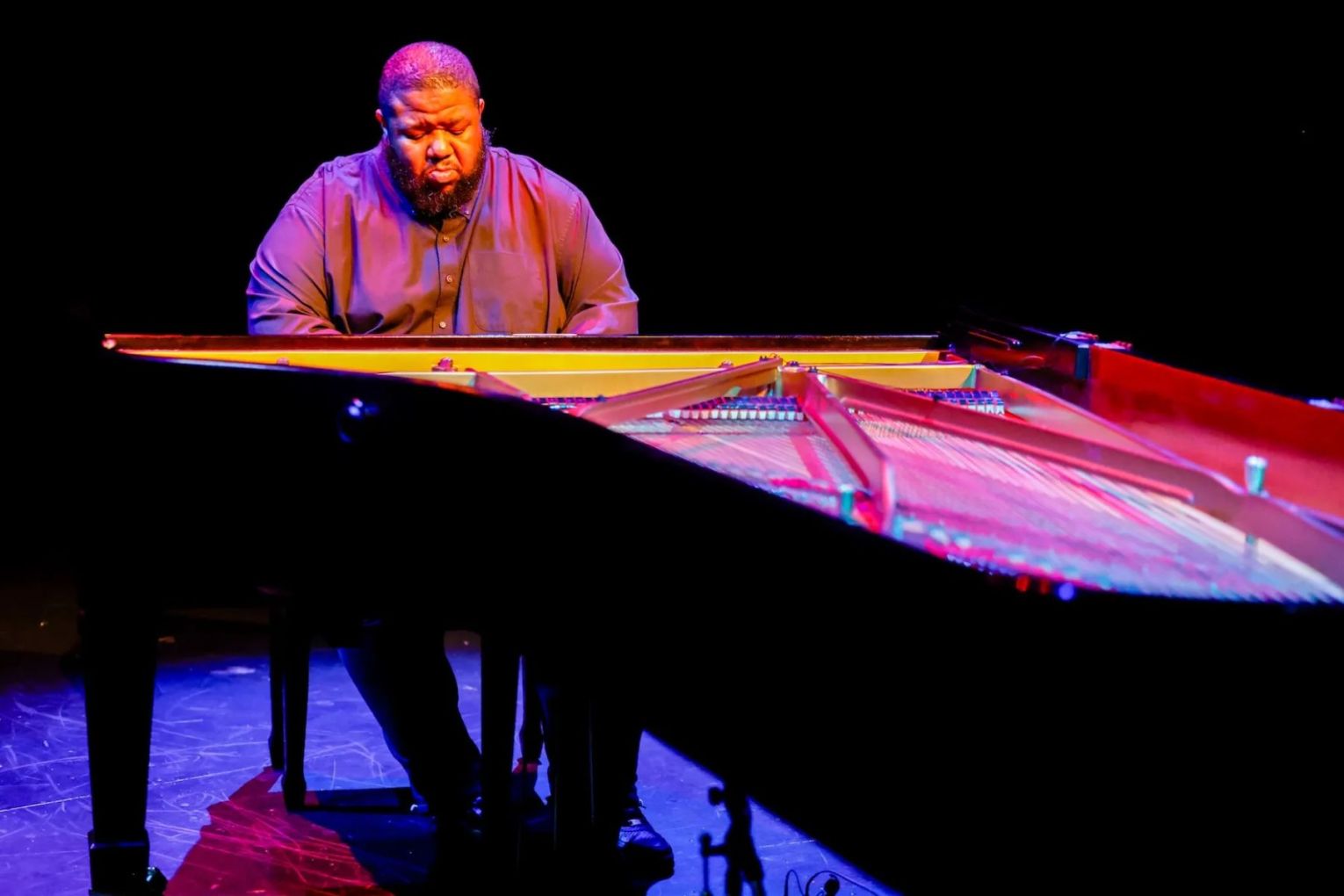
In their promotional material for internationally-acclaimed composer, improviser and multi-instrumentalist Tyshawn Sorey’s solo piano performance at Her Majesty’s Theatre, the Adelaide Festival Centre described the evening as “a rare moment of musical intimacy – an extraordinary artist, a piano, and the promise of a transcendent experience”.
Upon taking one’s seat in the theatre, it was clear that at least one-third of this tripartite guarantee would be kept: a grand piano sat in the centre of the stage, basking in the pale glow of the stage lighting. Moments later, as the house went dark, Sorey walked out on stage and just like that two-thirds of the promise had already been fulfilled, for an extraordinary artist he most certainly is.
A highly accomplished drummer, percussionist, pianist, composer, improviser, at various times and places a teacher, lecturer and professor of composition and improvisation in the most prestigious academic institutions in the United States, with a portfolio of solo albums and collaborations that have garnered much acclaim, including a Pulitzer Prize for his composition Adagio (For Wadada Leo Smith).
All that remained, then, was the “promise of a transcendent experience”.
On the surface, this would appear to be a foregone conclusion. Sorey is a highly unusual pianist, but a very skilled one. His musical approach relies on his most comprehensive understanding of musical forms, conventions and constraints, against which he throws his highly reasoned and detailed technique that pushes past them and out into the unknown. The piano’s lid had been removed entirely, and Sorey played the bare instrument to its limits, using all of its available expressive modes in the service of a truly unique performance.

In this sense, Sorey succeeds in delivering transcendence before having even played a single note, because his approach in and of itself goes so far beyond the conventional musical grammar to which any Western audience is culturally accustomed, regardless of their level of musical training, knowledge or expertise. Does this mean, however, that the audience’s experience was transcendent, or does it simply mean that they experienced transcendence?
Sorey began with a slow, languorous pulse marked out in chords in the very depths of the piano, filled with clusters that produced ringing overtones, especially with cavernous sympathetic reverberation constantly at hand thanks to his use of the sustain pedal. Against this, contrasting ideas began to develop: streaks of icy sparkle in the upper register, a few snatches of crystalline melody, beautifully articulated in a straightforwardly expressive classical manner.
As the performance took shape further, trills emerged that pushed the strings of the piano to rattle, even so far as to push one note quite sharply out of tune. It was clear that Sorey took this in its stride, even going so far as to intentionally highlight the note for a brief moment, deliberately re-articulating to bring the audience attention to it in the midst of a dense chordal texture. At the peak of the performance, he filled the theatre with a wall of clusters hammered out with the sustain pedal held down for several minutes, allowing murky melodic material to occasionally surface, only to quickly be re-engulfed by the thunderous roar of the piano’s lowest strings.
More could be said of Sorey’s performance – his use of extended techniques such as plucking and strumming of the strings from directly inside the piano, eschewing the keys and hammers entirely, or his use of the sostenuto pedal, allowing a few selected notes to ring out whilst others remain short and detached – but more importantly, what does any of it mean for the audience? What elements of this virtuosic exploration of the piano and its possibilities created a transcendent experience?
Sadly, it is difficult to say if any did, conclusively. The sacrifice one makes at this level of expertise, and with this kind of unique performance, is one of comprehensibility. Most listeners will be unable to experience the music with the kind of familiarity that is a precondition for a transcendent experience. They simply cannot follow the music easily enough to allow their experience to transcend anything.
Conventional musical styles are based on a shared musical vocabulary and grammar which limits expressive possibilities in order to retain the audience’s attention – put simply, to help them “get it”. Playing something that contravenes an audience member’s musical expectations is possible only if those expectations are first set up.
Subscribe for updates
Sorey is speaking an entirely foreign musical language, and whilst it may be interesting, or enjoyable as a raw auditory experience, or refreshing to hear because of its novelty, it is difficult to comprehend. The performance finished with a brief interpolation of the chordal ostinato from Bill Evans’ composition ‘Peace Piece’, first recorded on his 1959 album Everybody Digs Bill Evans, and unfortunately this is probably the only part of the performance that anyone present was able to fully grasp – it unambiguously referenced a part of the audience’s existing musical world (that is, of course, if they knew the tune), rather than requiring them to bring their own world up against that of the performance in real time as it happened.
It is without doubt that Sorey is a highly accomplished musician, and it is very special that Adelaidians were able to experience artistry on this level, even just for the one night only. Whether or not it was a “transcendent experience” as promised is perhaps less certain.
Tyshawn Sorey performed at Her Majesty’s Theatre on Monday March 2 as part of Adelaide Festival

Want to see more stories from InDaily SA in your Google search results?
- Click here to set InDaily SA as a preferred source.
- Tick the box next to "InDaily SA". That's it.
Free to share
This article may be shared online or in print under a Creative Commons licence