‘Everything happens in the moment’: Leonkoro Quartet balance the brutal and the fragile
Ahead of the Berlin-based group’s Australian debut, Leonkoro Quartet’s founding cellist Lukas Schwarz reflects on the group’s admirably mature approach to performance, musical canon, and their audience.

In just under a week’s time, the Leonkoro Quartet will make their Australian debut at the UKARIA Cultural Centre in Mount Barker, with a fascinating mix of canonical and contemporary works.
Their Sunday afternoon set will begin with Anton Webern’s Langsamer Satz; one of Webern’s earliest compositions, it’s a highly romantic single-movement work that is notably uncharacteristic of the composer’s usual, mature style in line with the Second Viennese School of atonal, modernist writing. This will then be followed by a performance of contemporary composer Jörg Widmann’s String Quartet No. 9, Beethoven Study IV, an extended exploration and manipulation of materials taken from Beethoven’s String Quartet No. 14, Op. 131 – a late-Beethoven masterpiece that the quartet will then perform to conclude the concert.
This intriguing running sheet raises many questions. How does one go about interpreting a work like Langsamer Satz which defies many of the expectations associated with its composer? What changes from work to work when performing one of the most revered string quartets of all time alongside its contemporary reimagining? And what logic dictates mixing all this material together?
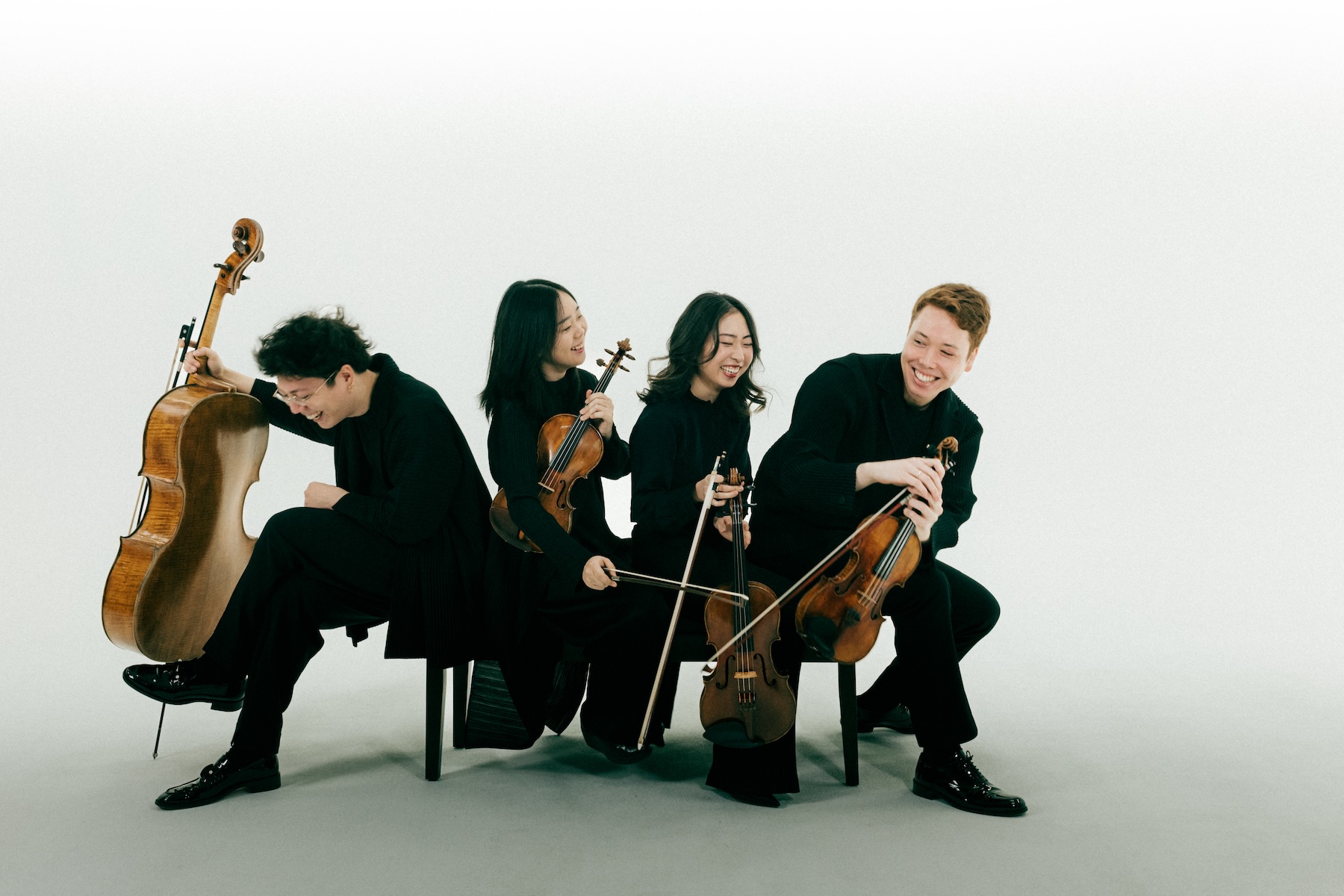
Speaking to the group’s founding cellist Lukas Schwarz, it’s clear such laboured lines of thinking aren’t a core concern.
You might like
“When we’re on stage performing the pieces… everything that happens happens in the moment, and there is nothing planned of some historical concept,” Schwarz explains.
That is not to say that they do not know their history. As Schwarz explains, the group take a more measured approach. “Knowing this stuff, keeping it in the back of our heads also forms the vision in the moment,” he says. “But not directly.”
Such comments offer a very thoughtful preview for their upcoming performance, and their ambitions as a group more broadly. Schwarz outlines a process of curation that is both forward-looking and deeply respectful of tradition, balancing canonical works and the appetites of concertgoers. Including Jörg Widmann’s study on Beethoven’s Op. 131, for example, allows them to challenge the audience’s perception of this monolith of the string quartet genre. Finishing the concert with the original work, however, offers a nod to its well-earned position in the canon.
Subscribe for updates
“It would also be interesting, of course, to play [the Beethoven] first, and then see what Widmann does with it, but we didn’t dare to do that,” Schwarz chuckles.
Of course, ardent supporters of the world of contemporary composition could easily take this deferential attitude as a sign of tokenism; the burying of contemporary works in a programme otherwise filled with canonical chestnuts, but the group are clearly very keen on the contemporary work, and earnest in their dedication to expressing Widmann’s work in all of its strange – and sometimes jarring – glory.
In fact, Schwarz indicates that Widmann’s study must be handled with care: after playing the Widmann, which is “so intense, and sometimes very brutal”, one needs to reset. “[The Beethoven] is so fragile and so precious, so you really have to play some scales in the intermission and get clean again,” he says. “I have to look to my colleagues, because when you first rehearse this piece and then you rehearse the original Beethoven, sometimes you feel like ‘I could take the wrong turn and go crazy’.”
The quartet’s genuine investment in both the contemporary and the canonical, while ensuring one does not derail the other, has paid dividends. In 2022, the group famously won first prize, alongside nine other prizes, at the Wigmore Hall International String Quartet Competition, but they have not taken this stunning performance as a carte blanche. In fact, much of their reasoned approach is likely due to their competitive background.
“When we started, we did all the competitions, so we had to do all the standard programmes,” Schwarz says, and as such they have the best of both worlds: a keen interest in the inclusion of contemporary works, and a firm grounding in the classical tradition.
Schwarz believes that carefully considered repertoire selection for each concert programme is the best way to convince audiences of their approach. Based on his experience, he reports that “if you ask the concertgoers, what I hear sometimes is, ‘Yeah, I don’t mind modern music, if it’s not too weird or too crazy’. I think it’s all about programming, it’s really important to put it in a context that makes sense, and to take the audience by the hand.”
It is clear that the Leonkoro quartet is destined for great things, and with this knowledge of their vision, Australian patrons should be very eager to welcome them down under for the first time. They, too, are eager to be welcomed: “We’ve heard so many great things about UKARIA, so we’re extremely excited,” Schwarz says. “And we’re also there a few days in advance to get used to the time zone, so we will have time to see all the beautiful nature.”
Leonkoro Quartet perform at UKARIA Cultural Centre on Saturday May 2 and Sunday May 3
Want to see more stories from InDaily SA in your Google search results?
- Click here to set InDaily SA as a preferred source.
- Tick the box next to "InDaily SA". That's it.
Free to share
This article may be shared online or in print under a Creative Commons licence