Guy Keulemans takes a shotgun to design convention
An exemplary JamFactory exhibition of collaborative works from artist and designer Guy Keulemans plays with the tension between iconoclasm and repair, history and innovation.
When JamFactory was established just over half a century ago during the progressive Dunstan decade, what constituted ‘good design’ and how it applied to the handmade object seemed far less problematic than it does today. One of JamFactory’s founding fathers, former AGSA curator Dick Richards, recalled in his retirement in 2013 that the aim was to ‘create an environment where small craft and design enterprises could grow and contribute to the South Australian economy by producing high-quality, value-added goods made from local raw materials for the local and Asian markets, especially Japan’.
Fast forward 52 years from that founding moment to X Keulemans, the JamFactory’s current exhibition which takes a literal and metaphoric shotgun to conventional notions of good design and the handmade. The exhibition’s run coincides with the announcement that JamFactory has ceased production of jam, a commercially-minded furniture and lighting line launched in 2019 in the hope of financially supporting other JamFactory operations. In the face of such challenges, how might X Keulemans offer any insights or solutions?
The exhibition showcases a diverse range of collaborative work led by designer-artist-researcher Guy Keulemans, all based on the ethical design premise that designers today need to approach object-making in the context of over-consumption and ecological threats, with the aim of being part of the solution, not part of the problem. He is an Associate Professor at Adelaide University, which is partnering with JamFactory to present this third iteration of a biennial exhibition series highlighting the practices of the University’s creative faculty.
Across two decades Keulemans has pursued his concept of ‘transformative repair’, both as a form of critique in design discourse and in the making of ethically designed objects. Across those two decades he has frequently collaborated with his life partner, artist-jeweller Kyoko Hashimoto, in their creation of exquisitely crafted but indefinable objects which exist in a zone across art, craft and design, and which invite us to question our notions of consumption and sustainability of the world’s natural and material resources. In 2021 Hashimoto and Keulemans were named among the Top 100 Game Changers in Design by Architectural Digest Italia. Their collaborative work is held in public collections including both the National Gallery of Victoria, Melbourne, and AGSA, which acquired a major piece, Paperchain for the Mountain from Hashimoto’s Guildhouse Fellowship exhibition held at AGSA in 2025.
You might like
While many of the exhibits in X Keulemans are collaborations between Keulemans and Hashimoto, there are also works by Keulemans alone, and a range of new collaborations with other artists, designers and makers, most of whom have associations with both the University and JamFactory.
Back to that shotgun, and its role in the exhibition. In a short video sequence made by Alex Robertson and Keulemans, we see him holding a .22 rifle to his shoulder and firing, followed by images of exploding ceramic vases. The handmade porcelain vases were provided by Keulemans’ father-in-law, Kiyotaka Hashimoto, who is a potter based in New England, NSW. The video is screening beside Keulemans’ series of three Archeologic vases which have been created by his painstaking repair of the bullet-shattered shards with silver and gold staples, to partially reform the vases. In the accompanying publication, Keulemans states, “I’ve always been fascinated with rupture and disjunction, chaos and generative systems”. This sequence of violent iconoclasm followed by finely crafted repair is an eloquent if essentially symbolic gesture, resonant with Keuleman’s core concerns around transformative repair.
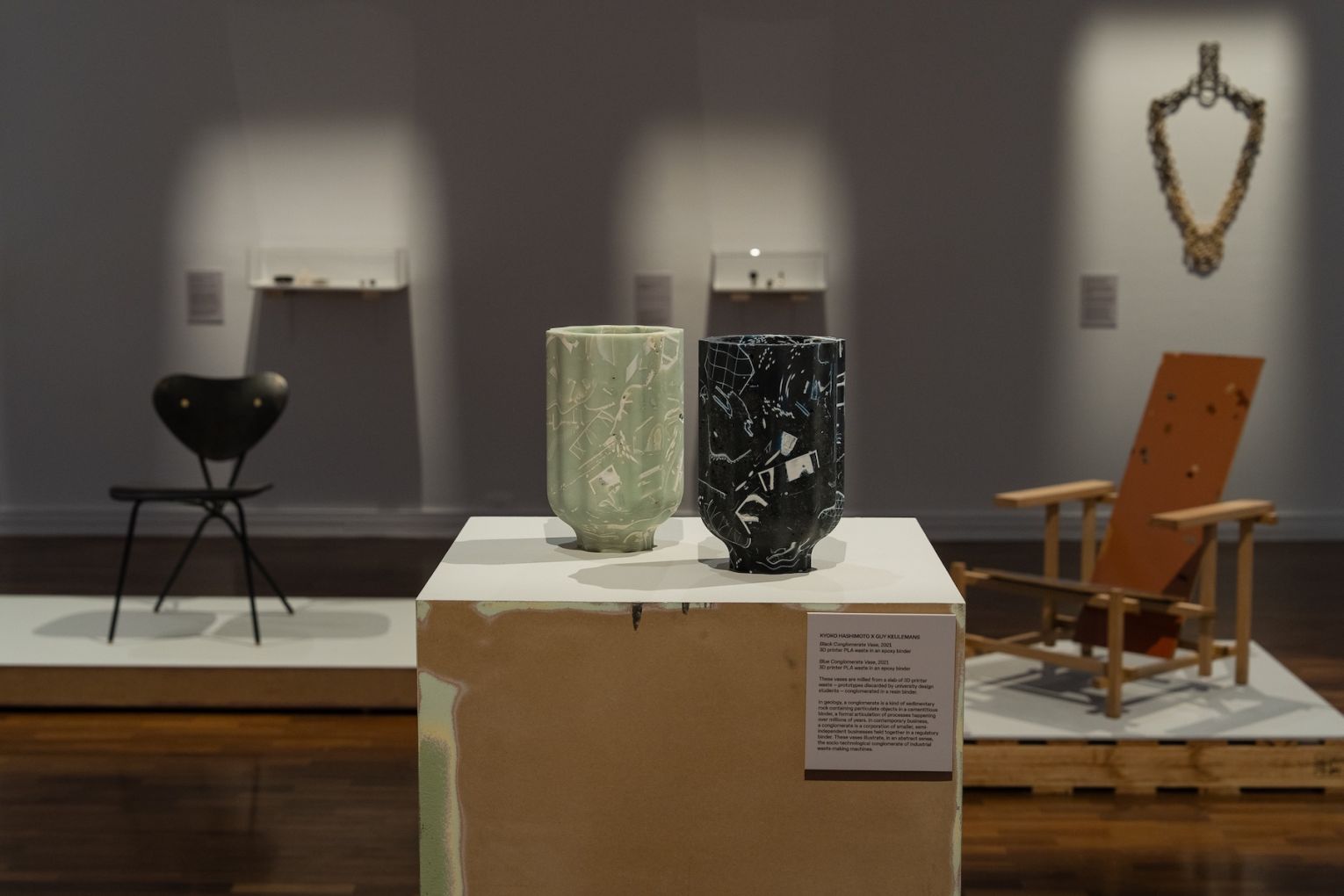
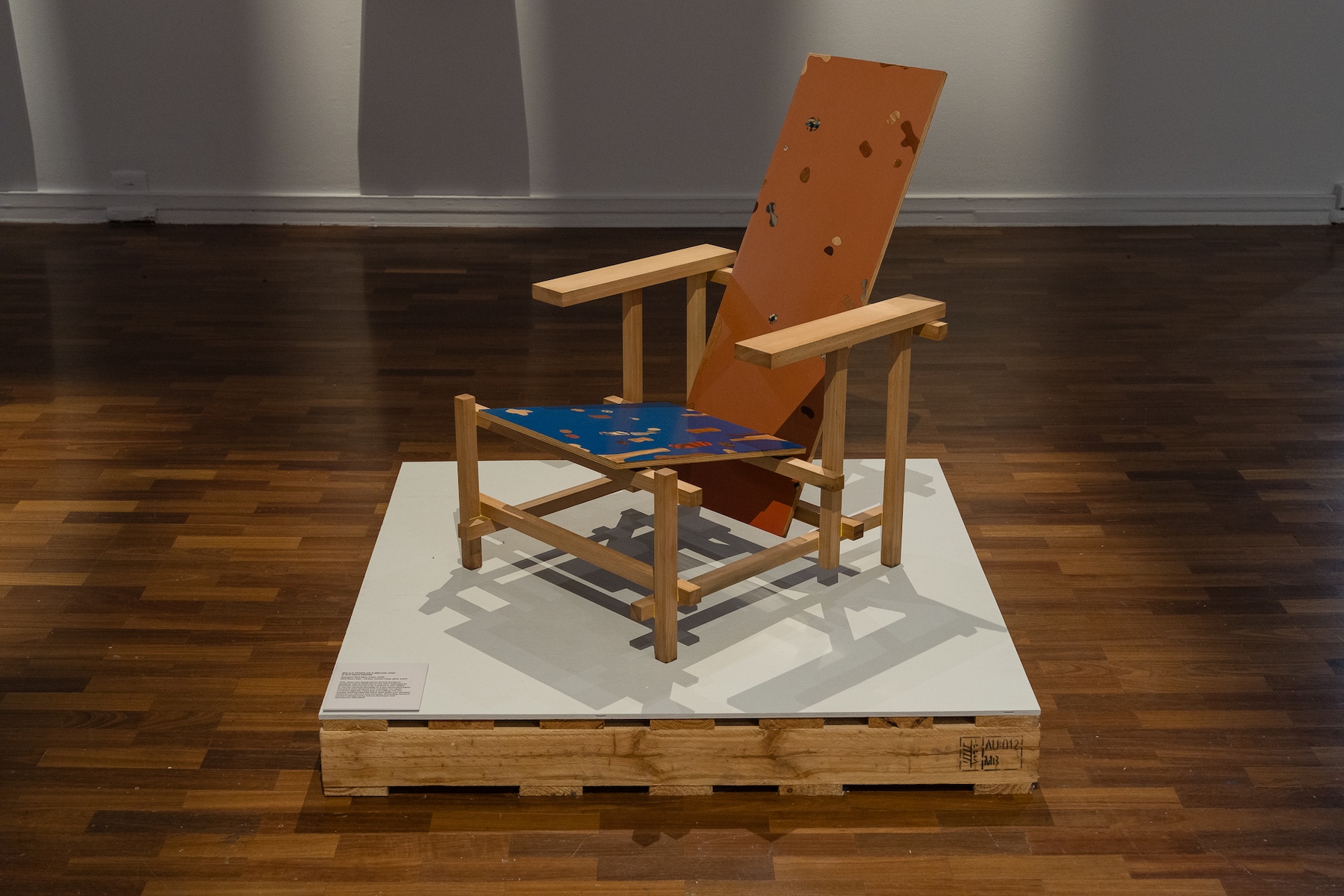
This is again the driving idea for Repaired Red-Blue Chair, a collaboration by Keulemans with Bolaji Teniola and Melvin Josy. A 1980s version of Gerrit Reitveld’s iconic Red-Blue chair, owned by the Keulemans family and fallen into disrepair, was repaired in 2026 with coloured timber veneer inlays. These clearly visible interventions give the chair a new life while retaining its history.
Subscribe for updates
There are a range of arguably less successful collaborations, exploring the exhibition’s core rationale of experimenting with repurposing and repair utilising industrial waste products. Keulemans and Christian Hall have collaborated on sculptural adaption of an abandoned street sign found on Belair Road; a collaboration with Peta Kruger using plastic waste has produced a woven textile, Vastus; and he has collaborated with Kyoko Hashimoto to create pairs of vases and discs from various waste materials. These works and other exhibits in this vein seem more like R&D lab experiments, rather than fully resolved designed objects. Most successful is a collaboration with Matthew Harkness and Achintya Chaudhary which produced a trio of necklaces featuring miniature dustpans and brushes fabricated from industrial waste products.
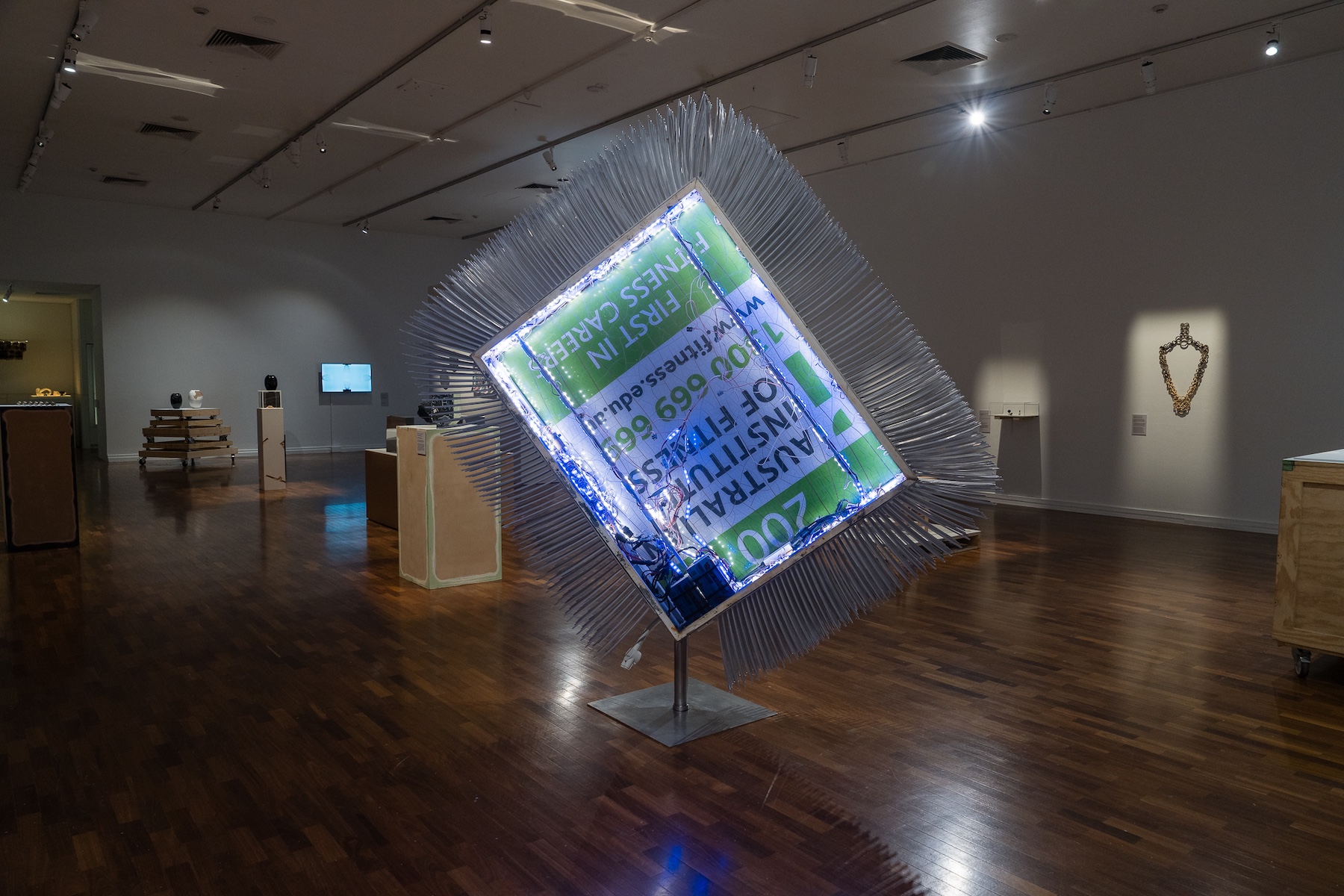
Those works in the exhibition by Keulemans alone have a more abrasive, strident edge. He trained initially as a graphic designer and has included three giclee print posters with fluorescent agit-prop messages on the dangers of pollution and over-consumption. Arguably the exhibition centrepiece is another didactic piece by Keulemans, Coal and steel mirrored table, in which a large chunk of Hunter Valley coal is positioned atop a polished steel coffee table.
There is a discernible shift in sensibility between these high-energy experimental collaborations driven by Keulemans, and the more fully resolved body of collaborative work by Kyoko Hashimoto and Keulemans. In these latter works, using natural found materials in juxtaposition with precious metals, her refined aesthetic and crafting skills are in successful creative tension with his ideas-driven approach. Esteemed NGV curator, Ewan McEoin who interviewed the pair for the book, refers to “the instinct that Kyoko, as a jeweller, has for material intimacy, and Guy’s restless appetite for systems critique”. In conversation with McEoin she refers to her desire “to draw people in with the beautiful objects and then to have an audience discuss the darker themes relating to the materials”.
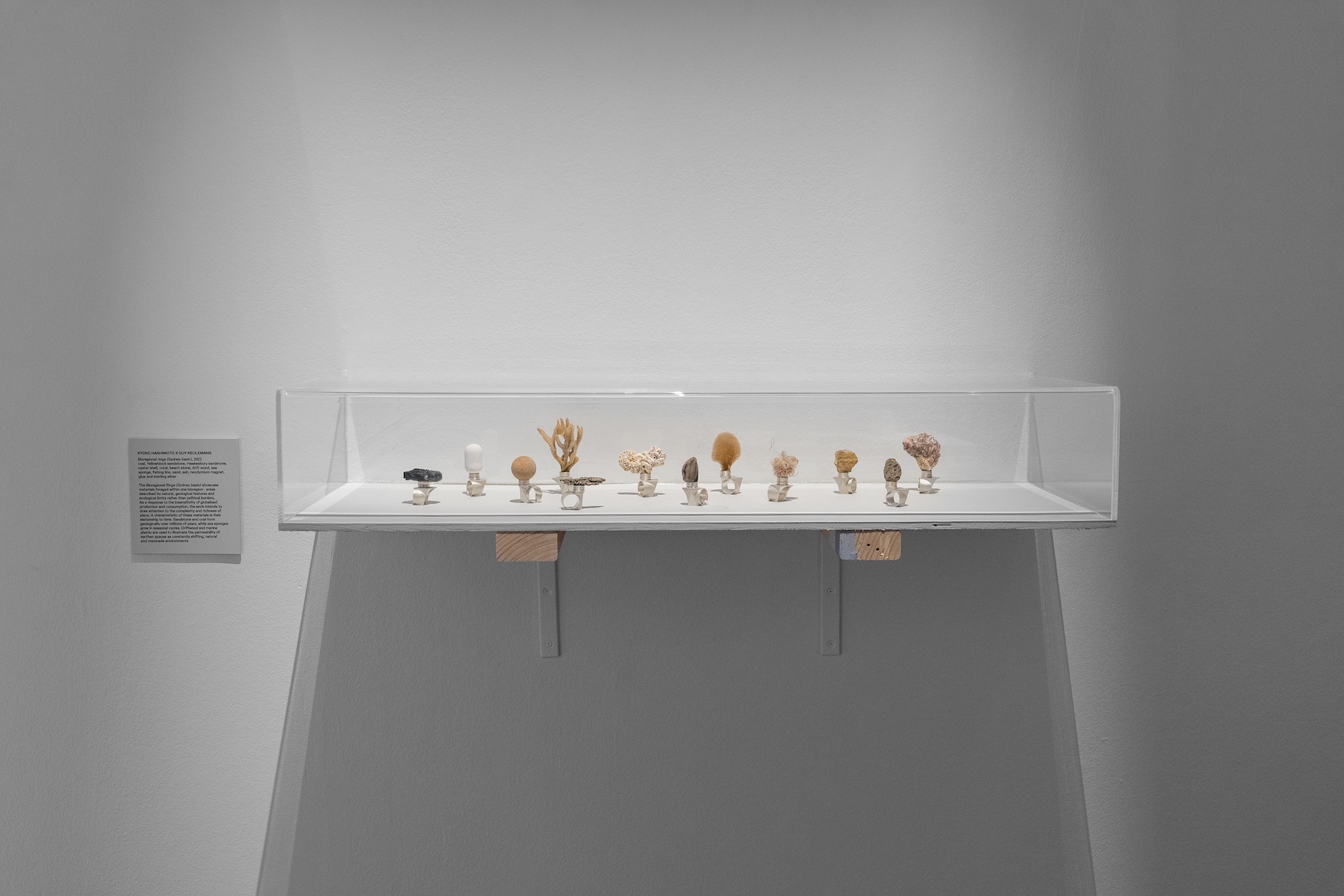
The exhibition features an outstanding body of jewellery-based collaborations by Hashimoto and Keulemans made between 2019 and 2026, in which they respond to natural and geological environments in Sydney, the Flinders Ranges and their own Adelaide Hills backyard, foraging for unconventional source materials. There is a beautiful grouping of polished copper and bauxite mirrors set in bases of copper ore, aluminium and bauxite; a series of Bioregional Rings (Sydney Basin) with ornamentation including sandstone, sea sponge and driftwood; a Coal ring set in sterling silver; and a Bioregional Rock chain, with found rocks from the Flinders Ranges set in sterling silver.
Across the years Hashimoto/Keulemans have made a series of scaled-up sculptural necklaces, with one of the first in 2019 being a rope strung with 107 concrete and steel beads (for JamFactory’s touring Concrete exhibition), followed by Paperchain for the mountain (with video), 2025, now held by AGSA, and the most recent in the current exhibition being Paperchain no.2, feral olive tree, 2026, an intricately interlocked ‘chain’ necklace fabricated using olive tree pulp from a tree in the couple’s Adelaide Hills back yard and dyed with hand ground eucalyptus through an amazingly labour-intensive process. This necklace is a wondrous object which gains even more resonance from knowledge of the arduous process of manufacture.
X Keulemans is an exemplary risk-taking exhibition involving experimental ethical design, radical new materials and ways of making. Inevitably not everything works, and there is some lack of coherency, possibly intentional, in terms of an identifiable, unifying style or signature resulting from Keulemans’ input towards each collaboration. Taking these reservations on board, X Keulemans reinforces JamFactory’s role as a leader at the vanguard of craft and design practice. This role of the gallery in showcasing the most experimental, the most innovative, and simply the very best of Australian craft and design is a big reason why Adelaide remains home to a thriving community of outstanding practitioners.
Set against the short-lived experiment of jam, this side of JamFactory’s operations is surely more important to its future. Yes, house-made products were a core part of the founding dream, but this latest failure reinforces the argument for consigning that dream to the archives, and to move forward with those parts of JamFactory’s operations that meet national and international benchmarks of excellence and innovation in craft and design.
More recent news of initiatives like New Territories – Australian Biennial Craft Commissions, slated to launch during the 2028 Adelaide Festival, and an expansion of the biennial Fuse Glass Prize into Adelaide Glass Week is a promising sign that JamFactory is indeed moving in this direction. The fly in the ointment is that, on closer inspection, this announcement is simply a prospectus calling for philanthropic support for an envisaged program that is not yet financed – let’s hope it might one day emerge fully-formed.
X Keulemans is on display at JamFactory until January 10 2027
Want to see more stories from InDaily SA in your Google search results?
- Click here to set InDaily SA as a preferred source.
- Tick the box next to "InDaily SA". That's it.
Free to share
This article may be shared online or in print under a Creative Commons licence