James Tylor’s long exposure of colonisation on Kaurna Yarta
The Art Gallery of South Australia is presenting the first major solo exhibition by a Kaurna artist in its 145-year history. But for James Tylor, making it into a colonial institution was never on his bucket list.
Some of James Tylor’s earliest childhood memories are at the Art Gallery of South Australia. His parents split when he was two, and in subsequent years the North Terrace institution became the neutral ground where his mum would take her son to spend time with his dad.
“I’ve got photos of me as a kid there,” Tylor tells InReview.
The one work he remembers most vividly is Evening shadows, backwater of the Murray by Birmingham-born artist H.J. Johnstone. The 1880 canvas was the first painting acquired by the gallery and remains one of its most recognisable holdings – an idyllic scene teeming with rivergums and rushes, as three First Nations people make camp by a pink sunset mirrored in the still water.
But even at a young age, Tylor – whose ancestry includes Kaurna Miyurna, Māori (Te Arawa) and European (English, Scottish, Irish, Dutch and Norwegian) heritage – could sense there was more to the story than the tranquil canvas suggested.
“I guess I’ve always been aware of colonialism,” he says. “Even as a boy, from both my Aboriginal side of the family and my non-Aboriginal side of the family, I’ve always thought about Australia as being Aboriginal land – these other people on someone else’s land.”
After leaving school Tylor spent stints working as a carpenter, an electrician, and a roadie, before returning to Adelaide in his twenties to study photography. He had harboured ambitions of becoming a photojournalist, perhaps covering the war in the Middle East, but upon his return to Kaurna Yarta he encountered a different kind of conflict.
You might like
“It was really shocking to me that I was in a community that was just all white,” he says of the Adelaide scene, which felt far more homogenous than the regional communities he grew up in. “The way that people talked to you, they just didn’t understand anything about what it was to be a Nunga. I needed to explore that, and address that.”
This month a major survey exhibition, Turrangka… in the shadows, has opened at the Art Gallery of South Australia, with curator Leigh Robb collating Tylor’s years-long project of reasserting Kaurna culture, history, and agency over greater Adelaide and beyond.
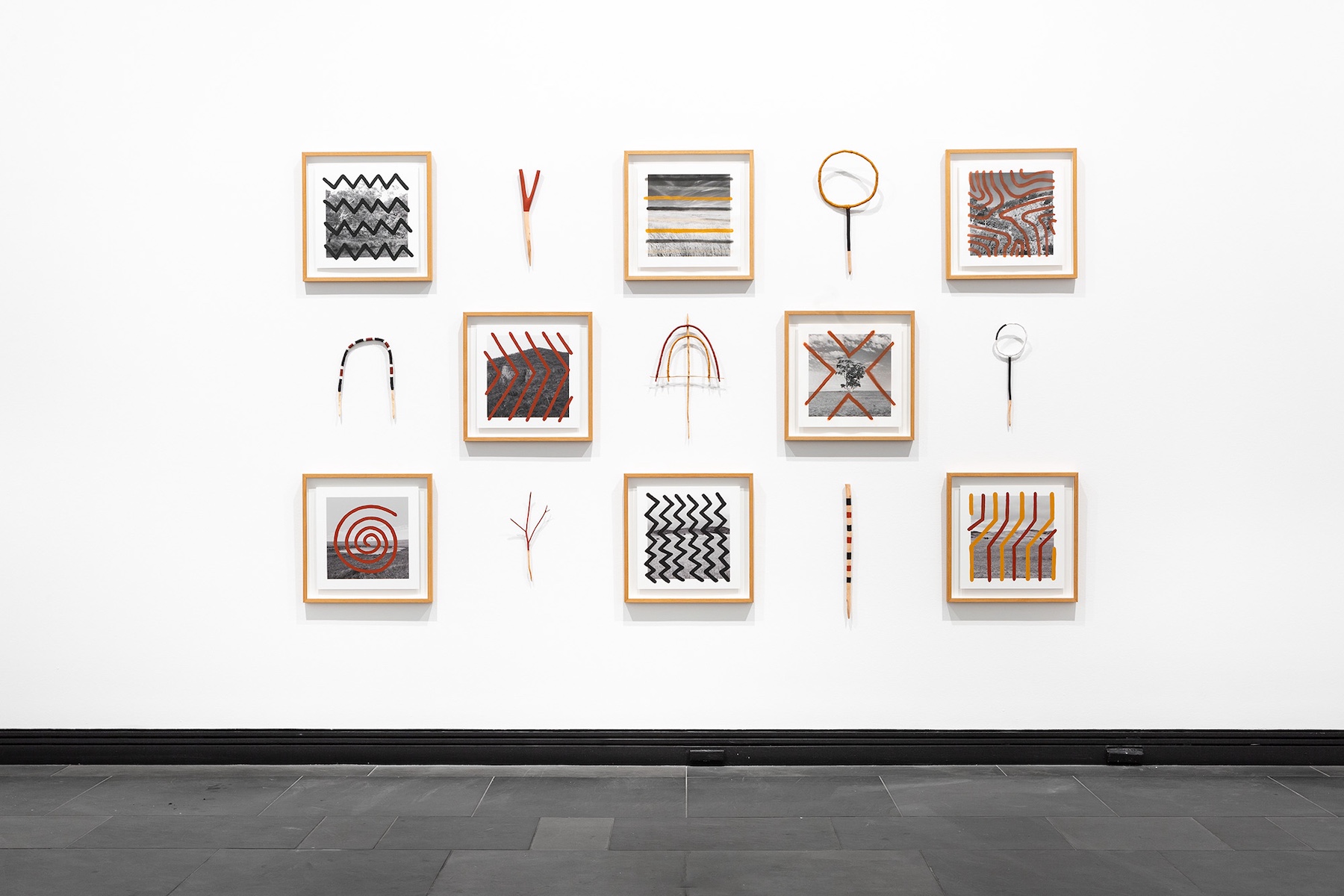
Landscapes dominate the exhibition, but despite similarities in title and subject matter Turrangka… in the shadows offers a wholly different perspective to Johnstone’s Evening shadows a few galleries over. These images are burnt, etched, stippled with echidna quills to evoke colonial smallpox outbreaks, or painted in ochre and charcoal gathered from the Country they’re depicting.
Sometimes Tylor’s interventions occur before the shutter closes, like his Un-resettling series that documents his efforts to reconstruct examples of Aboriginal infrastructure that were once common sights – bird snares, scar trees, fish traps, earth ovens and an a-frame hut not unlike the one seen in Evening shadows.
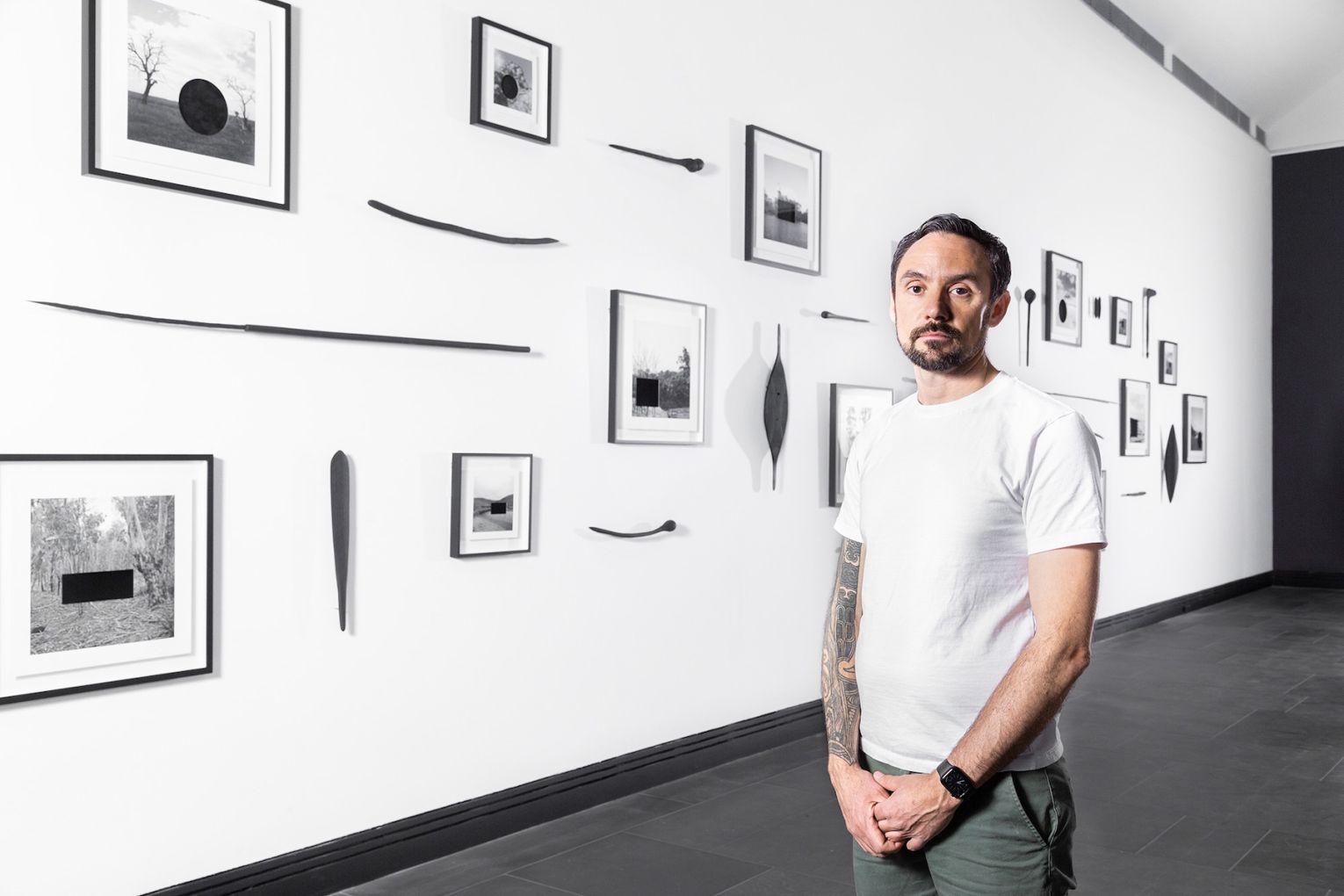
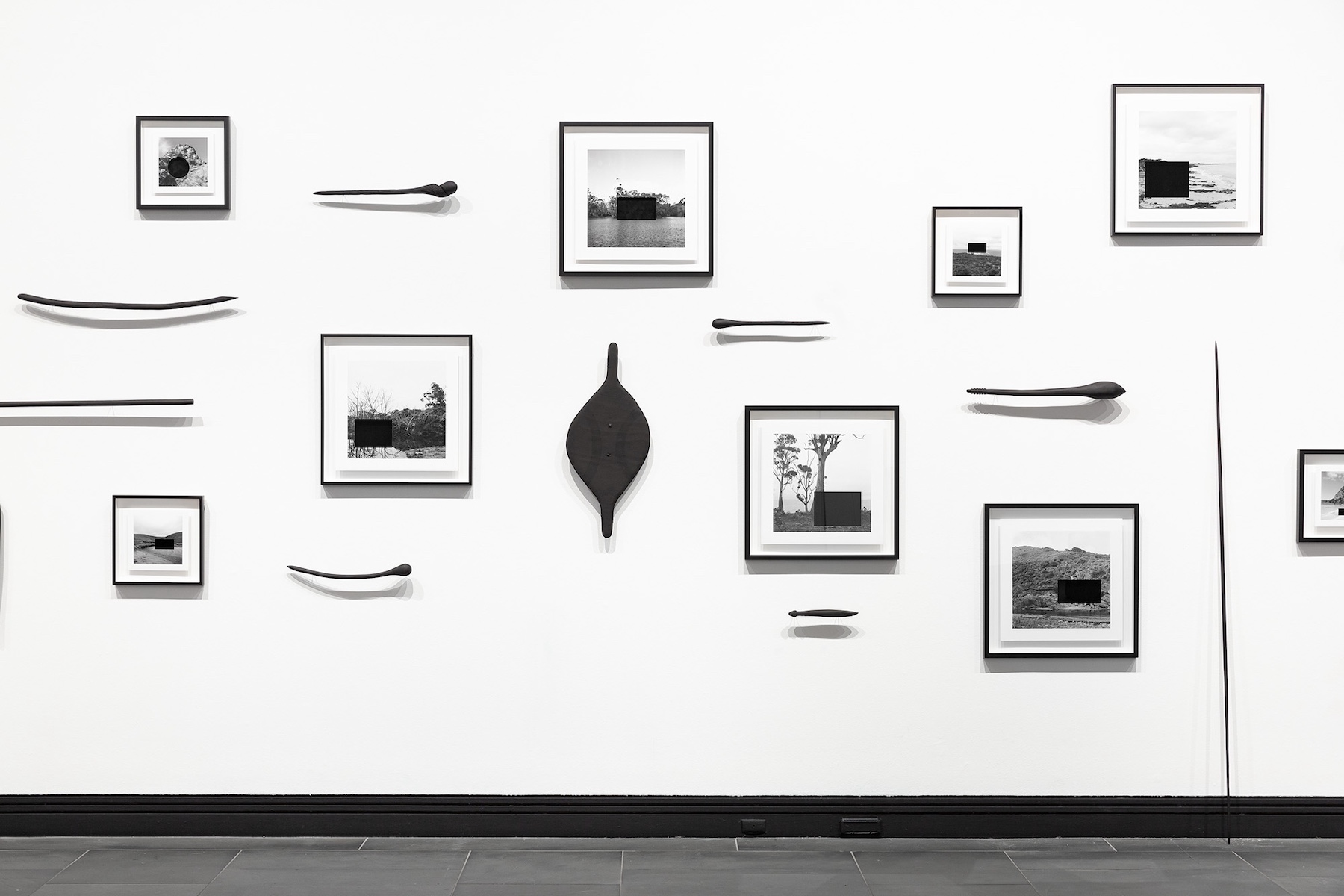
In others, it occurs after the fact, like the series From an Untouched Landscape that occupies the vast wall of Gallery Nine. These shots of rocky coastlines, watercourses and gum-dotted plains each bear a single black gap carefully cut out of the image like a redacted government report. The black spots allude to the histories emptied from the frame over 190 years – erasures that are all but invisible to the passing observer, until Tylor shows us just what we’re missing.
In We Call This Place, Tylor presents daguerreotype images of well-known places with their original Kaurna name etched into the glass. Tylor says this recoupling of place, language, and identity challenges the “violent” practice of imposing British and German names over Kaurna placenames. While the former often invoked the names of influential European men, or distant landmarks back home, Tylor says the qualitative nature of Kaurna naming practices act as a “beautiful time signature” for how much has changed.
“Our place names are very unique in the way that Kaurna language captures the things that grow in those places,” he says. “Adelaide’s a perfect example; like, Tarntanya is literally the ‘red kangaroo’s place’ – now there’s none. Pinky Flat is the bilby, it’s no longer here, it’s extinct in the region. They’re like perfect signatures to what was here, and what has been removed.”
Tylor’s embrace of the antiquated daguerreotype format is also historically loaded.
Subscribe for updates
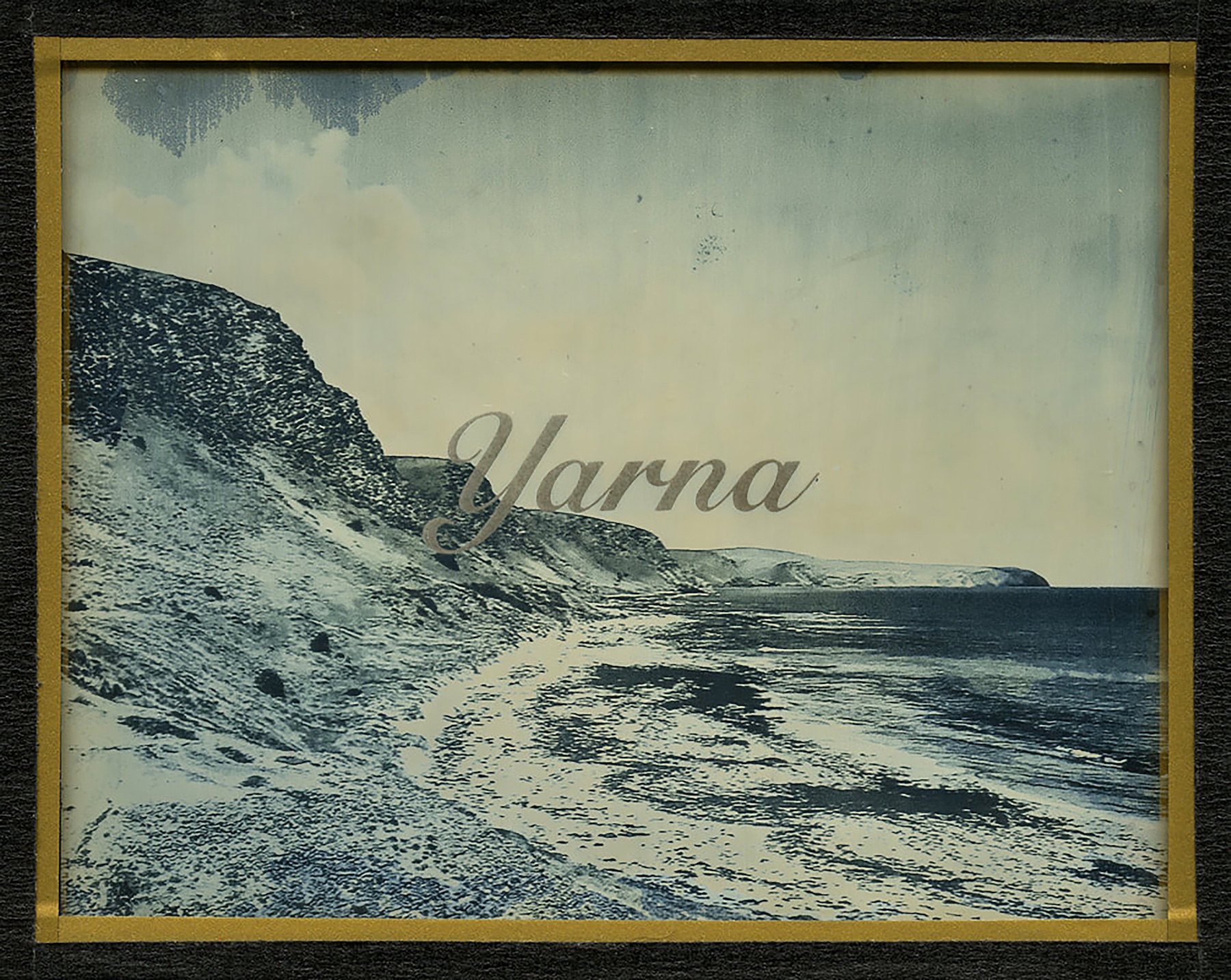
“Daguerreotypes are so precious,” he says of the expensive and temperamental technology first introduced in 1839 – the same time South Australia was being colonised. “It becomes this really nice vessel … like we’re looking at historical images, and that automatically puts you in that era, and so I use that historical aesthetic to get people’s minds into that period.”
Tylor says these formats were typically used to portray the faces and perspectives of colonisers – the kind of people who wanted, and could afford, to be remembered. Now, he turns the same tools towards the colonised people and places they omitted.
“Mostly, it was portraiture for wealthy colonists. So I wanted to de-centre that, I wanted to fill those gaps in the Western archive with these images, and sort of talk back to the archive.”
Interspersed between the wall-mounted photographs are numerous carved objects – a part of his practice that Tylor has gradually refined, tapping community knowledge and historical sources to recreate the specificity of Kaurna culture.
“I’ve spent time researching how to make cultural objects the way that they were made back in the day, and making things as accurate as possible,” he explains.
He stresses, however, that he’s “not an island”; he is one of many members of the Kaurna community researching, reviving, and sharing cultural knowledge today. His social media presence often documents these activities, and he recently curated Irrapinarna Young Kaurna Warriors, an exhibition of work at Nexus Arts by young Kaurna men Drew Kilner, Isaac Hannam, and Bryce Cawte.
Hannam is one of several Kaurna community members – Elders, poets, artists and activists – whose blown-up tintype portrait appears in CIPX Kaurna Miyurna, a companion exhibition in the atrium outside Turrangka… in the shadows. Curated by Tylor alongside Damien Shen and Carly Tarkari Dodd, it’s another moving act of community and reclamation.
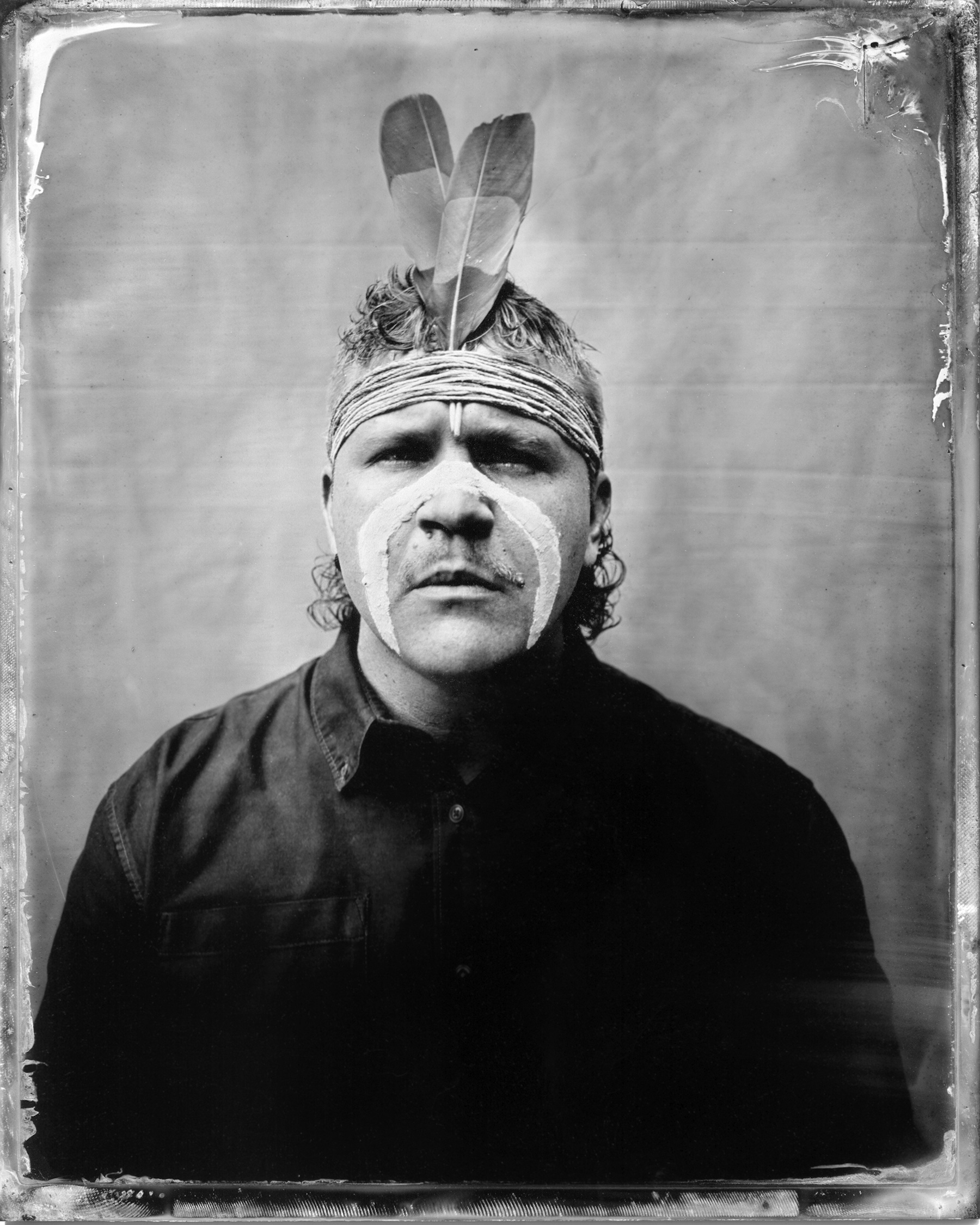
As Hannam himself has noted, seeing his own face portrayed in this uncanny, historicised format connects the past, present and future: “I look like all my ancestors at once.”
Having already toured the country since it was first exhibited at the University of New South Wales in 2023 – subsequent stops included Melbourne’s Centre for Contemporary Photography, Goulbourne Regional Gallery, Mornington Peninsula Regional Gallery, and Curtin University in Perth – there’s something historic about Turrangka… in the shadows arriving in Adelaide.
Tylor’s work has been displayed on North Terrace before, featured in Tarnanthi festival, the 2022 Adelaide Biennial, and the Ramsay Art Prize. But this substantive survey exhibition, encompassing some 150 works, isn’t just Tylor’s biggest solo show on Kaurna Country – by InReview’s reckoning, it’s the first major solo exhibition by a Kaurna artist in the Art Gallery’s 145-year history.
Tylor, however, is circumspect about his work being embraced by the state gallery he used to visit as a child.
“The work is important to me, and my work with the Kaurna community is important to me,” he reflects. “Having my work in institutions… it’s not breaking boundaries for me. It’s breaking boundaries for them.”
James Tylor: Turrangka… in the shadows is on display at the Art Gallery of South Australia until November 1 as part of SALA Festival 2026.
Want to see more stories from InDaily SA in your Google search results?
- Click here to set InDaily SA as a preferred source.
- Tick the box next to "InDaily SA". That's it.
Free to share
This article may be shared online or in print under a Creative Commons licence