Theatre review: The Lark
Noni Hazlehurst delivers a devastating one-woman performance in Daniel Keene’s The Lark, a tender exploration of ageing, obligation and the way a life can become inseparable from the place we inhabit.
There’s a heartbreaking moment in The Lark when publican Rose Grey describes the freedom she found after closing time. While everyone else was sleeping, she would wander the streets of her inner-city Melbourne suburb, imagining the parents and children curled up in their beds, their sleeping pets, everyone warm and content inside while Rose passes by alone. It’s one of the play’s most moving images and one of the most revealing.
Loneliness and longing sit at the heart of Daniel Keene’s delicately observed one-woman play, inhabited with extraordinary authenticity by Noni Hazlehurst. On one level, The Lark is about an ageing publican saying goodbye to the working-class pub where she was born – a pub now destined for demolition. But this play is also a portrait of a woman whose sense of self has become so entwined with one place, and caring for one person, that she no longer knows who she is without them.
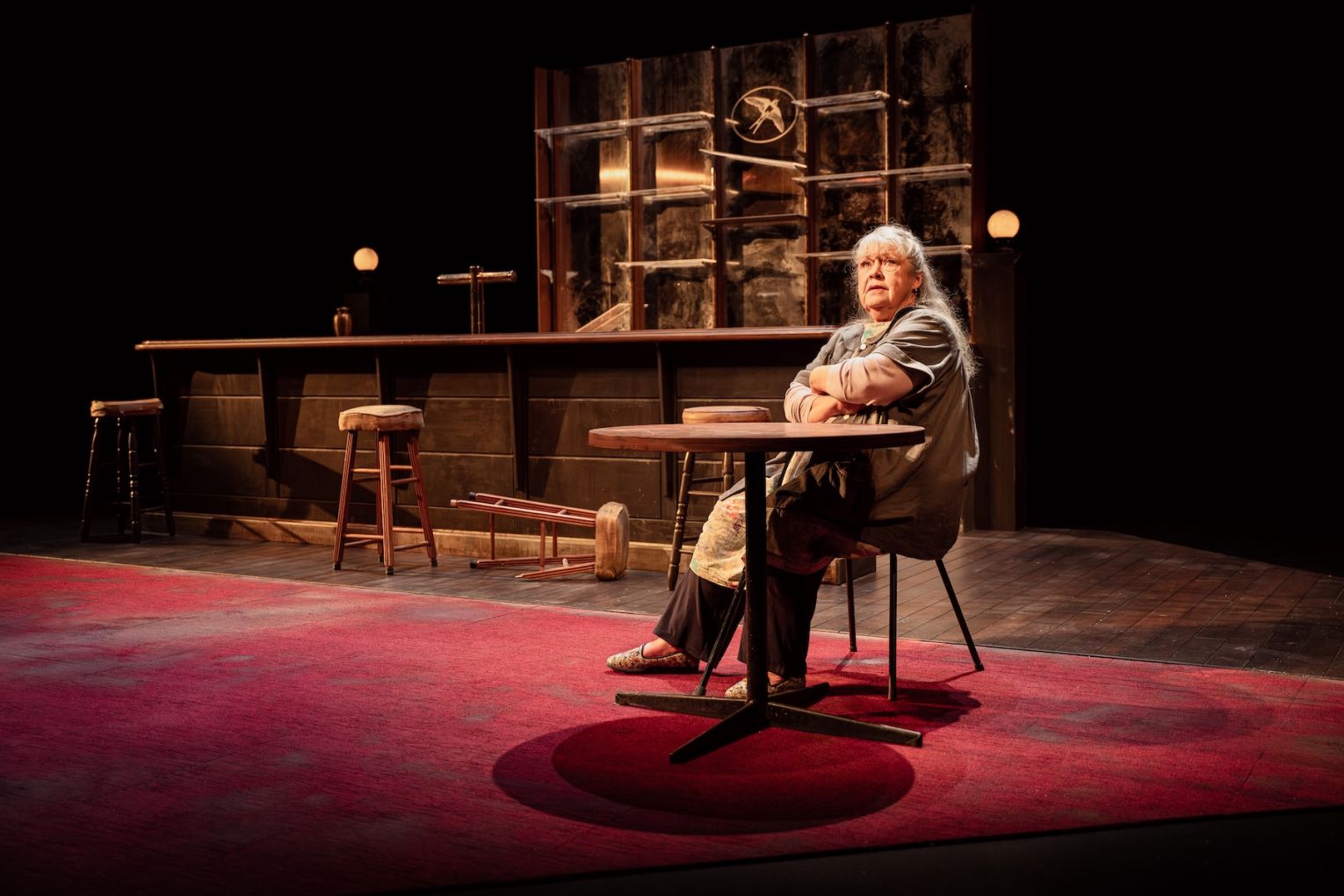
The first thing you notice about the set of The Lark is its emptiness. Emily Barrie’s design evokes an abandoned mid-century Australian pub – dusty mirror splashback, bare shelves, empty taps, cracked vinyl stools and threadbare carpet. At its centre hangs the image of a lark in flight, a memory of movement in a place that is now entirely still. The pub has been closed for six months and will soon be demolished – another victim of gentrification.
Rose Grey runs her hands over the bar and leans in to begin her story. For the next seventy-five minutes Noni Hazlehurst is mesmerising, inhabiting Daniel Keene’s tenderly observed portrait of a woman returning one final time to the place that has formed her. It’s a staggering performance and not simply for the feat of delivering a monologue of this length. Hazlehurst settles behind the bar with the authority of someone who has spent a lifetime there, listening to other people’s stories before beginning to tell her own.
Rose reveals she was born in the pub and worked behind its bar for fifty years. She cared for her father in the rooms upstairs as dementia slowly faded him, then carried him away. Now, in her mid-seventies and walking with a stick, she returns each evening to watch the light fall through the stained glass around the front door, unable to let the building or her past go.

The play begins as a portrait of her publican father. A returned serviceman, emotionally damaged by war and abandoned by the love of his life, George raised Rose alone while running the pub. Hazlehurst captures him through tiny details: his stoicism, the dry humour, the emotional reserve familiar to anyone who grew up around Australia’s Silent Generation. Like many men of his era, he survived by refusing to look backwards. “We scratched a living,” Rose remembers, “hanging on grimly to the tits of life.”
But as the play goes on, this portrait of George becomes a window onto her own. She left the pub briefly after school, only to return at nineteen and never leave again. Obligation hardened into habit, and by the time George died, Rose and the pub had become impossible to separate.
Keene’s script and Matt Scholten’s immaculate direction tenderly reveal a situation in which small choices and a sense of responsibility accumulate to shape a life. Rose didn’t actively sacrifice marriage or children or travel – her life just imperceptibly narrowed through a sense of duty and care.
The second half shifts the focus away from George to the pub’s regulars. Veterans, labourers, women escaping difficult lives – the characters who brought colour and larrikin charm through the doors and transformed a working-class drinking hole into a community. Rose describes it as neutral ground, a place where everyone was treated equally.
But as time moved on, the culture around the pub transformed and the community gradually evaporated. Regulars died or moved away as the suburb gentrified, and the pending demolition comes to represent something more than a change of architecture.
Moments of humour and Rose’s salty delivery never allow the production to dip into sentimentality. Hazlehurst’s cadence and gestures are perfectly delivered: the self-deprecating shrug, the dismissive huff, the rhythms and colloquialisms of an older working-class Australian woman so perfectly calibrated Rose’s character feels lived rather than performed.
Subscribe for updates
Director Matt Scholten clearly trusts both actor and script and Richard Vaber’s lighting and the sound by Darius Kedros are equally understated, never pulling focus from the performance. Barrie’s set is a standout, the design of the lonely, ageing pub speaking for both place and character.
The Lark is a performance that reveals how a life can disappear within a place. Rose has spent her life listening to others’ stories while postponing her own. All her memories revolve around other people, and it is only at the end of her life that she seems to understand how thoroughly she has bound herself to this place.
Hazlehurst brings this realisation home without melodrama or theatrical flourish. It’s a profoundly moving performance – intimate, funny and devastating – reminding us that sometimes the most poignant lives leave almost no trace.
The Lark continues at the Space Theatre, Adelaide Festival Centre, until July 5.
Want to see more stories from InDaily SA in your Google search results?
- Click here to set InDaily SA as a preferred source.
- Tick the box next to "InDaily SA". That's it.
Free to share
This article may be shared online or in print under a Creative Commons licence