Adelaide Festival review: Gatz
Curiously and successfully blending narration with performance, Gatz brings an American classic into fresh perspective.
As is often the case, the final weekend of the Adelaide Festival delivers up unexpected highlights – and Gatz is certainly one. We have been uplifted before by the Brooklyn-based Elevator Repair Company when they presented William Faulkner’s The Sound and The Fury in 2010.
Taking the novel’s first section – narrated by the mentally disabled mute, Benjy, in a torrential stream of tangled consciousness – the ensemble shared a verbatim reading of 62 pages of text that not only reminded audiences of Faulkner’s masterful language, but exuberantly explored new theatrical possibilities.
This time with Gatz they have taken a whole novel: F. Scott Fitzgerald’s The Great Gatsby which, despite celebrating its 100th birthday this year, is still American modernism at its sharpest and freshest. A project which began in 1999 and premiered in 2006, it is now twenty years into a trajectory that, judging by opening night at Her Majesty’s, is as assured and dramatically satisfying as ever.
We have had examples of marathon theatre in Adelaide over a long time, whether Nicholas Nickleby, Jan Fabre or Peter Brook’s The Mahabharata in the 1980s, or more recently, works by Robert Lepage, Ivo Van Hove and Maria Abramovich.
Eight hours and thirty minutes is a trip to Singapore – but time flies with Gatz. Divided into four Acts, with a 90-minute dinner break and two 20-minute intervals, it amortises our attention and our appreciation splendidly.
Director and founder, John Collins and fellow creators describe the process leading to a presentation of Gatsby in its entirety:
You might like
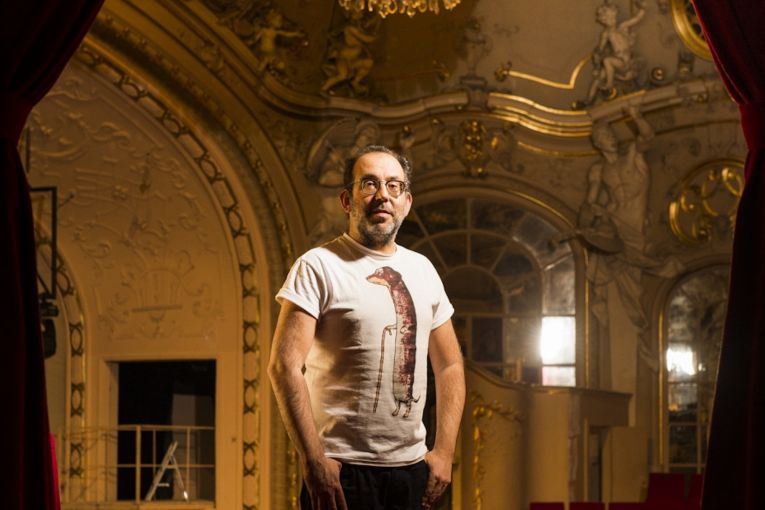
“We knew we were interested in the writing, and not just the story, and we quickly found that the elegant efficiency of Fitzgerald’s style was irreparably injured when we tried to edit or condense … The prose is so delicately constructed that even the omission of a single adjective is rhythmically disappointing.”
So, it was not surprising to go all out, especially in a world of E-books and downloads where every other person is either wired into podcasts or narrated fiction. But the Elevators are aiming higher, and more interestingly. They are mixing reading with performance in a way that alters both when in combination.
It is a variation, perhaps, of Bertolt Brecht’s V-Effekt, where a performance is not so completely absorbing that there is no perspective. Misleadingly called alienation, it is better described as distancing, when we move in and out of the action, selecting and evaluating like a zoom lens.
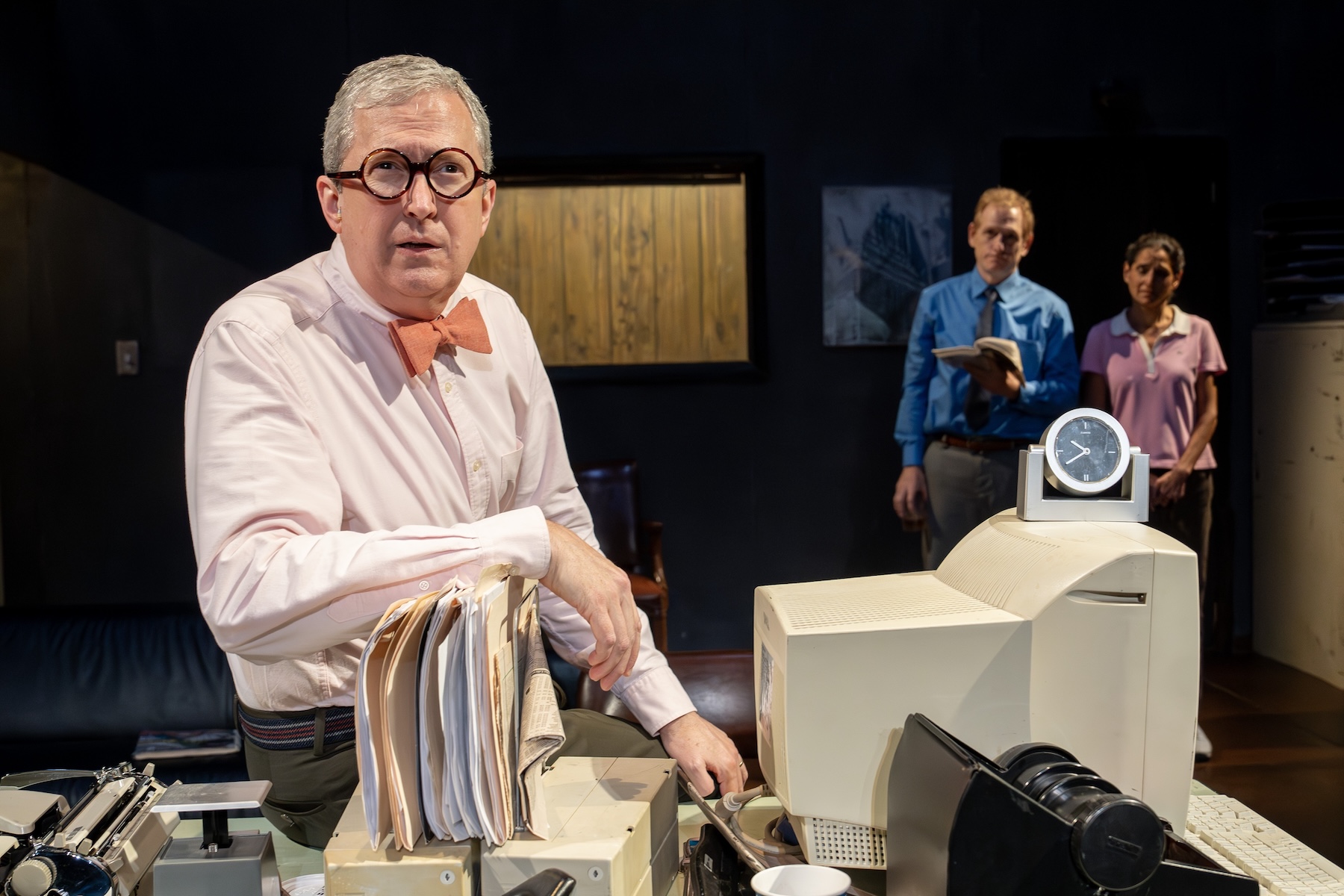
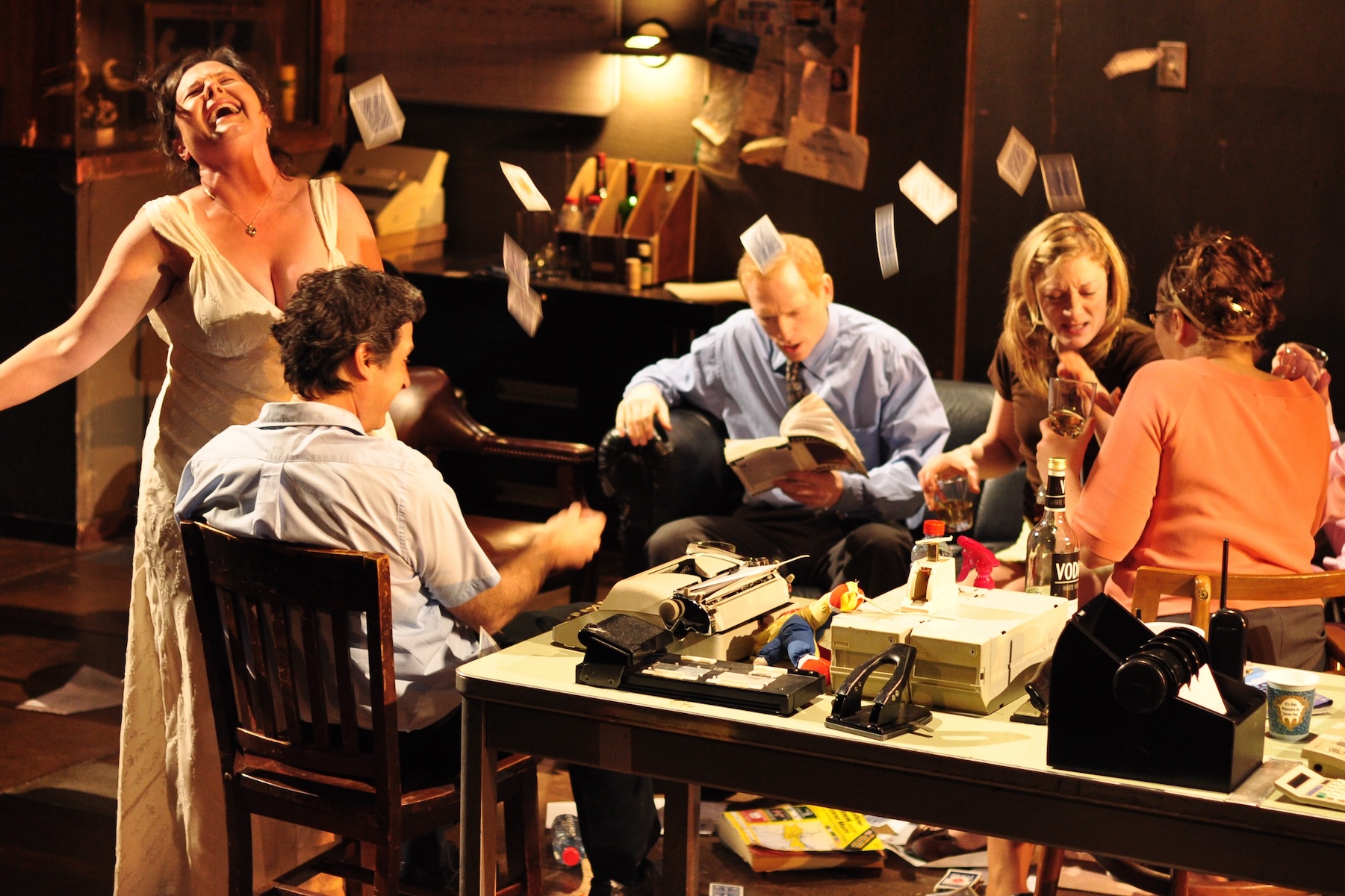
The stage of Her Majesty’s bears no resemblance to either Gatsby’s palatial grandeur or the dystopic Valley of Ashes under the beady glare of Dr TJ Eckleburg. It looks like a ramshackle office. In fact, it closely resembles the scuzzy theatre upstairs space where Collins and lead actor Scott Shepherd and others first mooted the production.
In Louisa Thompson’s set design (often lit in warm, autumnal tones by Mark Barton) there are racks of scruffy filing boxes, desks covered in folders, loose stationery, filofaxes, and computers of various vintages. The furniture is mish-mash mid-century, a spongy settee is midstage and three large fluoro tubes periodically flood the downstage area.
This is the location of the frame narrative. Nick Carraway, the unmotivated bond salesman, is sharing an office with secretaries and fellow workers who take phone calls, sign memos and generally push paper around. But he prefers to be hunched over his battered paperback copy of Gatsby, reading every word from “In my younger and more vulnerable years …” to “So we beat on, boats against the current, borne back ceaselessly into the past.”
In this unchanging setting, the entire six hour-and-something story unfolds. Gatsby’s extravagant parties, the intrigues, treacheries and recriminations between the beastly Tom Buchanan and his careless, unhappy wife Daisy, the miseries of George and Myrtle Wilson, the vulpine Wolfsheim (fixer of the 1919 World Series) and Nick Carraway’s anaemic romance with golfing celeb Jordan Baker – all happen convincingly and vividly in this rag and bone shop of the heart.
The performances are excellent. As Nick Carraway, Shepherd is central to the success of this production. Supplying every “Gatsby said suddenly” and “demanded Daisy insistently”, his reading is fluent and engaging, but also restrained and understated. He is servant to Fitzgerald’s cadence and drollery. Sustaining the delivery for the entire performance and then lifting to a higher level for the conclusion is a tour de force.
Subscribe for updates
The wicked wit, the dry understatement, the epigrams and satiric swipes are captured. But one limitation, perhaps, is that in holding the book (and operating as a sort of onstage director) he becomes omniscient and incontrovertible – and not the bedizened, unreliable observer of the ambiguous Gatsby preferred by literary critics.
The ensemble is terrific to watch. Especially since they depart so emphatically from, for instance, the influential film adaptations which have defined popular reception. In case of the Robert Redford version, despite its many strengths, it ultimately steered the novel into a lavish, doomed, sentimental romance. And, in the Baz Luhrmann travesty, straight over a cliff into pointless triviality.
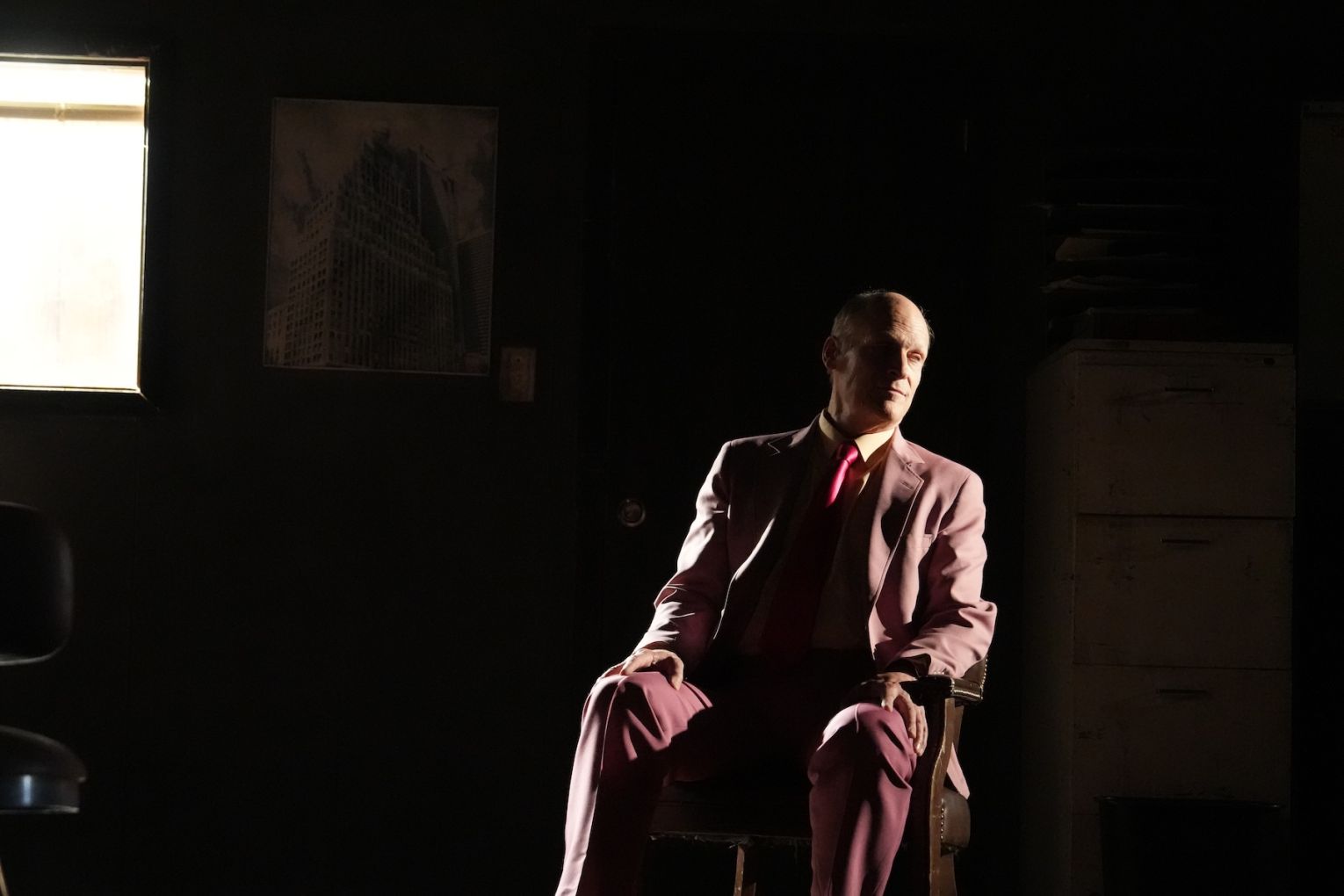
Lucy Taylor’s Daisy is refreshingly direct. Still self-serving and irresponsible but real enough for Gatsby to be devoted to the point of calamity. She even affords opportunity for farce in the unexpected (but textually accurate) comic lift in Act Two when Gatsby, in his pink suit, clumsily woos her with near slapstick consequences .
As Tom, Gary Wilmes captures the lethal mix of privilege and brutality. Fitzgerald describes Tom’s “cruel body” – and his penchant for racist supremacy is eerily current.
Laurena Allan and Frank Boyd, as George and Myrtle, bring a credible tragedy to a predicament which is both materially and emotionally bereft. Allan’s Myrtle is less of a caricature and Boyd, doubling as the computer guy, gives George a perspective that is true to the novel when it could easily be caricatured.
Susie Sokol’s Jordan, omnipresent in many of the scenes with Scott Shepherd’s Nick, is an enigmatic observer. Sporty, odd, sometimes gawky in her leisurewear, she is given more than the usual Daisy sidekick role.
Others who feature include Gavin Price as Michaelis (and a variety of other small dialogue interactions). He has the most up to date laptop on his desk because, as sound engineer, he is toggling the effects and music including the ragtime strains of ‘The Love Nest’ – “In the morning / In the evening? Ain’t we got fun.”
Also, late in Act Four, is Terence Crawford as Gatz Senior, father of Jay come to grieve over his son’s death. A boy he failed to understand, who created a whole legend to erase his wretched origins. Gatz reads from the Hopalong Cassidy book’s flyleaf a list of Jay’s resolutions and plans, his self-improvement schedule. Only too late does the parent draw pride in the future Gatsby supposedly had in front of him.
Key also to the success of this adaptation is Jim Fletcher as Gatsby. At first we see him as one of Carraway’s fellow bondsmen but his presence as the enigmatic social chameleon is suitably calm and self-possessed. Fletcher, like so many others in this company of players has found a sufficiency in his performance that is in sync with the textual rhythm and never attempts to “act” over, or against it.
As Scott Shepherd delivers the last pages, he powerfully evokes Fitzgerald’s portentous words:
“And as I sat there brooding on the old unknown world, I thought of Gatsby’s wonder when he first picked out the green light at the end of Daisy’s dock. He had come a long way… and his dream must have seemed so close that he could hardly fail to grasp it. He did not know that it was already behind him, somewhere back in that vast obscurity beyond the city, where the dark fields of the republic rolled on under the night.”
This exceptional project, Gatz reminds us of the range and ambition of a novel that is not only still engaging, but a century later, disturbingly prescient.
Gatz is playing at Her Majesty’s until March 15 as part of Adelaide Festival
Want to see more stories from InDaily SA in your Google search results?
- Click here to set InDaily SA as a preferred source.
- Tick the box next to "InDaily SA". That's it.
Free to share
This article may be shared online or in print under a Creative Commons licence