‘Sad experiment’: West Australian Ballet’s larger-than-life Dracula with an empty pit
West Australian Ballet’s interpretation of the 1992 film Bram Stoker’s Dracula is gripping and masterfully original. The only thing missing was a live orchestra.
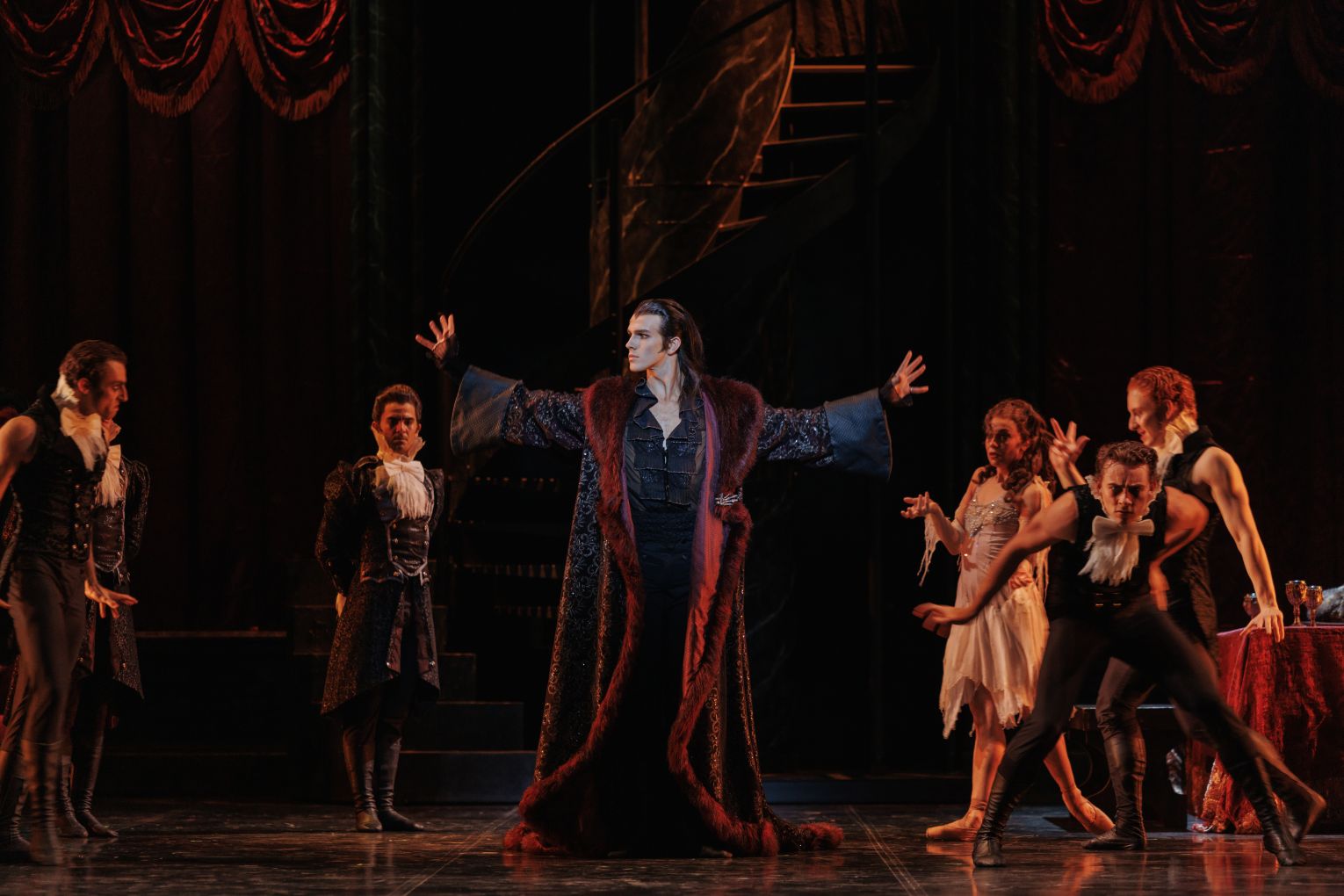
Not for more than a decade has WA Ballet visited Adelaide, and with sporadic visits by the Australian Ballet – unfortunately none in 2026 – and Adelaide Ballet valiantly working to fill the gap, its visiting production of Dracula aroused quite a bit of interest. Brilliant it proved to be as well, once again confirming that this dance troupe from the west is right up there with the national flagship company in prowess and quality.
Why it generated so much attention, however, was not for all the usual reasons. For despite winning a row of ticks from a visual standpoint, there was something missing from this production. A live orchestra: controversially, this Dracula was danced to pre-recorded music.
When George Balanchine famously came up with the saying, “See the music, hear the dance”, he was referring to the interaction between dance and music – and how these the artforms inform each other to make the lifeblood of theatre. He was not referring to ballet being danced to pre-recorded music.
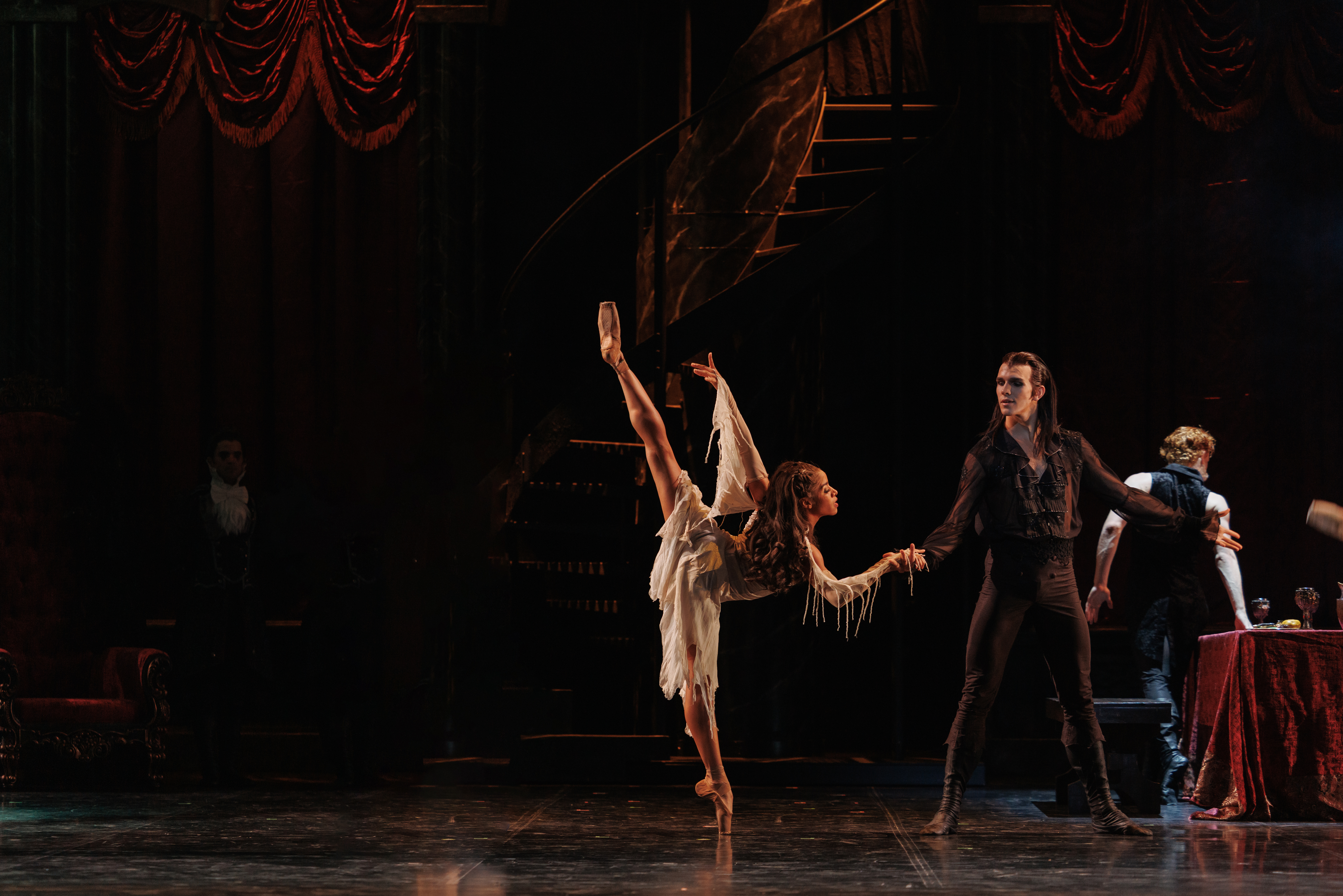
That being said, director Krzysztof Pastor’s choreographic adaptation of Francis Ford Coppola’s 1992 film Bram Stoker’s Dracula is wildly creative and gripping visually. It follows a hybrid language by moving unpredictably between styles with an unsettling effect that entirely suits the subject. Elegantly structured pas de deux by six couples in ballroom scenes contrast with agitated, knotty movements by other characters in darker settings as the story lurches along its morbid trajectory.
The younger Dracula is danced with athletic distinction by Charles Dashwood in broad, sweeping movements that exhibit boundless arrogance. His older counterpart, consumed evil, is imposingly taken by the white maned Jack Whiter and accompanied by writhing, semi-naked ‘ghosts’. Polly Hilton is expressively characterful as Elizabeth, while Juan Carlos Osma and Alexa Tuzil carry much of the narrative strength as Jonathon Harker and Lucy Westenra.
These are manifestly some of the best dancers in the country, and yes, the only problem with this whole production was that they were dancing to a recording made by the West Australian Symphony Orchestra and played over the Adelaide Festival Theatre’s loudspeaker system. Beneath was an empty pit, and nowhere to be seen was a conductor. All the technical crew had to do behind in the control room was press play.
Pastor’s much praised interpretation has travelled from Perth to Brisbane and has been taken up by overseas dance companies from Poland to Latvia, each time using a live orchestra. This Adelaide version felt like an odd and rather sad experiment.
For the greater part, the show went smoothly, although a delay occurred during interval due to “technical difficulties’, and moments did occur along the way when synchronisation between the dancers and soundtrack was fractionally lost – at one point the dancers were still exiting the stage when the music had stopped. Having a conductor care of such matters. More than that, a conductor and live musicians bring a unity to the performance.
The official explanation is that this “trial season” in Adelaide “could not sustain the cost of an orchestra”. Full-size orchestras like the ASO cost in the tens of thousands to hire yet they are essential, especially for a score as mammoth as the one that Polish composer Wojciech Kilar wrote for the Dracula movie.
Sound reproduction over the Festival Theatre’s recently upgraded line-array speakers was acceptable but unrealistically loud. At times the violins sounded screechy, and the bottom end of the orchestra – where Kilar’s orchestration is thick with cellos, double basses and heavy brass – became bloated. But my goodness, what a score it is.
Subscribe for updates
The only argument in favour of performing a ballet in this way would be if the aim was to replicate the cinematic impact of Coppola’s Gothic horror classic from the movie theatre to the concert stage. If the volume is winched up – which it was.
For sure, everything about Dracula is larger than life (or death), except that a live orchestra would have enhanced it further. Nevertheless, this deficit took little away from Pastor’s forceful choreography, and one could appreciate why it has been enthusiastically taken up by dance companies from Poland to Latvia and Finland. And despite it playing over speakers, Kilar’s blood-curdling music is magnificent. With touches of Prokofiev, Holst and Respighi, it has huge potency and sends tingles down one’s spine.
Unnervingly, it felt for much of the time that this wonderful Perth troupe were dancing to the music, not with the music. But whatever one felt about their Dracula, it made an indelible mark.
West Australian Ballet’s Dracula was performed from April 17 – 22 at the Festival Theatre. This performance took place on April 22.
Want to see more stories from InDaily SA in your Google search results?
- Click here to set InDaily SA as a preferred source.
- Tick the box next to "InDaily SA". That's it.
Free to share
This article may be shared online or in print under a Creative Commons licence