Adelaide Festival review: Mary Said What She Said
Isabelle Huppert is superb as Mary Queen of Scots in an unorthodox monologue that explores the woman who would be queen. And Adelaide finally has a chance to see the theatrical vision of the late Robert Wilson.
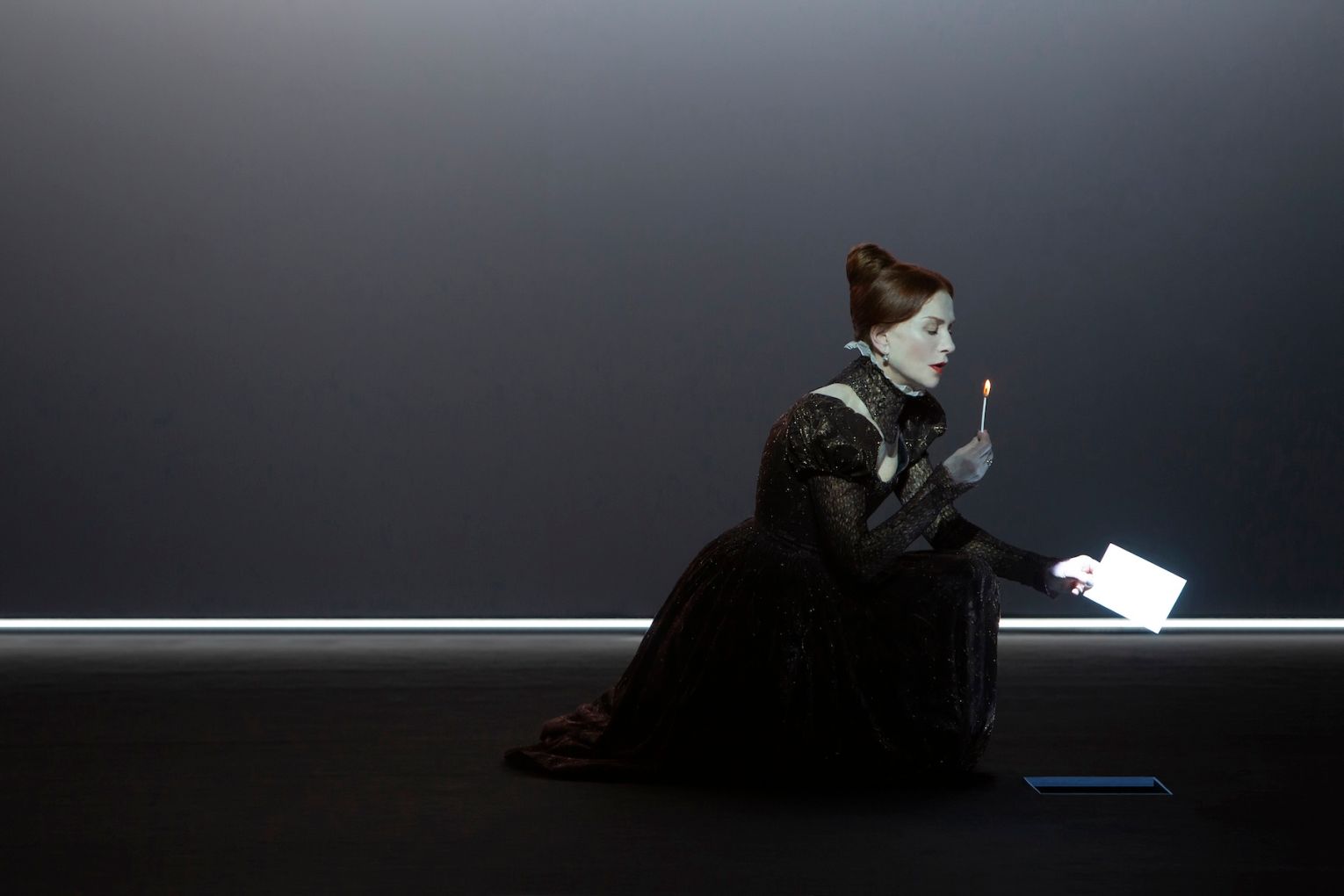
Much is known about the last 24 hours in the life of Mary Queen of Scots before her execution at 8am on February 8, 1587. Her night prayers with household servants, were documented, as were her farewell letters – including to King Henri III of France – and poignant details such as settling wages for her servants and choosing the clothing she would wear.
Her black gown, removed to reveal a red petticoat, symbolising her martyrdom to Catholicism, caused consternation when she was prepared for the block. There were many reports of the event – perhaps because so many saw it. Three hundred people in the Great Hall witnessed her steady calm, her courage, and her declaration of Catholic faith in English and Latin.
She forgave her enemies, and the executioner – even though he was to botch the beheading. Witnesses also testified that her small Skye terrier dog emerged from under her garments after her death.
As the title Mary Said What She Said suggests, writer Darryl Pinckney is giving her, not just a voice, but the uncontested floor, to tell her story – from becoming Queen of Scotland at six days old, to becoming Queen Consort of France, to the treachery of her demise.
We learn of her tragic and ill-advised marriages. First to Francis II, King of France (who died a year later from an ear infection), then to Henry Stuart (Lord Darnley), her half-cousin, who died suspiciously in an explosion at his house, and, finally, to the 4th Earl of Bothwell, a complete rotter, suspected of Darnley’s murder, who so scandalised Scottish nobility that Mary was imprisoned and Bothwell exiled.
Then, after abdicating to her son, she seeks refuge in England with her cousin Elizabeth I – only to be further betrayed and imprisoned for the last eighteen years of her life.
Pinckney’s text, in 86 paragraphs, circumnavigates her 44 years with a zigzagging energy and urgency that is irrepressible. Combining fable, ballad, a witchy magic realism, and dark humour, it is digressive and indifferent to chronology. Mary says what she says in a dazzling way:
You might like
“Father of France , farewell. He died of a splinter in his eye. Death sneaked into his body’s mighty fortress like a bird come over a rampart, a little thing not singing. “
Of herself as bride she announces – “Once upon a time I was so white the poets went mad. I was white, white and smooth and flawless. They went mad, I was so fair. They couldn’t believe it. They said so.”
Elsewhere she says, almost as incantation: “Because men love me and have always loved me, hateful women think me a witch. Let them know there is delicacy in my witchcraft. Men take me for their cause. I am the silk.”
She mockingly describes Elizabeth I: “She who holds the stick owns the cow. But I lead this dance. London plans a revel for my severed head. Let no one lie about how well I did. Let Mary’s face be full of grace. Mary has a son. The painted virgin leaves no trace.“
The son became James I of England and Scotland (“My end is my beginning,“ Mary prophesies).
More tenderly, she coos to her maidservants – the four Marys who remain faithful in spirit to the end. “So it was before this, but I like to think of them as around, and so you are around my Marys, even you miserable Mary Fleming. You are here with Mary Beton, singing and choosing my jewels and the two of you with Mary Livingstone, at embroidery and ready to laugh, and the three of you have gone to find my dear Mary Seton, who loves me best, and always has.”
Legendary director Robert Wilson (who lamentably died in July last year) has created another masterful mise en scene for the text he commissioned from Pinckney for the renowned French actor, Isabelle Huppert. Both of whom worked previously with Wilson on Orlando, adapted from the novel by Virginia Woolf.
Subscribe for updates
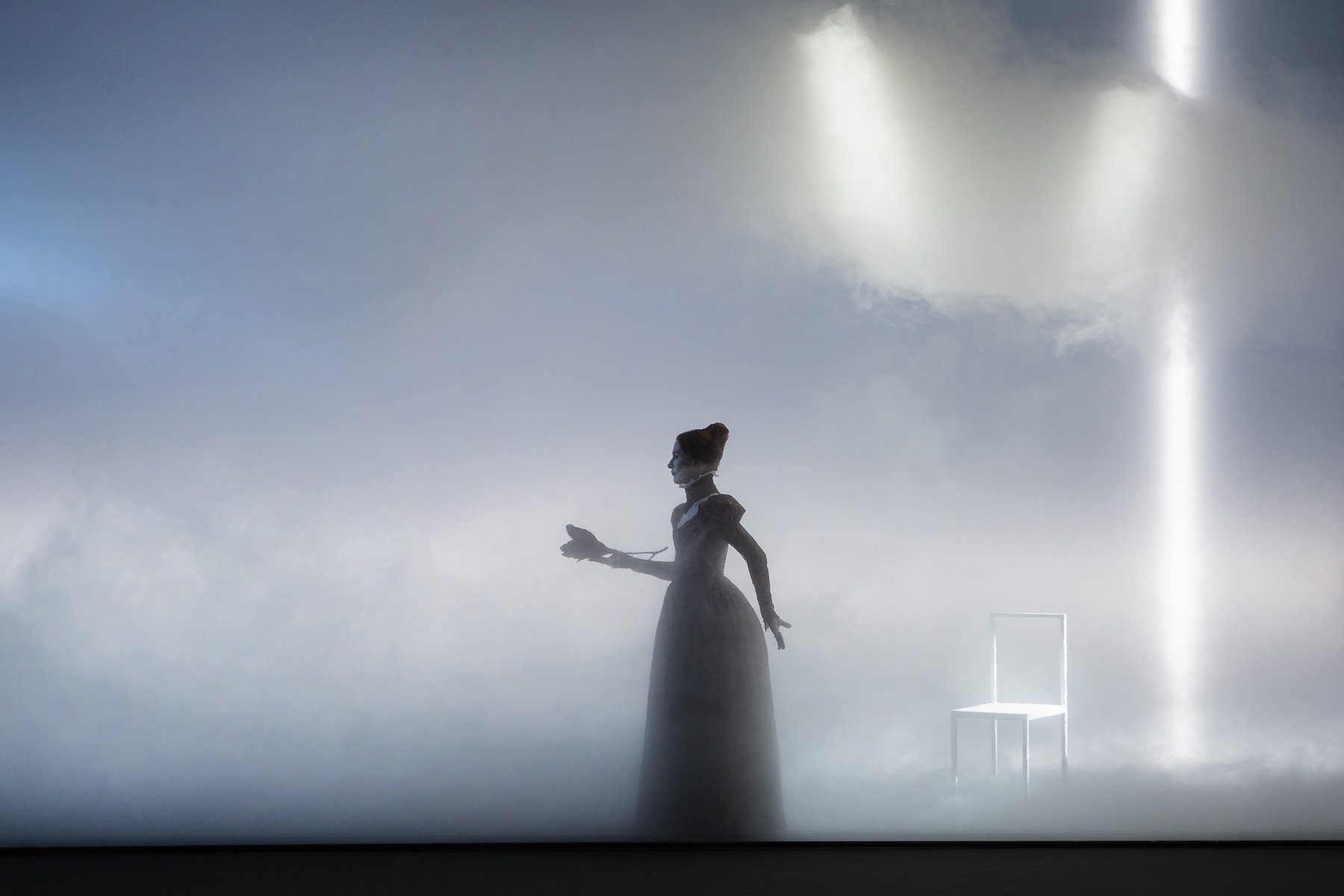
Wilson’s theatre is both vast and minimal. It is the antithesis of naturalism and psychological realism, but is revelation nonetheless. Flooding the Festival Theatre stage with a pale bluish light on a large screen with two lines of white strip lights running along the floor, Wilson establishes his canvas. And though never literal, it has a meteorological effect as the washes of light become overcast and turbid, emphasised by stage smoke effects and shadow.
Huppert, looking amazing in Jacques Reynard’s extraordinary gown – a black sequined bodice with puff shoulders, a black neck piece with white ruffle, nipped in at the waist and then surging to the floor – is in complete silhouette. Like so much of Wilson’s set and light design, it is simply perfect.
As we are looking at this spectacle, composer Ludovico Einaudi’s score is filling the space with rich (but never sentimental) strings and basslines. It has a driving tempo that will intensify later in the performance, using overpowering repetitions and rhythms that match Mary’s agitated recollections, regrets and retributions.
From the moment Huppert speaks (in French) it is evident that this is not usual, measured, carefully inflected delivery. It is a chant, a spell, a torrent of feeling and outrage. It is a voice that has been kept demure and silent. Mary is now saying what she is going to say.
It is a remarkable performance. When Huppert sustains the pitch and speed, punctuated by frozen silent screams (and actual ones), it is reminiscent of Billie Whitelaw’s solo performances of Samuel Beckett – especially the 1972 Not I.
Wilson has always encouraged unorthodox vocal delivery – whether the recitations of autistic poet Christopher Knowles performing “The Sundance Kid is Beautiful” or Wilson’s own howls and groans, developed from voice exercises designed to control his stammer.
"Wilson’s choreography has captured social agitation, excitation, futility and agency since his earliest works from the 1970s. More than 50 years on, they still speak to the 21st century."
Similarly Huppert’s movement is hieroglyphic – walking, gliding, parading in strict, almost OCD diagonal patterns, arms raised and hands fanned, fingers posed like a dancer’s, shoulders swaying. It is mannered and intriguing, but never merely decorative. Wilson’s choreography has captured social agitation, excitation, futility and agency since his earliest works from the 1970s. More than 50 years on, they still speak to the 21st century. And they work wonders for Huppert’s portrait of Mary.
There is so much to glean from this production. Almost too much. Like Simon Stone’s The Cherry Orchard, which was performed in Korean, this production depends on subtitles which are not well placed for some audience vantage points and contain a rapid volume of dense text that can distract, or restrict, our appreciation of the excellent staging and performance.
It is a great occasion to finally have a full production directed by Robert Wilson at an Adelaide Festival. His video work featured at the Art Gallery several years ago, but never a theatrical work such as this.
The blend of text, performance, and the director’s unique staging, is a reminder that – even after half a century – his work still looks like the future. Mary said what she said – and so, brilliantly, did Robert.
Mary Said What She Said is playing at the Festival Theatre until March 8 as part of Adelaide Festival

Want to see more stories from InDaily SA in your Google search results?
- Click here to set InDaily SA as a preferred source.
- Tick the box next to "InDaily SA". That's it.
Free to share
This article may be shared online or in print under a Creative Commons licence