‘If I could talk about it, I wouldn’t paint it’: The enigmatic Anna Platten returns
Fourteen years after her last survey exhibition, a rare showing of new work from Anna Platten sees the reclusive artist reckon with ageing and death in her own virtuosic, idiosyncratic style.
In an artworld obsessed with visibility and networking, acclaimed Adelaide artist Anna Platten is an anomaly, having no website, no social media accounts, and no representing gallery. It is now fourteen years since the Art Gallery of South Australia’s mid-career survey exhibition of her figurative paintings and drawings, Anna Platten: The devil is in the detail, attracted estimated visitations of 40,000 and established Platten’s standing as a widely admired and respected, yet idiosyncratic artist. Recently one of her paintings from that 2012 AGSA exhibition sold on the secondary market for over $60,000 – believed to be one of the highest prices achieved for a living South Australian artist.
In the intervening years since that show Platten has worked away from the public eye in relative seclusion in her home studio in the Adelaide foothills, undertaking occasional portrait commissions, and preparing the exquisitely realised selection of paintings and drawings that are currently on display at Adelaide Central Gallery, Adelaide Central School of Art (ACSA) in her long-awaited new exhibition, My Head as a House.
In opening the exhibition Tracey Lock, AGSA’s curator or Australian art and curator of that 2012 exhibition, praised Platten as a “cultural treasure”, and went even further, stating that “qualities such as an exquisite painterly touch, technical facility and conceptual rigour, position Anna as one of Australia’s greatest living figurative painters.” Lock, who has attained a keen insight into Platten’s practice across many years, queried, “Why is it we are so spellbound by the enigmatic, mysterious and sometimes absurd world of Anna Platten? How do we explain the sheer emotional power of her practice?”
My Head as a House is only Anna Platten’s fourth solo exhibition across a painting career spanning over 40 years. Each of these four exhibitions has marked a pivotal period of personal and artistic growth as she has progressively refined both her tonal realist painterly technique and the visual language of her autobiographical narrative paintings. These are distinguished by a rich blend of poetic beauty, absurdist humour and querulous vulnerability that sets her art somewhat apart from prevailing trends in contemporary art. Her reverence for the traditional skills of the great masters, and her frustrations in achieving something approaching their virtuosity, exist alongside her questioning of the essence of painting as a magician’s game of illusion. Perhaps it is due to her unfashionable pursuit of virtuosity as a painter, coupled with her small output and reclusive avoidance of self-promotion that Anna Platten has attracted a dedicated following among her professional peers and private collectors in Adelaide, while remaining virtually unknown elsewhere in Australia.
You might like
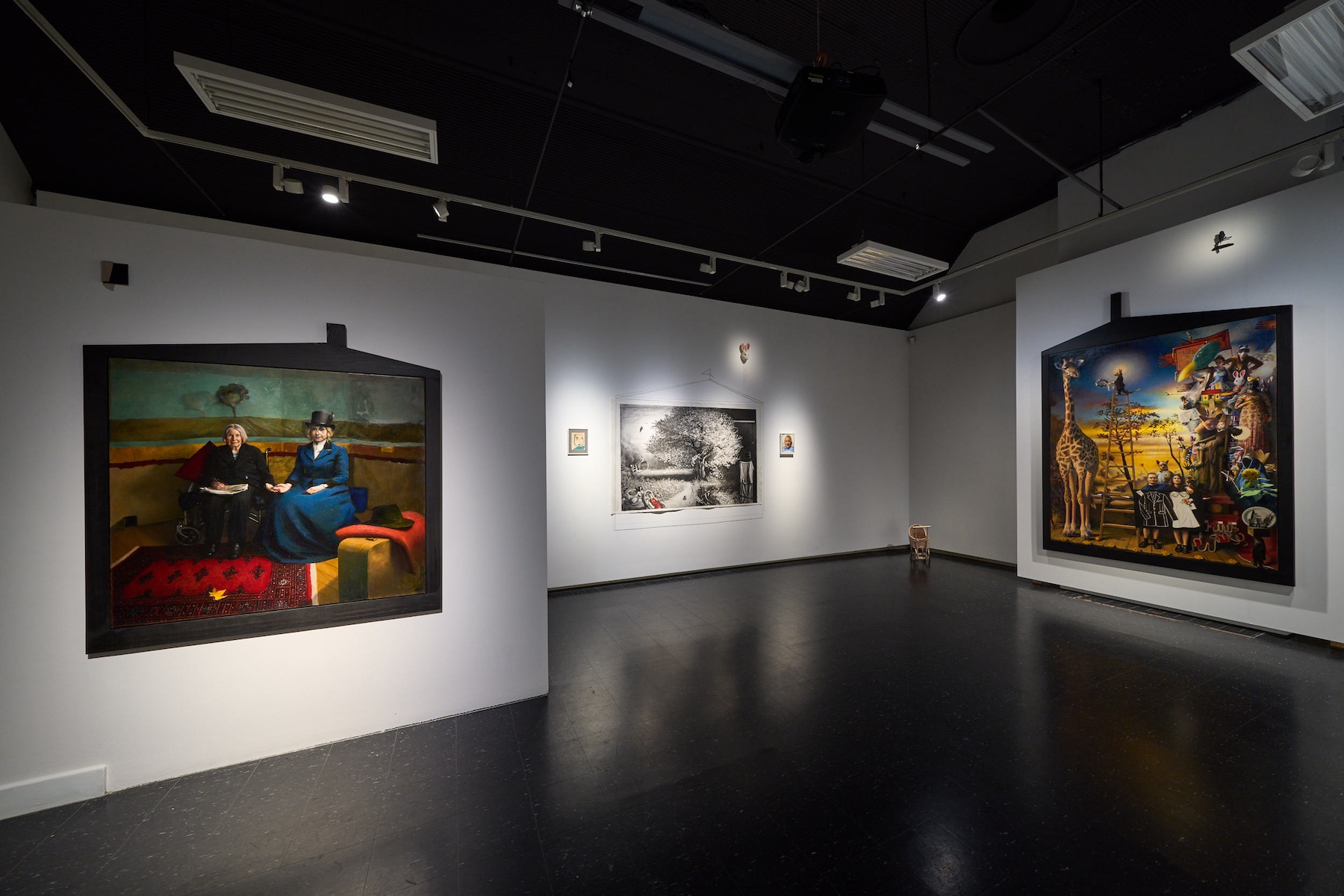
After such a long wait, this new exhibition at ACSA is quite small, tailored to the modest scale of the gallery space, and comprising no more than three major paintings, and three drawings. Yet it affords a richer experience than many a much larger exhibition. It is both a standalone exhibition, but also the sequel to those previous surveys as the manifestation of the most recent stage in Platten’s artistic and life journey – a period when the artist, who seems perennially youthful but is now in her sixties, withdrew further into the world of her imagination while coming to grips with ageing and the death of loved ones. As in the past, each artwork is a consummately realised and formally complex, with every element having a personal meaning for the artist. Although the uninitiated observer needs a key to enter this private world, the initial gestalt impact of her paintings is so seductive that many will be entranced to persevere and look more deeply.
A clue to the significance of Anna Platten’s art lies in her achievement in delving deep into the insecurities and vulnerabilities of her own psyche while also manifesting more universal aspects of human experience at differing stages of life’s journey. She is in a perpetual tussle with the medium in this quest to find the means of visualising ideas swirling around inside her head.
Reflecting on the almost-hung exhibition the day before its opening, an exhausted Platten said simply, “If I could talk about it, I wouldn’t paint it.”
Subscribe for updates
She added, “I think these paintings are about an emotional state, about memory and childhood, about life, about experience. It’s very particular but also general and universal.”
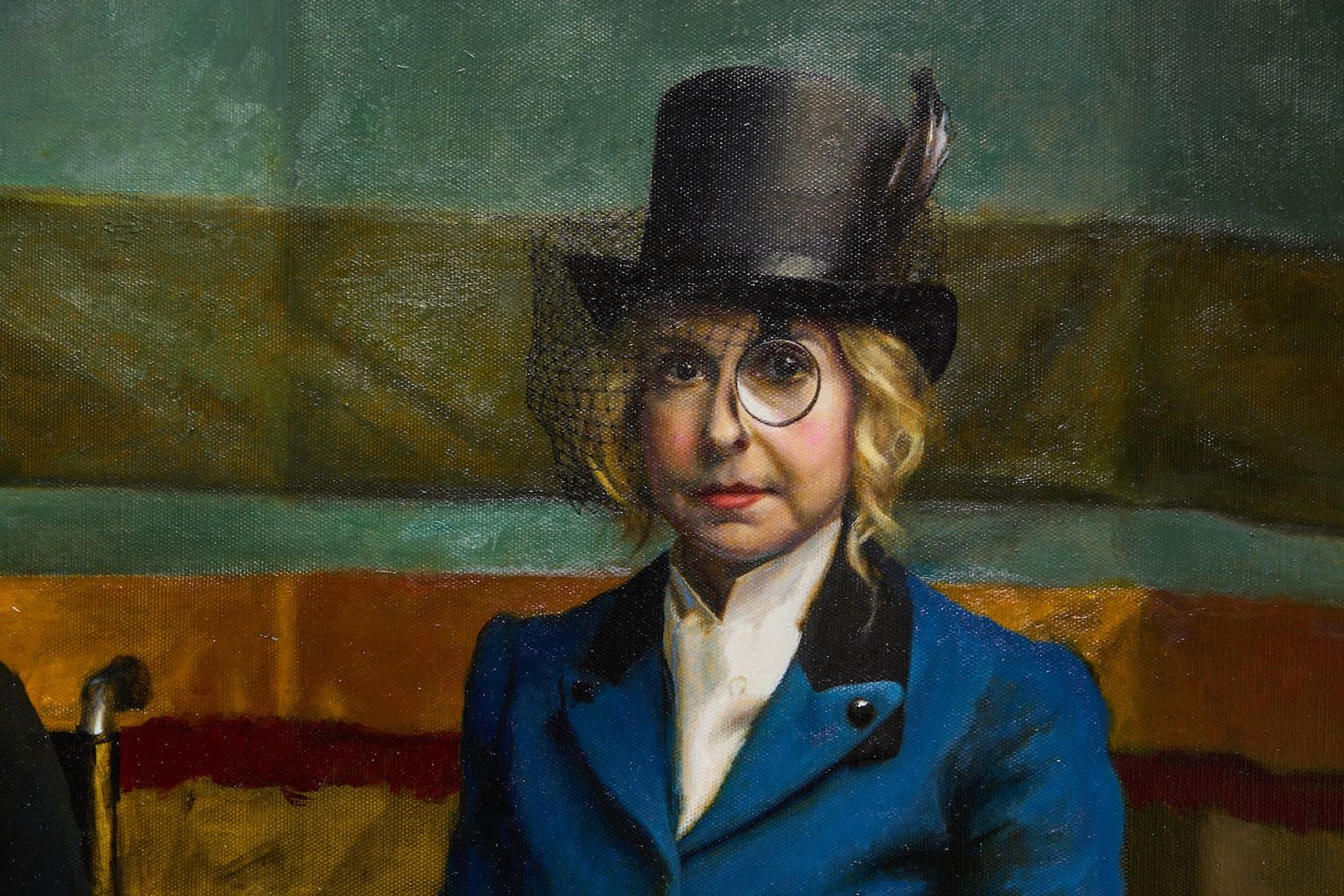
This internal tussle with herself and with the medium is exemplified in her oil painting, Χάρις (Charis), 2021–2026, which was the outcome of a prolonged process of creative torment across the period 2021-2026. The artist portrays herself as a woman warrior, garbed in a blue gown (which she made), with a bodice adorned with armour-like studs, standing imperiously as she crosses ‘swords’ with an alluring younger woman, who is attired in a flounced and corseted period costume. With great virtuosity, Platten has captured the vibrating movement of the young woman’s hand as she is forced to drop her weapon. Both figures stand theatrically on a backlit stage with the golden light of dawn or sunset suffusing the scene. At the very centre of the image is a small black square or void, which is replicated in three-dimensional form on the wall above the painting. These voids or portals to another dimension are a recurring device in Platten’s art and are part of her allusions to a mystical, spiritual dimension.
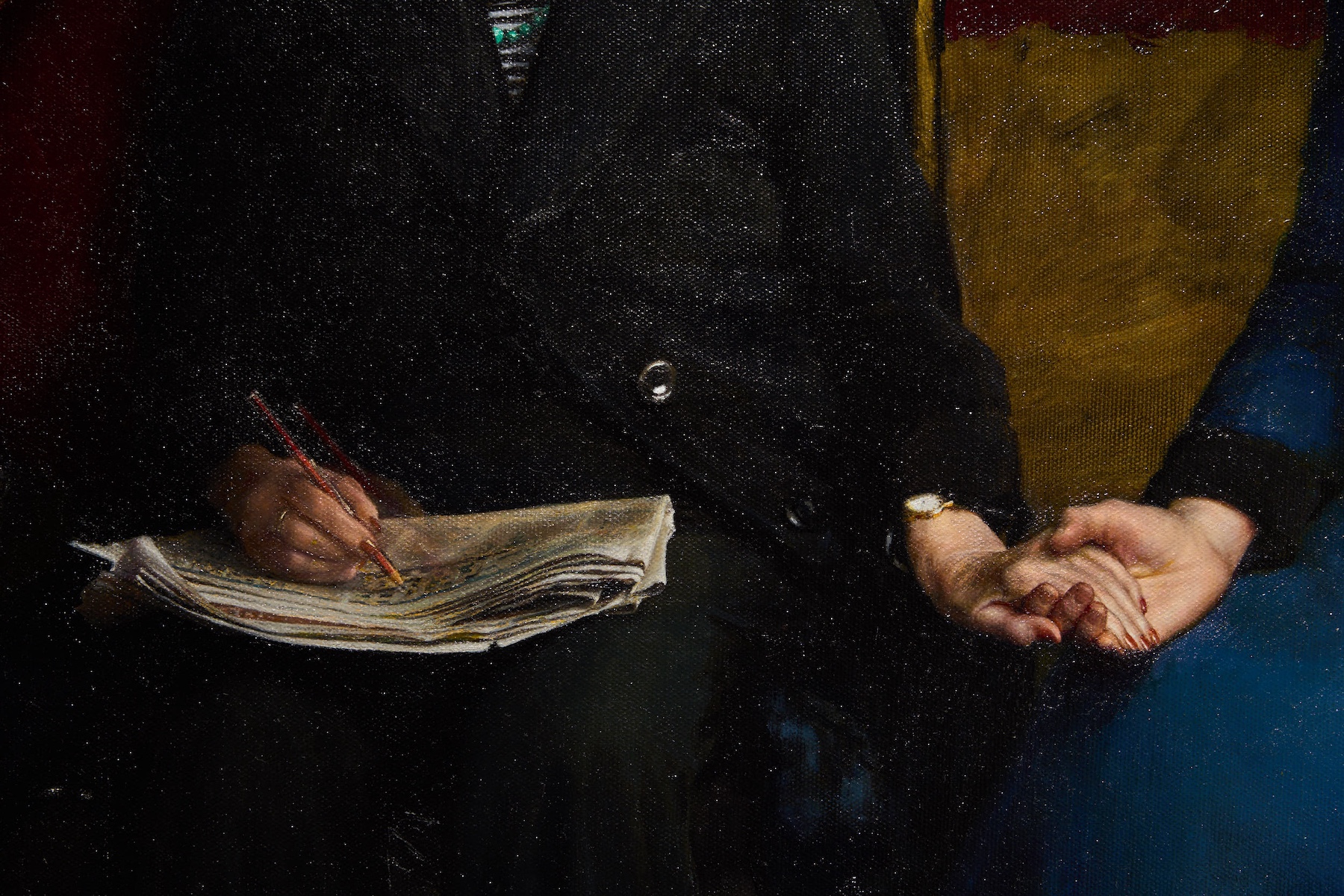
Two of the most personal works in My Head as a House reflect Platten’s attempts to deal with unresolved sadness arising from the dementia-related death of her mother in 2016. The formal double portrait of the artist and her mother, There was an old woman who swallowed a fly, 2020-2021, is a poignant farewell tribute, in which the two women are seated, close and yet apart, with hands held and a suitcase, travel blanket and hat, signifying the journey ahead. Her drawing and installation, Μητέρα (Mitéra), 1960-2026 has a more complex resonance, with love, memory and sadness entwined, while the drawing’s central image of a blooming blossom tree stands as an emblem of hope and renewal.
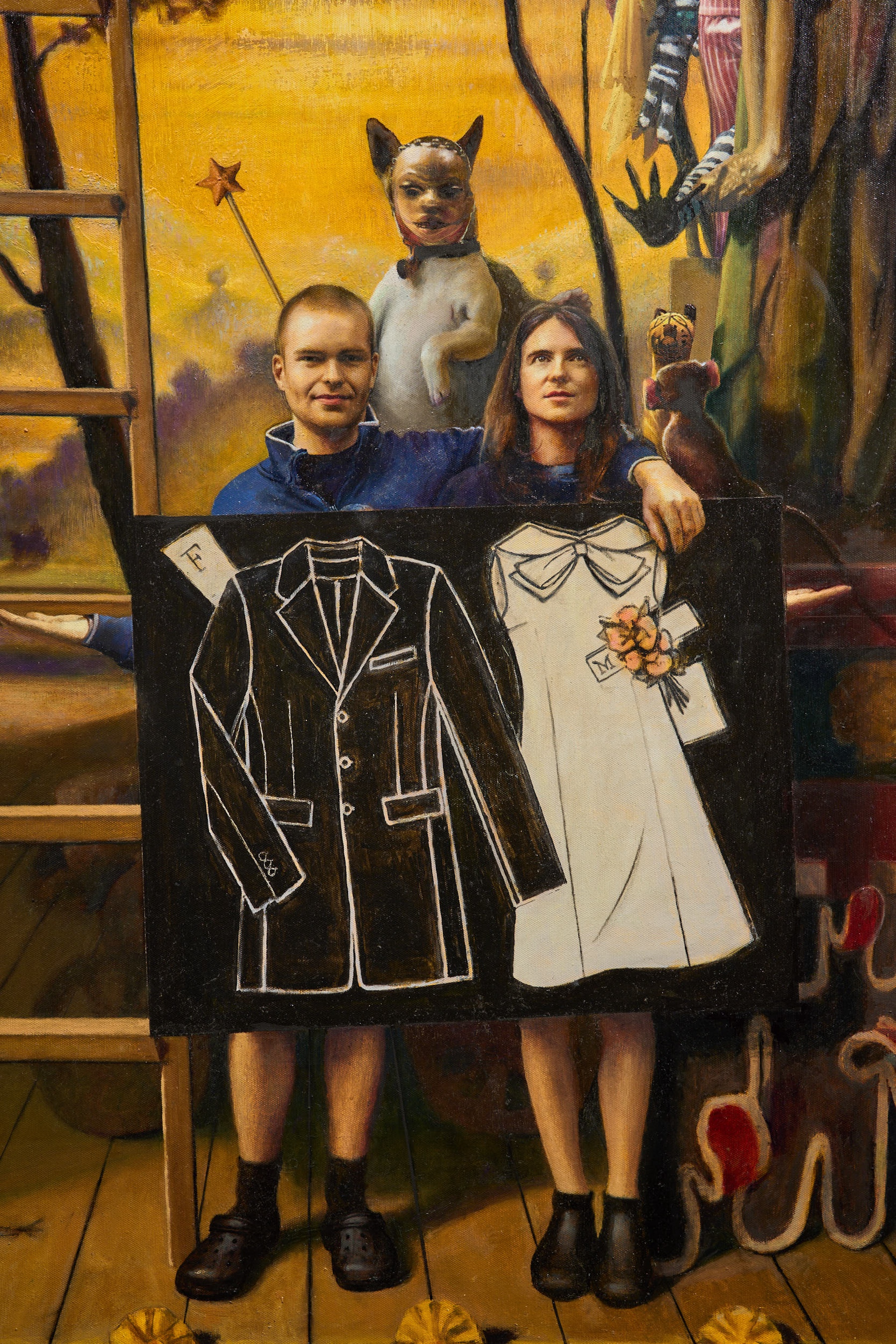
Platten’s more generalised grief at human folly is part of the complex associations of her oil painting, Ζώα (Zoa), 2022–2026. Acclaimed by Lock as the artist’s “greatest yet tour de force”, Ζώα (Zoa) is a vertical composition with a magisterial giraffe on one side, and on the other side balanced by an unstable tower of wildly disparate objects, some of which are personal totems and others are signifiers of human material culture across time. In the centre there is a ladder, a recurring symbol of hope in Platten’s paintings since it first appeared in the 1980s, with a hybrid fox/kangaroo standing on the topmost rung and offering a floral wreath to the giraffe. A small bird perches in vulnerable isolation on a fragile twig poking out from the tower of worldly goods, while on the wall above, the same image is replicated as a small sculpture. In the foreground, Platten’s son Felix stands smiling with his arm around his friend Hannah who gazes up to the heavens. As with Χάρις (Charis) this scene is bathed in the golden glow of sunset/sunrise. There is an ambiguity in possible interpretations so that although Platten has said that she intends this painting as a sign of hope vested in the younger generation, it is also open to interpretation as encapsulating the threatened future for coming generations as the world teeters on the brink.
It is a quality of much important art that interpretation is not proscribed too tightly by the artist but rather there is an ambiguity that allows imaginative engagement by viewers. For the first time, Platten has experimented with creating an extension to the actual artworks, with each of the paintings and drawings presented in specially designed black frames which are in the form of the pitched roof and chimney of the archetypal ‘house’ seen in childhood drawings. This was a calculated risk which on first impression seems to work well, as these understated interventions augment the art without distracting attention from it. In retrospect, however, the frames lend themselves to another interpretation as metaphors for containment of the artist’s emotional and imaginative world. When viewed in this light the portals and small sculptural items positioned above the contained artworks may be signs of freedom and escape.
There are hopes, still at the formative stage, that My Head as a House will be seen more widely in galleries beyond Adelaide, perhaps augmented by further new work currently in progress and by selections from the artist’s earlier body of art. It is time for the artistic achievement of this important Adelaide-based artist to be exposed to the wider Australian audience that it deserves.
My Head as a House continues at Adelaide Central School of Art until October 30
Want to see more stories from InDaily SA in your Google search results?
- Click here to set InDaily SA as a preferred source.
- Tick the box next to "InDaily SA". That's it.
Free to share
This article may be shared online or in print under a Creative Commons licence