Monet to Matisse delivers the unfamiliar and the exceptional
Far more expansive than the headline-grabbing names in its title, Monet to Matisse: Defying Tradition is an often revelatory roll call of European and American artists and movements.
Until as late as the 1960s the Art Gallery of South Australia’s international collection reflected the Anglophile and antimodernist tastes of its governing board, which tended to look askance at modern ‘Continental’ art movements from the Impressionists onwards, while finding postwar American modernism equally undesirable. In 1949 Sir Kenneth Clark’s offer to secure for AGSA “a very beautiful Monet” painting of a coastal landscape for £2,000 was rejected as too expensive by the Art Gallery board. It was not until the late 1960s that the appointment of progressive director John Baily saw a change in attitude – but by then it was far too late to build a representative collection of European and American art from the Impressionists onwards.
This significant gap in AGSA’s collection is one reason why it is thrilling to view paintings by a roll call of famous European and American artists in the Gallery’s latest exhibition Monet to Matisse: Defying Tradition, curated by Tansy Curtin, Assistant Director, Artistic and Collection Programs.
The unique appeal of Monet to Matisse lies not only in the high quality of so many of the paintings, but also in their unfamiliarity. Nearly all have been lent by the Toledo Art Museum in Ohio, and augmented by paintings and prints from AGSA’s collection. It is revelatory to discover paintings which were key players in the grand art historical drama, or which were early or late works in an artist’s career, and which occasionally seem to disrupt the timelines of mainstream art history.
Contrary to the marketing spin of the exhibition’s title, the art in Monet to Matisse spans around 125 years with the earliest painting being The Quarriers, 1846-7, by influential French realist Jean-Francois Millet and the most recent among the loan works being American artist Richard Diebenkorn’s abstract, Ocean Park No. 32, 1970. Approximately a third of the exhibits were created before 1900, encompassing Realism, Impressionism, and Post-Impressionism; a third were made between 1900 and the outbreak of the Second World War and give a taste of the wild ride that was early 20th century modernism; and a third range from 1940 to 1974, giving a very limited look at American modernist abstraction and Pop.
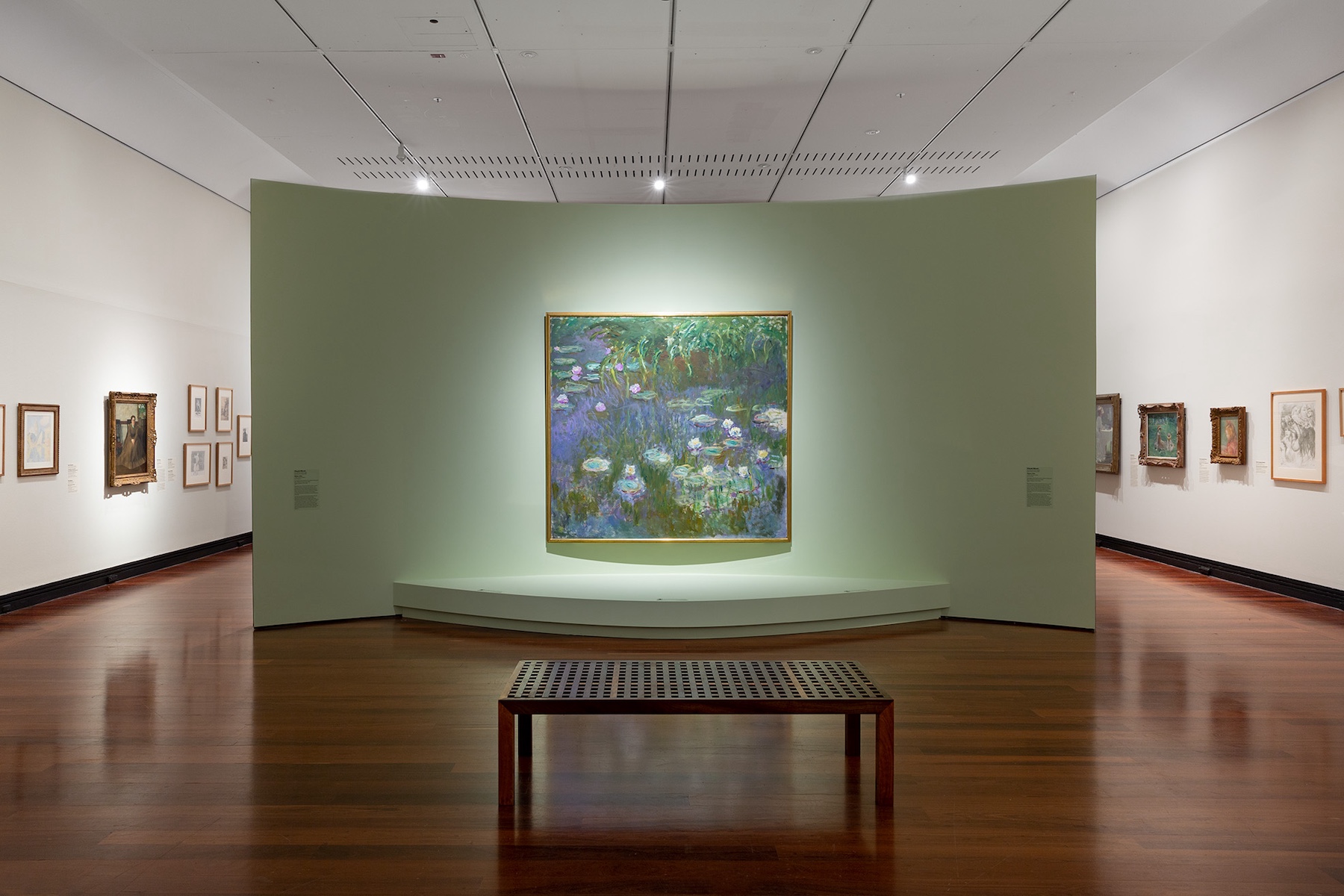
The exhibition’s hero painting, Claude Monet’s Water Lilies, 1922, falls at the exhibition’s mid-point, with 33 works pre-dating it. It is beautifully presented in the centre of the exhibition on its own wall, with a protective barrier that still permits close examination, and a nearby bench seat for more distant contemplation. Painted very late in Monet’s long career, and 50 years after his first Impressionist paintings, Water Lilies is a lyrical semi-abstract interpretation of shifting light and colour, encapsulating a moment of timeless beauty that transcends its historical period, looking both back to its origins in Impressionism and forward to the more harmonious forms of gestural and expressive abstraction across the 20th century.
You might like
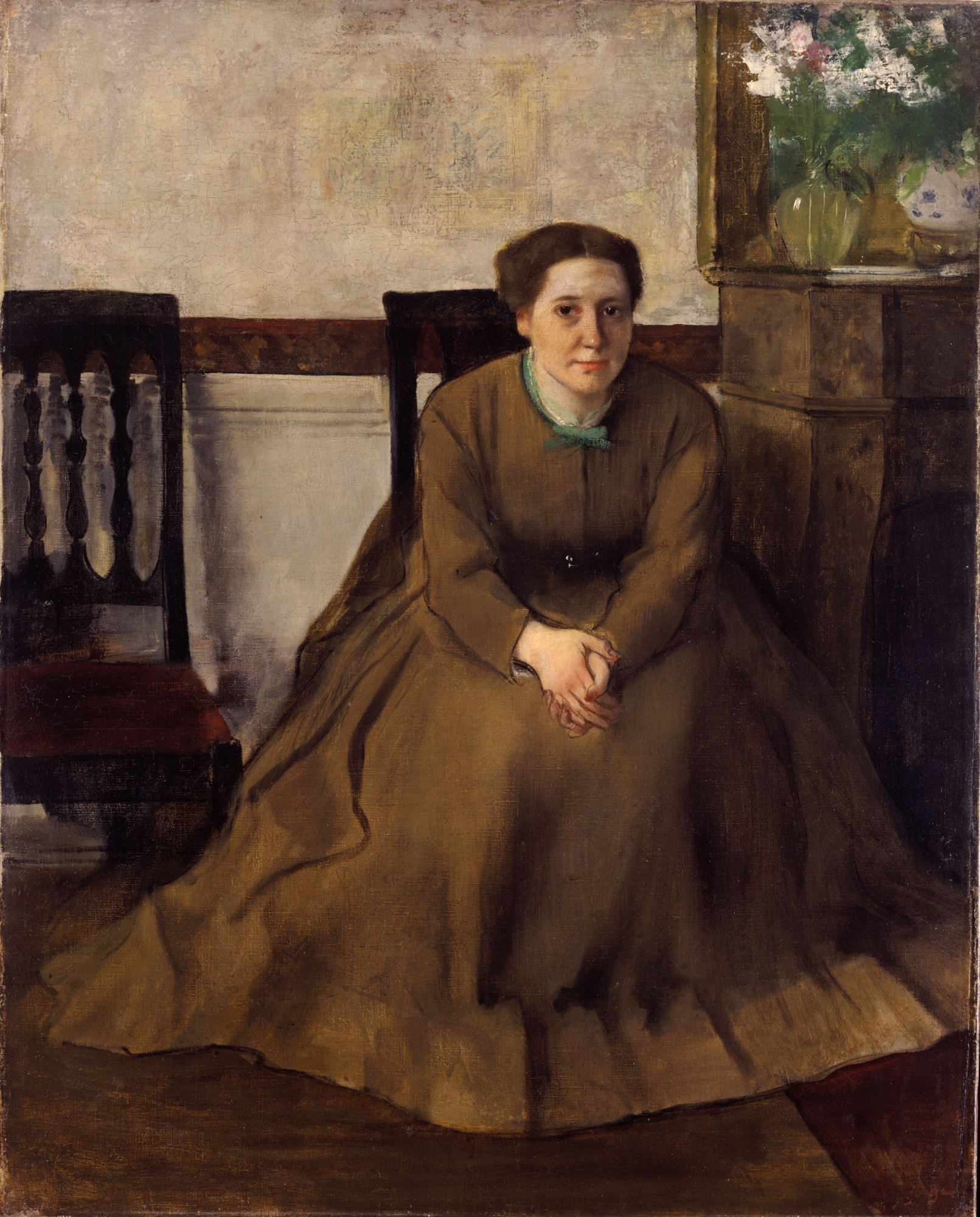
Some of the earliest works in the exhibition are amongst its most interesting, namely a selection of paintings created by James AM Whistler, Camille Pissarro and Edgar Degas, in the period before full blown Impressionism took hold. In his almost entirely abstract small landscape, Crepuscule in Opal, Trouville, 1865, Whistler captured the last faint glimmer of warm light in a tonal grey seascape, presaging Impressionism and even Monet’s lyrical abstraction. Pissarro’s expressive approach to the painted surface in his Still Life, 1867, looks astonishingly modern in his abandonment of academic illusionism as a precursor to Impressionism. What a shame that this painting – which so clearly presaged later developments – has been placed in a later gallery devoted to the still life genre, at a distant remove from Impressionist paintings by the artist and his contemporaries. Degas’s portrait of fellow artist, Victoria Dubourg, c. 1868-69, so resonant with her life force, has been exhibited separately from Dubourg’s contemporaneous but more academic Still Life with Flowers and Peaches, 1874, which is also hung in the still life section.
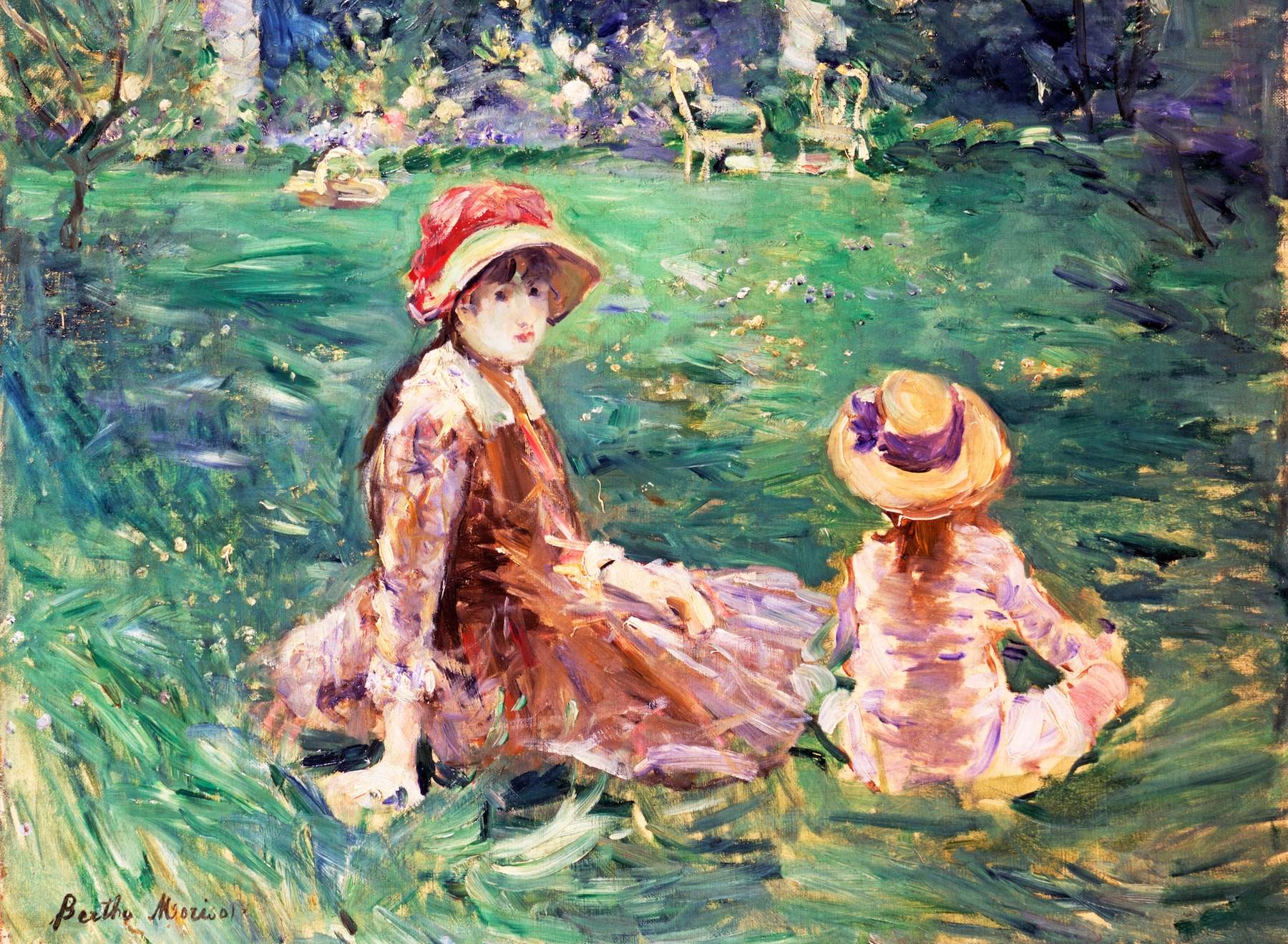
Amongst the selection of French Impressionist paintings there is a focus on en plein air landscapes, boosted by less well known and generally less accomplished American works. Amongst those significant paintings that represent this movement at its height are Renoir’s unusual landscape, Road to Wargemont, 1879, in which his technique of applying layers of wet paint has created an eerily blurred effect, and his more characteristic interior, The Green Jardiniere, 1882, a sensual (arguably voyeuristic) portrayal of a young woman, the exquisitely rendered pale flesh of her decolletage highlighted by the loosely painted greenery of the titular green jardiniere; Berthe Morisot’s In the Garden at Maurencourt, 1884, depicting a woman and child reclining amidst a verdant private garden, portrayed through a lyrical Impressionist tangle of loose brush marks; and Gustave Caillebotte’s Regatta at Trouville, 1884, infused with light and movement, the surface disrupted by occasional thick smudges of paint.
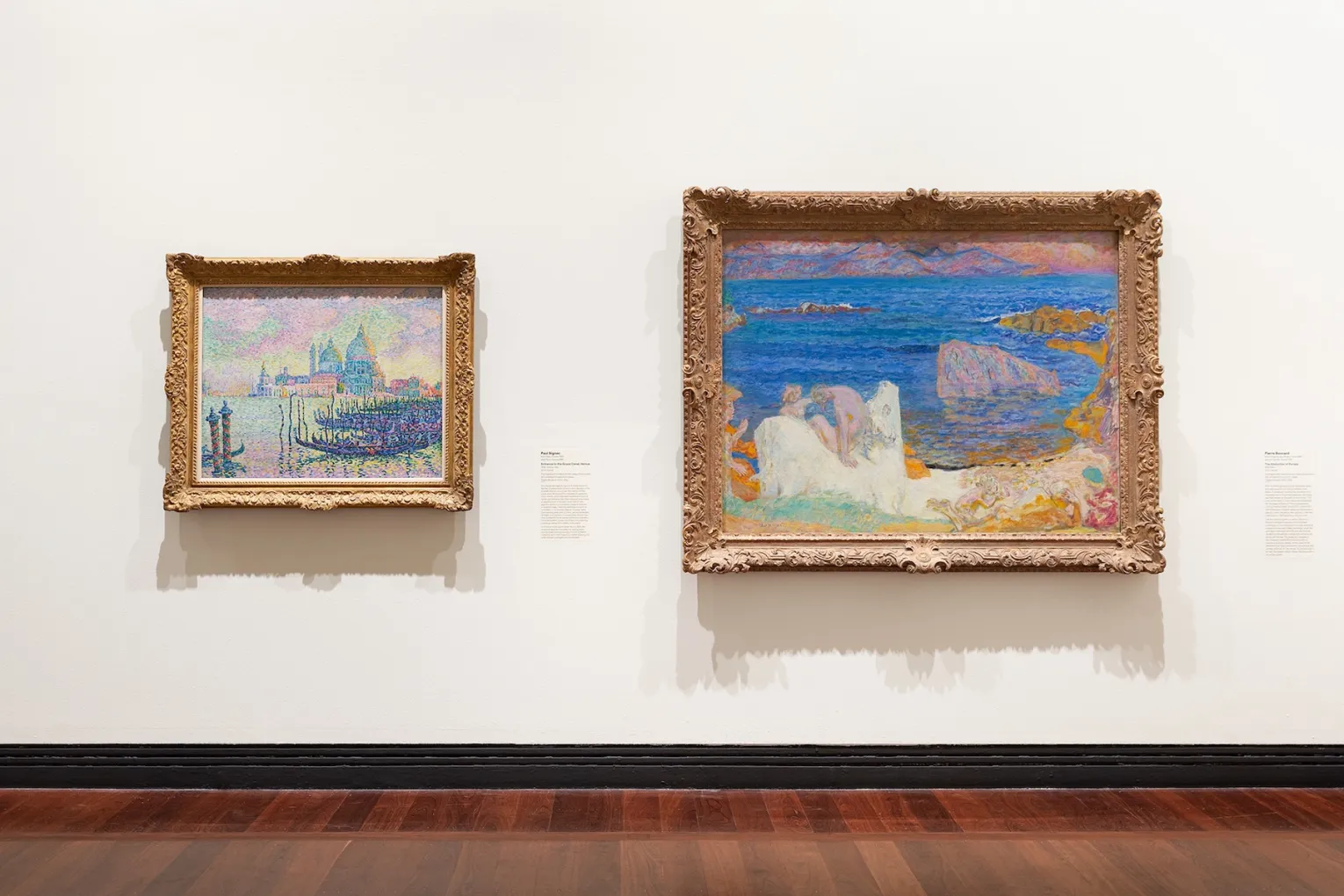
"One of the masterpieces of the exhibition, Signac’s pointillist Entrance to the Grand Canal, Venice 1905 is an exemplar of the power of pure colour to compose a world of light."
There are key Post-Impressionist paintings by Paul Cezanne, Vincent van Gogh, Paul Gauguin and Paul Signac. In Avenue at Chantilly, 1888, Cezanne structured colour and form according to rational principals of geometry, to generate interplay between illusionism and flatness of the painted surface. At the other end of the emotional spectrum, Van Gogh’s Wheat Field with Reaper, Auvers, 1890, made not long before his death, continues to exert a latent manic energy through his thickly applied gestural swirls of paint. One of the masterpieces of the exhibition, Signac’s pointillist Entrance to the Grand Canal, Venice 1905 is an exemplar of the power of pure colour to compose a world of light, evoking Marx’s famous sentence, ‘All that is solid melts into air’, to usher in the fast-changing and unpredictable world of the 20th century modernity.
Subscribe for updates
In the galleries devoted to 20th century modernism, the art historical continuity of the opening galleries gives way to trans-historical genre groupings around European and American figuration, pure abstraction, semi-abstraction and still life.
The lack of art historical synchronicity in this hang is occasionally jarring, for instance the anomalous placement of Fernande Leger’s early modernist abstract, Esquisse pour ‘La Ville’, 1919, by the exhibition exit next to Robert Rauschenberg’s late modern Round Sum, 1964; or, the incongruous juxtaposition of Paul Klee’s restrained small abstract, Villas for Marionettes, 1922, with the spectacle of Frankenthaler’s huge multi-panel, Madame Butterfly, 2000, and Yves Tanguy’s two surrealist paintings, Passage of a Smile, 1935 and Pierre Premiere, 1947.
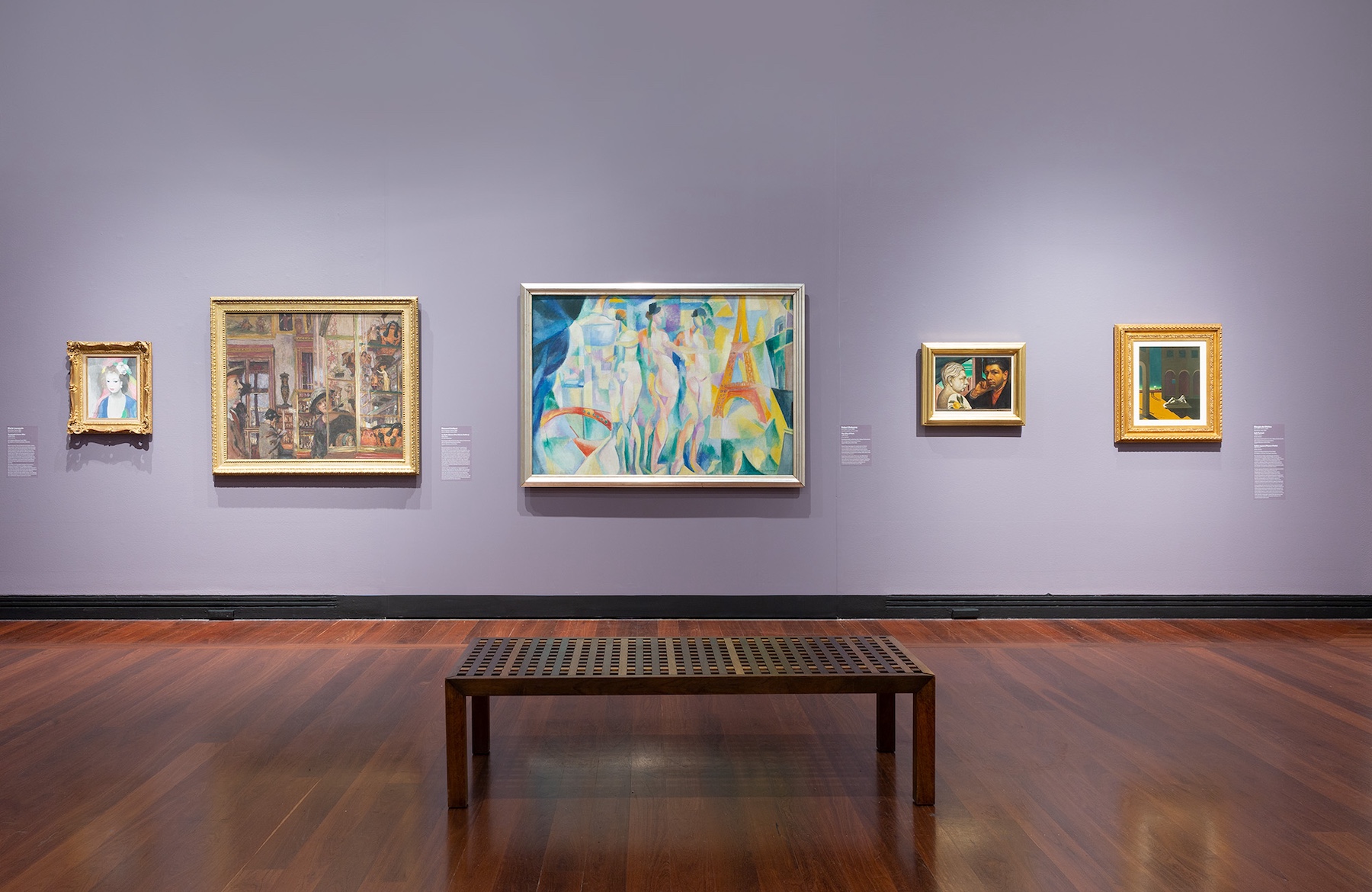
This said, there is some great art on view, most notably an exemplary painting from Pablo Picasso’s revolutionary cubist breakthrough moment, Woman in a Black Hat, 1909; a brilliant Robert Delaunay cubist painting, The City of Paris, c. 1911, which captures the dynamic spirit of the times; and a characteristically spare and asymmetrical portrait by Amedeo Modigliani of art dealer, Paul Guillaume, 1915. Henri Matisse’s painting, Dancer Resting, 1940 – which is included in this section despite being a much later work – is disappointing both in its overall enervated decorative style and in his unflattering sexualised portrayal of his much younger model/mistress, Lydia Delectorskaya.
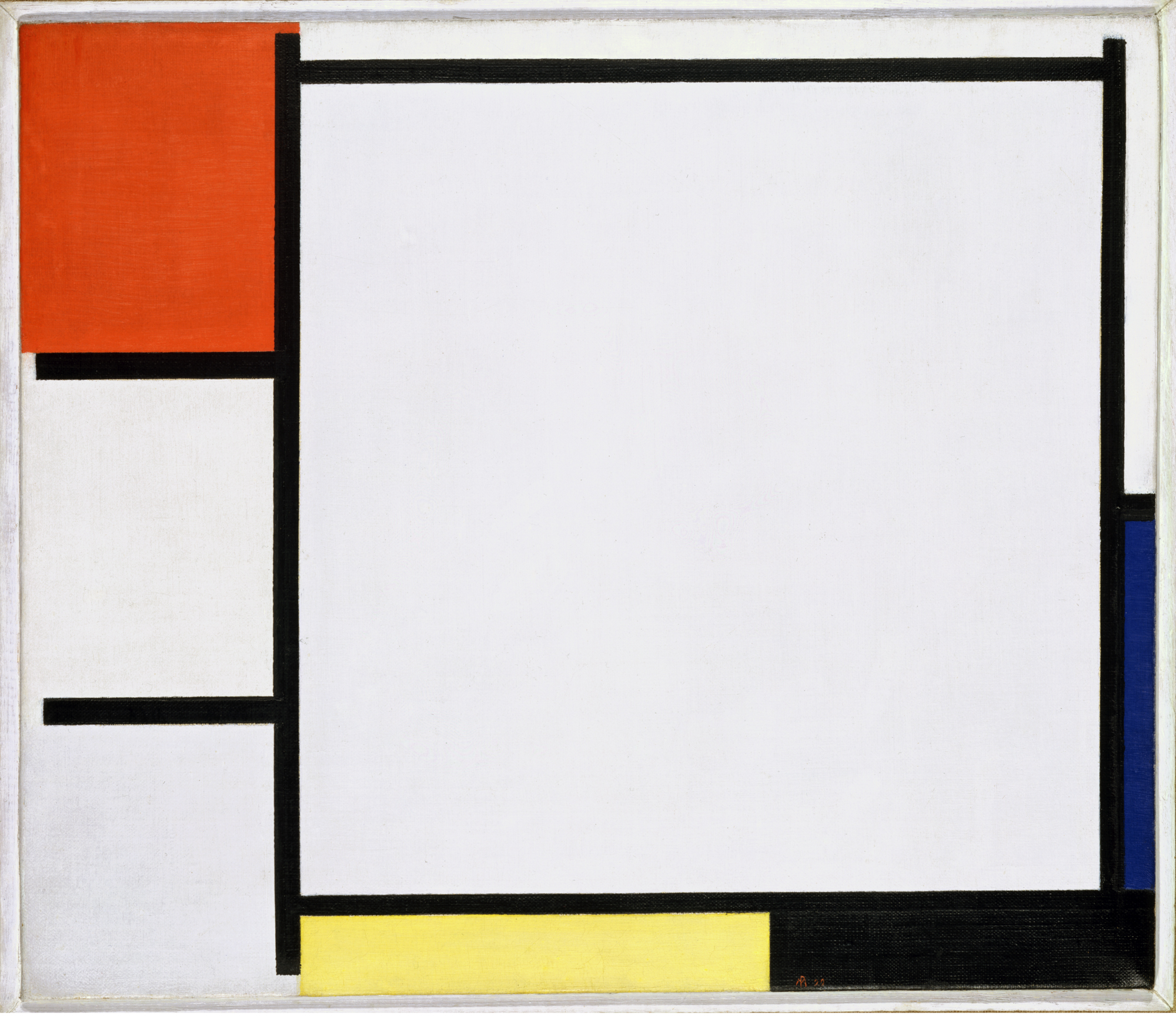
In the Pure Abstraction gallery there are many famous names, led by Piet Mondrian, whose Composition with Red, Blue, Yellow, Black and Gray, 1922, is emblematic of his paintings from this period (mysteriously, it does not include any grey, despite the title). Leaping forward to the postwar period, a big colourfield abstract by Morris Louis, Dalet Tet, 1959, rewards close looking as the huge black smear of acrylic paint that dominates the canvas reveals is underlying pigmented bleeds of red, yellow and blue. The other exceptional works in this time frame are wonders of subtle understatement by non-Americans, namely British artist Ben Nicholson’s refined linear design and quiet colour in Ides of March, 1952, and a small, characteristic Giorgio Morandi, Still Life with a Bottle, c. 1951.
Unfortunately, there are numerous faults in the exhibition’s catalogue, which appears to be the victim of a rushed production schedule. There is no list of works, and in several instances the groupings of works in each of the curator’s themed sections differ between the catalogue and the exhibition hang. This applies to Renoir’s The Green Jardiniere (in the catalogue’s En plein air section, hung in Figures of modern life); Pissarro’s Meadow at Eragny (in Figures of modern life, hung in En plein air) Lionel Feininger’s landscape, Baltic, A Recollection (in Pure abstraction, hung in Figuration and abstraction) and Ben Nicholson’s Ides of March (in Figuration and abstraction, hung in Pure abstraction).
Catalogue notes are missing for many paintings – most noticeably for the unfamiliar American paintings which might benefit most from further explanation. Crucial works suffer from inaccurate colour-matching – with a noticeable red imbalance in the Signac and Morisot paintings – and the design decision to spread landscape-oriented images across two pages has led to sections of some artwork images being lost in the central ‘gutter’ fold (in William Merrit Chase’s The Open Air Breakfast, c. 1888, a girl in a hammock appear headless, her face swallowed by the spine).
In all probability such critiques will not matter to most punters, many thousands of whom have already bought tickets. It is, after all, a not-to-be-missed exhibition affording Adelaidians and visitors from further afield a rare opportunity to experience with fresh eyes the compelling presence of less well-known paintings by a long list of great and influential artists. But it matters to those of us who look to state galleries to be an exemplar of the highest presentation and publication standards – and if no one holds them to it, attendance figures, tourism campaigns and social media ‘likes’ might become the only standards that matter.
Monet to Matisse: Defying Tradition continues at the Art Gallery of South Australia until November 8
Want to see more stories from InDaily SA in your Google search results?
- Click here to set InDaily SA as a preferred source.
- Tick the box next to "InDaily SA". That's it.
Free to share
This article may be shared online or in print under a Creative Commons licence