Camouflage collage: Jemima Wyman finds patterns in protest movements
A survey exhibition of the Palawa artist Jemima Wyman reflects upon the overlapping aesthetics of global activist movements, and the ‘power of anonymity’.

In 2004 Jemima Wyman relocated to Los Angeles, establishing a base there with the assistance of a Samstag Scholarship which enabled her to undertake a Master of Arts degree at California Institute of the Arts (CalArts). Her current career survey exhibition at Samstag Museum of Art, titled Deep Surface, reveals her fascination with optical patterns, colour and politics across some 30 years of art practice. The exhibition was curated by Katherine Dionysius for QUT Galleries and Museums, tour organiser and publisher of the substantial and informative exhibition catalogue.
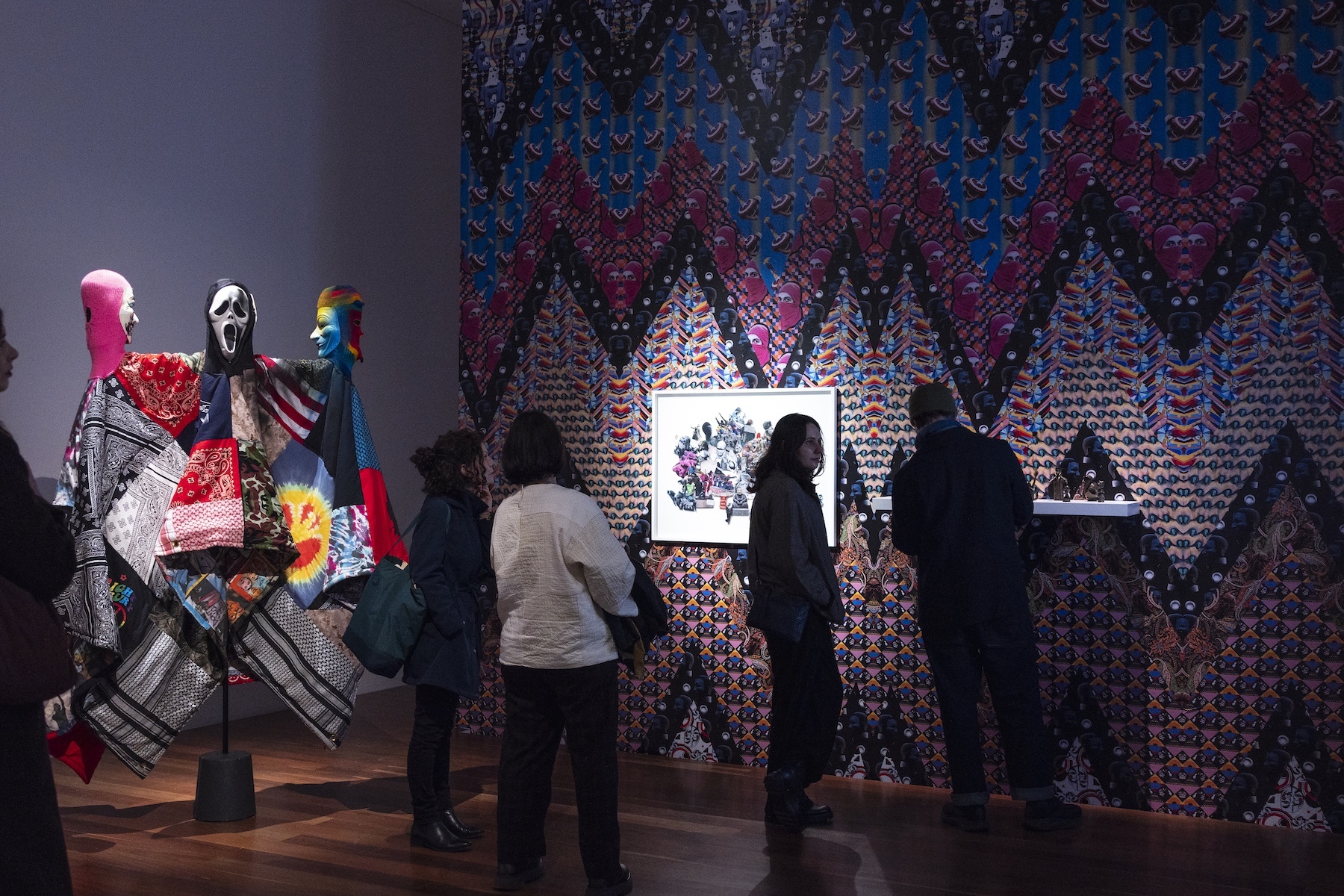
Entering the gallery space from the bleak, windswept environs of that part of North Terrace, the viewer is immediately immersed in Wyman’s world of colour and pattern. There are large-scale framed collages, textiles, sculpture, paintings and videos, all wildly colourful and densely patterned.
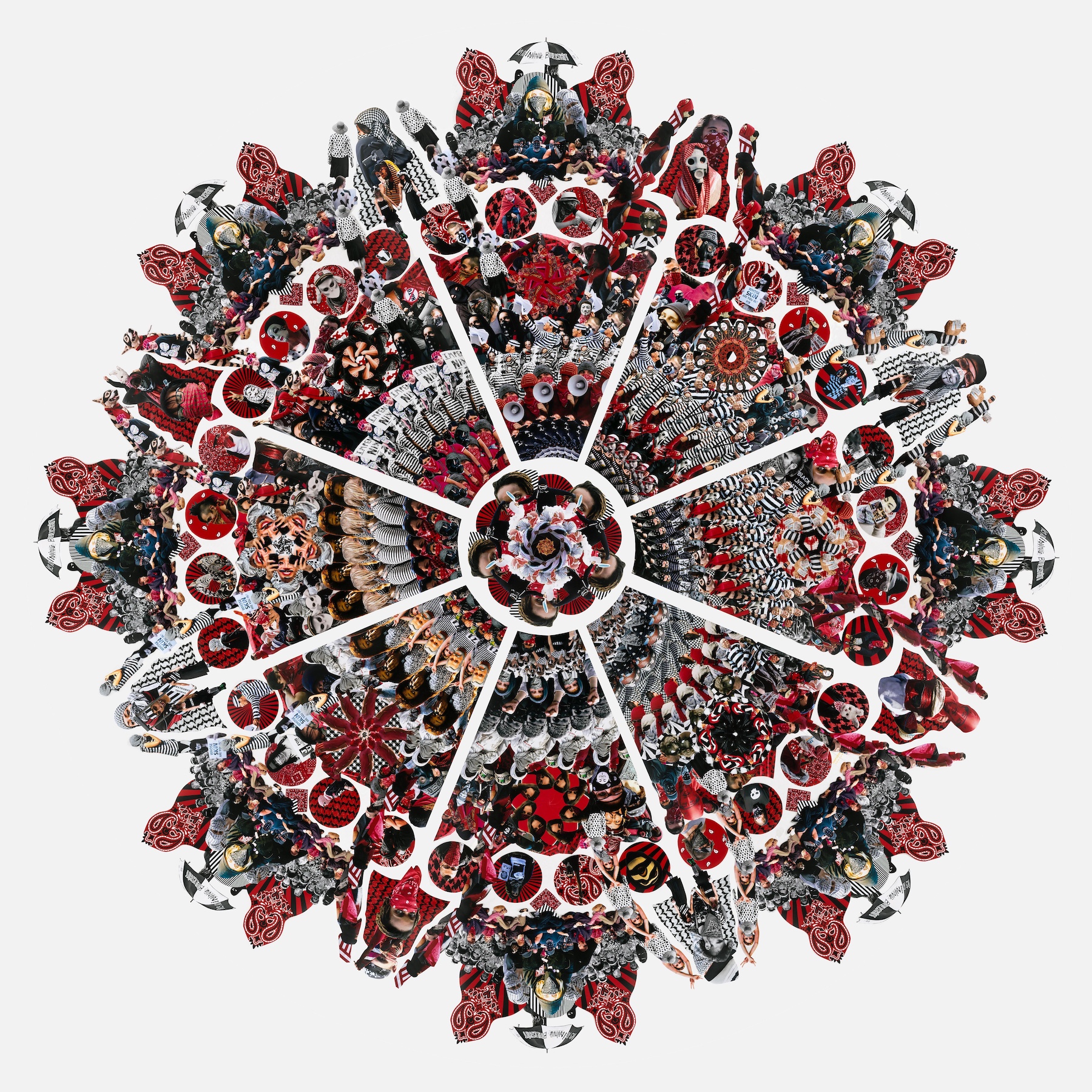
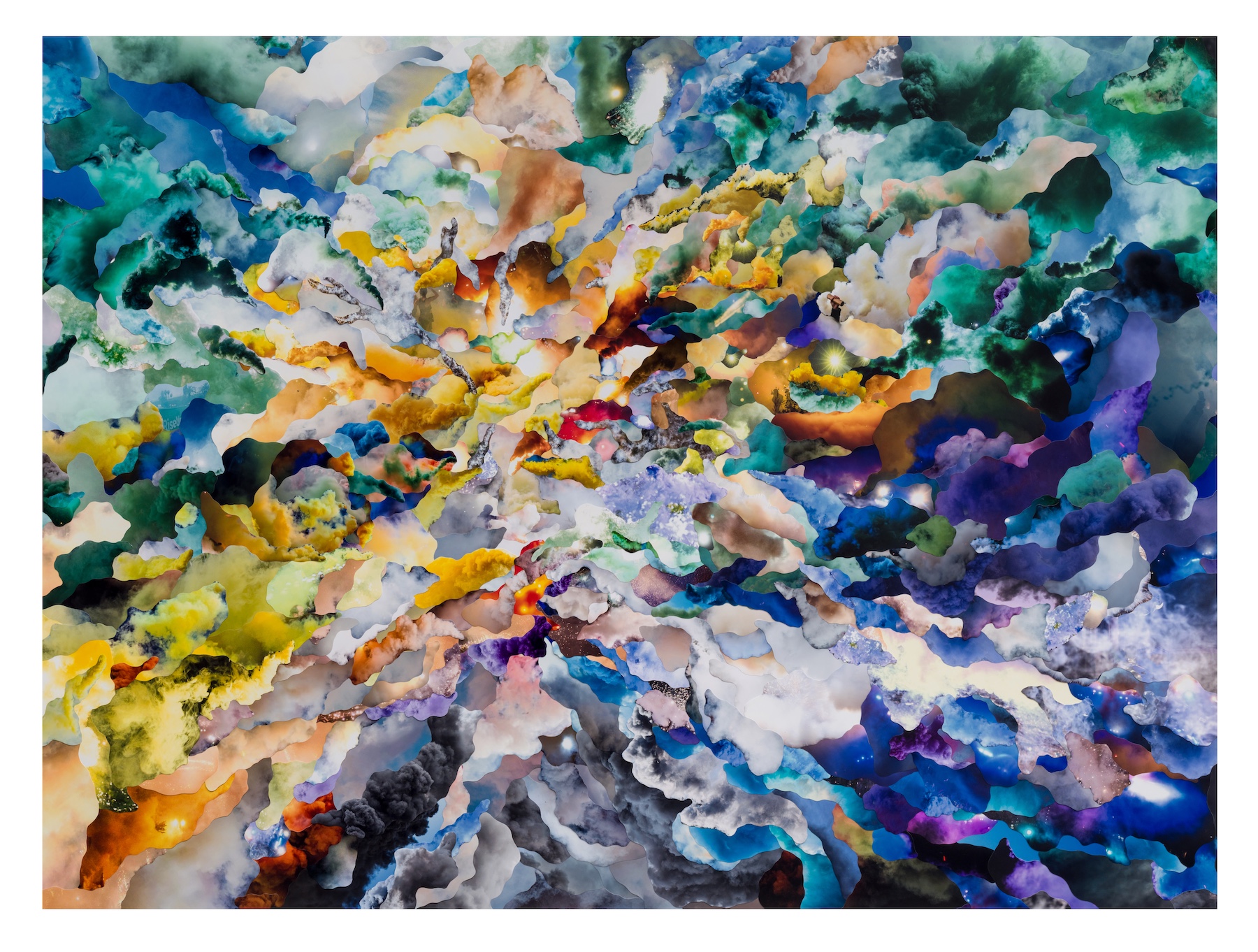
It takes more than a moment to comprehend Wyman’s optically rich yet deeply complex collages, which on close inspection reveal themselves to be comprised of literally hundreds if not thousands of digital images, sourced from the web, cut into shapes by the artist and assembled in intricately patterned collages. This is just the beginning, as this surface enticement is, in effect, a camouflage for the artist’s analysis of the visual language of political activism and global protest movements.
Since 2008 Wyman has been compiling an archive of web images of political dissent, accumulating visual documentation of the recurrence of signs and symbols across geographical and ideological divides. Her huge archive comprises files of recurring images with especial reference to facial disguise, masks, camouflage and most recently smoke from incendiary devices. Each fragmentary image is fully documented by date, place and nature of protest, with these details for each of the hundreds of images in her collages forming the very lengthy full titles of each work (abbreviated titles are used in the exhibition and catalogue).
Wyman has spoken of her fascination with the ‘power of anonymity’ conferred by masks and camouflage, and their erasing of individual identity within the identity of the group, while protecting the protagonists from official surveillance. Equally fascinating has been her observation that similar costumes, masking and performative strategies have spread globally and characterise diverse causes.
This global iconography of protest is exemplified in her Aggregate Icon series (2011-2020) of photo-collaged mandalas, most approximately 200 cm in diameter, comprising fractal-style patterns of masked and costumed protesters. Aggregate Icon (Rosetta RBW) 2017, is a dazzling kaleidoscopic pattern in red, black and white with fragmented details of costumed protesters emerging through close inspection. Aggregate icon (New Zealand) 2011, is an amazing collage of imagery so dense, with colour gradations so subtle, that it is only gradually that masked faces can be discerned in this camouflage collage.
Wyman’s two more recent series, Haze and Plume, are awe-inspiring in their operatic ambition. Each is created by collages of web-sourced images of coloured smoke generated by protestors and law enforcement responders. The multi-coloured myriads of smoke plumes are individually documented by Wyman. For instance, the title for Haze 2 is listed in full in the catalogue and extends to four closely printed pages. The artist’s command of colour and movement in these works has an impressive choreographic and orchestral flare in its evocation of cataclysmic threat. In an interview in the catalogue with Yuval Etgar, Wyman draws a comparison with 19th century Romantic painters who sought to summon awe and terror in their depiction of the sublime. She cites British artist John Martin’s inferno painting The destruction of Pompeii and Herculaneum 1822 as inspiration for Haze 2.
Subscribe for updates
Other aspects of Deep Surface do not quite live up to the impact of these collages. Most works are of interest primarily as exemplars of Wyman’s creative evolution, revealing her commitment from the outset to an analytical approach to the optics of pattern and perception. This is seen in the earliest exhibits, a sequence of graphite diagrammatic drawings of an imagined cross-section of the connection between eye and brain, made during 17-year-old Wyman’s first undergraduate year at Queensland University of Technology.
Possibly the most political, and least analytical exhibit is Wyman’s agit-prop three-headed mask costume, Thronging bluff face, 2014, with the accompanying video showing the costume being worn on the streets as part of a political performance. This is the closest Wyman comes to showing her hand as to whether she is a fellow-traveller or simply a detached observer documenting global protest movements – most probably, a bit of both. In stark contrast to this overtly political wearable art, one of her major recent textile works is Rise and fall and rise… 2025, a multi-layered draped textile printed and painted with patterns in shades of blue, and measuring a massive 366 by 518 centimetres. According to the wall text this hanging is concerned with the recurrence of blue in protest movements, notably in protests about threats to the ecology and to water sources. In a stylistic shift for Wyman, it has a disarmingly innocuous decorative style that possibly suggests an institutional commission.
The lingering questions provoked by Wyman’s art concern whether the gritty anti-establishment world of street protest is deracinated, rendered harmless, by her analytical optical manipulations, and by her creation of art objects for wealthy collectors and for museum display. Indeed, is this the intended outcome, or alternatively, are her artworks envisaged as testaments to the protest movement and to the human urge for collective action and street theatre? Arguably, both propositions may be true. Turning from the artist’s intentions to impact on the viewer, responses to Wyman’s optical analysis of the global protest movement may well be determined by the perceptual and political orientation of the individual. Whatever the case may be, a visit is recommended.
Jemima Wyman: Deep Surface continues at Samstag Museum of Art until September 18
Want to see more stories from InDaily SA in your Google search results?
- Click here to set InDaily SA as a preferred source.
- Tick the box next to "InDaily SA". That's it.
Free to share
This article may be shared online or in print under a Creative Commons licence