‘It lies at the heart of art history’: Miguel Chevalier sees the light
Miguel Chevalier, this year’s Illuminate Adelaide artist in residence, has been creating digital art since the early 1980s. Here, the pioneering French creative tells InReview about the technological advances he’s seen, the themes that influence his work, and what he’s created for this year’s Illuminate Adelaide.
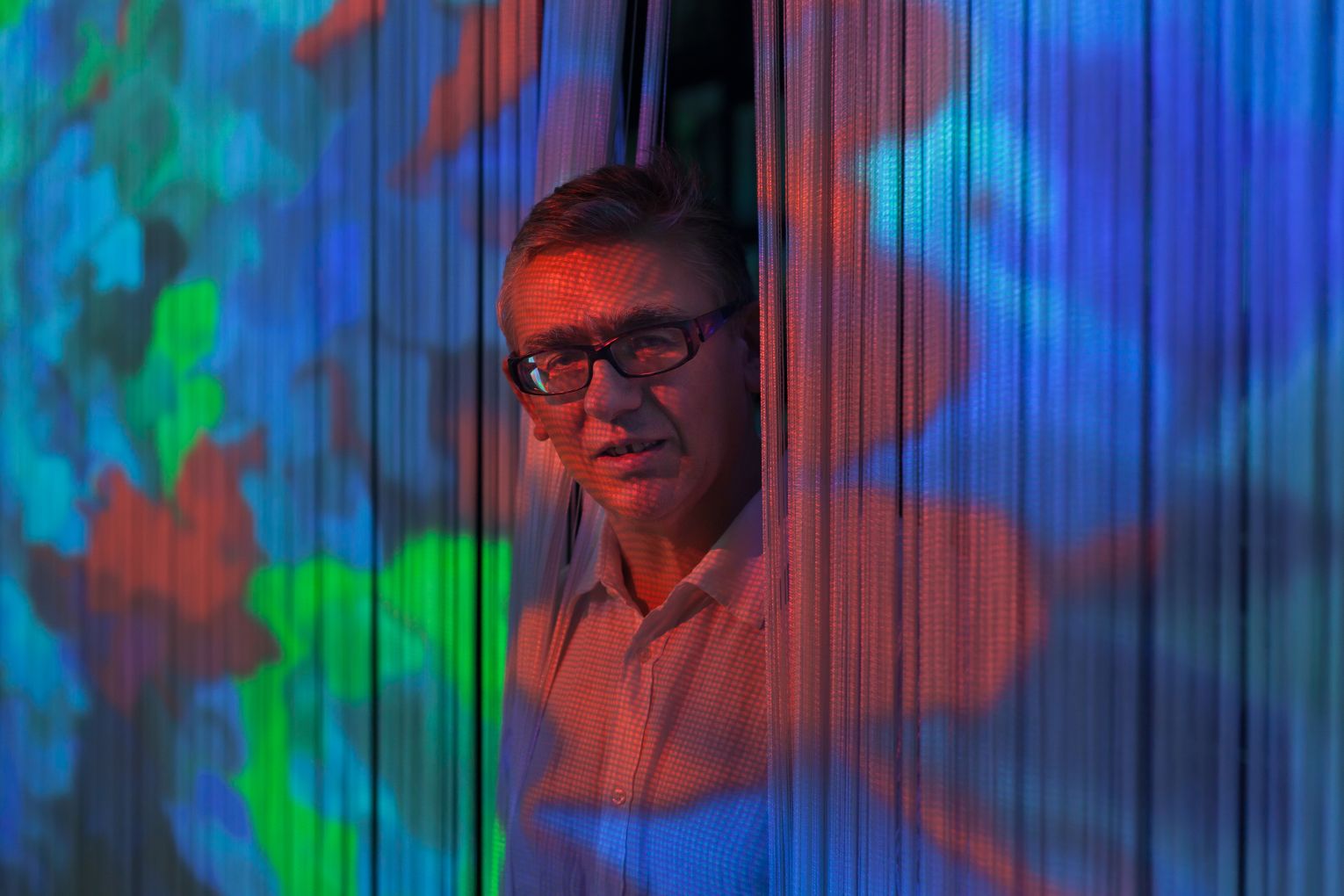
You are one of the pioneers of virtual and digital art using computers from back in the 1980s – what drew you to this world?
I have never considered digital technology to be merely a technological tool, but rather a medium of artistic expression and experimentation in its own right.
Very early on, in the 1980s, I realised that artists always appropriate the tools of their time and ultimately become those best placed to bear witness to them. Figures like Man Ray, who transformed photography into a fully fledged artistic medium, and the Korean artist Nam June Paik, a pioneer of video art and the father of electronic art, profoundly influenced my thinking. They understood before many others that new media would transform the way we see and represent the world.
What attracted me to digital technology was the possibility of transcending the limitations of traditional media such as painting, photography and video. The computer offered the possibility of introducing movement, chance, and above all, generativity – that is, the ability to create entirely new forms and ever-evolving worlds. I was fascinated by the possibility of creating artificial life forms and making the viewer an active participant in the artwork through interactivity.
For me, the shift to digital has never been a break with art history, but rather its natural extension in our time. Digital art allows us to work at all scales, from the microscopic to the monumental, and to bring art, science, and technology into dialogue within a shared worldview. It is a particularly relevant medium for exploring the profound transformations of our era and our relationship to increasingly connected, hybrid, and complex worlds.
What major technological advances over the years have influenced your work ?
When I started working with computers in the early 1980s, the technical resources were very difficult to access and extremely limited. Since then, the evolution of computing power, software, graphics cards, and projection systems has considerably transformed the possibilities available to artists.
The democratisation of computers in the late 1980s and the advent of real-time technology with video games in the 1990s was a crucial step, as it allowed me to develop generative and interactive works capable of reacting to the presence of the public. More recently, artificial intelligence has opened up new creative territories and allows me to imagine unprecedented hybrid forms.
However, despite these advances, the fundamental questions that drive my work have remained the same: how to represent life, movement, and the world’s constant transformations? The tools evolve, but my artistic approach remains remarkably consistent.
What sort of technologies do you use today to create your installations and sculptures ?
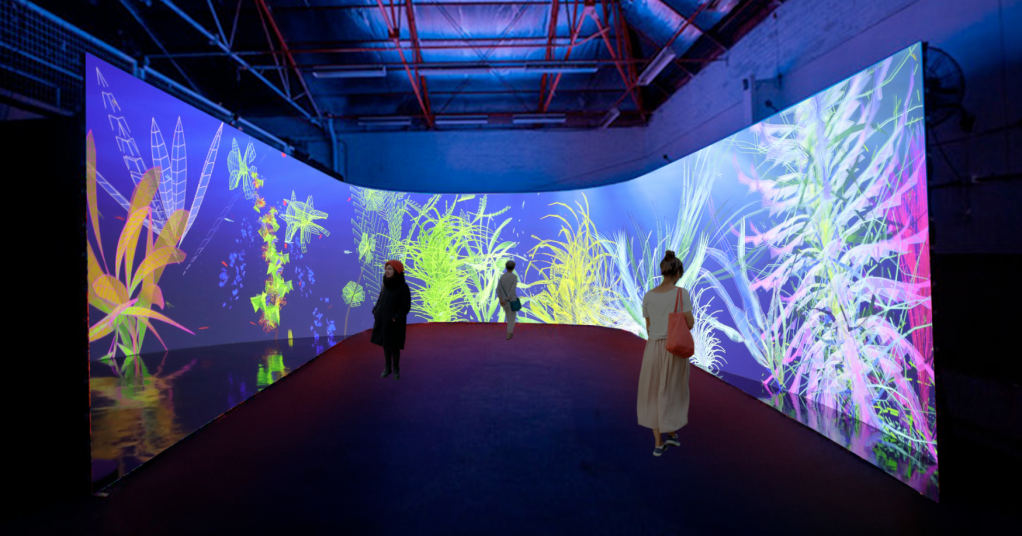
My work is profoundly trans-disciplinary. I enjoy working at all scales, from the microscopic to the monumental. My creations thus take the form of immersive installations, architectural projections in public spaces, interactive environments, robotic drawings, 3D-printed sculptures, and moving light installations on screen.
You might like
For my digital works, I have collaborated for many years with several computer scientists who develop custom software for me to create my generative pieces. I also have access to infrared sensor detection systems that allow the public to interact with my works in real time based on their movements.
For the past few years, I have also been integrating various artificial intelligence tools to enrich my image databases and imagine new 2D and 3D plant collections. For the sculptures, using my software, I employ 3D printing technologies in ceramic and resin, which allow me to materialise forms originating from the virtual world.

Can you share a couple of career highlights for you?
For over 45 years, I have had the privilege of presenting my work in numerous museums, art centres, and public spaces around the world. Among the most memorable moments, I would mention my large-scale immersive installations in exceptional heritage and architectural sites, such as the Domaine de Chaumont-sur-Loire in France, with its custom-built double dome and 360° projection inside; the former Sacré-Cœur Cathedral in Casablanca, Morocco, with the interactive floor installation “Magic Carpet”; and, more recently, the Digital by Nature exhibition at the Kunsthalle Munich in Germany, featuring a 1200 m² space filled with immersive installations and physical artworks. This exhibition was very well received, attracting 240,000 paying visitors.
I am very happy to see that digital art, which was very marginal when I started in the 1980s, is gradually being exhibited by institutions and is slowly entering museum collections. But more than significant achievements, what pleases me most is having been able to remain true to my initial vision and to continue to explore this vast artistic territory.
Tell us about the recurrent themes reflected in your work.
From the beginning, I have been interested in living systems, flows, networks, fractals, and the phenomena of growth and transformation. Nature is a key source of inspiration, not as a model to be reproduced, but as a set of dynamic and evolving processes.
I also explore the relationships between the real and the virtual, the natural and the artificial, the material and the immaterial. My works seek to create immersive and generative environments in perpetual metamorphosis, where the viewer becomes an active participant in the experience. More recently, artificial intelligence has enriched my thinking on new forms of life and the shifts in our perception of the world.
Can you give us some insights into the three works you will be presenting for Illuminate this year – Digital Abyss, The Origin of the World and Pixel Waves at City Lights?
The three works presented at Illuminate Adelaide showcase different facets of my artistic research, but they share an immersive, generative, and interactive nature.
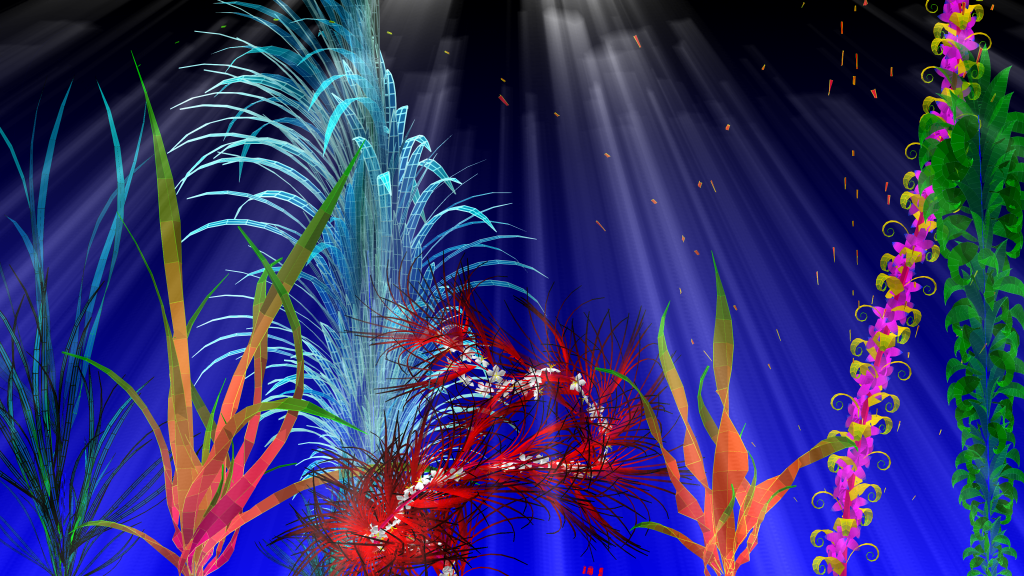
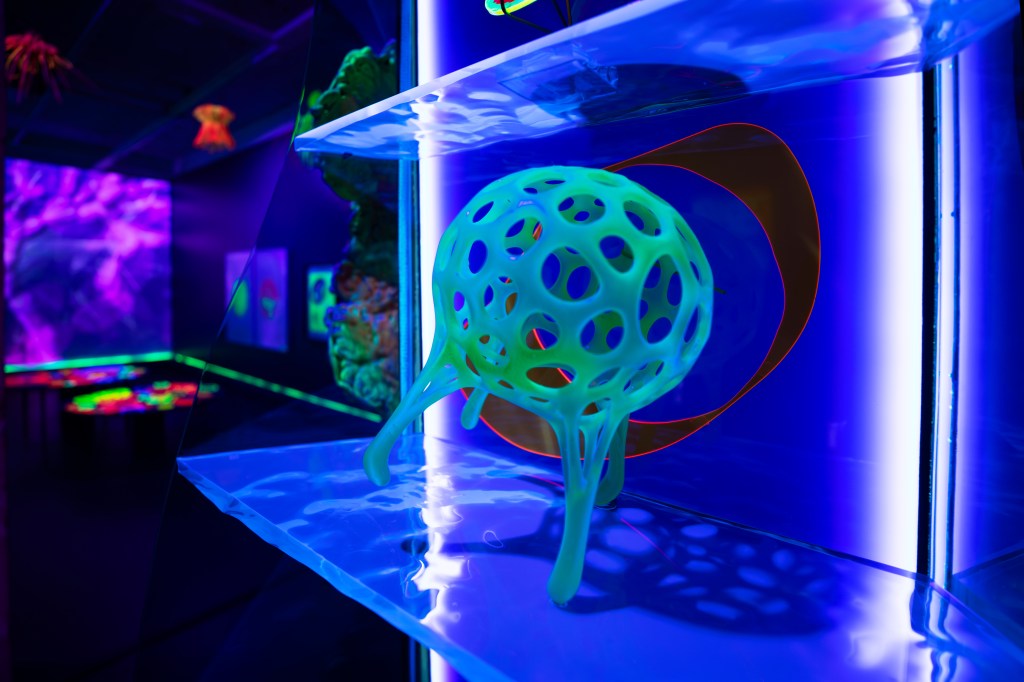
Digital Abyss, an exhibition presented at ILA (Immersive Light and Art), is an immersive dive into a universe inspired by the ocean depths. The exhibition includes various digital installations composed of planktonic forms and algorithmically generated creatures, robotic drawings that react to ultraviolet light, and 3D-printed sculptures depicting an imaginary bestiary of microscopic organisms. These forms evolve continuously within a vast digital environment, accompanied by a spatialized sound composition by Jacopo Baboni Schilingi.
The work invites the visitor to explore a world that is at once scientific, poetic, and mysterious, revealing the beauty of a universe usually invisible to the human eye.
The Origin of the World, projected onto the iconic Government House, explores an imagined vision of the origins of life. The installation presents a virtual organism composed of evolving cells, subject to dynamics of division, proliferation, and mutation. These cells evolve in a universe made of pixels, as if biological language were meeting digital language. I like this idea that the pixel, the elementary unit of the digital image, can echo the cell, the fundamental unit of life.
The unique aspect of this installation lies in its specific adaptation to the façade of Government House. The projection completely transforms the perception of this classically architectural building. The flow of colored cells metamorphoses the structure into a kind of baroque palace of light in perpetual evolution.
Subscribe for updates
Finally, Pixel Waves, presented as part of City Lights at Bonython Hall, transforms the space into a moving carpet of light. Composed of multiple colorful graphic tableaux inspired by pixels and digital language, this interactive work reacts to the movements of passersby, who endlessly distort and recompose the patterns. It echoes the research of kinetic art and Op Art while offering a playful and participatory experience.
Although the three installations are visually distinct, they share a common exploration of the dynamics of life, flows, transformations, and the relationship between nature and artificiality. These creations required several years of development and are the result of collaborative work with my team. I enjoy creating living works that are constantly evolving and invite the public to take a fresh look at our world.
How important is the sound component of the work – created by composer Jacopo Baboni Schilingi?
The sonic dimension is essential in my immersive works. I have collaborated with Jacopo Baboni Schilingi for over 26 years, and we share a common interest in generative processes and the interactions between image and music.
His music is not simply an accompaniment added to the images; it is conceived according to the same principles of transformation and evolution as the visual worlds. Over the years, we have developed a true artistic dialogue where sound and image constantly respond to each other, creating an organic coherence between the visible and the audible.
For Digital Abyss, Jacopo imagined original soundscapes evoking imaginary underwater worlds and the ocean depths. The music fully participates in the immersive and poetic experience. Together, we seek to create a total work of art where image, sound, space, and time merge into a single sensory experience.
Why do cities need festivals like Illuminate Adelaide and what did it mean to you to be this year’s Artist in Residence?
I believe that festivals like Illuminate Adelaide are essential because they allow art to engage with architecture and the general public. They transform the city into a space for discovery, sharing, and wonder, while making contemporary art accessible to diverse audiences of all ages.
Being the artist-in-residence this year is a great honour for me. It allows me to present several facets of my work and develop a genuine dialogue with the city and its inhabitants. I particularly appreciate the ambition and openness of this festival, which has become one of the major events dedicated to immersive arts and light.
What do you love about what you do ?
What I love most is exploring the unknown and giving birth to worlds that didn’t exist before. Each project is an adventure that allows me to combine imagination, research, and technology to create new experiences. I also love seeing the public’s reactions. When visitors experience joy, wonder, or emotion in response to a work of art, I consider it to have achieved its purpose. For me, art is a way to share sensations, to spark questions, and to open up new perceptions of the world.
Why do we all love the light ?
Light is the origin of all visual perception and has always been a universal symbol of life, energy, and knowledge. It lies at the heart of art history, from the stained-glass windows of cathedrals to the Impressionists and contemporary artists like Stan Ostoja-Kotkowski or Dan Flavin and James Turrell, who are pioneers in this field.
What is fascinating about light is its immaterial nature and its ability to transform our perception of space. It creates emotions, reveals shapes, colours, and movements, and possesses an almost magical dimension. Thanks to digital technologies, light is now becoming an artistic material in its own right, capable of creating poetic universes that speak directly to our senses.
What do you hope people feel when they experience one of your works at this year’s Illuminate?
Above all, I hope that visitors will experience pleasure and emotion. My works are designed as experiences that invite slowing down, contemplation, and allowing oneself to be carried away by ever-changing worlds.
I would like everyone to rediscover a sense of curiosity and feel a sensitive connection with the living world. My creations do not seek to impose a single message; they are open and allow each person the freedom to have their own experience.
If, upon leaving, visitors have a slightly different perspective on nature, on our changing world, and on the links between humanity, science, and technology, then I consider the work to have achieved its goal. Ultimately, I try to create moments of poetry and sharing that inspire both reflection and wonder.
Illuminate Adelaide runs from July 1-19
Want to see more stories from InDaily SA in your Google search results?
- Click here to set InDaily SA as a preferred source.
- Tick the box next to "InDaily SA". That's it.
Free to share
This article may be shared online or in print under a Creative Commons licence