Ceramics shaped by hand, history, and a hope for ‘Convivencia’
At JamFactory, ceramicist Avital Sheffer shares a body of work inspired by archaeological records and the entwined cultural histories of the Levant.
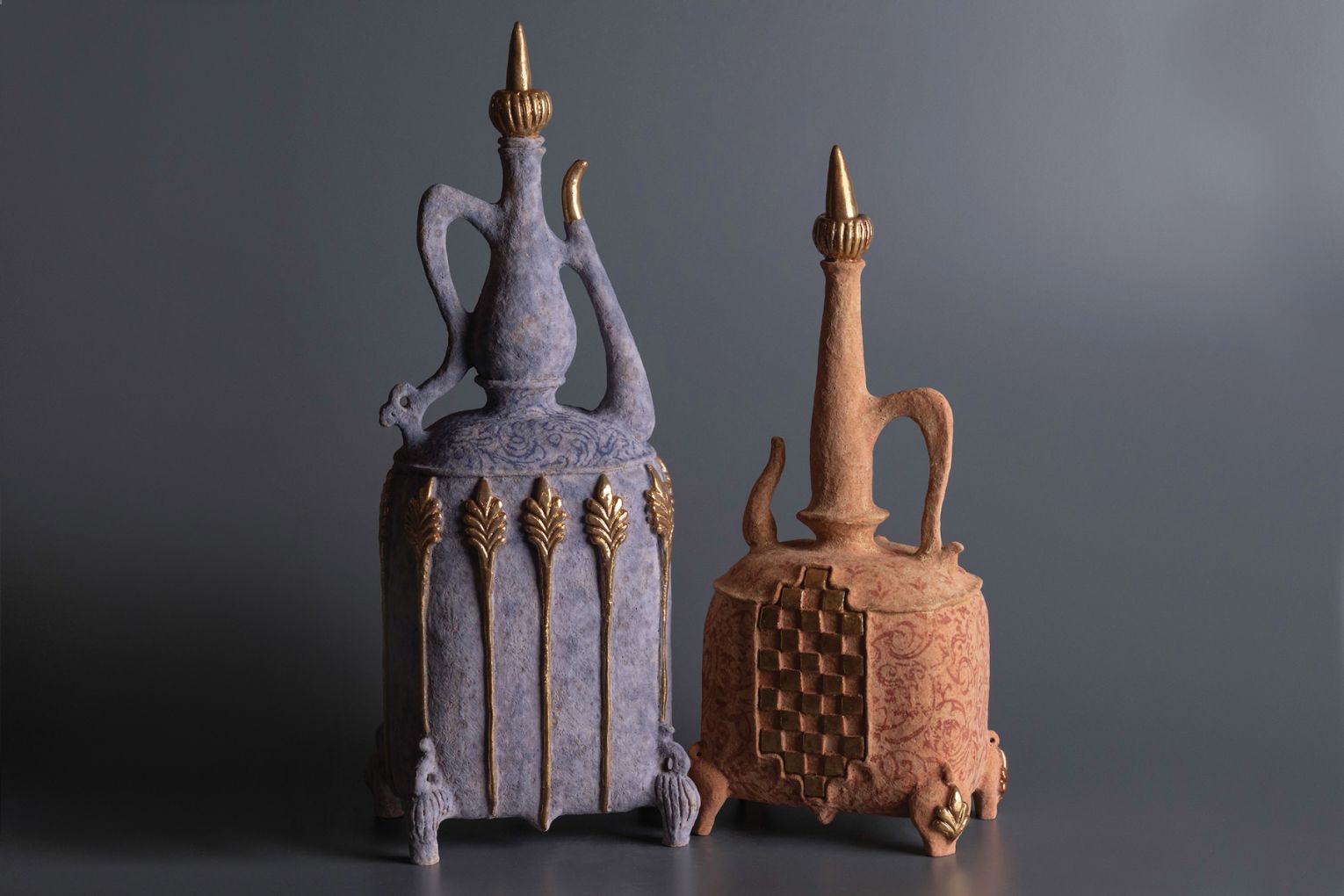
Across more than two decades Israeli-born ceramicist Avital Sheffer has created a significant body of ceramics inspired by her fascination with the entwined cultural histories of Judaism, Islam and Christianity in the Middle East. From her home in the northern rivers region of New South Wales, she has pursued her quest to embody in her hand-formed clay vessels aspects of her own Hebrew ancestry, while also drawing on the Middle East’s rich archaeological archive of material culture across sacred texts, ceramics, textiles and architecture.
Sheffer has held over 30 exhibitions in Australia, USA and UK and received numerous honours and awards, including a curatorial survey of her recent work at Grafton Regional Gallery earlier this year. The most unexpected international recognition of her achievements was a prestigious commission from the Prince of Abu Dabi for her to create 14 large vessels containing Hebrew, Arabic and Judeo-Arabic texts and designs for his family palace in Dubai. Then came the invitation from the Saudi Arabia Ministry of Culture to exhibit in the Saudi International Handicraft Week, including her hosted visit to Riyad in Saudi Arabia – a country where Israelis are not normally permitted entry.
Avital Sheffer’s latest exhibition Convivencia: The Archaeology of Identity, in Gallery 2 at JamFactory until July 5, is the latest iteration of her sustained research into the archaeological archive, and her deep engagement with the complex cultural resonance of this rich trove of creative source material. At this dangerous moment of conflict in the Middle East, inevitably Sheffer’s exhibition is imbued with increased poignancy and relevance as a timely reminder of the possibility, however remote, of cross-cultural understanding and shared aesthetic appreciation.
Sheffer found her distinctive ceramic language early in her career, with her initial inspiration being the miraculous survival of the ancient clay cylinders housing the Dead Sea Scrolls. In her hand-built earthenware vessels she has transmuted this seed idea of the resilient clay vessel as a container of archival knowledge into vessels in which the clay is embedded with traces of the calligraphic texts and iconography of past and present-day civilisations.
Across the gradual evolution of her practice, Sheffer’s fecund fig-shaped forms have often referenced the female body, although in Convivencia she has adopted more globular or almond-shaped vessel bodies and adorned several with elongated handles, spouts and fanciful stoppers. These imposing forms draw the gaze upwards – from the split in the base that ‘floats’ the vessel, through the upward curvilinear trajectory of the silhouette and applied ornamentation. The pale ochre surfaces have an unusual dry-glazed patina that reveals the organic textures of the making process. Each vessel is decorated with exquisite calligraphic and curvilinear patterns, mainly in blue or red, with occasional gold lustre highlights.
You might like

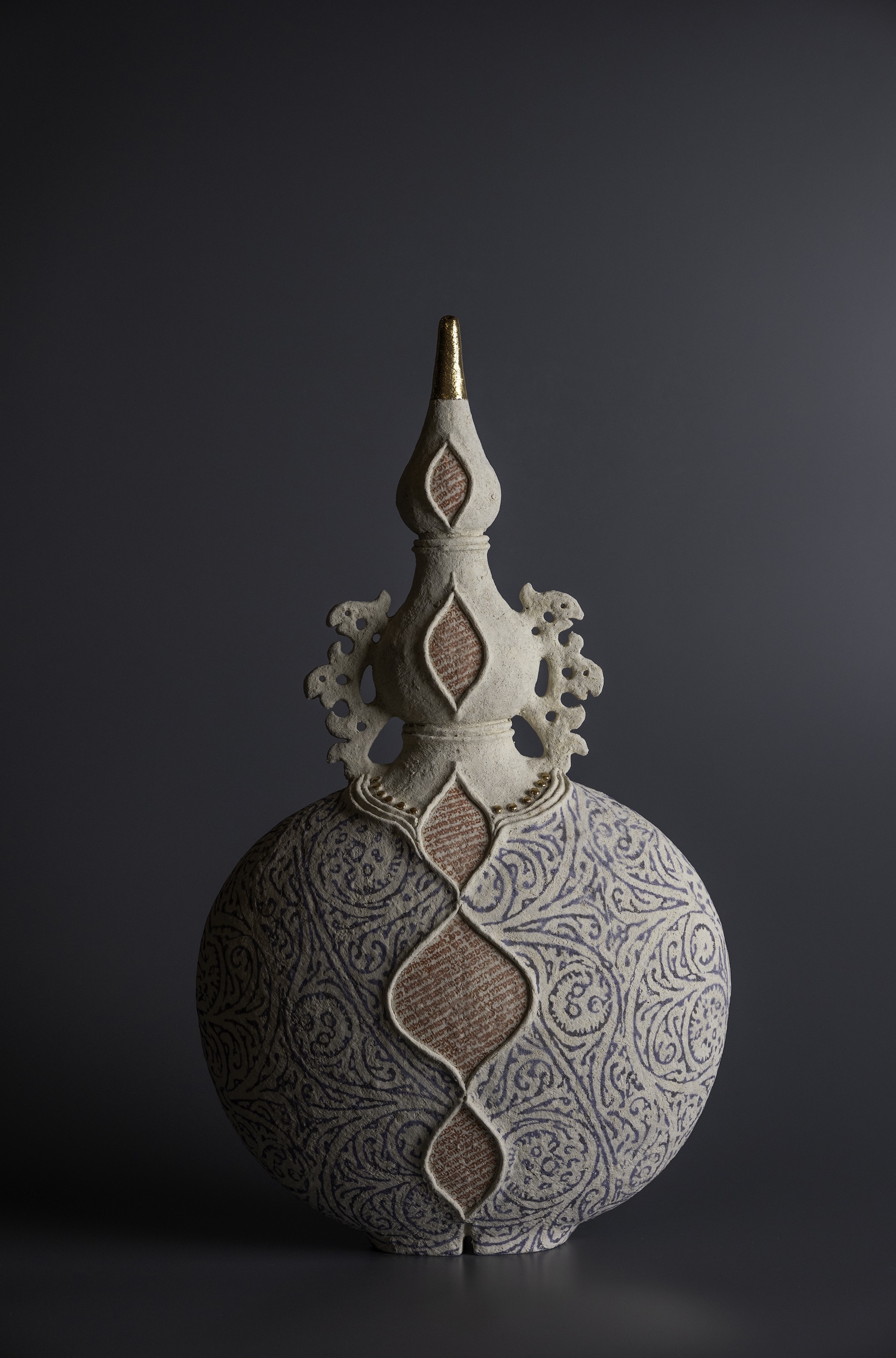
These patterns draw on Sheffer’s extensive research into ancient Hebrew texts, Arabic textiles, architecture and other sources of ancient graphic design in the material cultures of the Middle East. She has created her own interpretations of the original sources, gradually building a ‘library’ of designs, and has evolved a technique of applying combinations of these patterns to the vessel surface by means of a screen-printing process. This is a highly skilled, laborious process, although not nearly as laborious as hand-painting these patterns in all their intricate, repetitious detail.
A pivotal moment influencing the recent body of Sheffer’s ceramics in Convivencia was her Australia Council residency in Barcelona in 2016. During this residency she researched the Jewish legacy in the Spanish regions of Toledo and Al Anduluz, in the period known as Convivencia, meaning co-existence, when Muslims, Christians and Jews lived together under Islamic rule. This fertile period of intercultural exchange lasted for several hundred years from the 700s to the expulsion of the Jews under Roman Catholic rule in 1492. It is the underlying metaphor for the confluence of design influences in Sheffer’s JamFactory exhibition. In the catalogue she states:
Settlement and exile, conflict and conquest, contested lands and religious wars between diverse cultures have shaped the history of the Middle East and the Mediterranean Basin for millennia. Yet material objects and written records also speak of Convivencia – the ability to co-exist and evolve in this fertile cultural crossroads where ideas, languages and traditions converse.
Subscribe for updates
Across the ‘family’ of densely patterned and embellished ceramic forms in Convivencia there are numerous variations in Sheffer’s repertoire of design features, with differing treatments in application of patterns and embellishments to the vessel body, neck, spouts and stoppers across a group of forms. In some cases, every surface is densely patterned, while in others, areas of unadorned clay create a breathing space from what some may find to be the risk of decorative excess. Vessel bodies are segmented into blue or red patterned fields by applied gold lustre decoration. Bands of Hebrew calligraphy are juxtaposed with curvilinear Islamic motifs. There is a group of spouted vessels with elaborate upper body variations and an ‘offspring’ grouping of smaller forms with straight-sided bodies where Sheffer chooses stronger shades and more gold lustre. The surface decoration of these smaller forms is arguably too fussy and their proportions less pleasing, lacking the graceful gravitas of the strongest pieces in the exhibition.
Perhaps the most distinctive decorative features in Convivencia are Sheffer’s miniature fantastical creatures. In a lunchtime talk at JamFactory in May, the artist explained that the prohibition by both Judaism and Islam on depicting the human figure gave rise in illuminated texts to playful and grotesque hybrid creatures blending biblical narrative and folklore. She has sculpted her interpretation of these figures as delicate ornamentation around the elongated vessel necks. This is a feature of seven works including the small form (#11) Bucaro 1 and (#7) Albarrada III. The latter is a beautifully resolved vessel displaying formal balance and poise, with interplay between the unadorned areas and restrained decorative elements. The other two vessels in this series, namely Albarrada I (#4) and Albarrada II (#15), each employ finely judged variations in form and pattern, with the trio being possibly the aesthetic highpoint of the exhibition.
While the vitrine-lined, walk-in space of JamFactory’s Gallery 2 has its own magic, Sheffer’s imposing vessel forms would benefit from more breathing room, and the possibility of being viewed in the round. It would be a shame if this beautiful exhibition is overlooked due to its low visibility.
Convivencia: The Archaeology of Identity continues at JamFactory until July 5
Want to see more stories from InDaily SA in your Google search results?
- Click here to set InDaily SA as a preferred source.
- Tick the box next to "InDaily SA". That's it.
Free to share
This article may be shared online or in print under a Creative Commons licence