Jasmine Crisp paints with restless energy and empathetic spirit
Jasmine Crisp’s murals have taken the Adelaide artist all around the world, but a new body of work swaps walls for canvas to capture friends and fellow travellers in moments of makeshift domesticity.
Towards the end of 2024, artist Jasmine Crisp returned to Adelaide after several itinerant months in America, Mexico and Europe, working on mural projects, making connections with the global network of muralists and generally living on the edge – while looking at art everywhere she went. In Mexico she undertook a residency at Arquetopia, Puebla, and it was here that she developed the concept for the 8 x 10 metre mural, She brought them with her, 2024, which she subsequently painted in the town of Mantua, Italy, on side of a block of apartments.
Crisp often accompanies her murals and paintings with texts and for this mural she wrote, “She didn’t have a home waiting for her this time, but it was an illusion from the start … There was however, a world contained within her, an existence of collected spaces, that for everyone else, would differ.”
The mural is a larger-than-life self-portrait of Crisp clutching portable possessions dear to her. She has stated that: “It’s my goal with murals to convey highly personal, private and intimate narratives as large, very public totems, making public topics that are not usually shared with strangers on the street.”
These preoccupations with transgressing the separation between the private/intimate and the public/impersonal, with the impermanence of ‘home’, and especially with moveable possessions as embodiments of memory, are at the heart of the body of paintings she made for her first exhibition in Adelaide since her return. Not Without Each Other, is the outcome of her studio residency at Adelaide Central School of Art in Glenside, and is on view at the school’s gallery until March 20.
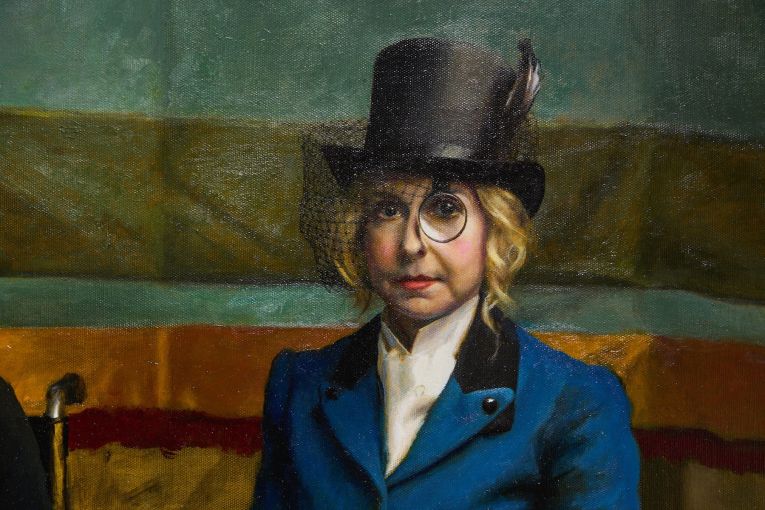
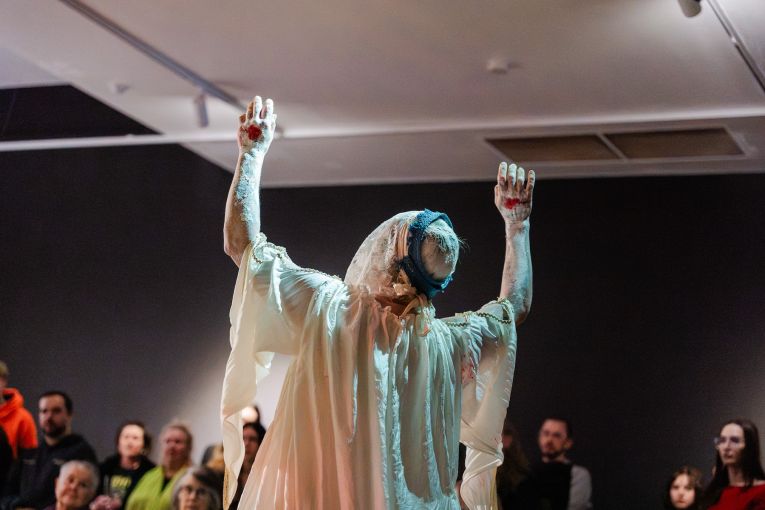
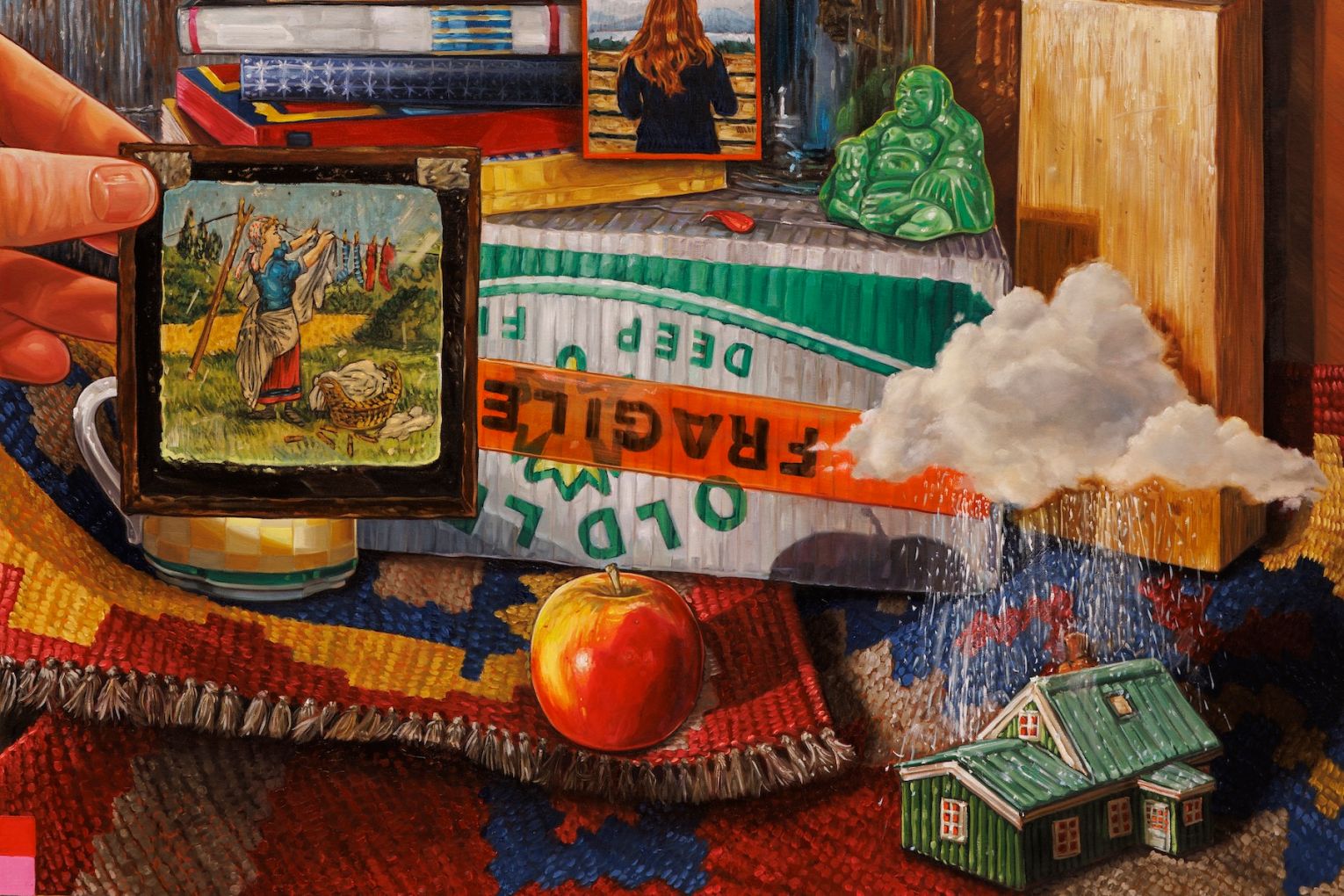
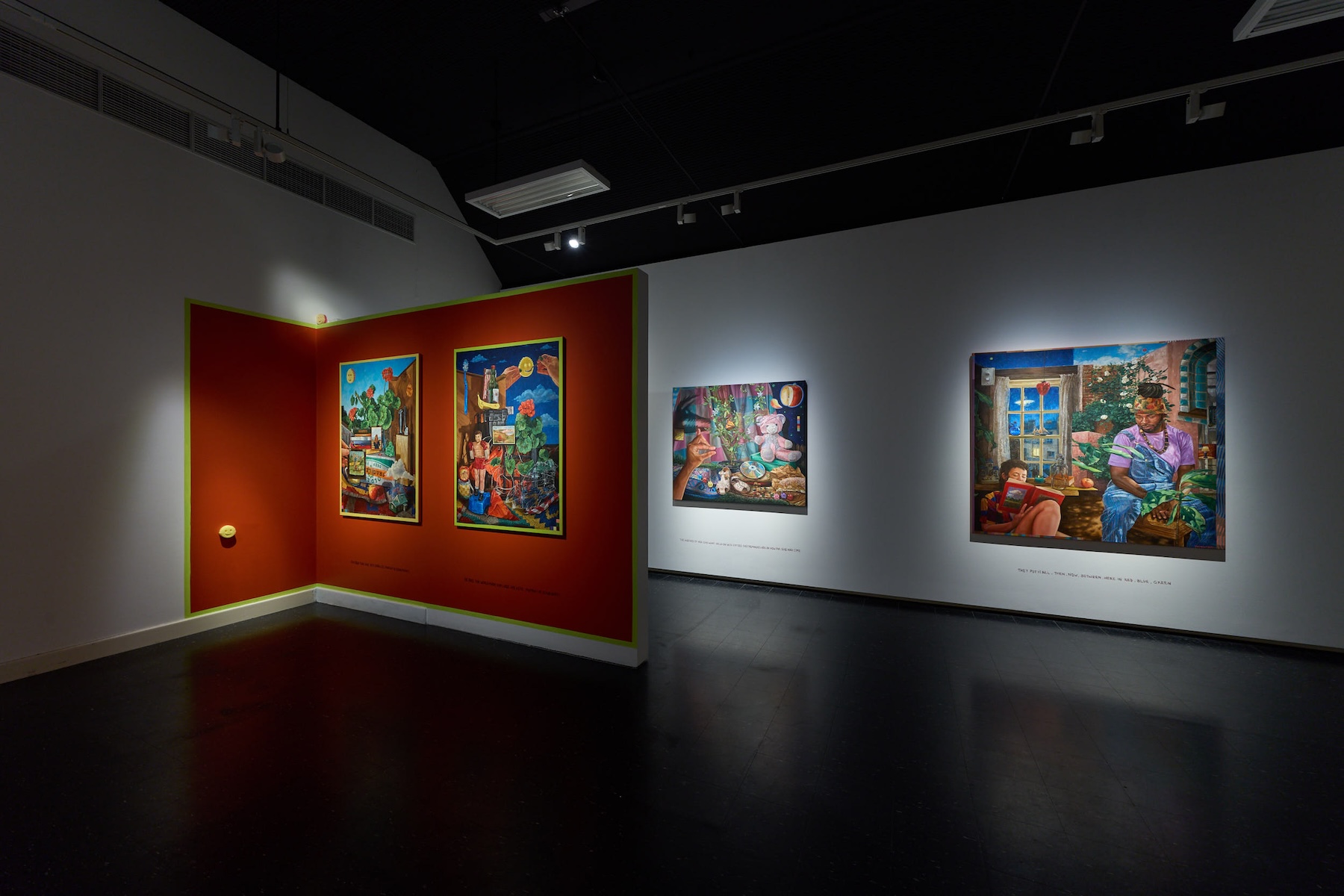
The modest scale of the exhibition space serves to enhance the intensity of Crisp’s crowded canvases. At the simplest level these bear witness to the experiences of the artist and her friends, portraying a restless, unstable way of life, transitory living arrangements, eviction, and love in improvised domestic spaces. They are painted with confident, almost casual brush strokes, and convey both a restless energy and an empathetic vision. This is important; it is apparent that the artist is a fellow traveller in the scenarios she portrays, rather than a detached observer.
This said, there are differing technical demands in applying house paint to an exterior wall to create a mural composition which will usually be viewed from a distance, in contrast to applying oil paint to a canvas that will be viewed at close quarters – in terms of her palette and brushwork, Crisp has yet to fully master working with this more intimate medium.
Although she belongs firmly to a figurative tradition, and acknowledges noted Adelaide artist Anna Platten as a mentor, it would be a mistake to conflate ‘figurative’ and ‘realist’. Crisp’s narrative paintings literally overflow with realistically depicted people and objects that invite the viewer’s gaze only to disrupt an easy connection with everyday reality. In place of the classical illusionism of three-dimensional perspective and of a world contained within the picture’s frame, her paintings may be read as layered montages. Spaces and objects are superimposed, there are shifts in scale, frames within frames, disembodied hands, partial views of limbs with the rest of the person outside the frame, and all manner of domestic paraphernalia arranged in vignettes that seem to be visual embodiments of Crisp’s mind as a cluttered attic, filled with objects redolent with past associations.
Subscribe for updates
The exhibition centrepiece is an almost three-metre-long panoramic canvas Decathexis (birds of wisdom). A word new to my vocabulary, according to Google ‘decathexis’ refers to a psychological process of withdrawing emotional energy from a person, object, idea or memory. Across the surface of this painting flit three China ‘bluebirds of happiness’ winging their way towards an open window. They are superimposed over a votive altarpiece, with an array of small, framed paintings and images. The two most recognisable, and a clue to this cryptic crossword of iconography, are Crisp’s versions of two early career Lucian Freud paintings, Boy with white scarf 1949, and Girl with a Kitten, 1947. While most of the other objects in this painting hold more obscure personal associations for the artist, these two paintings, in conjunction with the painting’s title point towards a theme of creative tension between the pull of past associations, and the urge to move forward.
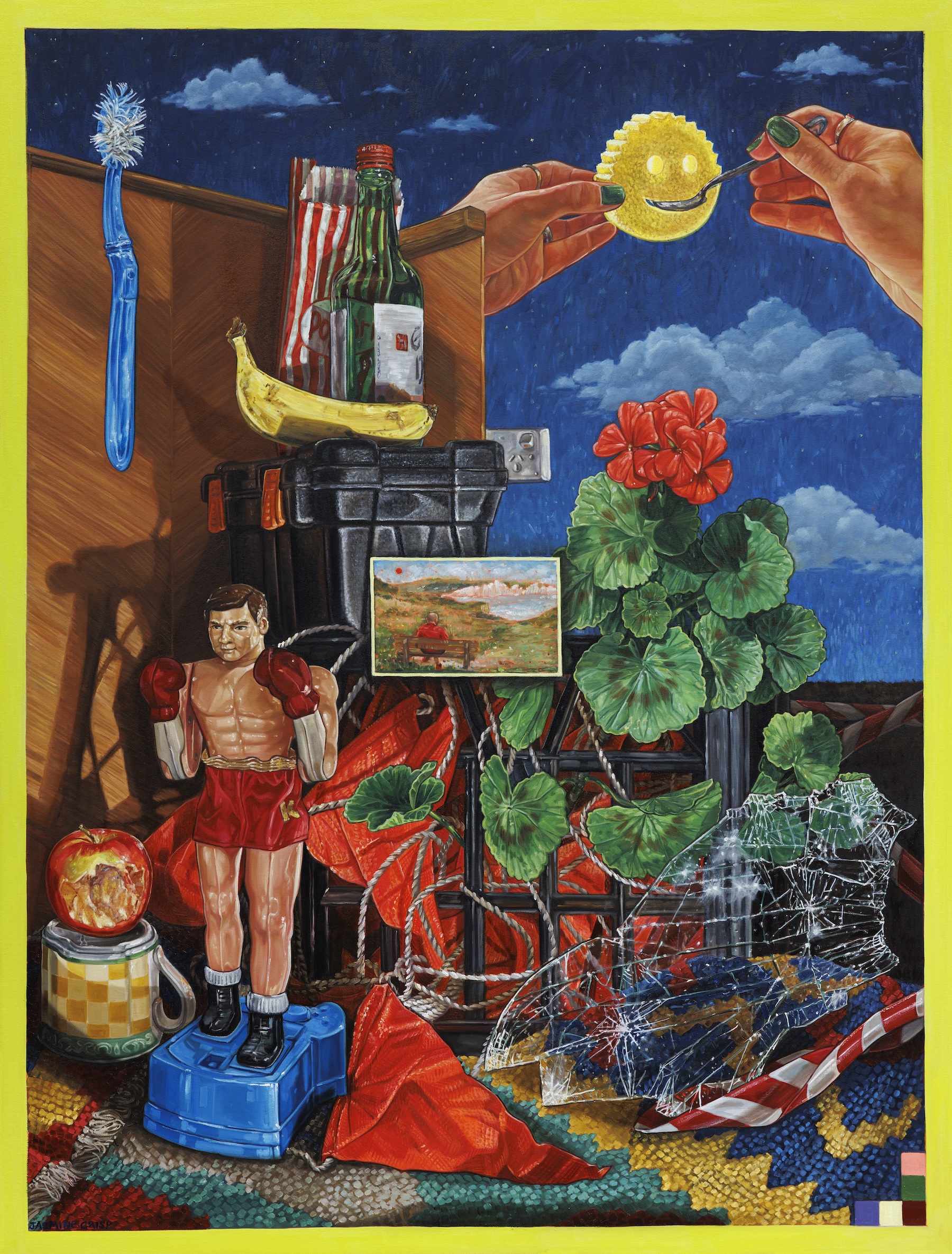
Throughout the exhibition there is a sense of Crisp testing her technical prowess by depicting all manner of contrasting textures and challenging visual effects, often creating a slightly surreal result through incongruous juxtaposition. In one painting, titled The hub caps of her car were held on with zip ties, they reminded her of how far she had come (self portrait on childhood) the composition includes folded fabrics, shadows, a reflective CD, a pair of dirty white child’s sandals, a hand with fingers shaped to cast the shadow of a monster, a threadbare teddy and an apple with a wedge cut from it floating nearby. Similarly, in her Portrait of scrub daddy the composition features an array of textures including broken glass, a crumpled paper bag, a worn tooth brush, a bitten apple, shadows, wood grains and a plastic toy, set against a blue sky with fluffy clouds in which there hover a pair of hands spoon-feeding a small circular yellow sponge with a smiley face.
Crisp is an original, inventive and energetic artist speaking to a youthful audience. There is an enticing level of visual appeal and social connection in her paintings that points to a promising future – although this will probably not be in Adelaide.
Jasmine Crisp: Not Without Each Other is on display at Adelaide Central Gallery until March 20

Want to see more stories from InDaily SA in your Google search results?
- Click here to set InDaily SA as a preferred source.
- Tick the box next to "InDaily SA". That's it.
Free to share
This article may be shared online or in print under a Creative Commons licence