Fringe review: The Wild Unfeeling World
A witty and inventive reimagining of Moby Dick set in contemporary London, Casey Jay Andrews’ transforms a crisis in Hounslow, feline vengeance and Melvillean philosophy into an intimate and exhilarating storytelling experience. ★★★★½
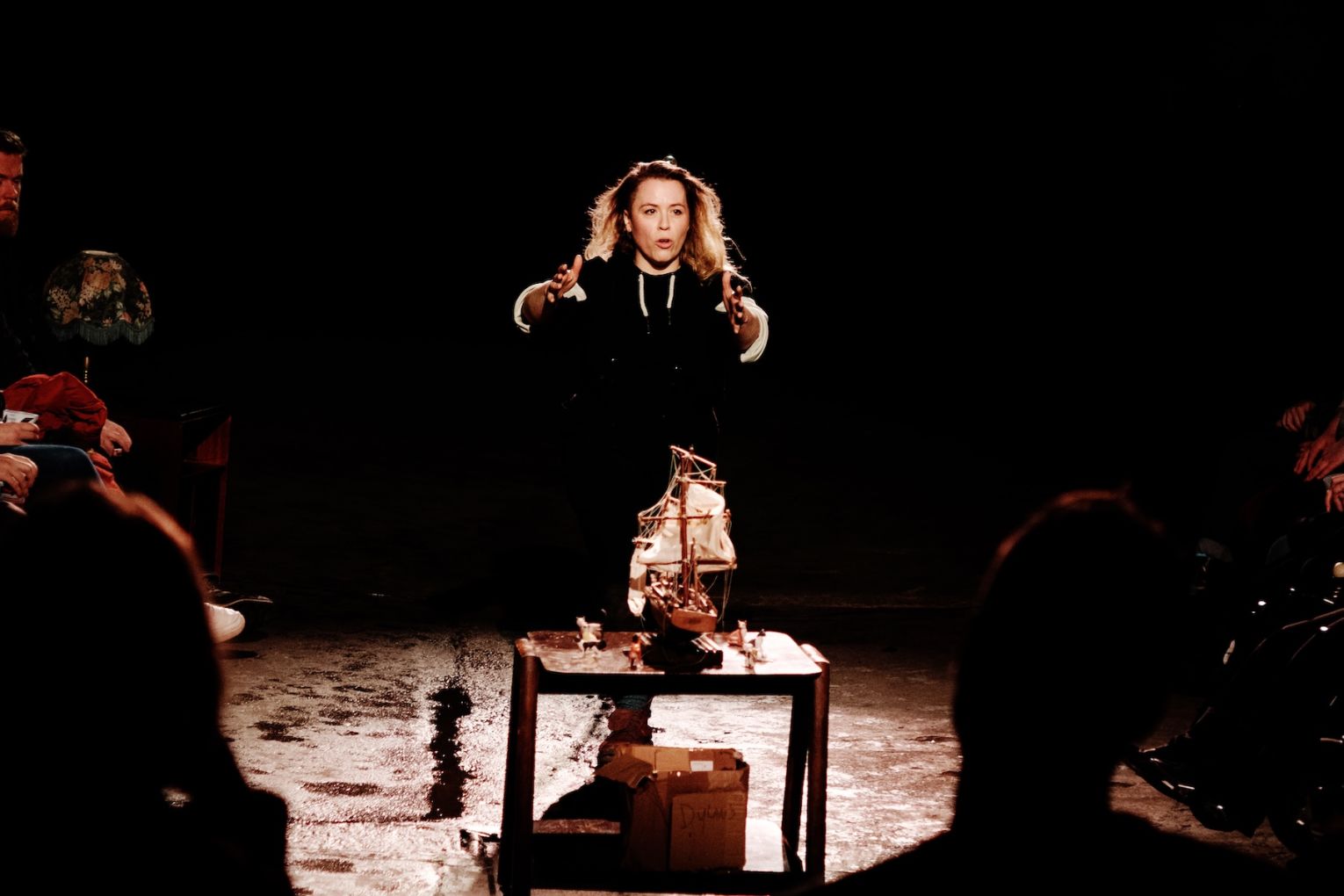
Inside The Yurt, the audience is clustered around a tiny performance space dominated by a blue tarp that spreads across the floor and climbs the rear wall, its folds and crinkles evoking Hokusai’s famous wave. Writer and performer Casey Jay Andrews steps onto the surface of this handmade ocean dressed in black-and-white overalls and holding a small plastic whale.
Andrews quickly establishes the show’s playful intellectual frame. She opens not with Melville, but with an explanation of pareidolia – the human tendency to find meaningful patterns in random shapes: figures in clouds, faces in burnt toast. The impulse, she tells us, is an ancient survival mechanism that keeps our brains scanning for patterns and connections, alert for danger. It is also the key to The Wild Unfeeling World, a contemporary, darkly comic reimagining of Moby Dick in which the monstrous whale becomes something far more ordinary and relatable.
The story centres on Dylan, a young Londoner having the worst day of her life. In the past 24 hours she has lost her job, been evicted from her flat, mugged, and watched her white Renault Clio (number plate M0B1) splutter to a halt. We meet her at 4.30am as she lies on the rooftop of a Hounslow car park, watching planes roar overhead from nearby Heathrow, wondering how her life reached this disastrous low.
Across the city, however, another narrative is unfolding. A three-legged cat named Ahab has sworn vengeance on the human who ran him over. Gathering a small feline crew, he launches a hunt for the leviathan responsible.
What follows is an inventive theatrical collage. The story unfolds in fragments: shifts between Dylan’s perspective and Ahab’s, fascinating snippets of whaling history, sociological reflections on the impact of urban life, and quotations from Melville’s novel projected across the rippled tarp backdrop. This ingenious Melville-like structure is stitched together by Andrews’ compelling storytelling as she guides the audience through Dylan’s pre-dawn odyssey across London.
Remembering the last time she felt genuinely happy – a visit to London’s Sea Life Centre – Dylan resolves to reach it again. On foot. With no phone or map after the mugging, she must navigate instinctively, embarking on a 10.8-mile trek across the sleeping city. Her journey becomes a kind of migration, with London rendered as a vast, unpredictable urban ocean.
Simultaneously, Ahab and his crew pursue their quarry along the Thames, the narrative gaining pace as hunter and hunted draw closer. Andrews builds this suspense with a deft combination of music, voice and physical storytelling, shifting seamlessly between characters and tonal registers.
Despite this playful premise of feline revenge, the show’s emotional centre is grounded in empathy. Dylan is not a monster, but a woman crushed by accumulated misfortune, the psychological demands of urban survival and self-blame. Andrews explores how easily guilt can spiral into self-condemnation, particularly in an unforgiving world primed to translate every misfortune as personal inadequacy.
The result is theatre that feels unmistakably handmade. Andrews herself describes the work that way, and the label fits perfectly – the piece has the intimacy and personality of something deftly handcrafted. While the storytelling occasionally wanders into digressive territory, it is these moments of curiosity – the odd facts, psychological asides and observations about London – that give the performance its great charm and distinctiveness.
Subscribe for updates
Anchoring everything is Andrews’ magnetic stage presence. Alone in the small yurt space for the entire hour, she holds the audience effortlessly, shifting between humour, suspense and tenderness with ease. By the time Dylan’s journey reaches its moving climax, the fragments have come together into something unexpectedly powerful.
Creative and compassionate, this is a clever adaptation that in Andrews’ hands becomes both intellectually playful and emotionally sincere.
The Wild Unfeeling World is playing at The Yurt at The Courtyard of Curiosities at the Migration Museum until March 14

Want to see more stories from InDaily SA in your Google search results?
- Click here to set InDaily SA as a preferred source.
- Tick the box next to "InDaily SA". That's it.
Free to share
This article may be shared online or in print under a Creative Commons licence