Music review: Za Górami
Za Górami are a jazz fusion trio with Polish foundations who create the most fragilely beautiful sounds.
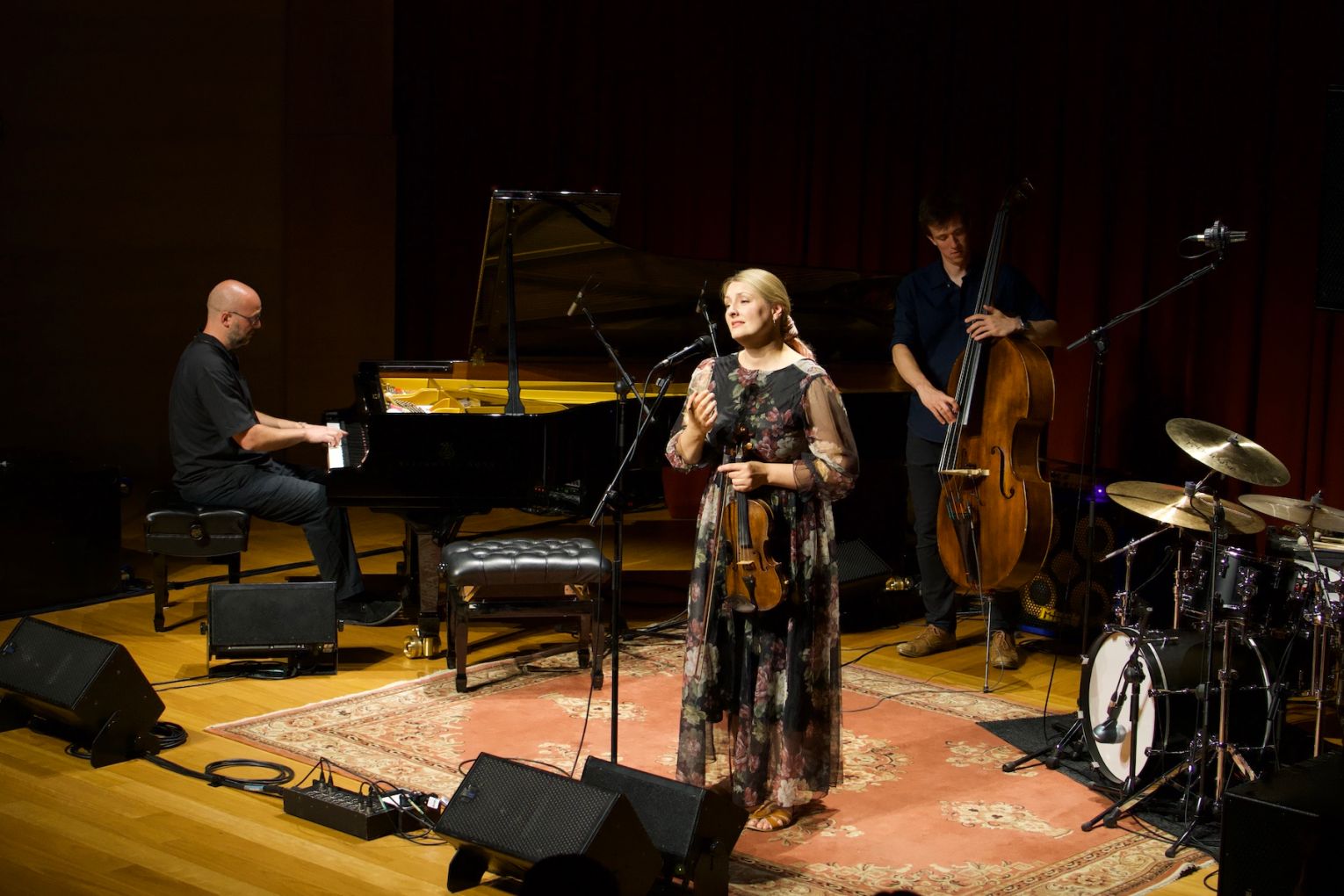
Polish by virtue of its singer’s heritage, Za Górami are a well-credentialled folk and jazz-based trio from London who have recently made it onto that most coveted of independent labels, Manfred Eicher’s ECM (Edition of Contemporary Music). That alone makes them interesting to hear.
To join the company of such established ECM artists as composer Arvo Pärt, jazz pianist Keith Jarrett, saxophonist Jan Garbarek, oud player Anouar Brahem, and the Argentinian bandoneon player Dino Saluzzi, is itself something to raise attention. However, the prospect of hearing what Za Górami are particularly known for, namely their deep explorations into folk traditions of Poland and beyond, was the main appeal about their appearance at UKARIA.
Hearing Za Górami was, shall we say, very much an ‘ECM experience’. They brought along their own sound technician meticulously set up UKARIA’s stage like it was halfway between a live set and a carefully controlled recording session. Neatly arranged around a Persian carpet were all their instruments and gear, and even before they began one could feel their hyper-attention to detail.
Stylistically, ‘eclectic’ might as well be middle name. Za Górami are more allied to jazz and rather less to traditional Polish music than one might have thought. Roving around widely between centuries-old Sephardic Jewish music and Mediterranean folk traditions, they are group on the move. Their name in Polish in fact means ‘beyond the mountains’, embracing exploration in both the story-telling and geographical senses. Medieval ballads and Irish folk music make it onto their playlists.
Initially, this made it genuinely difficult getting a handle on them. However, Za Górami’s exquisite combinations of solo voice, piano, percussion, violin and double bass is immediately attractive, and one can just immerse oneself in the subtle, abstract beauty of their songs about life and love. The other thing that one quickly admires is their versatility: comprising just three members, Za Górami switch across these said instruments in a kind of seamless, mesmeric dream.
You might like


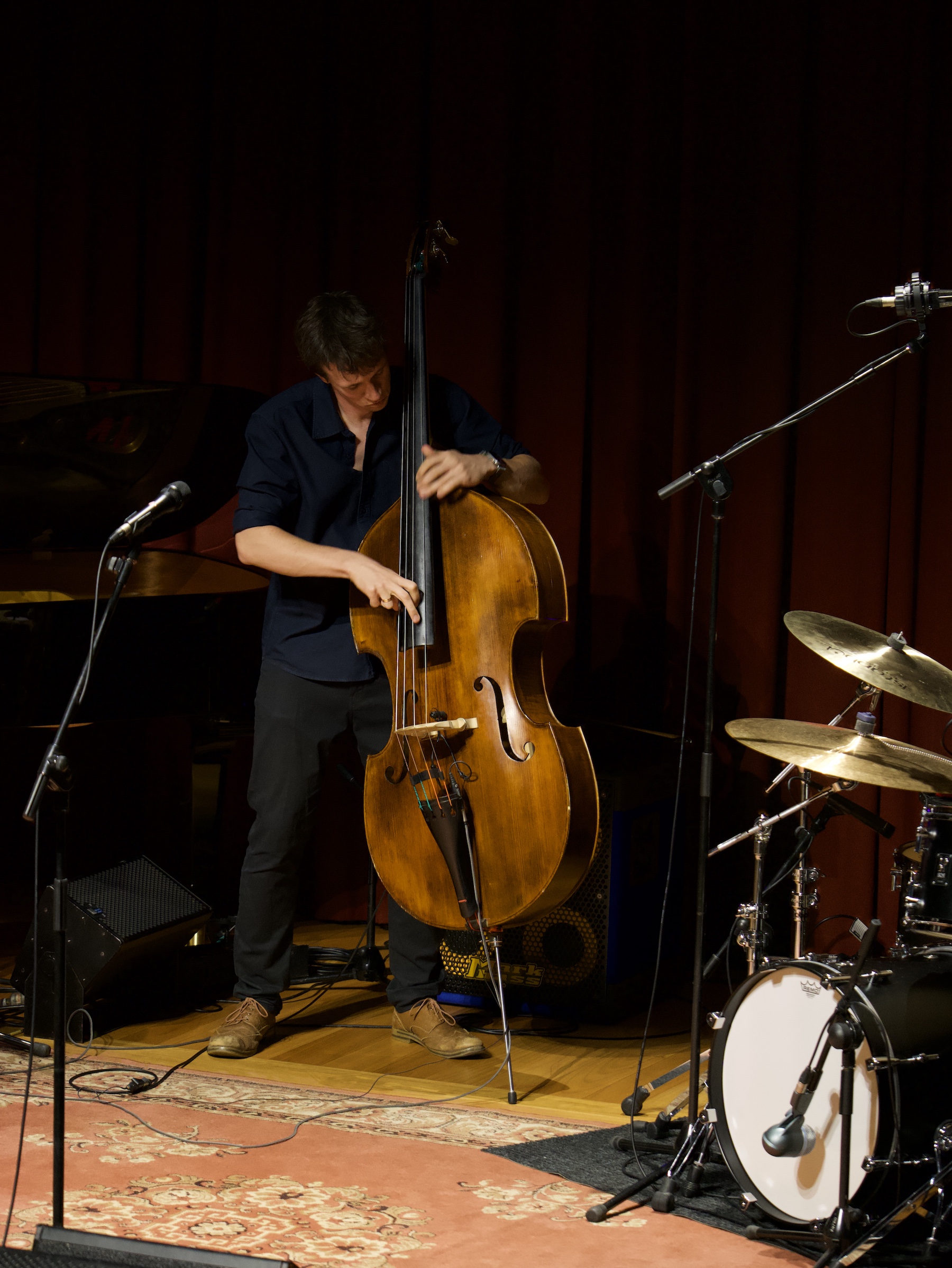
First was an Argentinian song, ‘Suéltate las Cintas’ (Untie Your Ribbons) by Gustavo Santaolalla. With UKARIA’s velvet curtains drawn, the feel slipped straightaway into that of a late-night listening bar. Tidy post-bop style improvisations on piano from Fred Thomas were the perfect backing for soft, mellow vocals from the group’s well-schooled jazz singer, Alice Zawadzki. Behind them on upright bass was Misha Mullov-Abbado – yes that’s right, he’s the son of Italian conductor Claudio Abbado.
They are a well-oiled trio. Each song arrangement is highly crafted, and their timing is impeccable. Eyes focus a lot on Fred Thomas. A musical polymath does extraordinary things on piano and frequently heads across stage to add soft mallet and swishes of wire brush on his drumkit. It all depends on the mood. With an array of career interests and credits on other ECM recordings, this Londoner is obviously one of the group’s main drivers.
The other is Zawadzki. Using her voice flexibly and unobtrusively like an instrument, her tone is creamily smooth and her range extends low. Her diction is chiselled and authentic-sounding no matter what the language happens to be. Many song texts in this concert were in Ladino, this being the language of Jewish peoples who were forced into Poland, the Balkans and other regions of Europe as far back as the 15th century.
Subscribe for updates
Sometimes, Zawadzki reaches for her violin for added expressive colour – not as frequently as one hoped, but sufficiently to show her fine chops as a jazz fiddler. In the haunting Spanish Ladino song ‘Los Bilbilikos’, about failed romance and separation from one’s homeland, she even plays while she sings.
Zawadzki has a very attractive voice with the gentlest vibrato. She showed this especially in the poignant lullaby ‘Nani Nani’ about marital infidelity. By contrast in ‘Za Górami’, a traditional Polish folk song that serves as title track of the trio’s 2024 ECM album, she blazes forth passionately like a trumpet.
A sideways shift into 16th-century France by way of Nicolas Gombert’s chanson ‘Je Suis Trop Jeunette’ was curious but rewarding. In this they employed the same tasteful fusion of soft jazz but without much historical reference. It didn’t matter unless the original was already lodged in your mind. Another memorable song was ‘The Leaving of Limerick’, a traditional Irish folk song which they arranged with similarly attractive understatement.
Za Górami answer to the dictum that less is more, and one came to savour above all their acoustic subtlety. Reaching over the keyboard, Fred Thomas at times extracted beautifully feathery, gong-like sounds from the piano using cloths and assorted objects laid over the strings. He’s a master at this sort of thing, where Cageian aesthetics meet jazz.
Meanwhile, Mullov-Abbado is impressive too in his solos on double bass. His big moment came in ‘Pizzica di San Vito’, a wild tarantella song from southern Italy that depicts the frenzied dance of a person bitten by a spider. Energetic finger-work and bowed tremolos showed him to be a muso of high accomplishment.
There were moments when the levels coming over the speakers seemed to worry the musicians, but other than that this was a well-honed show. It did leave one wondering, however, why this Polish-named group was not more anchored to Polish music. But in truth, Za Górami are international in their outlook and appeal. With fragilely beautiful and distilled sounds, they are a lovely reward for the ear.
Za Górami performed at UKARIA on 10 October
Want to see more stories from InDaily SA in your Google search results?
- Click here to set InDaily SA as a preferred source.
- Tick the box next to "InDaily SA". That's it.
Free to share
This article may be shared online or in print under a Creative Commons licence