French pianist who seeks to be different
Cédric Tiberghien has a gift for coming up with novel programming. But this French pianist is most special for his interpretative insight.
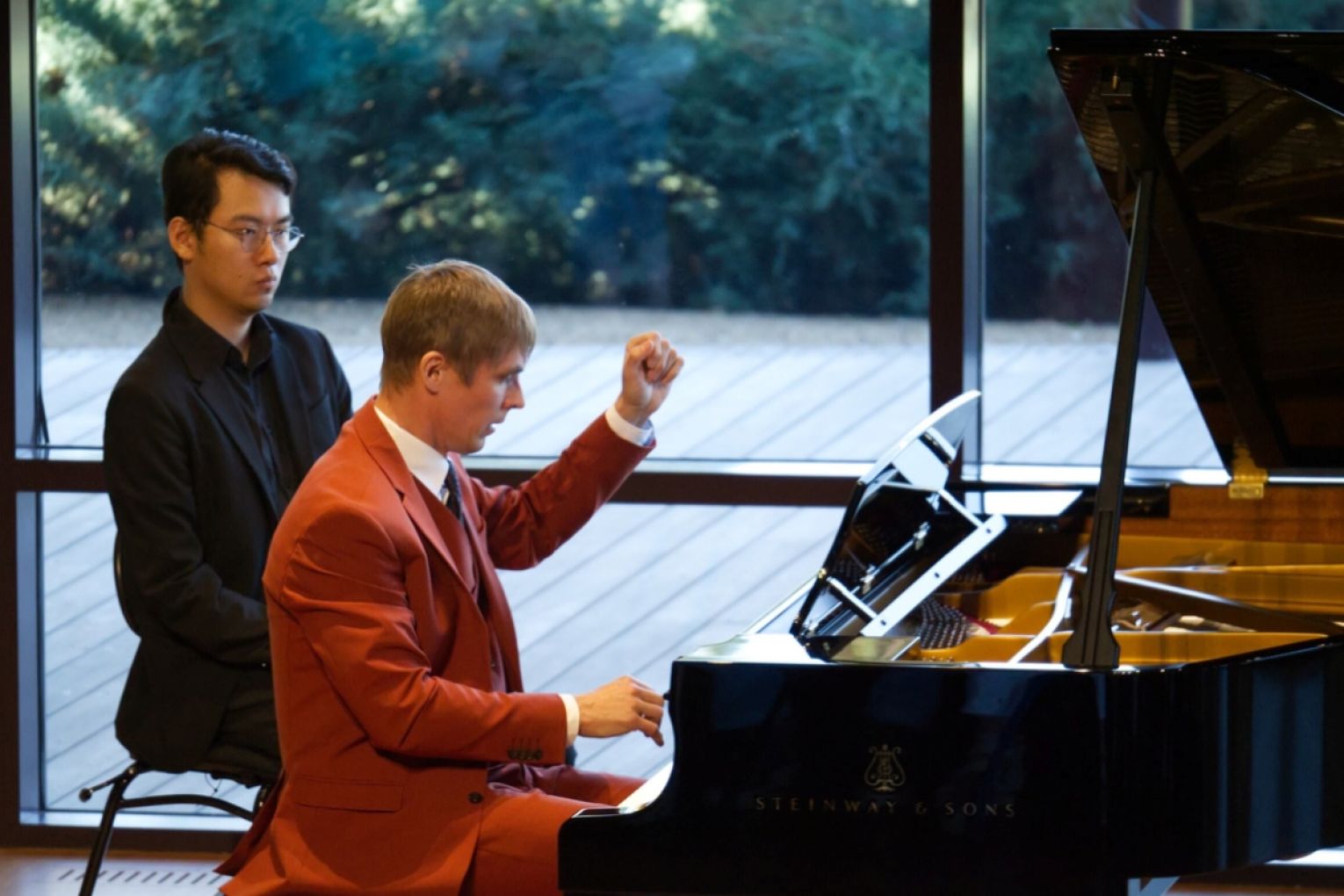
A recitalist who seeks to be different, Cédric Tiberghien always pricks up attention with his interestingly off-beat programs. One instance was his ‘Cage Project’ at the 2023 Adelaide Festival: in that he played Cage’s Sonatas and Interludes with a massive sound sculpture by Matthias Schack-Arnott hovering over the piano.
This French pianist must like it here in Australia, as this was his second return visit, and again he chose to present uniquely different kind of recital.
Having no special title, it all depended on his explanation at the start, which was clear enough. It was to be all about how Ravel and Debussy expressed a “French flair” and “French soul” in their music, against a prevailing Germanness at that time represented by Wagner.
The way he illustrated this was interesting. In between the five movements of Ravel’s Le Tombeau de Couperin, which structurally resembles a Baroque suite, he interleaved movements from a harpsichord suite by that composer of the French Baroque, namely his Pièces de clavecin, Book 4, No. 20.
It seemed a clever idea, not least because Ravel based part of Tombeau (literally ‘tomb’) on the ‘Forlane’ movement from Couperin’s suite.
Generally, Tombeau de Couperin is seen as having more to do with his interest in Baroque forms and less to do specifically with Couperin. But this concert’s interest was to hear their music side by side.
The first observation was that Tiberghien’s Ravel is very distinctive, but the second observation was that his insights seemed to come from Couperin.
You might like

Tombeau’s opening Prélude was beautifully finger-light and crystalline flat in dynamics. He used virtually no sustaining pedal, and overall his sound was astringent.
One might as well have been hearing a harpsichord. Touché.
It started to add up with first piece of Couperin, La Reine des Cœurs (Queen of Hearts). Tiberghien’s feather-light touch highlighted its pithy elegance, not harnessing any of the piano’s muscular resonance but extracting all its delicacy.
Moving between Ravel and Couperin in alternation, one began to admire Tiberghien’s thinking and the contained refinement of his playing. His timing and gesture gave it an unmistakeable French accent. Expansions and contractions of length within a phrase was how he achieved this – rubato, in a word – but intelligently applied to sound flowing and natural.
Indeed, he was using the piano noticeably differently to how it is usually played in a concert situation. In particular, it agreed with Ravel’s ‘cool aesthetic’ and his stated preference avoidance of excessive emotion.
Clarity was everything, giving life and studied precision to Tombeau’s second movement (the Fugue, which coincidentally uses a harpsichord-like range of just four octaves), and its magnificent Toccata at the end.
A trap can be to treat Debussy and Ravel the same way as ‘Impressionist’ composers, when this label is actually problematic for both. In many ways they are dissimilar and seek different sound world.
One admired how Tiberghien acknowledged this in his Debussy in the second half.
Subscribe for updates
In Images Book 1, L’isle Joyeuse and other pieces, his playing was untethered and dreamily sensual, surrendering to feeling and moving in longer spans of time.
The three individual pieces in Images were glorious. Tiberghien’s playing was smooth and effortless playing in ‘Reflets dans l’eau’, nostalgically melodic in ‘Hommage à Rameau’, and gorgeously delicate in the concluding ‘Mouvement’.
He accomplished what one supposed is a secret in Debussy, to make time dissolve and sensuality take over.
One thing Debussy and Ravel did share in common, however, was their interest in the musical past. This concert’s other keen insight was to pair Debussy up with Rameau, being that other master of the French Baroque to whom Debussy pays tribute in that second movement of Images.
Rameau’s L’Entretien des Muses (Conversation of the Muses), from Book 2 of Pièces de Clavecin, is an exquisite little dialogue between multiple voices with melody at its heart. Tiberghien played it in a pliant, less structured way, and it felt right.
Just as it was with Debussy, the lingering over phrases seemed to align with the passage of thought itself.
It was wonderful to reach across the centuries like this.
A moment of pure whimsy came up later with a contemporary piece by the British composer Julian Anderson. Called ‘Misreading Rameau’, it incorporates deliberate mistakes – intentionally ‘wrong notes’ – as though the pianist is groping their way through his music for the first time. Adding a human touch, this was delightful too.
Lasting all of 20 seconds, Rameau’s cheeky minuet ‘Le Lardon’ (Bacon) served as a fun encore. Luckily after that came a divine performance of Debussy’s La cathédrale engloutie (The Sunken Cathedral). With magnified dynamics, it seemed to sweep everything away.
Tiberghien is a thinking musician whose artistry emanates, as it were, from his mind, not his fingers. There are hosts of exceptional recital pianists, but he is one to enjoy for that additional dimension.
Cédric Tiberghien played at UKARIA Cultural Centre on March 29.
Want to see more stories from InDaily SA in your Google search results?
- Click here to set InDaily SA as a preferred source.
- Tick the box next to "InDaily SA". That's it.
Free to share
This article may be shared online or in print under a Creative Commons licence