Music review: Coriole Music Festival
Kate Suthers, well known as the ASO’s concertmaster, somehow found time to run this year’s 2026 Coriole Music Festival. The result could not have been more invigorating.
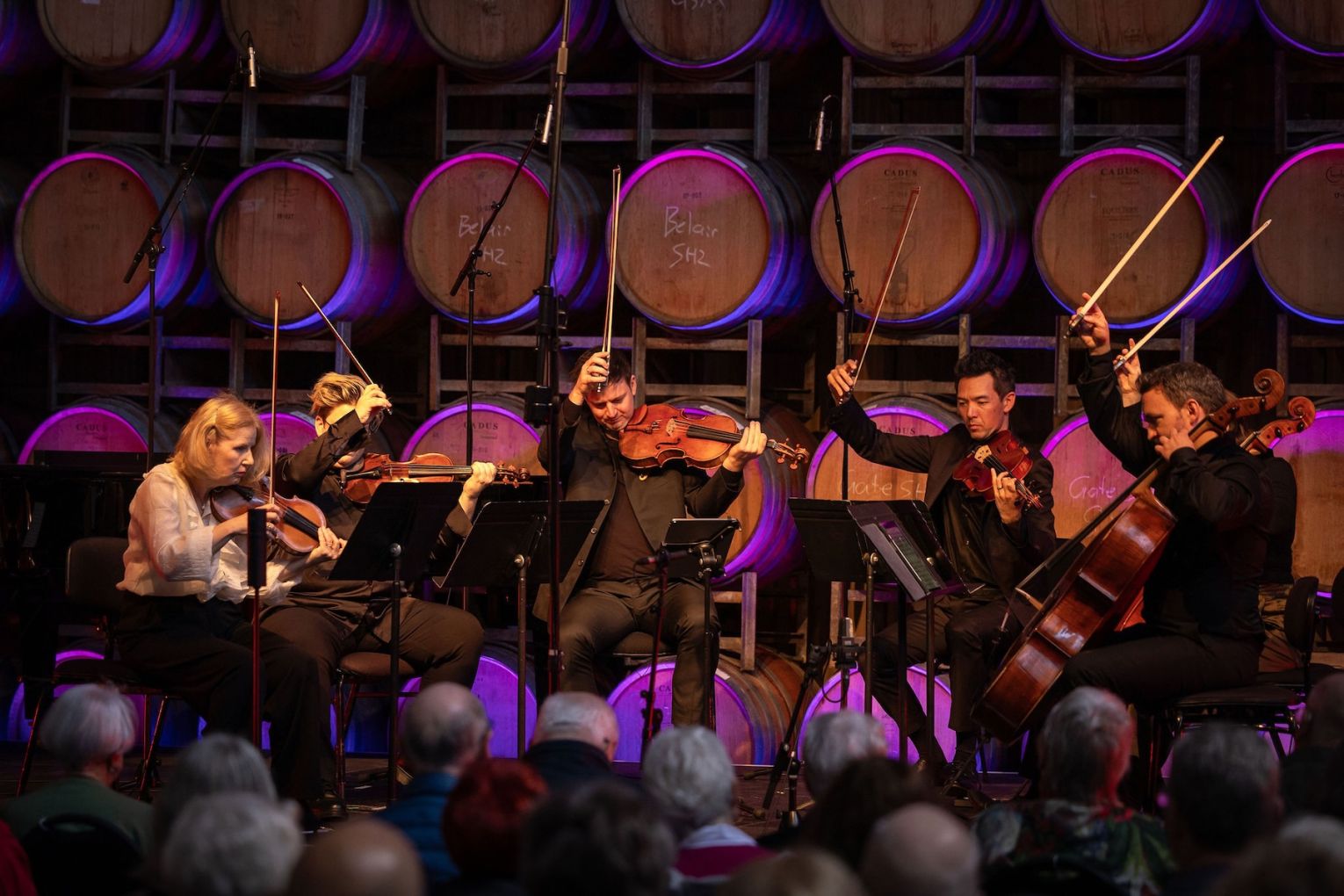
It is for good reason that Coriole Music Festival has established itself as one of the country’s preeminent chamber music festivals. Classical music, food and wine in a beautiful vineyard setting always seems a winning combination, but this weekend festival at McLaren Vale has proven to be a past master at getting the formula right since it was founded in 1999.
There is one somewhat unpredictable factor that it does depend on, though. The energy brought to it rests on the commitment of each new artistic director who runs it.
Late in the piece, Kate Suthers agreed to direct this year’s Coriole, and two more to come – a three-year term is usually how it goes.
And suffice to say, Coriole veterans and newcomers alike will have been well pleased. Familiar to many as the ASO’s concertmaster (a role she started in 2023), this dynamic musician exhibited many more sides than one might have realised. In the concerts that she devised, her accomplishment across multiple styles made for a highly rewarding experience.
In addition to acquitting herself as an exceedingly fine chamber musician, Suthers proved to be an artist of curiosity and rare span of interest.
Her début program began with fin-de-siècle Vienna and fanned out from there to include a sizeable chunk of modernist American music and, intriguingly, a through-composed set of folk tunes and improvisations.
You might like
Excellent in various chamber music capacities, it just happens that Suthers also turns out to be a terrific folk fiddler.
Erich Korngold was the unexpected starting point. While we may associate him with film music, the fact is that this composer began his meteoric career ascent in Vienna. Near the beginning, and even before he even dreamed of leaving for Hollywood, he composed an extraordinary String Sextet; and it must be one of the lushest pieces ever written for chamber strings.
Mahler may have declared the young boy Korngold a genius, but his estimation seems to have been based on larger works such as his cantata Gold and ballet Der Schneemann. One very much doubts it was this sextet. As a chamber piece, it is vastly out of proportion for its medium: its bravado and heroism make it more suited to film music.
Yet there is an unmistakeable Viennese grace that seduces the ear. This Sextet has a sweetness that is difficult not to like, and what the Coriole Music Festival heard was a most flattering account.
Violinist Elizabeth Layton was commandingly strong with its wrestling energy, but she was also gracious with its warmth. And around her was an ensemble of the most pleasing discipline. Knitting it all together like fine embroidery were second violinist Belinda Gehlert, violists Richard Waters and Neil Thompson, and cellists Martin Smith and Gemma Phillips.
After that, it seemed only fair to reach back and play one of Mahler’s own student compositions. His single-movement Piano Quartet was composed in his mid-teens in 1876, and what a gloomy young lad he must have been. Obsessively tied to a particularly grim-sounding three-note motif, this work seemed to hold a pessimism beyond his years, foretelling his symphonies.
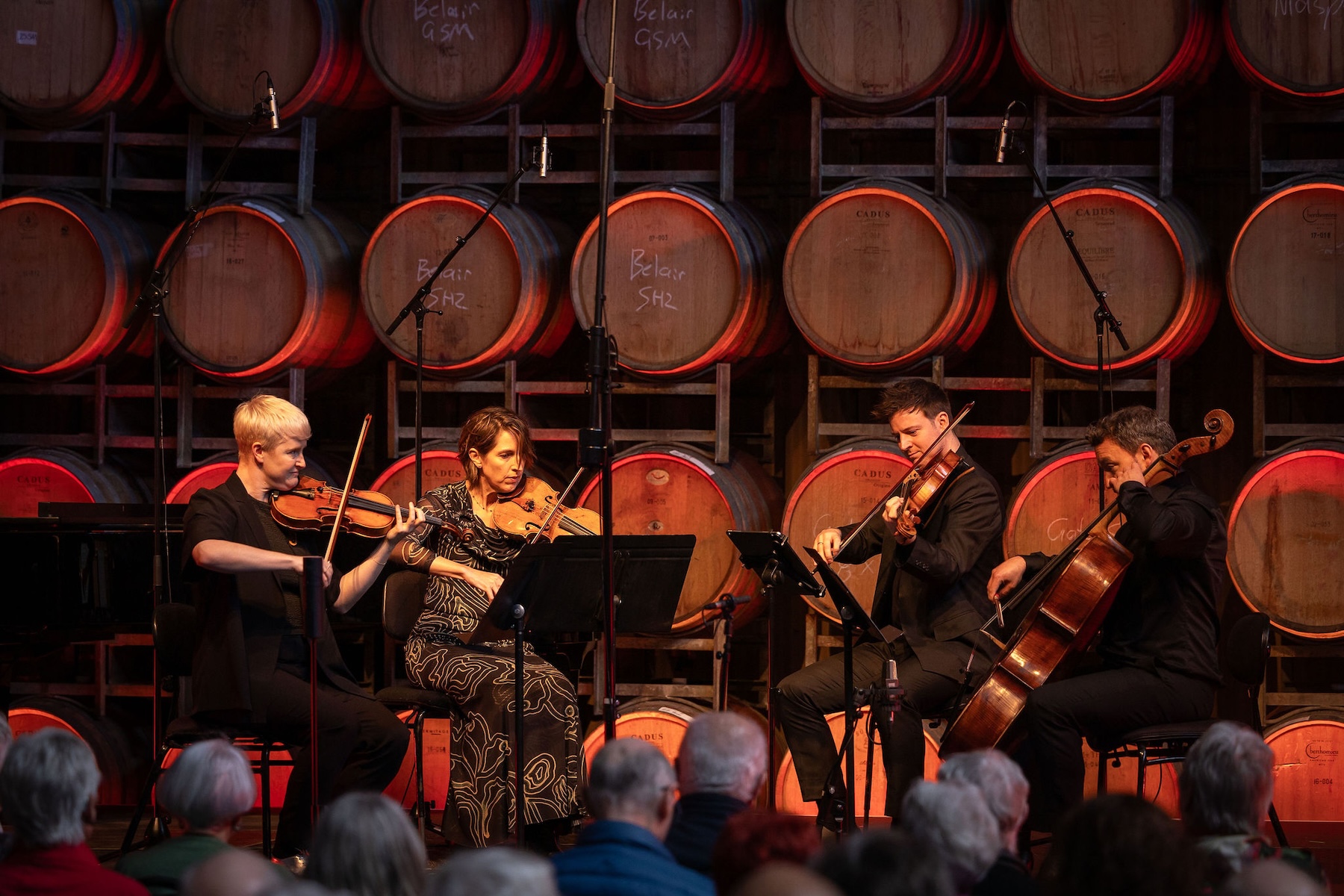
With Michael Ierace at the helm, the performance was one of true stature. This is a pianist who continually impresses, and here he was at his most insightful. Thoughtful and without a trace of indulgence, Ierace ushered it in with magnificent breadth. Alongside him, Thompson, Phillips and violinist Alison Heike completed the magic.
Subscribe for updates
In terms of composers who placed their stamp all over musical Vienna, Brahms was an obvious omission. But in his place was another composer who truly upset the status quo when he arrived in the Austrian capital. Beethoven was still a young man flexing his muscles there when he wrote his Sixth String Quartet. And it brims with a self-confidence that hits home to this day – especially when played as well as we had here with Suthers and friends.
Never mind the seriousness of his later quartets, this one bounds along with the cheeriest energy imaginable. One loved the sheer vivacity of Suthers’ playing in its cheeky exchanges between violin and cello.
We are spoilt in Adelaide when it comes to the standard of quartet playing. The ASQ is officially resident here at the Elder Con (even if three of its four members live in Melbourne), and thanks to UKARIA a steady stream of leading string quartets comes from overseas (latterly Leonkoro and Brooklyn Rider).
On this occasion, however, it was clear that the quartet assembled in Coriole’s barrel shed, though individually accomplished, lacked experience as a unit. There was less polish than one might have hoped for, but character and vigour made up for that.
Another highlight on the opening Saturday was vocal. Suthers devised a most clever interleaving of songs by Alma Mahler (née Schindler) and Alexander von Zemlinski. These two were turbulent lovers and luminaries in Vienna’s hedonistic art scene. Set to Richard Dehmel, Heinrich Heine and others, some of these songs are incredibly sensual.
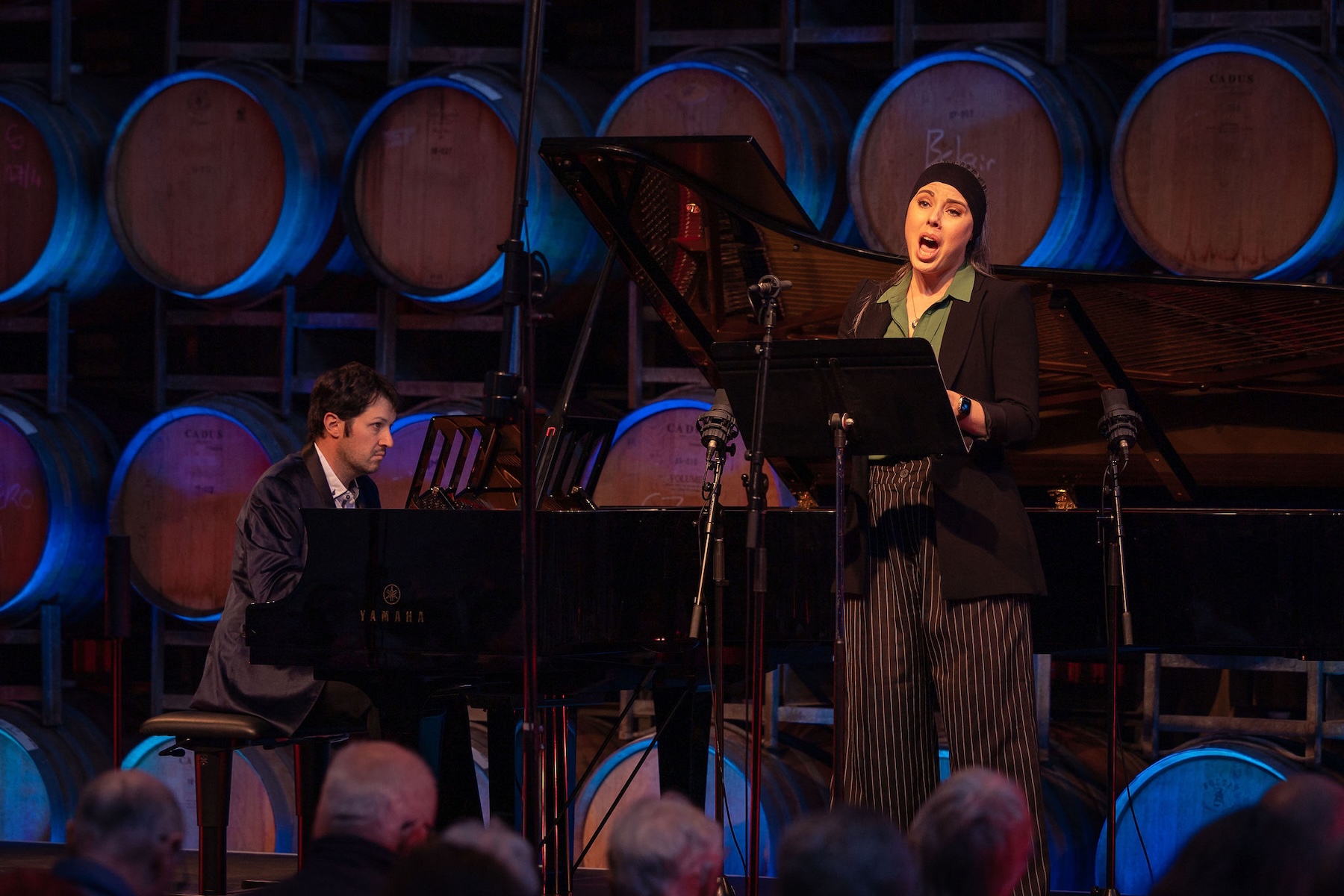
Accompanied by Ierace, soprano Desiree Frahn sang them finely, heightening their loneliness and craving.
The same combination were even better in Copland’s Twelve Poems of Emily Dickinson. Frahn sang a selection of these with the simplest, most direct poignancy.
For Ierace, less is more, and this meanwhile proved a virtue in Bartók’s Suite, Op. 14. Pianists often overplay this composer’s dynamic contrasts and insist on a percussive edge. but he approached this amiable work with musicianly intelligence and balance.
Interest mounted through the day with an engaging pair of pieces by contemporary American composer, Caroline Shaw. Suthers shares an immediate kinship with her music, connecting with its pensive gaps and whimsy.
Her concluding folk set was just plain dazzling. With escalating virtuosity, she kept pulling rabbits out of the hat in a succession of Irish reels and folk-based pieces from Norway and Denmark. Seeing the glee on her face as she aced it every time was a total joy.
An exhilaratingly versatile musician, Suthers looks set to steer Coriole in valuable further directions.
Coriole Music Festival ran from May 16 – 17. This is a review of Saturday’s program.
Want to see more stories from InDaily SA in your Google search results?
- Click here to set InDaily SA as a preferred source.
- Tick the box next to "InDaily SA". That's it.
Free to share
This article may be shared online or in print under a Creative Commons licence