Music review: Makoto Ozone’s TRiNFiNiTY
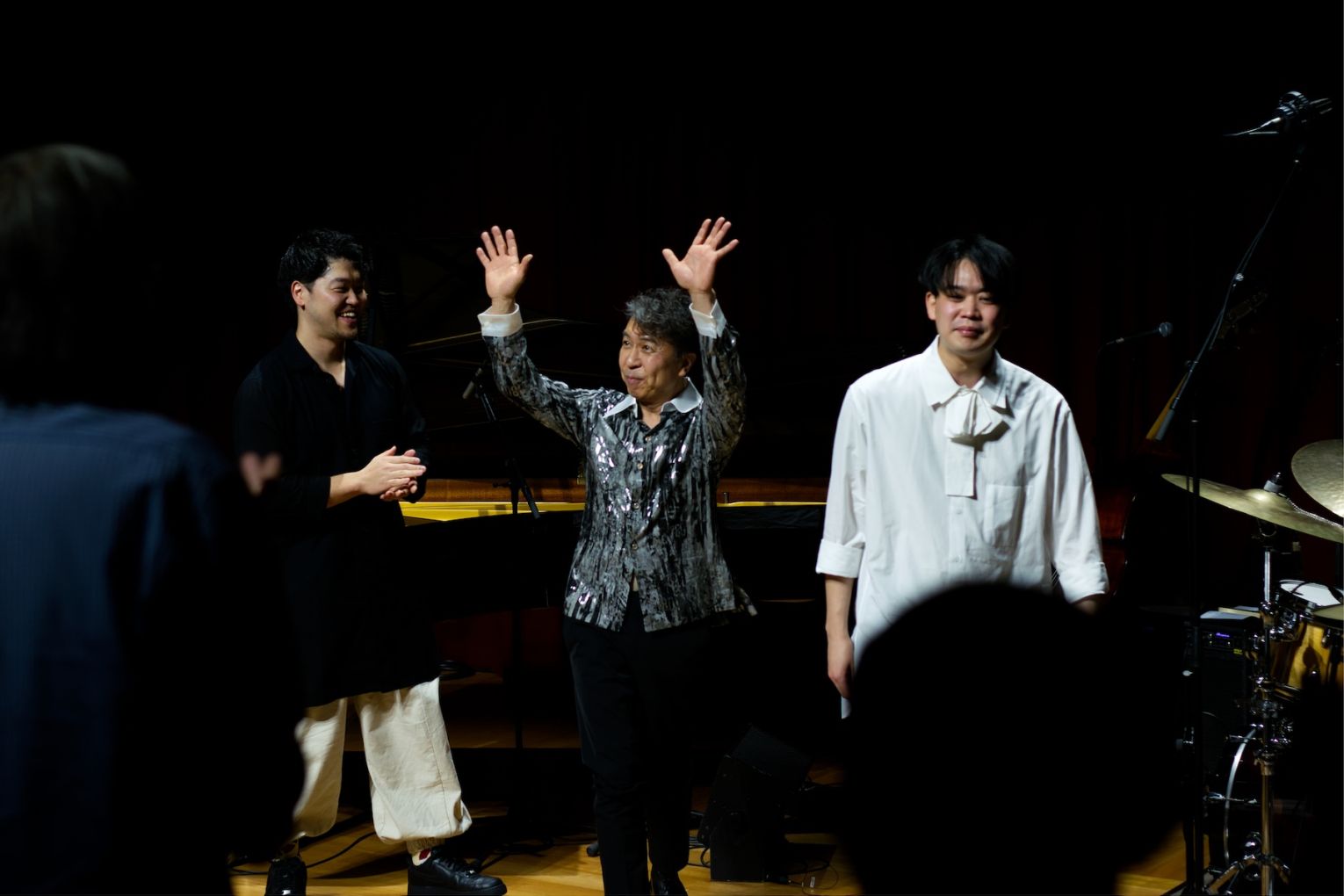
Japanese jazz pianist Makoto Ozone and his energetic group TRiNFiNiTY brought a welcome hit of unbridled joy to the often self-serious world of contemporary jazz.
Since its inception in the earliest part of the 20th century, jazz music has wrestled with its identity. On the one hand, it is African American community music that intentionally defies the elite trappings and strictures of Western art music. On the other hand, it seeks recognition as a high art form that can co-exist with the classical tradition in its concert halls.
Nowadays, with mainstream popularity almost entirely out of the question, many jazz musicians seek to retreat exclusively into the concert hall, and feel that their music can only survive in its purest form on the whims of wealthy patronage or government grants. These musicians adjust their approach accordingly, sacrificing the easygoing humour of the traditional jazz vernacular on the altar of respectability. Others instead reject the thought of self-serious refinement and carve out a niche in the fickle world of constant bar gigs, small-scale tours and album recording and release cycles that are sustainable, but only just – meagre profits are turned solely with the aim of reinvestment into the next project.
For many, this reality can feel increasingly bleak, birthing a kind of hopelessness that starts to permeate musicians’ expressive language, leading to music that alienates whatever devils with whom it is not acquainted in favour of the ones with whom it is. However, Makoto Ozone and his TRiNFiNiTY trio manage to exist somewhere in between the two camps of devils, seeming learned and refined enough to be at home amidst the pomp of a one-time appearance at the prestigious UKARIA Cultural Centre in Mount Barker whilst simultaneously bursting with the sheer unbridled (and wonderfully unserious) joy the three musicians clearly feel as they play together.
The TRiNFiNiTY project is a jazz piano trio in the most traditional way. An older bandleader (Ozone) has enlisted the help of younger colleagues (Shimpei Ogawa, bass) and students (Kunito Kitai, drums) in order to both have and eat his cake – there is heritage, there is tradition, there is a long performance experience, and yet there is still a great youthful freshness, and more importantly, the incredibly exciting awkwardness that comes with such a varied set of experiences amongst the band. Musically, these three could not be more intimate, but it is not an easygoing intimacy. Ogawa and Kitai appear to be both deeply respectful towards Ozone; eager to prove themselves to an elder of their scene, but neither one ever shies away from pushing him to his expressive limits. This carefully deliberated lack of complacency is what allows them to successfully marry the folksy jazz tradition to the aspirational refinement of jazz-as-art-music.
You might like
The trio began their first set with one of their new tunes, ‘Rolling Tales’, a dark modal waltz very reminiscent of the forward-looking jazz of the 1960s, and yet it did not feel self-serious or stymied in its expressive capabilities by its reverence for that sound. Indeed, despite Ozone’s acknowledgement that much of their newer music was written in order to feel more contemporary, rather than the more straight-ahead jazz that the group usually played, they did not reject their older, more conventional music, such as a number of brilliant tunes by bassist Ogawa.
His composition ‘Mr. Monster’, from their first album together, was a particular highlight, at once harking back to the second-line blues music of New Orleans, and also featuring impossibly tight cross-rhythmic hits played by the whole band. These three are not so much synchronised as they are synchronous; playing in time with each other not out of deliberation and choice, but out of the sheer necessity of moving together as one unified sonic front. They do not will themselves into playing together, they are destined to.
Another excellent Ogawa composition was the tune ‘Etudade’, written at first simply as an exercise in playing labyrinthine and complex melodies on bass, but then, hearing a Brazilian rhythm, Ogawa turned the ‘Etude’ into ‘Etudade’ (a neologism in line with the names of Brazilian jazz/bossa nova crossover standards such as ‘A Felicidade’, ‘Chega de Saudade’, etc.), a tune performed so deftly that one could almost forget how incredibly virtuosic one had to be in order to play it convincingly.
Ozone began the second set with an unamplified solo piano performance of the second movement from Maurice Ravel’s Piano Concerto in G Major, replete with his own harmonic and melodic variations. Many contemporary jazz musicians interpret classical works, but most will shy away from including the folksier side of jazz; the blues, the swing, all the traditionally African American features that put it at odds with the Western classical tradition. However, with this performance, and again with the trio’s last tune ‘Pasja’, complete with neo-classical textures and the gritty drive of modern un-swung art-jazz, one got the feeling that this group do not worry themselves with any perceived clashes of sensibility – they simply let their brilliant music speak for itself.
Makoto Ozone and TRiNFiNiTY performed at UKARIA Cultural Centre on Friday February 20
Want to see more stories from InDaily SA in your Google search results?
- Click here to set InDaily SA as a preferred source.
- Tick the box next to "InDaily SA". That's it.
Free to share
This article may be shared online or in print under a Creative Commons licence