Music review: Gillian Welch & David Rawlings
One of America’s most celebrated contemporary bluegrass duos returned to Adelaide for a night of smooth harmonies and quiet intensity.
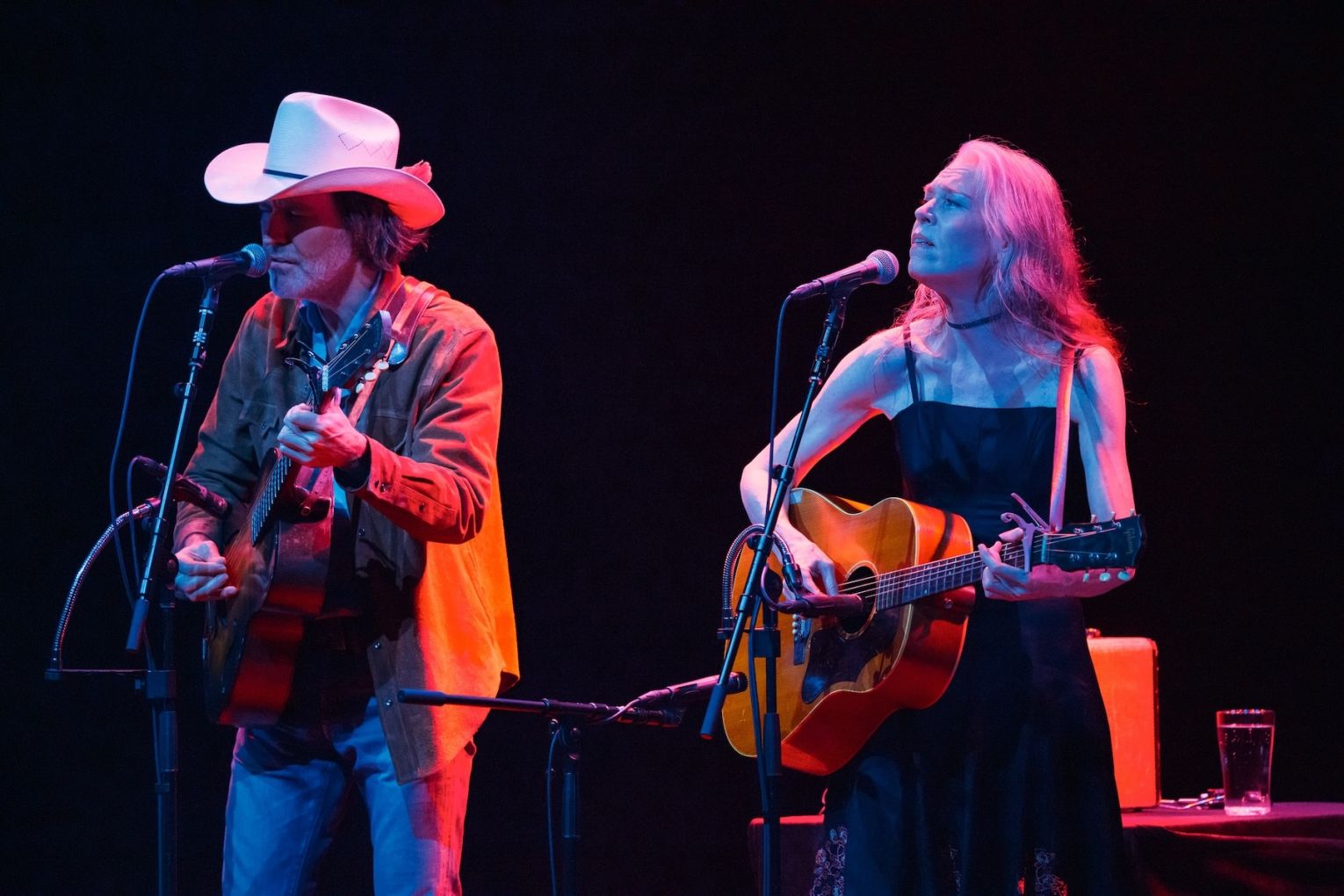
Country music – and especially its folksier side; bluegrass and the old-time music of the Appalachian Mountains – is often derided for its textural monotony, and perhaps not unfairly. After all, with only steel-stringed instruments and vocals, there is only so much variety that musicians can produce. However, this music does not rely on constant orchestration and instrumental variation in order to produce sustained engagement from its audience. Instead, folk-country artists rely on lyrical depth and a deep understanding of how their instruments work best, and there is perhaps no better contemporary example of this than the varied output of singer/songwriter Gillian Welch’s fruitful partnership with guitarist David Rawlings.
Their style together is sparse and restrained, and the pair consistently shy away from the upbeat – indeed, after a performance of the tune ‘Midnight Train’ in the first set with particularly fiery blues-inflected double-time soloing from Rawlings, Welch dryly remarked amidst the applause, “that’s about as chipper as we get”. However, the simplicity and stark solemnity of much of their music does not undercut its emotional effect, nor does it become suffocating.
On the one hand, there is constant delight to be found in the impossibly smooth harmonies that the pair sing. Welch is a phenomenal singer, and yet, despite never playing lead guitar, she does not always take the lead vocal, sometimes allowing herself to sing a perfectly balanced tenor harmony above Rawlings’ plaintive lead. Both vocalists, regardless of whether they are singing lead or harmonising, have a tendency to imply the beginning of a note rather than to articulate it fully, letting it keen unobtrusively in over the gently placed chord underneath. The ‘high lonesome’ vocal sound of bluegrass music permeates their approach, especially whenever they sing a bare fourth or fifth interval at the peak of a chorus, such as in their tune ‘Cumberland Gap’, performed with bluesy gravitas that tells a much darker story than the traditional old-time tune of the same name.
You might like
It is impossible to deny the power of Rawlings’ incredible lead acoustic guitar playing against the unforgiving backdrop of Welch’s constantly solid rhythm parts; traditional acoustic guitar lead playing is an act of survival, with an almost exclusive focus on ensuring that the instrument projects enough to be audible, but Rawlings has abstracted this approach to the point where a little jazz inflection appears. On acoustic guitar, the folk-country musician’s deep understanding of their instrument mostly manifests in a constant focus on the guitar’s six open strings, using them as anchors that guide melodic choices, and a tendency to pick across the strings against the beat to imitate the way that a banjo would outline the chord progression (a technique called “cross-picking”), including all of the momentary bluesy dissonances that can be obtained when open strings appear amidst well-chosen notes on adjacent strings. Rawlings has taken this philosophy of melodic focus and rhythmic liveliness and simply found new open strings high up the neck of the guitar, dashing up to high notes and then sneakily throwing in an angular clash against them slightly lower on the guitar. He is not philosophically at odds with the old bluegrass adage that “there’s no money beyond the fifth fret”, just at odds with a fixed definition of where exactly the fifth fret is; his approach is at once entirely idiomatic and incredibly unique.
As the pair performed in the Thebarton Theatre, one got the impression that the audience was constantly dazzled by the restraint of the pair, which is perhaps not quite a fair assessment of whatever thing makes them so special as musicians. There was no reason to believe that Welch and Rawlings were holding anything back – indeed, judging by the quiet intensity with which the pair moved as they played, it seemed obvious that they were giving their fans everything they had, all the time. Besides, restraint is not a precondition for musical brilliance. There is no difference between a learnedly restrained performance and an earnest outpouring of the maximum a musician can offer if the net result sounds the same.
The pair were called out for an encore at least three times, each time with an accompanying standing ovation, and eventually finished the evening with a deeply felt performance of one of their oldest and best-known songs, ‘Revelator’. As Rawlings dug into the tune’s opening dissonances with a fierce sequence of pick-strokes, it seemed obvious that this was not restraint. Restraint is not what makes Welch and Rawlings so special – it is the fact that they play and sing beautiful music that makes them so special.
Gillian Welch & David Rawlings performed at Thebarton Theatre on Sunday February 22
Want to see more stories from InDaily SA in your Google search results?
- Click here to set InDaily SA as a preferred source.
- Tick the box next to "InDaily SA". That's it.
Free to share
This article may be shared online or in print under a Creative Commons licence