Music review: Roomful of Teeth
American vocal ensemble brought their unique sonic vocabulary back to UKARIA for an exploratory set highlighting the qualities that make them so thrillingly different to more conventional choirs.
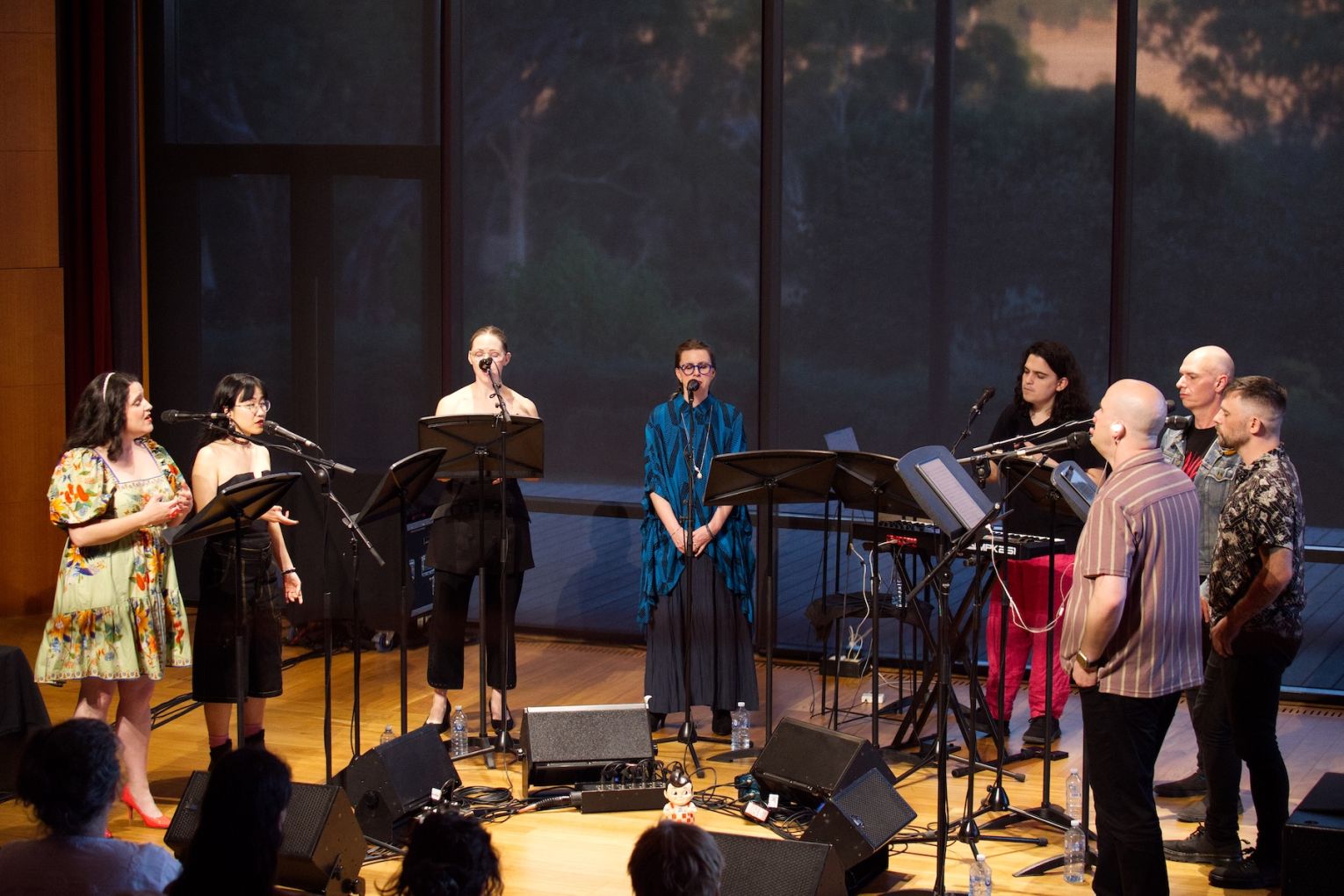
Having first appeared here at the 2020 Adelaide Festival, many curious ears were back at UKARIA to see again what this US vocal outfit are all about.
Roomful of Teeth are about as far removed from conventional a-capella singing as one would think is possible. Classically trained, they seem intent on, not so much disrupting existing choral practice, as reinventing it, with a whole new sonic vocabulary.
Nowhere have they demonstrated better than in Caroline Shaw’s Partita for 8 Voices, which won the composer a Pulitzer Prize in 2013 and propelled her into international prominence. How lovely it would have been to hear some further excerpts from that spectacular piece again in this return visit. But that didn’t seem a likelihood, as Roomful of Teeth are conspicuously a group that does not sit on their laurels. They have moved on, and that was the point of this concert.
Here they were in all their unconventional glory, looking infinitely cool and casual, and performing a new piece from Shaw entitled The Isle. This is another suite, the composer once again nodding to past musical forms, but here was an altogether different and subtler composition. Text-based, it draws on Shakespeare’s The Tempest and transforms three of its monologues from the semi-human creatures Ariel, Caliban and Prospero into patterns of word and sound.
The suite is bookended by a prologue and epilogue, and creates a succession of haunting dream-like states. Shaw’s innovative harmonic and exploratory effects are fully in evidence. Murmuring and burbling effects created by inhaling and exhaling recall the sounds of nature that are implicit in Shakespeare’s verse. Resonances are generated from the front and back of the singers’ throats as The Isle dramatically opens out. The whole conception is arrestingly imaginative.
You might like

One missed the outright exuberance and wild edge and that won so much acclaim in Partita, but this sequel was intriguing in a more internalised way. It is true to her ethos as an onward-thinking composer who is not content to do the same thing twice.
Much the same can also be said of Roomful of Teeth, the group that Shaw co-founded and obviously continues to serve as her testing ground for new ideas – although, just like last time, she was not present in this Adelaide visit.
There have been some minor changes to personnel since last time. Most noticeably, Cameron Beauchamp now directs where Brad Wells formerly did. But in configuration and sound, the group is essentially the same.
The restrained mood set by Shaw’s piece intensified in Leilehua Lanzilotti’s On Stochastic Wave Behavior. Receiving its Australian premiere, this sought a pared down purity in its construction from single and adjacent pitches, and very memorably it was sung entirely in ʻŌlelo Hawaiʻi, the indigenous language of the Hawaiian Islands.
Subscribe for updates
Individual contributions from Roomful of Teeth’s singers gave this program a particular interest, and Beauchamp explained in the second half that it owes to experimentation that the group has undertaken in recent times into the solo capacities of its members.
Yodelling is a technique they have employed since their inception. Soprano Estelí Gomez again showed how she excels at this in the first half, together with the whole ensemble in Missy Mazzoli’s Vesper Sparrow. The singers’ alacrity at jumping across high and low registers in imitation of birdcalls was remarkable in this completely charming piece.
So was mezzo-soprano Virginia Kelsey’s polished vibrato. Operatic style warbling is just not something one expects from this ultra-clean sounding group, and when it is called upon and done so impeccably, as here, the effect sounds wonderfully different. It’s interesting that Kelsey also specialises in Baroque performance practice, for she has a ton of technique.
Jodie Landau also moves impressively into the spotlight, proving to be completely at home at gospel in Gabriel Kahane’s Speaking in Tongues. With its synth backing and heavily amplified bass lines, this song moves right into the zone of contemporary pop – another area in which Roomful of Teeth are entirely conversant.
From there, it was a short detour into contemporary electronica by virtue of Angélica Negrón’s Math, the one which is sweet. This was the show’s most entertaining number by a long way. Emanating from stand-mounted speakers either side of the singers, powerful asymmetric bass pulses gave it massive impetus. It’s a really interesting piece.
The final item, William Brittelle’s Psychedelics, was a tour-de-force of vocal effects over hard-driving synth. The composer has described how it depicts a human apocalypse that inevitably will come, and while it is bamboozling in the montage it creates, it is also a likeable composition. It suggests that, far from being frightened, we might choose to accept humanity’s doom as part of nature’s larger cycle of change.
Perhaps there’s comfort in that. Psychedelics may paint a bleak picture, but its elements are reassuringly familiar and even commonplace.
Roomful of Teeth is all about the new in all its forms. It is impossible not be totally enthralled by this group – and in the end, both heart and mind tell you to love them.
Roomful of Teeth performed at UKARIA on Sunday February 15
Want to see more stories from InDaily SA in your Google search results?
- Click here to set InDaily SA as a preferred source.
- Tick the box next to "InDaily SA". That's it.
Free to share
This article may be shared online or in print under a Creative Commons licence