Change of life: A strange and exotic journey of body and mind
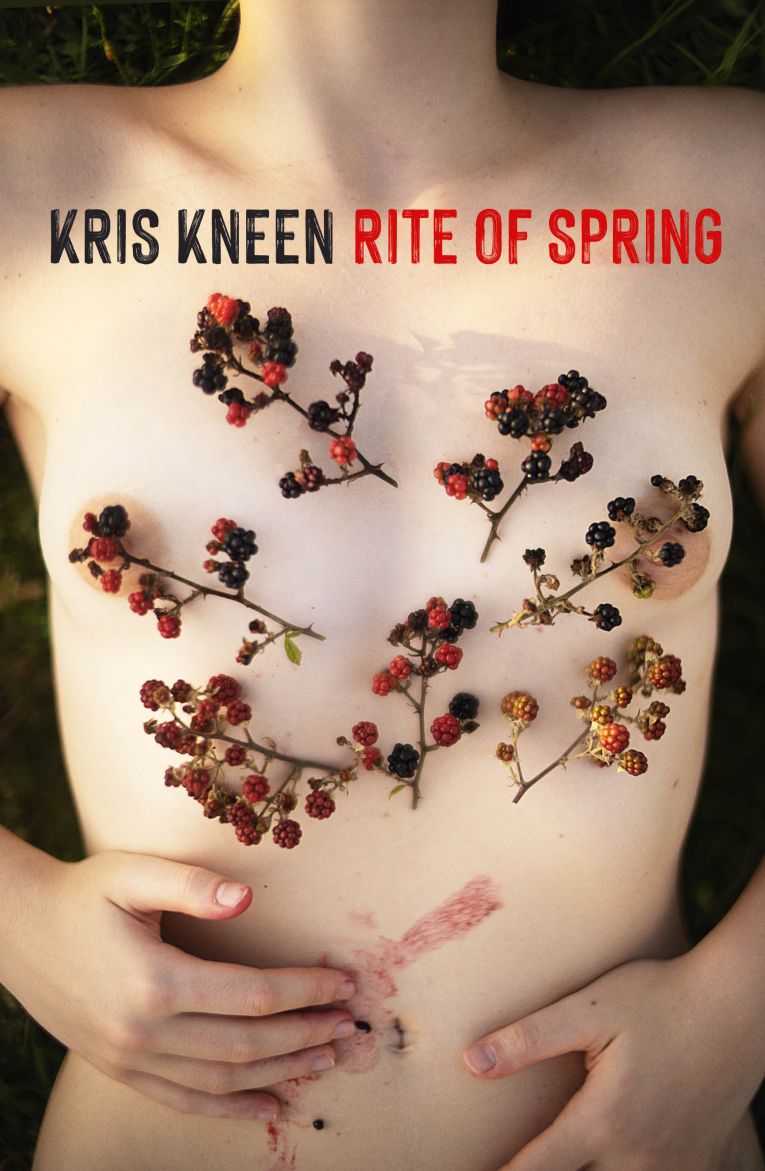
Kris Kneen’s latest novel, Rite of Spring, is a surreal and transformative story that includes the author’s usual eroticism.

Since publishing their revelatory memoir, Affection: A Memoir of Love, Sex and Intimacy, in 2009, Brisbane-based wordsmith Kris Kneen has forged a career as one of Australia’s boldest and bravest writers.
Kneen has crafted an incendiary and engaging body of work that spans both fiction and non-fiction, exploring often deeply uncomfortable and confronting issues of place, eroticism, environment and subjective corporeality.
Their seventh novel, the elegiac and stunningly written Rite of Spring, references both William Shakespeare’s The Tempest and Russian composer Igor Stravinsky’s ballet and orchestral work, The Rite of Spring, in telling the story of one woman’s profound menopausal, psychological and physiological transformation.
The story begins with marine biologist Miranda and her husband Richard crouched in the bow of a boat that is heading on thunderously rough seas toward a remote, isolated and unpopulated island off the coast of Tasmania. Though the island is unnamed, descriptions of it bring to mind Maatsuyker Island, which is 10km off Tasmania’s coast, highly isolated and an international site of importance for seabird breeding.
Richard fights seasickness and grasps his wife’s hand protectively as her stomach falls and she feels “like her soul was left crouching on the surface of the ocean as her body was lifted so high she thought she might be tossed out of the vessel”.
 The pair is on a journey that is both geographical and existential. Richard is keen to reset his life, and their marriage, after the damage done by an extra-marital affair he had, while Miranda seeks to reenergise her own existence after narrowly surviving a near-death drowning accident that happened while she was diving as part of research fieldwork.
The accident has left her with mild cognitive difficulties and neurological damage, and she is further struggling to contend with the unfamiliar onslaught of menopause, an experience that has left her body feeling alien and distant to her.
You might like


The island is overseen by the Department of Parks and Wildlife, and the pair will be the caretakers of the local lighthouse, built in the 1800s, and the caretaker’s cottage in which they will live. They will be the only two humans on the island and will have to contend with dangerous winds, destructive rain and the untouched wilderness that surrounds them.
As ever, Kneen writes the rugged, lush beauty of the wilds of the island and the sea that buffets its coasts with admirable beauty and lyricism. Similarly, she writes Miranda’s discordance and disjuncture from her physical self with adroitness and insight, capturing perfectly the bodily alienation that both the menopause and her husband’s affair have stirred in her.
The island, however, keeps secrets of its own. Not long after their arrival Miranda is exploring when she happens upon a vegetable garden and finds a strange scarecrow erected, crafted from kelp, seaweed and bird bones, with a “screaming face” and shark-like glass teeth.
Stories abound of unusual, unexplained, often solitary deaths of past caretakers – and it is while reading the journals left behind by their predecessors that she becomes entranced by the near-mystical writings of the mysterious KJ.
Like Miranda, she and her husband came to the island as caretakers, and she has left behind pseudo-religious writings of angels and demons, and of bodily and sexual encounters with an unexplained figure that seems a fusion of human corporeality and elements of the natural world: kelp, seaweed, sand, the ocean. Soon Miranda begins discovering odd, often seemingly sexually explicit, primitive figures carved into trees dotted around the island, also attributed to KJ.
One day, as she cleans the lighthouse windows, Miranda becomes convinced that she has glimpsed a visitor to the island. Shaken, she tells Richard who immediately questions the validity of her sighting, instead blaming the incident on a post-accident hallucination. Miranda, however, stands her ground, insisting that her vision was real, and the pair alert mainland authorities and spend almost three days in horrendous, stormy weather searching the areas of the island adjacent to the lighthouse and the cottage for any signs of an intruder.
It is at this point in the narrative that it becomes apparent that Miranda is losing her powers of perception and distinction – or is she? Is there in fact an overlap between the natural world and the human world to which we are not all attuned? Or is it truly all in Miranda’s head?
Do her fluctuating hormones and the aftermath of her accident have her hallucinating figures on the clifftop and imagining long, thin fingers made from kelp and seaweed dragging her downward as she swims in the ocean? Or is she more a part of the natural world than the land-locked, human one? Is she, indeed, as she feels herself to be, more water than flesh?
Subscribe for updates
Soon, Miranda finds herself existing in a state of heightened arousal and eroticism, an all-consuming “erotic fever”. Here Kneen writes the desires and longings of the body and the mind with precision and passion, giving voice to joyous, enthusiastic masturbation and a strange, otherworldly commingling of the human body with that of the sea. This results in a sexual consummation that brings Miranda profound bodily pleasure and sexual satisfaction, but might not be wholly consensual. Such are the blurred lines of existence and environment, boundaries of pleasure and desire, permission and violation, that she straddles.
Rite of Spring is … concerned with temporality – be it bodily, psychological or environmental – and the dissolution of borders and distinctions between self, time and place
Miranda questions her grasp on reality: “She had a flash of a creature – monkey body and a fishtail. The age of monsters was so temporally close, but it seemed like a distant, unruly place. She had grown up in the hug of science. Only recently, after the accident, had monsters from her dreams begun to bleed out into the real world.”
It is worth noting here how brilliant Kneen’s writing of interiority of character is – she narrates Miranda’s existence and experiences with such exceptionalism that, while reading, you truly feel you are inside her. Similarly, while more prudish readers might find her writing of sex and sexuality to be explicit and lurid, her prose is actually profoundly beautiful, suffused with life, emotion, sensation and buoyant physicality. Far from unnecessarily explicit or lurid, it is achingly present, sensual and even poignant.
Rite of Spring is a novel that is concerned with temporality – be it bodily, psychological or environmental – and the dissolution of borders and distinctions between self, time and place. For most of the novel, the reader is reliant on Miranda’s experiences, thoughts and feelings as a guide, though note should also be made of Kneen’s own authorial input in the form of prose-like sections that break the fourth wall, providing an alternative narrative perspective, and are attributed to “Kris”: “You are not a lone note. I am not a lone note. We trigger vibrations in others if we sense a similarity of waveform. See what can be triggered when my body sings.”
Such lines echo the hallucinatory siren song that Miranda hears, drawing her back to the ocean and into the water, down into its depths and further out towards the horizon.
Soon Richard questions Miranda’s experiences and her feelings of dissolution and displacement, again blaming them on the aftermath of her accident, telling her: “You can’t trust what you see. You can’t trust your brain.”
But Miranda is learning to trust in her body, in her physical form, and what her body’s feelings and impulses are communicating to her. Just as the siren song calls to her, so do the cells, bones and musculature of her body and the caverns of her mind.
The two artistic works that loosely underpin the novel also offer interesting insights into what transpires within its pages. Stravinsky’s Rite of Spring was, of course, a groundbreaking ballet and orchestral work that was inspired by the stories and folklore of pagan Russia. The ballet itself depicts various primitive rituals celebrating the advent of spring, during which a young girl is chosen as a sacrificial victim and subsequently dances herself to death.
Shakespeare’s The Tempest shares with Kneen’s narrative a protagonist named Miranda; a strange and alien character in Caliban; the angel-like Ariel; and an island that offers a refuge from worldly troubles. The parallels are never glaringly overt, but they are ever-present and powerfully enrich the story Kneen weaves over the four distinct but interlinked parts of her novel: Landfall, The Swell, Diving and The Abyss.
My one criticism of Rite of Spring would be the overly neat manner in which it concludes. For a story that feels so archetypal and mythical, so otherworldly and ephemeral, the tidy way in which Kneen wraps her narrative left me feeling a little disappointed. Such a conventional resolution for such an unabashedly unconventional novel felt unnecessary, a small betrayal of sorts, but such a criticism seems trite in the face of all that they achieve with this rich, multilayered narrative that unfurls with such precision and is written so elegantly and impressively.
This is a story of multivalence and transformation, of rich symbolism and deep eroticism, of one woman’s fragmentation, redemption and metamorphosis that is told with beauty, clarity and knowingness.
Rite of Spring by Kris Kneen, Transit Lounge Publishing, $34.99.
Want to see more stories from InDaily SA in your Google search results?
- Click here to set InDaily SA as a preferred source.
- Tick the box next to "InDaily SA". That's it.
Free to share
This article may be shared online or in print under a Creative Commons licence