‘Conversations with myself’: Peter Goldsworthy’s wry take on poetry, cancer and talking back to Tomorrow
Returning to poetry with his first collection in over a decade, Peter Goldsworthy’s Tomorrow features work born in the sleepless hours when medication, anxiety and imagination interact.
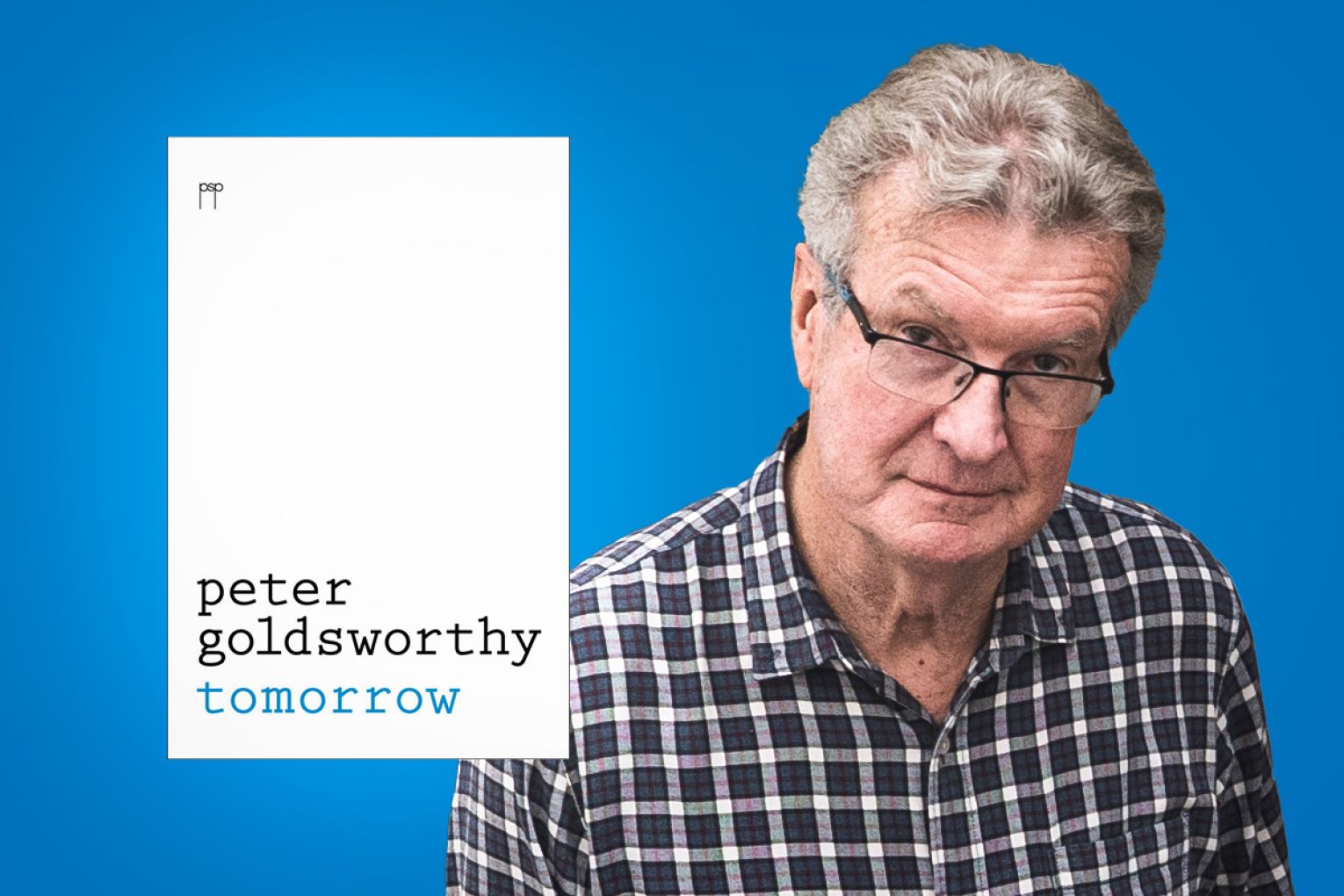
Long before he was a novelist, before the memoirs, the librettos and the literary prizes, South Australian writer Peter Goldsworthy was a poet, making his Writers’ Week debut alongside Allen Ginsberg back in 1972. In 2026, over a decade since his last collection, Peter Goldsworthy returns to the form that launched his literary career with Tomorrow (Pitt Street Poetry) a collection shaped by his experience with cancer.
If the subject sounds sombre, Goldsworthy’s poems subvert all expectations. These are poems that resist solemnity, tackling symptoms, treatment and mortality with wry humour and a deep understanding of both the human body and mind.
“I’m basically an optimist,” he tells InReview. “I’ve had the odd lapse over the last eight years, but I’ve always had trust in the medical world.”
As both a physician and a writer, Goldsworthy has a rare perspective on cancer: “I knew what the algorithms were, so I wasn’t anxious about the unknown,” he says.
For Goldsworthy, his dual identity of clinician and storyteller has become a way of coping. “I had this strange defence mechanism, that as a doctor and a writer I’m lucky to have this material,” he laughs. “You don’t get given stories like this very often.”
"I had this strange defence mechanism, that as a doctor and a writer I’m lucky to have this material. You don’t get given stories like this very often."
That sense of ‘given’ material runs through Tomorrow, particularly in its attention to the body. The poems do not flinch from granular detail of symptoms and treatment: saliva, baldness, the chemo chair reframed as an airport departure lounge. Cancer’s indignities are conveyed with a dry, dark wit as Goldsworthy enters direct conversation with his body, the disease and mortality itself.
You might like

An example of this is the title poem, Tomorrow, a work that exemplifies Goldsworthy’s balancing act between humour and philosophy. Framed as a direct, almost playful address to this abstract concept, Goldsworthy questions Tomorrow like a despondent lover analysing the corrosion of their relationship. It’s a poem that has already taken on a life beyond the page.
“Whenever I did interviews for The Cancer Finishing School [his 2024 memoir] people would ask me to read it. I wouldn’t say it’s gone viral,” he laughs, “but maybe bacterial.”
Dry wit may be the collection’s primary register, alongside clever wordplay and a philosophical take on mortality, but Goldsworthy is not completely immune to anger. In these rare flashes, rage is distilled into short, sharp poems that detonate like grenades. In ‘Parasite’ Goldsworthy addresses cancer directly.
“I remember an early draft being much more like ‘If I die, guess what? I’m taking you with me, you shitty little f***ing parasite,’” he recalls. “But I haven’t really been conscious of feeling much anger or fear. Sometimes it creeps out. Poetry can tap into the subconscious – often better than our conscious selves.”
"I remember an early draft being much more like ‘If I die, guess what? I’m taking you with me, you shitty little f***ing parasite’."
Many of the poems are conversational, speaking directly to the body, the mind, the soul and God, lending the collection an outward facing, communicative quality. For Goldsworthy these are less performances for a reader than attempts to think out loud.
“I think they are mostly conversations with myself, trying to think through mysteries that can’t be explained.”
Subscribe for updates
This openness to uncertainty and the limits of science and belief is at the heart of the second section of the collection where Goldsworthy turns his focus away from the physical nature of the disease to its impact on the consciousness, mortality and even the digital nature of our afterlives. “It’s great fun to think about these things,” he says. “It’s awe inspiring. But you have to be content for them to remain mysteries.”
In the section, Dead Friends Society, the collection turns towards literary community and inheritance. Goldsworthy brings together poems written in the aftermath of friends’ deaths, poems honouring the style or written in the tonal registers of poets including Les Murray, Clive James, Gwen Harwood and Peter Porter.
“I thought I’d write a little cattle poem,” he says of his Murray homage, recalling the formative shock of encountering Murray’s ‘The Cows on Killing Day’. “That poem utterly floored me. I’ve never recovered”.
The collection’s final section, Late Night Riffs, holds some of the most playful poems – pieces written, Goldsworthy says, in the chemically heightened wakefulness brought on by dexamethasone.
“The dexamethasone in the middle of the night is very creative in some ways,” he laughs. “You think you’re wonderful.”
These are poems born in the sleepless hours when medication, anxiety and imagination interact.
“It’s nice getting those lines down. When they start popping into your head, you can just play with it. I love doing that.”
For this writer, those small-hours poems were more than an outlet, they became a way of transforming a restless consciousness into art. And poetry, with its shorter bursts of intensity, suits his present moment.
“With a novel, you just sit down and do the slog. It sucks everything in,” he says. “I don’t think I’ve got the concentration span for a novel at the moment.”
Instead, he has been working on a contemporary adaptation of Anton Chekhov’s Uncle Vanya – a fitting project for a writer who shares Chekhov’s dual life in medicine and literature. The adaptation reimagines the play in a present-day, South Australian setting, reworking its characters and relationships while retaining the play’s central tensions.
“Chekhov himself had doctors in all his plays,” Goldsworthy notes. “And that really interests me.”
Goldsworthy’s instinct to keep making art – to keep playing with uncertainty rather than seeking neat answers – is what grants Tomorrow its wry individuality. These poems face illness head on, meeting mortality with the same qualities that have always characterised Goldsworthy’s writing: wit, intelligence and the ability to see the absurd within the most serious of situations. While Tomorrow may be Goldsworthy’s reckoning with what time takes away, it is also a paean to what he refuses to have stolen: language, laughter and his stubborn impulse to keep making art.
Tomorrow (Pitt Street Poetry) is out now
Want to see more stories from InDaily SA in your Google search results?
- Click here to set InDaily SA as a preferred source.
- Tick the box next to "InDaily SA". That's it.
Free to share
This article may be shared online or in print under a Creative Commons licence