Book Review: The Mother Is Restless & She Doesn’t Know Why
Gemma Parker’s collage-like memoir sees the poet and academic reflect on Nietzsche and nihilism as Covid-era border restrictions force her once-itinerant family to stay grounded in suburban Adelaide.
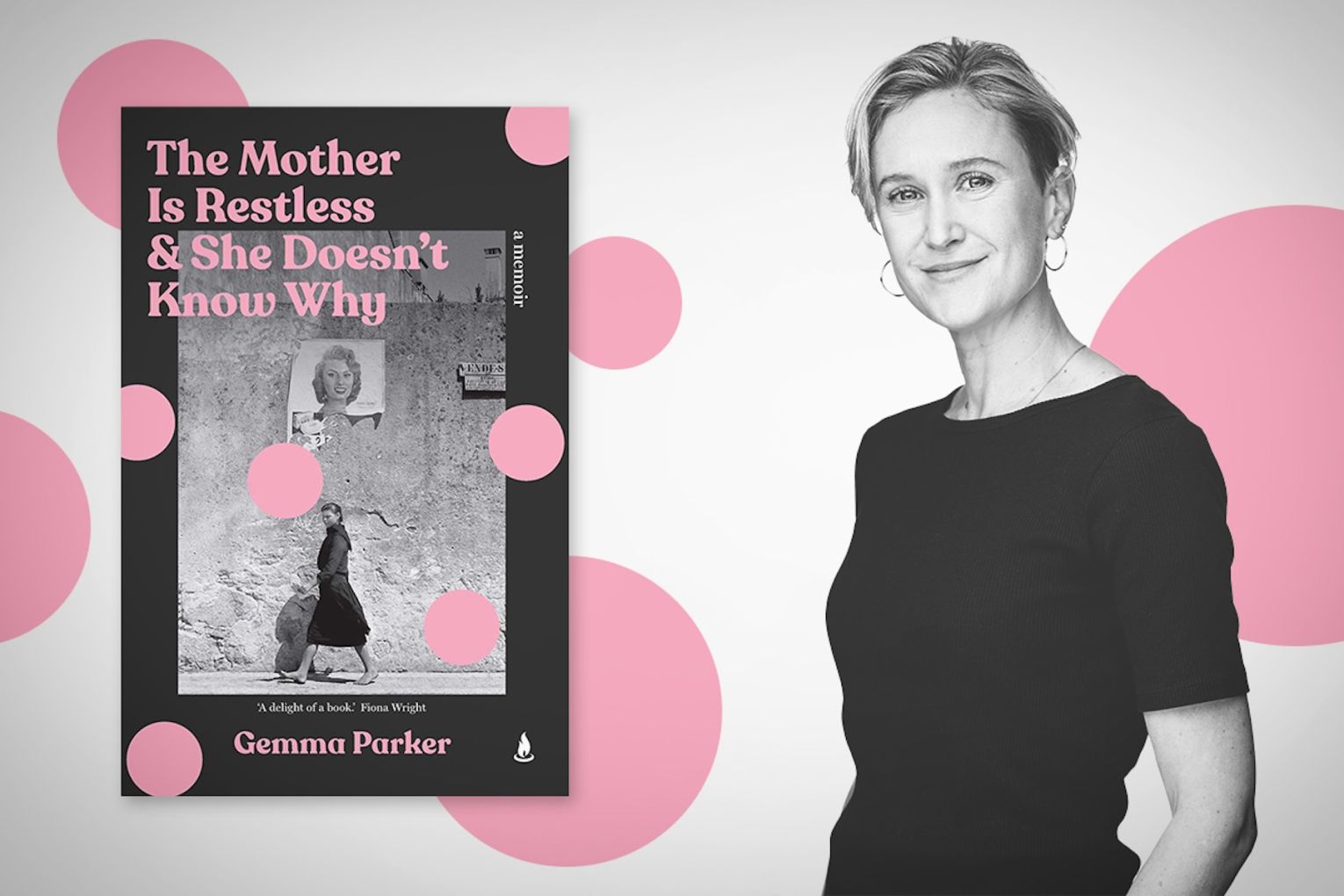
"Here is how I start: I read Nietzsche. I read Nietzsche in bed, with a chest cold. I highlight things in green and draw exclamation marks in the margins. I text friends. You wouldn’t expect I could be having so much fun reading Nietzsche, I tell them. They are worried about their children, about lockdown, about money, about their marriages. I am reading Nietzsche, I repeat. I text them quotes from Nietzsche. They do not reply."
It might seem unoriginal of me to quote the opening paragraph of The Mother is Restless & She Doesn’t Know Why, which also appears on the book’s back cover and online blurb. Call it lazy reviewing skills, but truly this is the kind of opener that must be celebrated and read by as many people as possible. Applying such simplistic language to a discussion on one of the most complex thinkers of our time is both unexpected and affective, and there’s a rightful sense of joy in the passage’s pacing. In the same way that Australia is more than an island, it’s also a country, the opener is more than a paragraph; it’s also one of hundreds of succinct fragments that shape the remarkable debut book from Adelaide writer and academic Gemma Parker.
Parker is a 42-year-old mother of two young children, desperate to travel to Paris so she can think fully and properly about Nietzsche’s theory of nihilism for her PhD thesis. She’s lived there before. Her partner is a Frenchman. She knows how to speak the language, but not so well that it doesn’t frustrate the hell out of her. There are Covid restrictions, which means no international travel, and lots and lots of family time. It’s almost too much, this pressure to have a handle on the domestic when all you want to do is run away and be on your own to read and ruminate on what you’ve read, and Parker works through this, as the book’s subtitle Finding Freedom in the Cage suggests. She looks to Nietzsche and his concept of nihilism, but this isn’t a book that wants to tell us what nihilism is. As Parker attests, ‘These days I am tempted to define nihilism as a mood.’ That’s what this book is: a mood.
Parker is piercingly authentic when presenting us with her experience of motherhood. She is a woman constantly longing for something like absence and ending up with crowded thoughts and business. Sometimes she’s whimsical, sometimes serious, and sometimes her wit is so wicked that she’s outright hilarious.
Parker’s publisher calls this collage of a book a ‘critical memoir’, and alongside Nietzsche many fellow nihilists, like Beckett and Camus, and other well-known philosophers pop in and out of her thinking.
So do writers like Elena Ferrante and Virginia Woolf, and mythological gods like Dionysus, and animals from The Wind in the Willows. With their example, Parker begins to understand herself and the world she has created for herself as both lacking and constantly filling. If that sounds too philosophical and wishy-washy, perhaps I should lay it out for you in Gemma’s words, as quoted from the five sentence section titled ‘Fragments, Continued’:
"‘How is your work going?’ my husband asks. ‘Frustrating,’ I reply. ‘The thing I didn’t realise about fragments is how completely you need to be able to articulate everything you choose not to include.’ ‘Ah yes,’ he grins. ‘You must know exactly what it is you are absolutely not saying.’"
Writers like Maggie Nelson, Leslie Jamison, Olivia Laing and Sarah Manguso have redefined, again and again, the nonfiction form, prioritising a pensive honesty over a rollicking plot. I don’t doubt that Parker is a fan of these luminaries, some of whom are quoted in the book, but let me go further by saying she’s as close to their collective love child as we’ll ever get, raised in the spirit of pushing boundaries and mastering the art of questioning what, exactly, the art even is.
I’ve been waiting a long time for a book like this to come out of Australia, and while I added The Mother Is Restless & She Doesn’t Know Why to my bookshelf full of creative nonfiction by the aforementioned writers and so many others, I realise I’ve been waiting a long time for Gemma Parker.
The Mother Is Restless & She Doesn’t Know Why (Scribner) is available from January 28 2026.
Want to see more stories from InDaily SA in your Google search results?
- Click here to set InDaily SA as a preferred source.
- Tick the box next to "InDaily SA". That's it.
Free to share
This article may be shared online or in print under a Creative Commons licence