Julia Robinson twists Arthurian motifs into mossy ‘eco-horror’
Exhibitions by Adelaide artist Julia Robinson and Brisbane artist Bridie Gillman at Hugo Michell Gallery generate starkly contrasting moods of darkness and light.
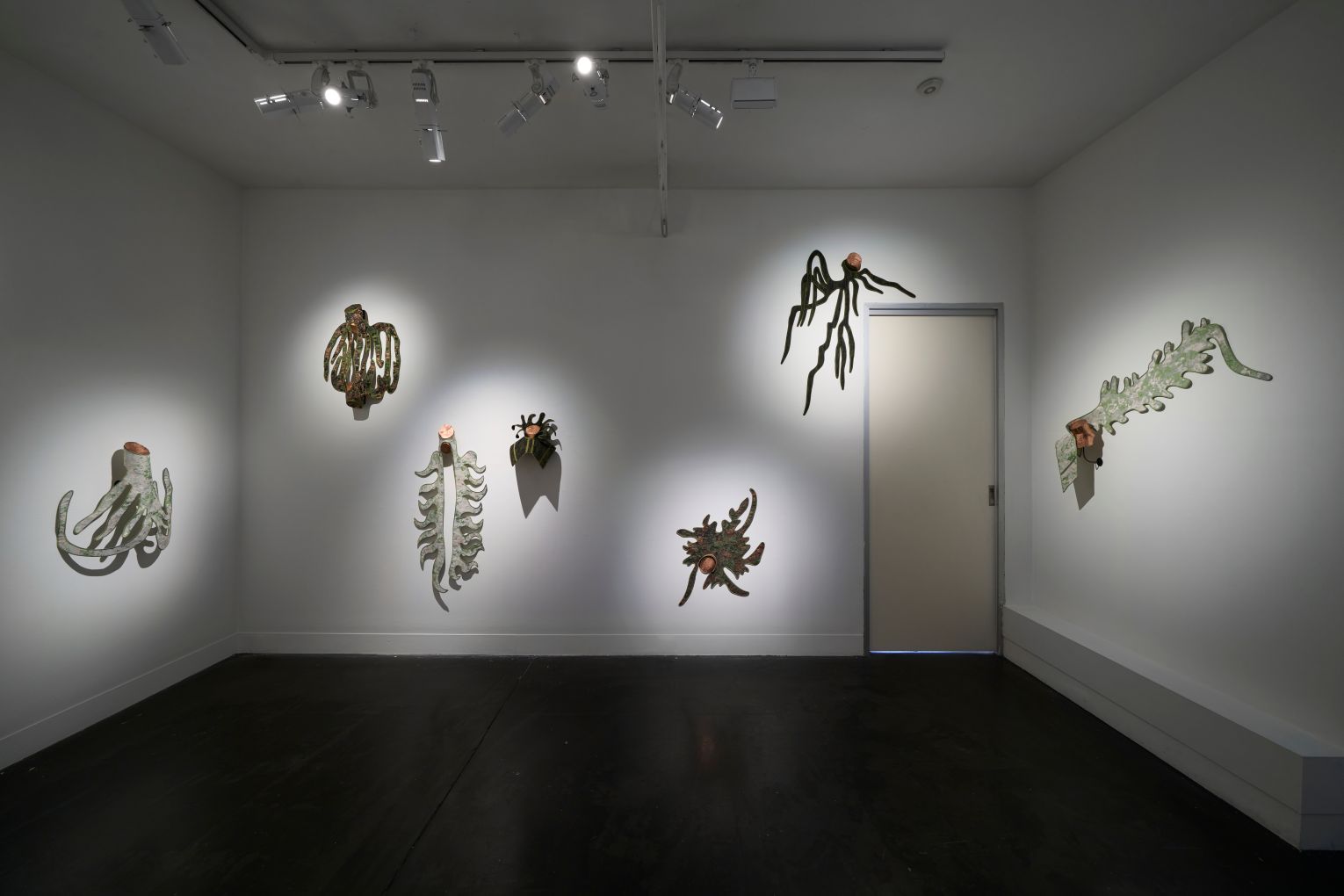
There is a perturbance of macabre beauty pervading Robinson’s latest exhibition, The Felling Place. An ancient English legend of brutal death by axe blow is transmuted into a warning of eco-horror, headless forms shift between human and vegetative allusions, luxurious jacquard fabric, trimmed with fine silk stitching, sprouts tendrils and ganglia. Welcome to the world of Adelaide’s pre-eminent contemporary artist working in the rarified field of folk horror.
Throughout her artistic career Robinson has created a substantial body of profoundly strange, unsettling sculptures, in which she delves for inspiration into Anglo-Celtic folklore, myths and legends. These provide imaginative source material for her sculptures in which she sets out to embody those dark, uncanny undercurrents that destabilise the rational everyday world. Her soft sculptures are frequently pierced and slashed with lethal metal spikes and sprout protuberances with paganistic phallic overtones.
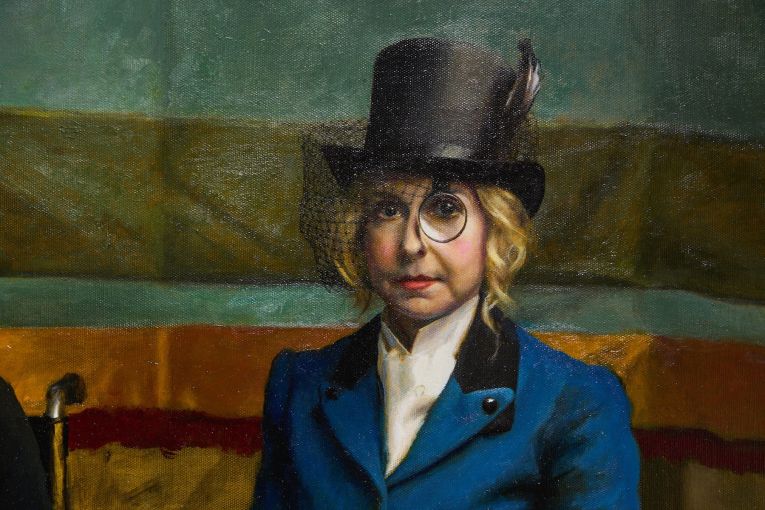
In 2020 Robinson created a major installation in the Museum of Economic Botany as part of the Adelaide Biennial, Monster Theatres, with this work subsequently being acquired by AGSA. She was honoured as the recipient of the 2024 SALA monograph, authored by Leigh Robb, Hannah Kent and Jess Taylor. That monograph revealed the full extent of Robinson’s fertile creative imagination across those twenty plus years since she graduated from Adelaide Central School of Art. She is a quiet, respected presence in Adelaide’s art world, lecturing in art at her alma mater and having been represented by Hugo Michell Gallery since 2022.
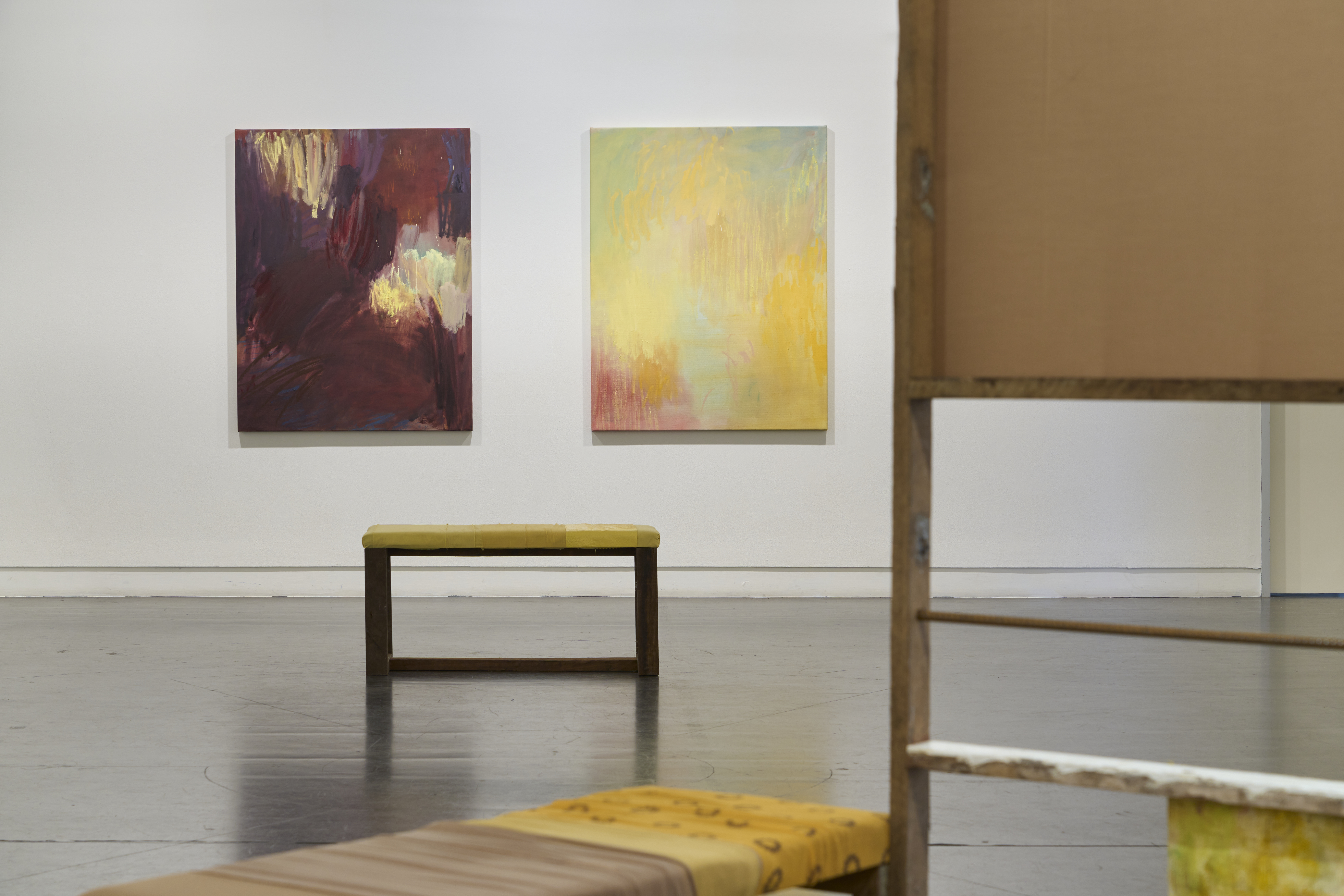
Before reaching Robinson’s latest body of work, the front gallery of Hugo Michell offers a suite of luminous abstract oil paintings from Brisbane-based artist Bridie Gillman. Landmarks is inspired by Gillman’s time spent in Yogyakarta, with its “patchwork of humidity-induced hues and textures” (Ida Lawrence, essay for Land marks). There are some truly glorious hues, identified by such richly evocative names as Alizarine Crimson, Quinacridone Red, Raw Umber Indigo (Banana Flower), or ‘Jogja Green’, a mixture of Phthalo Blue, Indian Yellow, French Ultramarine, Anglo-Saxon White. Although these paintings were mainly completed after her return to Australia, Gillman’s brushwork successfully retains the spontaneity and energetic application of working in the moment, responding to momentary stimulus of her surroundings.
You might like
There is a centrepiece installation comprising a timber frame clad in a patchwork of yellow fabrics found and variously acquired by the artist while walking around the streets of the local district where she was staying. The yellow tones of these fabrics have found their way into her paintings, with the uplifting mood of light-infused yellows filling the gallery as a counterpoint to vegetative and aquatic blue/greens and deep purples. The major painting in this exhibition is the titular Land marks. This is a patchwork of sewn canvases, where each piece represents a gradually accumulated record of the colours in all the surrounding paintings. The textural interest of the sewn sections, the balanced gradations of yellow tones and the structured design of the composition add an additional level of interest to this work.
In the rear gallery, Robinson’s latest exhibition moves away from her preoccupation in recent years with agrarian folk horror, exemplified by her finely stitched smocking, brutally pierced with the artist’s sculptural mutations of rusted steel farm implements. The Felling Place is a tale of beheading by axe, inspired by the Arthurian legend of Gawain, a knight of King Arthur’s round table, and the Green Knight, personification of vengeful nature. The setting for this tale is a dank mossy chasm, known in the legend as the Green Chapel, a site redolent with evocations of the ancient pagan and Anglo-Celtic nature myths of seasonal death and rebirth/ regeneration. For Robinson this tale is a metaphor for what she refers to as the “eco-horror” of a sentient and malevolent nature where beheading and tree felling are entwined.
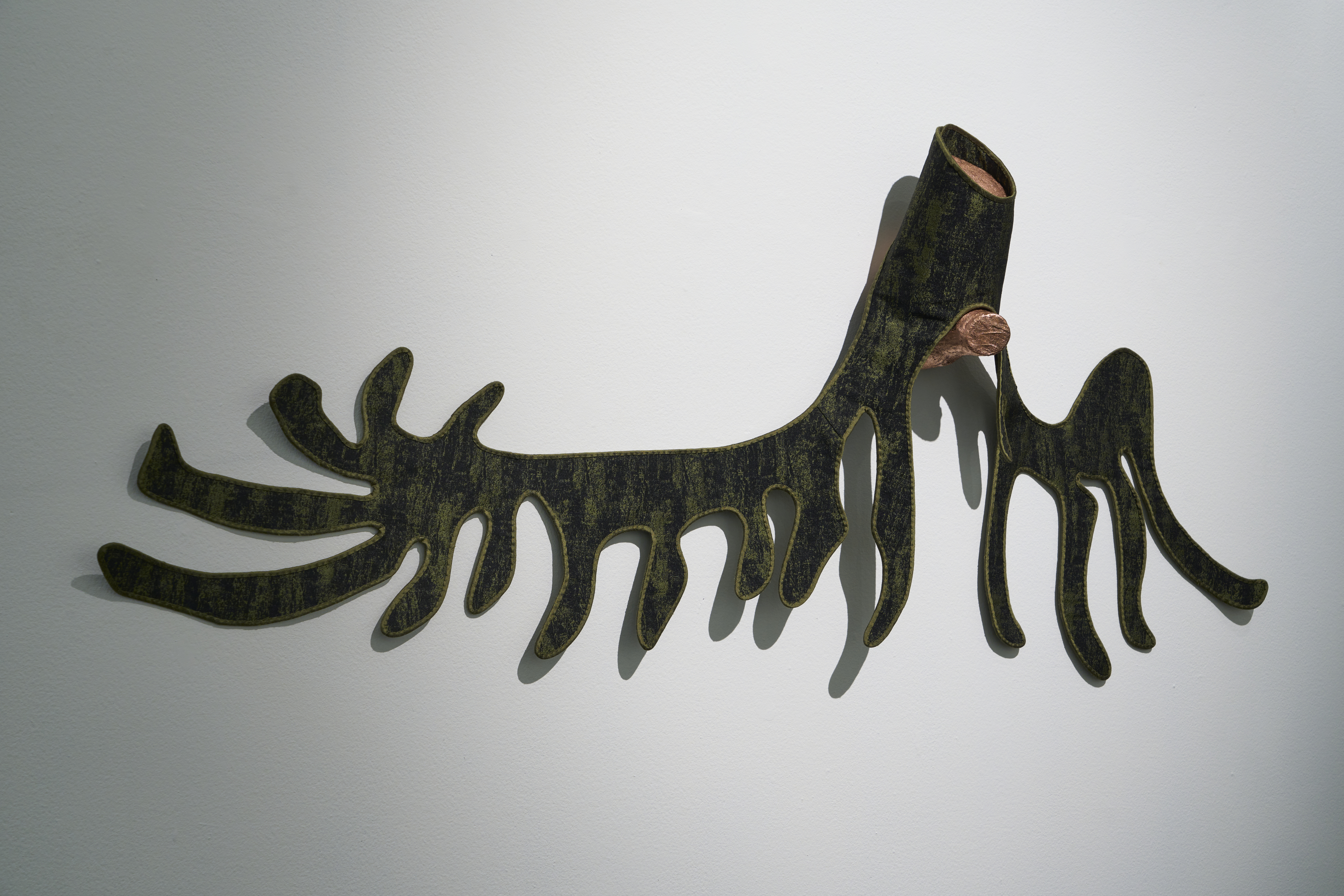
The Felling Place consists of a group of wall-hung sculptures, each comprising a section of copper-plated tree log which has been cut to emulate a decapitated human neck. These logs are ‘dressed’ in luxurious moss green jacquard fabric, which has been shaped into elaborate designs with evocations of both tree tendrils and human organs. Presiding over the group of ten is the key scene-setting sculpture, Woundwood, in which a lethal aura is imparted by a pair of rusted steel axes, blades welded together, juxtaposed with a mottled deep green jacquard, cut to resemble seeping pools of blood. Robinson always delivers beautifully crafted and conceptually fascinating work, but in this group, apart from the menace of Woundwood, subliminal horror is muted. The copper-plating of the logs neutralises their natural raw potency. Juxtaposition of these copper forms with the luxurious moss shades of the jacquard textiles is so refined that the uncanny element that Robinson has successfully evoked in many of her works in the past is quelled, lingering as a faint reverberation.
Julia Robinson: The Felling Place and Bridie Gillman: Land marks are on display at Hugo Michell Gallery until April 11. Julia Robinson is giving a free talk on Saturday April 11 at 1pm.
Want to see more stories from InDaily SA in your Google search results?
- Click here to set InDaily SA as a preferred source.
- Tick the box next to "InDaily SA". That's it.
Free to share
This article may be shared online or in print under a Creative Commons licence