Stephanie Radok’s spectral trees invite slow reflection
An exhibition from artist and writer Stephanie Radok’s presents portraits of skeletal, leafless trees from around her garden. Slowly but surely, they take root.
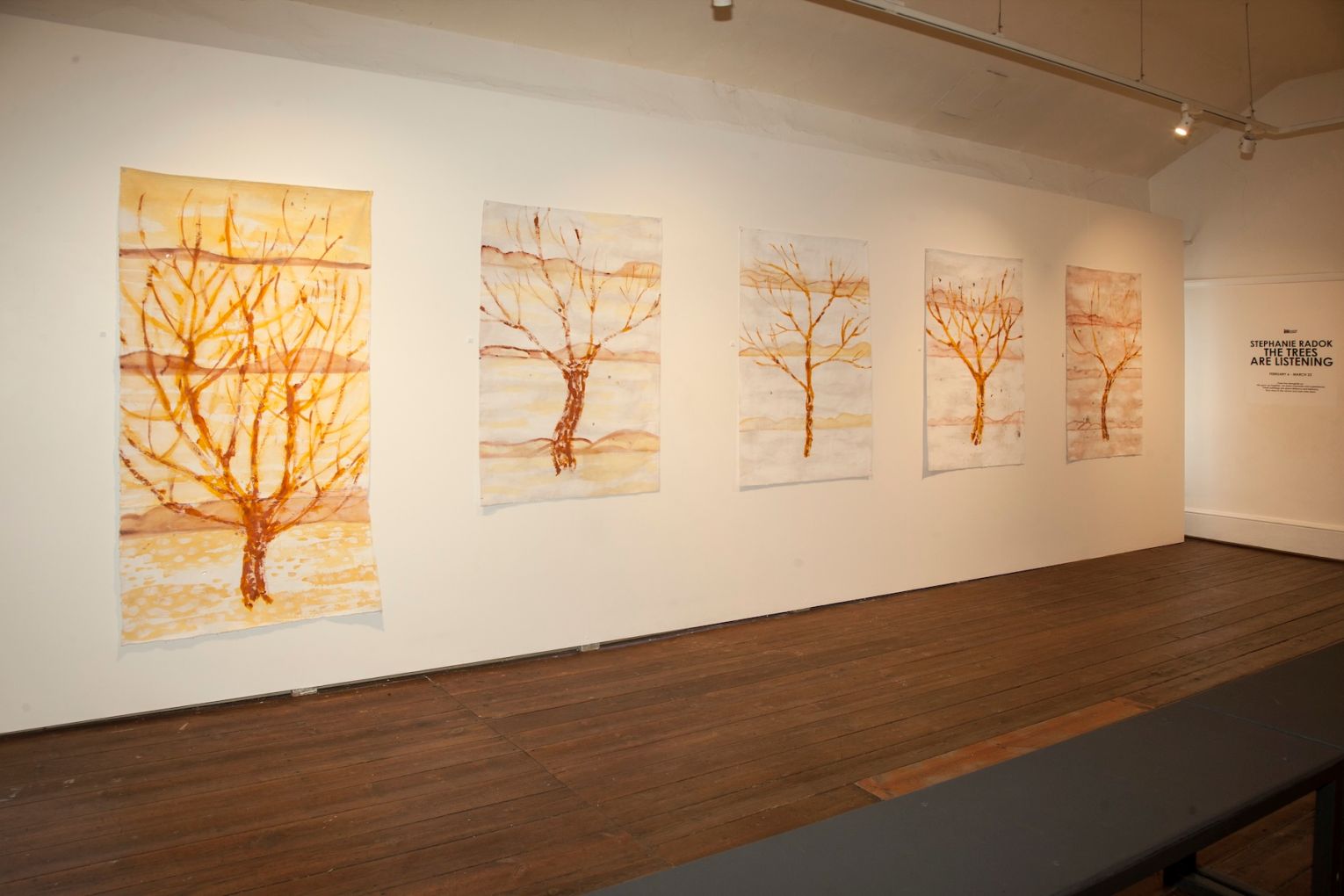
Enter the upstairs gallery via the narrow winding stairs. The old pine planks creak a welcome from an earlier time. Treads, skirting, nosing, risers, stringers, newel posts, balusters and handrail complete the balustrade package. Thus, shoehorned into this gallery space with the aid of a vertical conveyance, named after a 17th century mash-up of German, Dutch and English words, one enters Radok’s forest of trees.
But stay with words for a moment. Radok is not only a visual artist but a writer. She has published several books which reflect a lifetime of collecting ideas and words which find their way into notebooks for later reference. Becoming a Bird: untold stories about art (Wakefield Press 2021) has been variously critiqued as a “brilliant and eccentric book, loaded with insights” and containing insights which “shine out like gemstones in a rock face”. Her most recent book, Under the Bed, Inventories 2020 (Wakefield Press 2025) is crowded with notebook recollections, aphorisms and fleeting thoughts. Organised within monthly chapters, they invite the reader to join the artist in engaging with whatever a day throws up, in a mindful way.
It was the time of Covid, when the artist along with many others was given an opportunity to audit their inner lives. For Radok some insights spoke directly to her sense of trying to be authentic in the act of making art. A June 2020 entry reads, “Making art works makes me think again about what it is to make something rather than talk about it – it’s all decision/decision/decision. One after the other. And doubt/fear/, complex/simple, refined/raw, slow/fast, skilled/loose … alive and engaged in the moment. Artwork – care/caring/careful to be free/ to get lost in it.”
But first there is a staircase to climb. The yoga class is finished. I can ascend. The poet Vaclav Havel had it that “it is not enough to stare up the steps we must step up the stairs”. In Becoming a Bird she writes about entering the Egyptian Room in the South Australian Museum, up a spiral staircase: “These stairs are a kind of detail that enters your dreams; I have often climbed them in my sleep talking to various acquaintances along the way.”
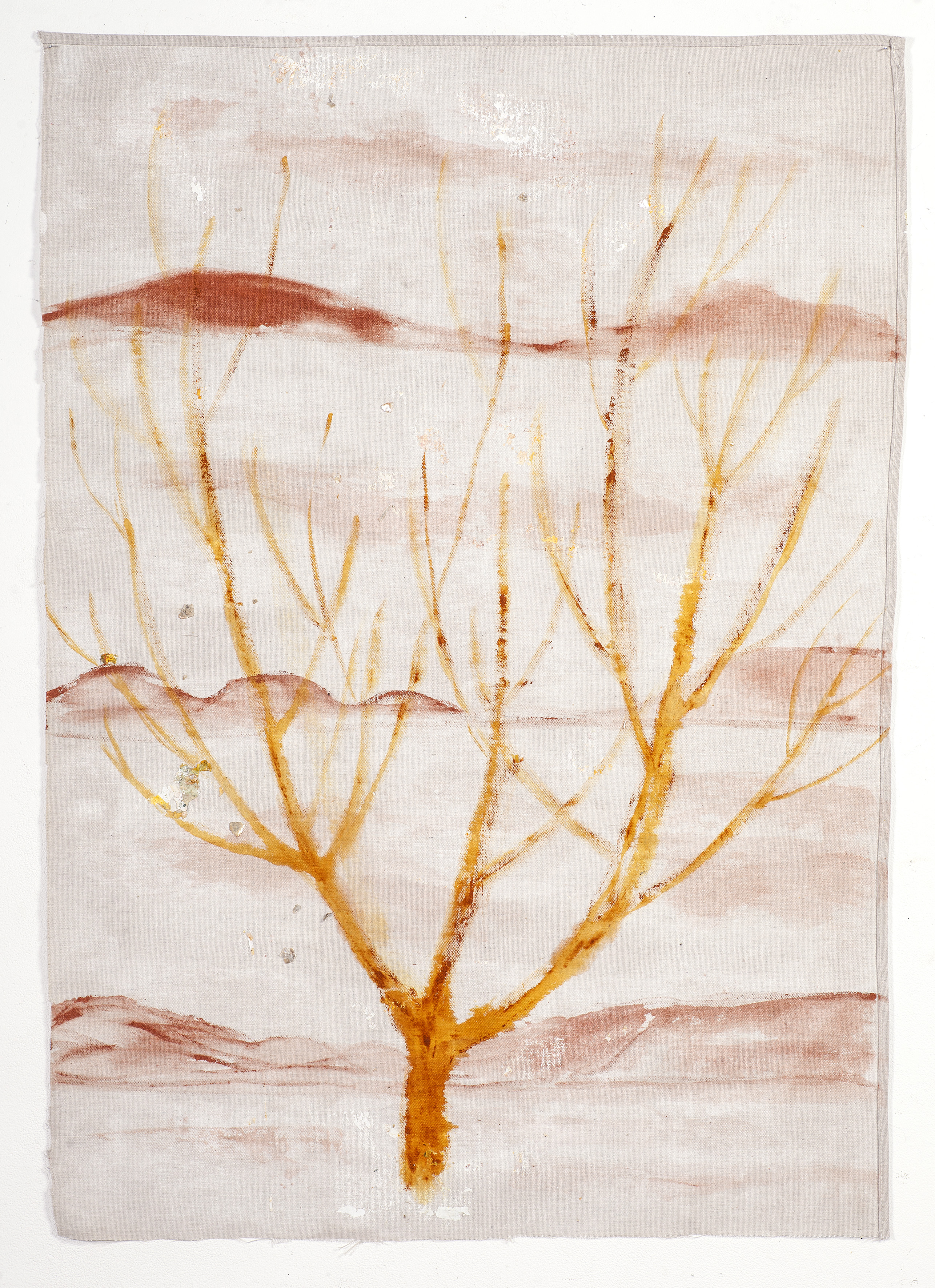
Finally, the trees. There are thirteen of them. Each one is a portrait of a tree from the artist’s garden, inscribed on a canvas panel pinned to the wall. They are skeletal and devoid of foliage. There are distant horizons delineated with a few gestures of the brush. They look like faded sketches of maritime artists recording coastlines. The artists says that these horizons were based on coastal profiles of parts of South Australia drawn by William Westall in 1802 when he was on HMS Investigator with Matthew Flinders who was mapping Australia’s coast.
These are bare-boned works. The colours have been sucked dry of intensity by the sizing which leaches the pigment of body and creates a stuttering of gesture as the brush tries to delineate lines. The artist reveals that the images are inspired by Egyptian wall paintings, cave drawings, tapa, worn walls and frescoes. There is a glare factor at work, as if looking at the trees and into the distance in the face of an Adelaidean western sun on a clear hot day. Flecks of mica embedded in the surfaces add to this sense of hard glitter and dryness. The artist’s sensory intuition, fuelled by time spent contemplating her natural surrounds, has paid dividends. But it does demand commitment from the viewer to simply sit and stare, surrounded by this spectre of a forest and imagine, if only fleetingly, what spectacle played out in the minds of maritime explorers, encountering this place for the first time.
Subscribe for updates
Radok says that the exhibition “asks the visitor to slow down and breathe deeply, letting their eyes travel into the distance while observing what is nearby. To remember the trees, they know. And to allow calm and a sense of space to enter the body and mind”.
One of the artist’s published observations states that “painting is an act and all the planning in the world doesn’t do it”.
That’s worth keeping in mind when spending time with these works. Allow the images some space to enter the imagination and find a home there.
Stephanie Radok: The Trees Are Listening is presented at Hahndorf Academy until March 22 alongside Quentin Gore: Abundance, Datsun Tran: Abundance and Harriet Geater-Johnson
Want to see more stories from InDaily SA in your Google search results?
- Click here to set InDaily SA as a preferred source.
- Tick the box next to "InDaily SA". That's it.
Free to share
This article may be shared online or in print under a Creative Commons licence