Greg Johns retrospective is a landmark exhibition – and an exhibition of landmarks
Greg Johns’ sculptures are recognisable sights around Adelaide. A 5o-year retrospective survey reflects on Johns’ remarkable journey experimenting with space and shape.
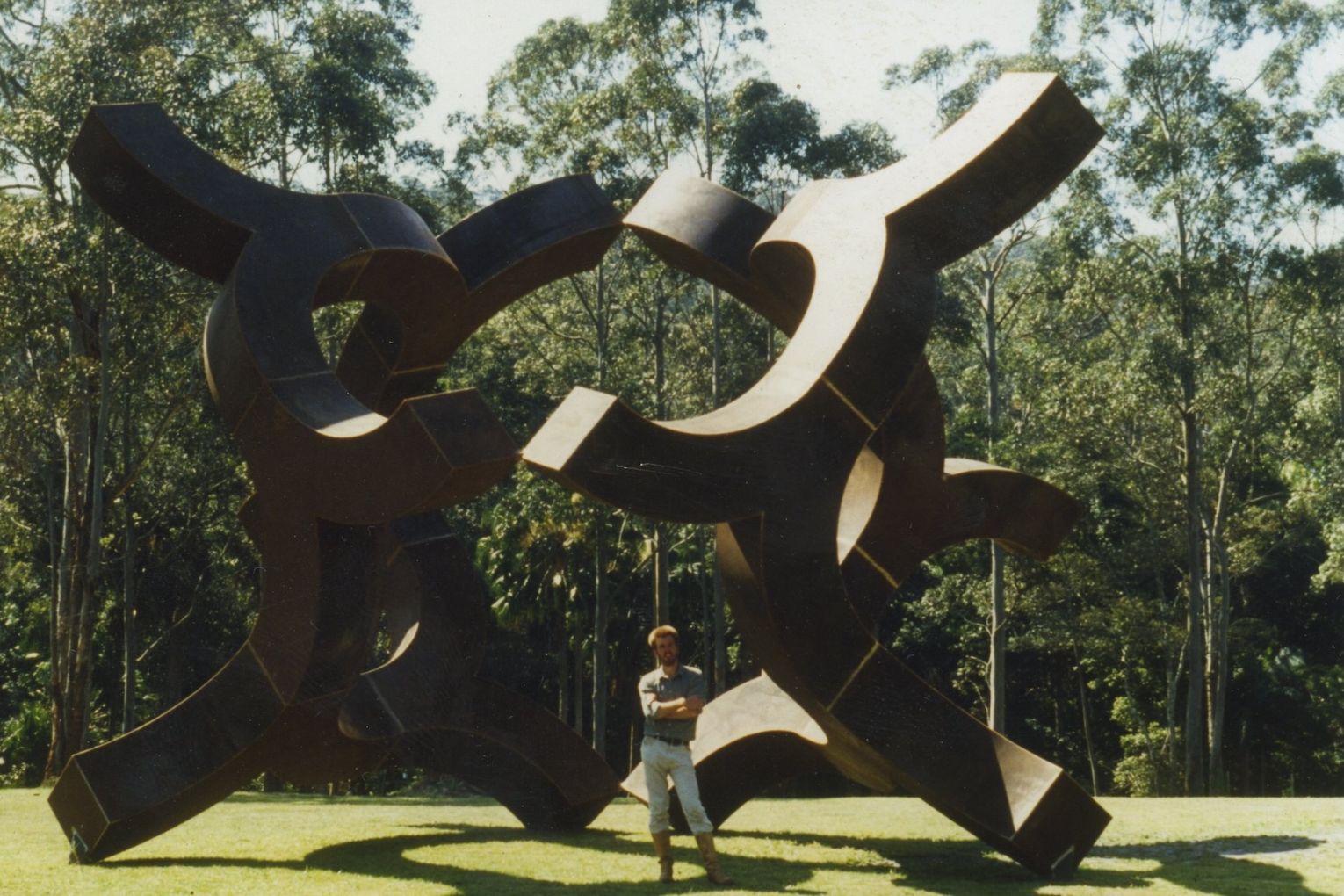
Ask me or anyone who knows how to produce a painting, to create one for a show in a month’s time. No problems. Any pictorial artist with some skills should be able to produce one and maybe more. But a sculpture, one made from welded steel and complex yet coherent in its structural design – now that would be a challenge, make no mistake.
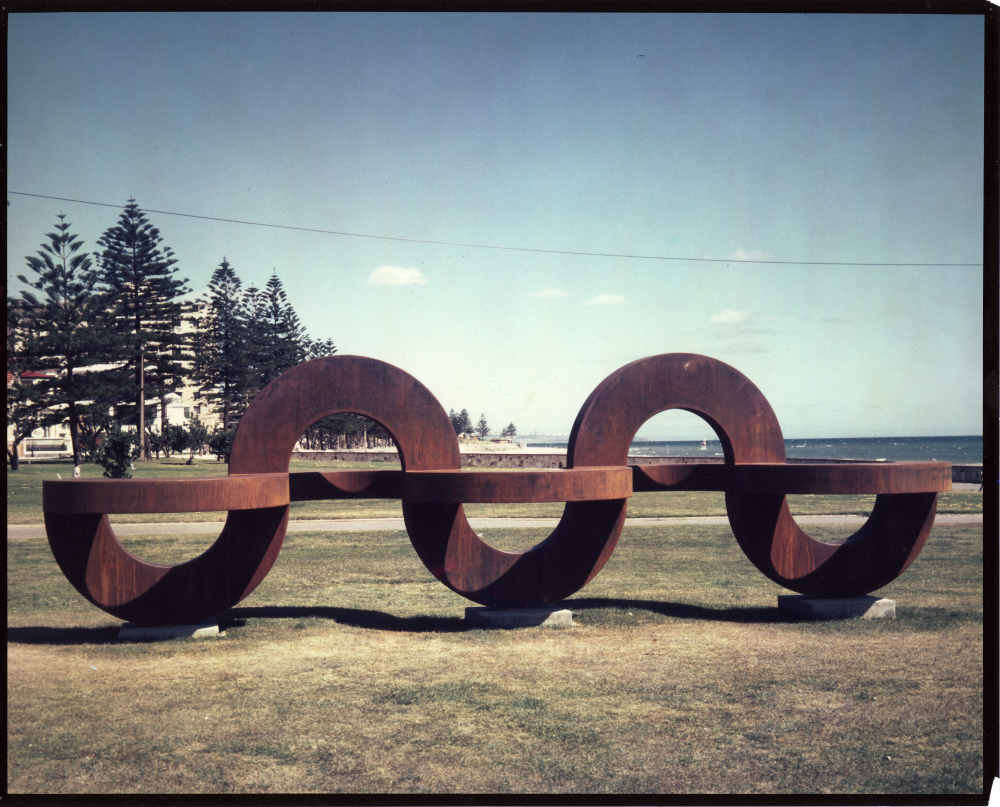
Being a full-time sculptor, making not only plinth and floor works but very large-scale public works is now a very demanding profession, physically, financially and conceptually. The bar is now a lot higher; large scale commissioned works need to be compliant with a raft of engineering, risk assessment and environmental regulations. Add to this commissioning committees’ expectations about the style of the work in terms of the thematics of the project. Greg Johns paid little heed to such realities when he embarked on his first major work Rhythm, 1978, installed and still sited at Glenelg foreshore. 50 years later he reflects in this landmark exhibition on a remarkable journey. It was and remains driven by a passion to not only make sculptures but to create large-scale works for public spaces.
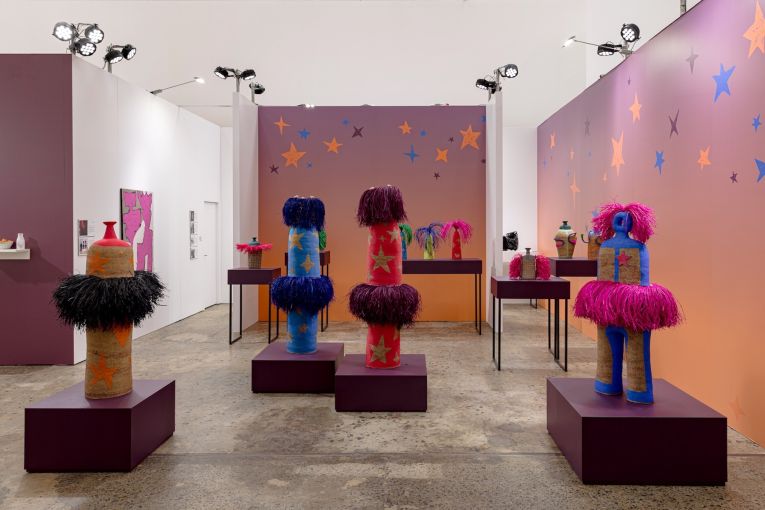
Remarkably, the Segwood Galleries spaces have been able to accommodate a comprehensive survey, nestled within Segwood’s changing display of designer furniture. It resembles, for those who have experienced it, a wander up the drive at the artist’s house in Eden Hills and into his workshop/ studio. At every turn are tall sculptures made over decades, massed like tree trunks in a forest. Works under construction lie on the floor or are propped against a wall. In a rear space is the artist’s ‘museum – maquettes of works from the 1970s to the present. Johns has recreated this archive (in a more curated fashion) in the gallery. So, it is possible by looking from one work to another to appreciate the transitions which have defined his progression of ideas to the present.
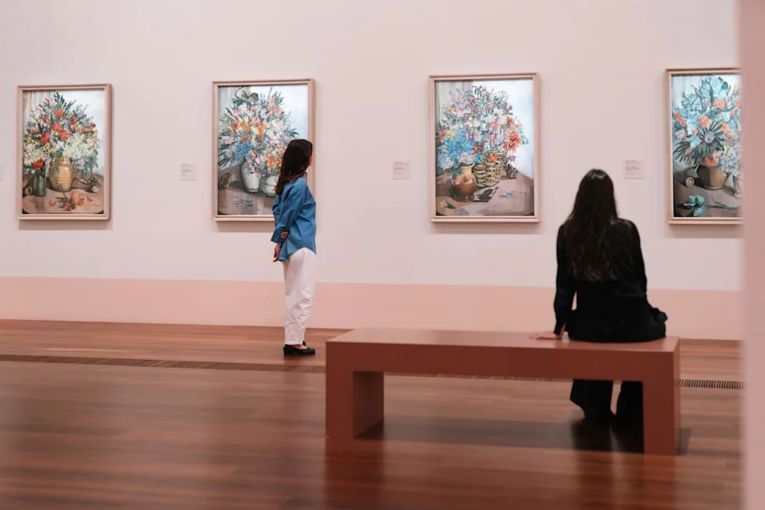
Also, there is space to move around many pieces to recreate the artist’s conversation with forms. Nothing gives him greater delight that to explore the possibilities of endless variations within a closed system. Try for yourself in the exhibition; fix on a work and move around it, noticing how many suddenly flip from say a circle to a square. Space, in an instant becomes an active component as seen in several mandala forms.
I occasionally meet people who think that Johns’ art is all geometric ‘international abstract style’ that faded from fashion late last century. They might be thinking of the large, squared circle work at Carrick Hill. This exhibition offers an armchair ride correction. The multiple transitions are literally within arm’s reach.
His originating form was the triangle, which appeared in sculpture of the mid 1970s. The triangle was followed by the circle with simple extrapolations of circular motifs gradually overtaken by more complex structures composed of half circles, then quarter circles interlocked in chain-like configurations. These configurations, which the artist refers to as “wave forms”, were a significant breakthrough in terms of creating a constantly unfolding sequence of views. Look for the ‘Y’ or ‘Tri form ‘unit which emerged in the early 1980s, which was derived from fusing quarter circles. Combination of these ’Y’ units, introduced rhythm and further complexity, can be seen in his Mandala works in the exhibition,
Another preferred motif of this period was the ‘squared circle’ – forms that presented as regular rectangular cubes from one viewpoint, suddenly flipping as the viewer changed position, to present as orbital or circular. There are examples of another break out motif of the 80s Another breakthrough of the 1980s, the wave column, representing electromagnetic wave patterns but later co-opted to reference the heat shimmer of inland arid landscapes.
Subscribe for updates
In the later 1980s figurative elements emerged in the form of shields, masks and guardian figures. It is interesting to see maquettes, early variants of such ‘guardian figures’, gradually levitating and adapting to life somewhere between earth and sky. Key motifs within this group are dagger-bladed helmeted figures, flying ‘shape-change’ figures, shield forms, towering guardians and spirit figures.
These figures were taken on a journey into the 1990s, corresponded with a growing interest in the Australian landscape as both a physical and cultural space. The hieratic qualities of early figures were gradually softened to become ‘floating figures’, with outstretched arms, as if winged, often appearing weightless, hovering above the ground.
By the late 1990s, the horizon figure underwent radical change as the central dagger-like body swelled into a curvaceous elongated heart shape (as seen in the three large guardian figures against the end wall) and the outstretched arms drooped down almost touch the earth. By this time Johns had expanded his methodology to include freehand drawing in chalk onto metal sheets before cutting. The result was a more organic and intuitive ‘feel’ in the forms. This explains the presence of some skeletal figures, which despite their cut steel character would likely melt into mirages if exposed to the glaring light of an arid landscape.
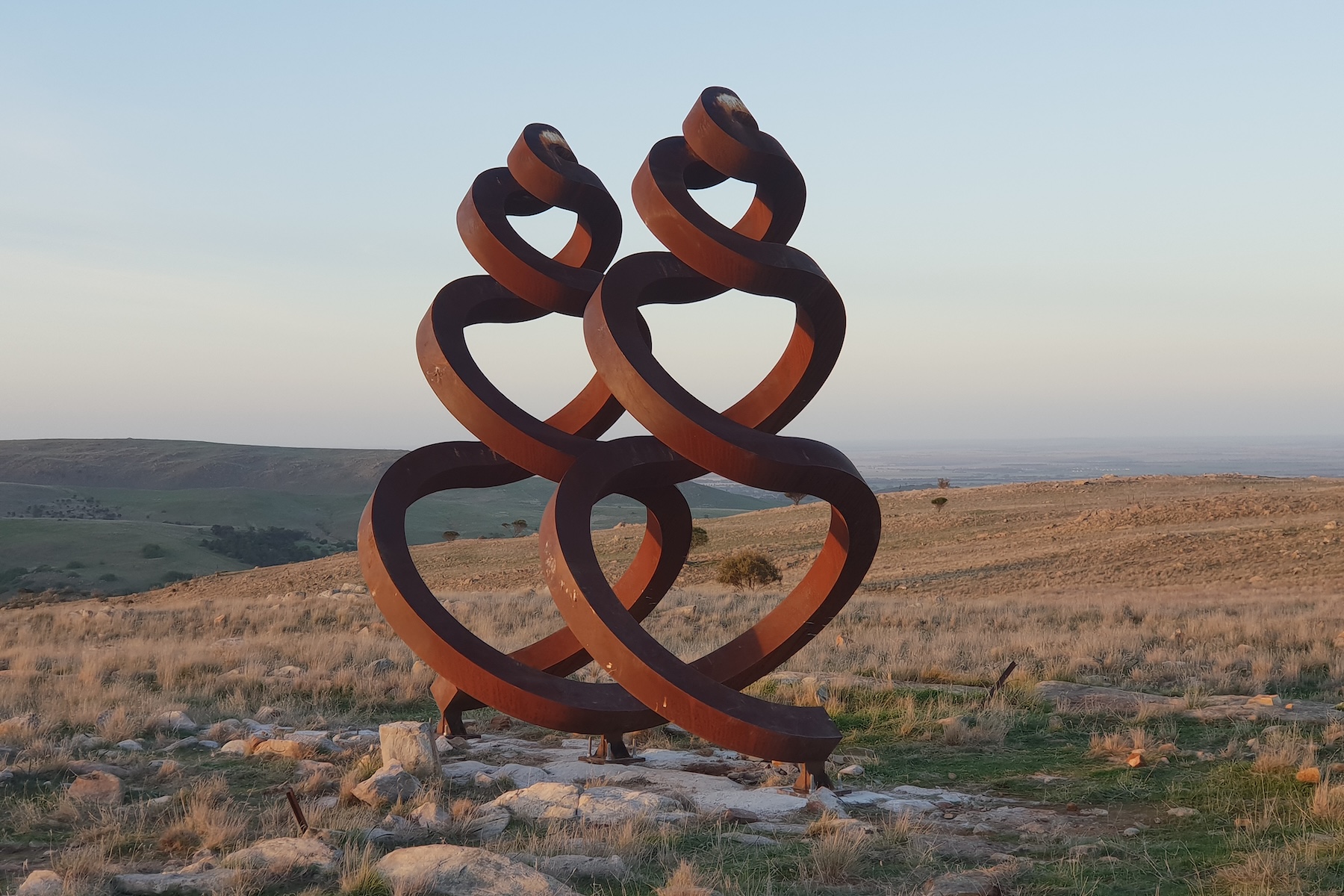
If curious about how such works, on a larger scale, behave in an outdoor setting, get to the Palmer Sculpture Biennial 2026 where you’ll encounter around 30 site specific works by around 30 artist and also experience a number of Johns’ works in the 50 Year Survey exhibition at Segwood – out and about, on a grand scale and doing battle with the elements.
Greg Johns: Against the Grain, With the Flow is on display at Segwood Galleries until March 28
Want to see more stories from InDaily SA in your Google search results?
- Click here to set InDaily SA as a preferred source.
- Tick the box next to "InDaily SA". That's it.
Free to share
This article may be shared online or in print under a Creative Commons licence