Theatre review: Death of a Salesman
With a first-rate cast led by Anthony Lapaglia, Neil Armfield’s brilliantly staged revival of Arthur Miller’s American classic is as prescient in today’s gig economy as it was in 1949.
In a television interview for the BBC in 1987, marking the publication of his memoir Timebends, the lanky, owlish Arthur Miller raised his arm and waggled his forefinger and moved it in front of him. “My plays”, he mused aloud, “are about how all birds come home to roost. They fly around doing a thousand things and the branch is empty. But one by one they have to come back down and sit on it. And that’s the play – the descent into the present of the past.”
Like Sophocles, Aeschylus and Euripides, the Greek dramatists he so admired, and the early Modernists – Zola, Ibsen, Chekhov and others – with their newly evolved notions of Naturalism and the twin forces and nature and nurture, Miller’s plays are about the inevitability of consequences – and tragedy as destiny.
It is a defining feature of them: All My Sons, A View from the Bridge, The Crucible, and, most particularly, Death of a Salesman. Written in six weeks in 1948 (the director Elia Kazan observed that Miller “didn’t write the play, he released it”) Salesman premiered in Philadelphia a year later. It made him, as he noted, “famous all at once.” Adding wryly, “After fifteen years of work.”
With his central character, Miller wanted to portray the tragic fall of an ordinary man. Calling his protagonist Loman (low man) seemed to underline this point but, in his excellent biography, American Witness, John Lahr tells us that actually the name was taken from the terrified detective, Lohmann, in Fritz Lang’s 1933 film The Testament of Doctor Mabuse. Although it was written in the late 1940s, the roots and branches of Death of a Salesman are in the Great Depression two decades earlier. The trauma of the Crash had a range of consequences – despair and ruin, of course , but there was also a kind of paralysis, of denial, leading instead to exaggerated optimism and a delusion that the much-vaunted American Dream was still coming true.
Like many of his generation and those before and since, Willy Loman has a perilous belief in self-belief, and that his destiny is entirely self-made. He is caught in the notion that his worth is measured in dollars and his reputation by popularity. These are the cup bearers of luck. It is the secular version of the puritan Prosperity Theology so shamelessly revived and paraded today.
Miller was asked by a play-goer – what is this salesman selling? What are the samples in his heavy suitcases? Miller’s reply, “He is selling himself.”
And Willy, summarily dismissed by his employer as useless and redundant, is now discovering there are no buyers.
You might like


Over the 77 years of the play, Death of a Salesman has intersected startlingly with the times – the American times, which we know all too well, are to a great extent, our times also. For a period, in the 1960s, optimism for a progressive future was high and Death of a Salesman seemed dated and obsolete – certainly for me, writing undergraduate essays about it. How wrong that turned out to be.
Because then came the financial hiccups which increased into conspicuously tubercular consumption – the 70s fuel crisis, the Greed is Good ‘80s, the 1989 Meltdown, the Dotcom Bubble, 2008 and Subprime, Covid-19.
And where are we now? In these Trumpian, AI-driven End Times, Death of a Salesman speaks to us louder than ever, but in ever-new ways depending on the fortunes and fears of the moment.
Miller reminds us that these financial crises, which occur within the huge wheel of rising and falling commerce and capitalism, greatly affect real people. Workers who only want modest prosperity and shelter for their families, and recognition and security for their industrial fidelity. And employers, stressed and uncertain about their responsibilities for maintaining thriving profitable businesses .
Except, of course, the play we see now is through the dark lens of oligarch mega-profit and reckless, ruinous de-regulation.
In director Neil Armfield’s outstanding new production (from GWB Entertainment and Andrew Henry) Death of a Salesman has found new life. And is also admirably true to Miller’s “poetic vision”. He had initially intended to call the play The Inside of his Head and toyed with idea of using a proscenium in the shape of a human cranium. He also tellingly noted that “In a certain sense, Willy is all the voices.”
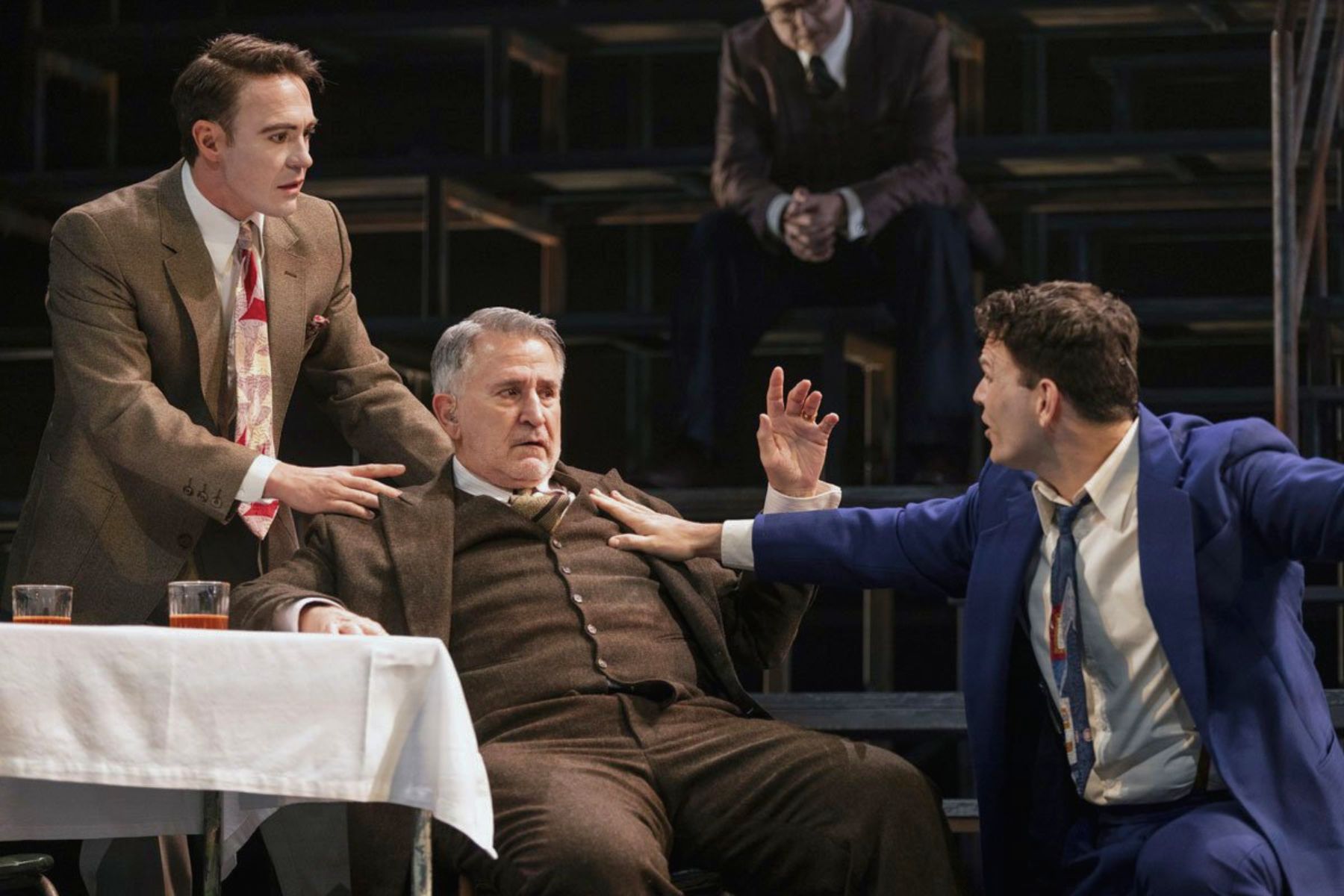
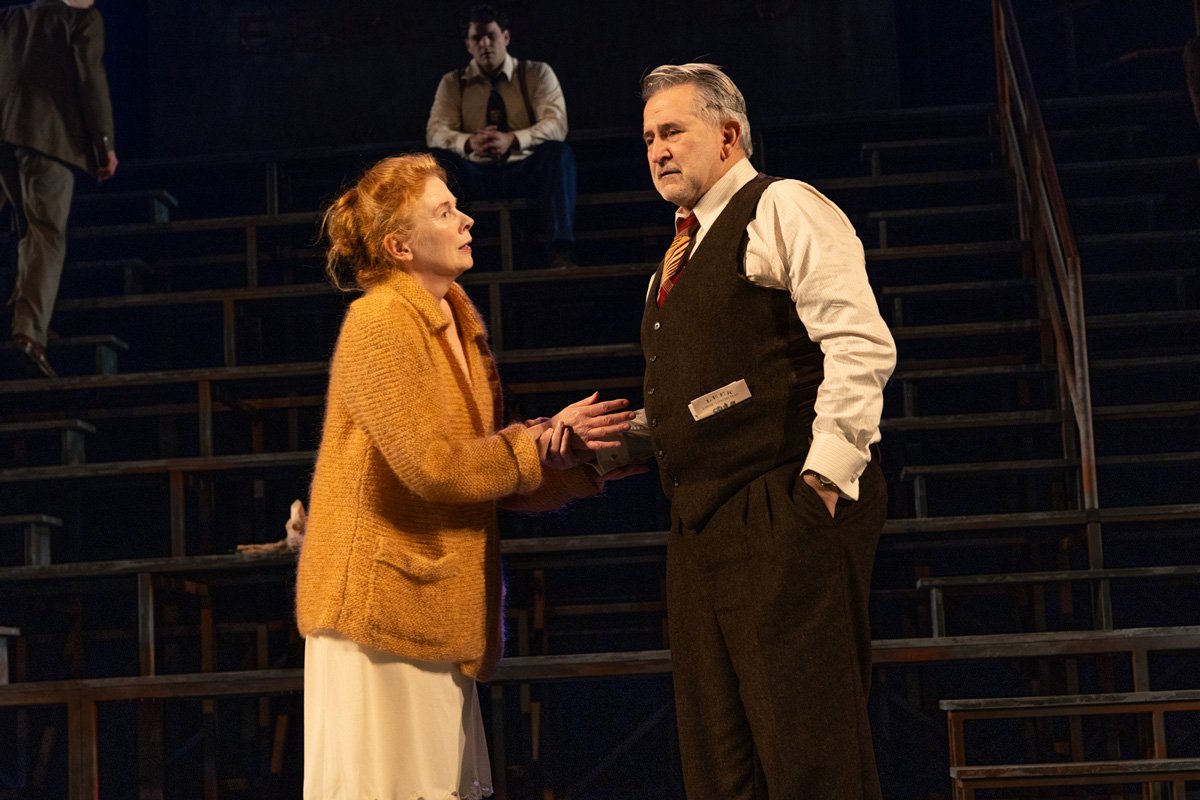
Armfield and designer Dale Ferguson have dispensed with even the partial naturalism of Jo Mielziner’s original concept. His “skeletal house” has now become an eleven-tiered bank of bleachers with a lookout room above, representing a 1940s version of Brooklyn’s Ebbets Field baseball and gridiron stadium.
There is performance space in front with nondescript tables and chairs for domestic, office and restaurant scenes during which cast members not included are artfully placed in scattered seating on various levels of the bleachers. Splendidly, even sometimes sumptuously lit by Niklas Pajanti the effect is of a forum, or a jury – or even deities witnessing Willy Loman’s gradual decline into the lower depths.
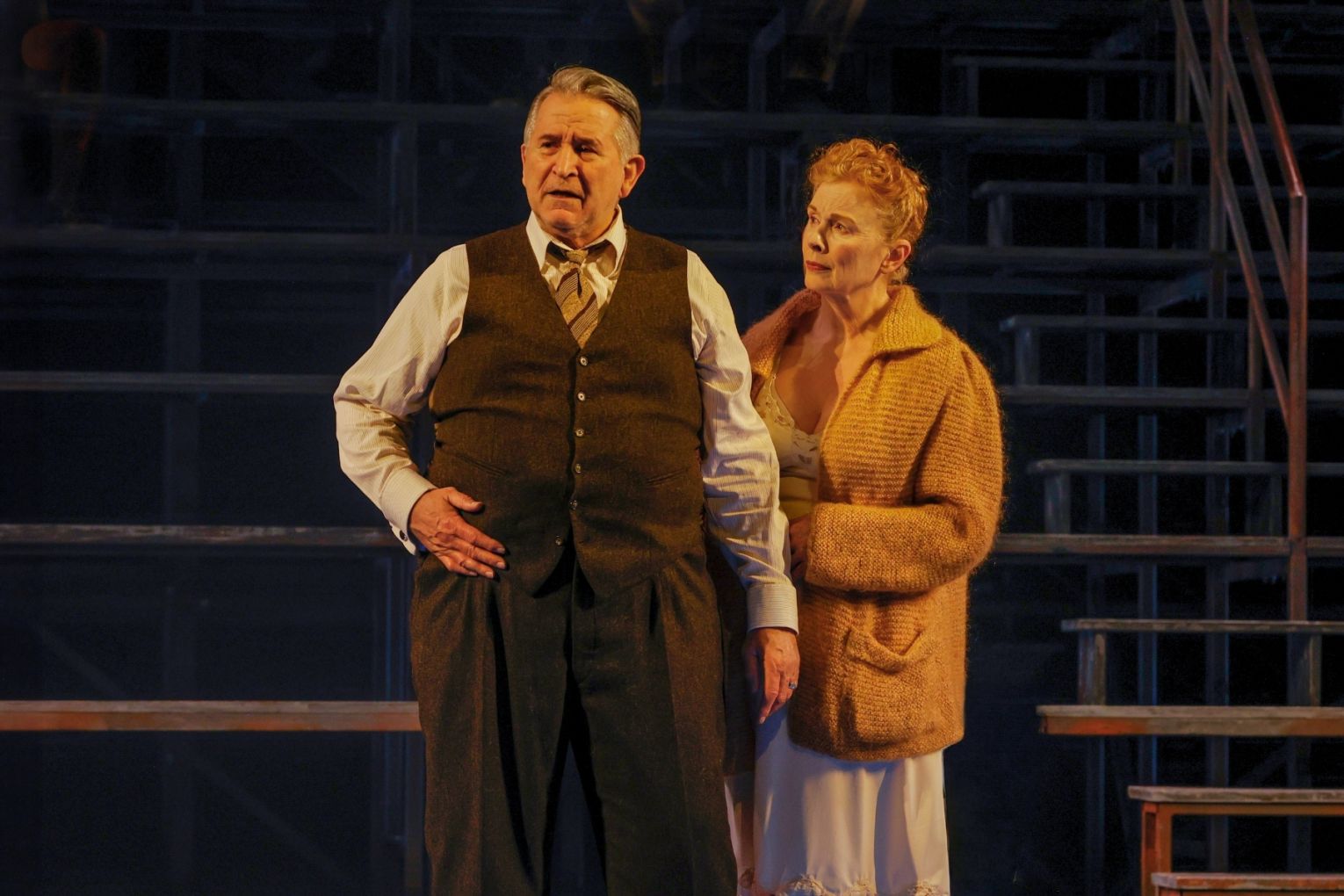
This is also an inventive solution to the abrupt shifts of time and dimension that occur because of the phantasmagoric nature of Willy’s dislocated consciousness. Dale Ferguson and Sophie Woodward use cleverly simple costume changes to differentiate past and present – Linda Loman’s orange cardigan for instance, or retro sportswear for sons, Biff and Happy.
The production is enveloped in mostly subliminal sound textures from David Greasley and David Tonion – that is, with the exception of the final auto cacophony late in Act Two. Mention is also due for longtime Armfield collaborator, the composer Alan John, whose score for strings, flute, woodwinds and perhaps marimba flutters just below the dialogue or, more strikingly, ushers in a change of scene.
Subscribe for updates
The performances are uniformly excellent, making the ensemble experience theatrically compelling. As the looming shade of Willy Loman’s older brother Uncle Ben, Anthony Phelan, in broad hat and long boots, delivers his rebukes in stentorian Yankee tones. One of the louder voices in Willy’s head, he also reminds us that he “walked into the jungle at seventeen and when I walked out at 21, by God was I rich!”
As the women carelessly and dishonourably treated by the Lomans, senior and junior, Luca Sardelis plays Jenny and Letta, Elizabeth Blackmore plays Miss Forsyth, and Paula Arundell memorably navigates the role of Willy’s on the road paramour, known only in the text as The Woman.
Closer to home are the neighbours, Charley and his son Bernard. Marco Chiappi brings depth to the kindly, but bemused, Charley whose assistance Willy both needs and resents, discovering only belatedly he is his only true friend. James Smith, as Bernard, provides a lively comic nerdiness alongside the strutting sports jocks, Biff and Happy, but also brings emotional shading into the later scene with the rapidly unravelling Willy Loman.
Another leading Adelaide actor, Mark Saturno, delivers two excellent cameos – one as a waiter steering diplomatically around the chaotic bar scene when Willy and his sons are supposed to meet for some family sit-down reconciliation. Then as Howard Wagner, the son of Willy’s original boss, giving his longtime employee the flick while blithely ignoring his impecunity, Saturno captures a very recognisable instance of privilege and employer bastardry.
In the key roles of the Loman siblings with the gee-whiz nicknames and easy excuses, Ben O’Toole as Happy and Josh Helman as Biff, with Armfield’s guidance, highlight the capture of two young men in postwar American adolescence. Goaded by their father to flaunt their sporting prowess and lucky good looks, they have become shallow and narcissistic, hooligans at school and abusive of women.
O’Toole’s Happy is lazy, sly and go-lucky, using his salesman’s charm to seduce gormless party girls, negligent and indifferent to his father’s misery, and his mother’s humiliation, he works constantly to keep Biff down at his easy level.
Josh Helman as Biff has a deeper character path to discover and his crisis (and genuine self-discovery) is a reminder of Miller’s insightful writing. It is Biff who calls halt on the fantasy of wealth and celebrity and his final scene brings an important dimension to this production.
Also key to the success of this reading of Salesman is Alison Whyte as Linda, the put-upon wife and mother who is both victim of the failings of the Lomen, and their fiercest protector. Whyte’s is a clear and vivid voice in the play, her accent is impeccable and she rises above the morass, only to find both her husband more mired in self-deception and dishonesty. Her “attention must be paid” is a famously quotable speech but it can also be sanctimonious and an easy emotional penance for the audience. Not so here. When Alison Whyte says it, no one is off the hook.
And then there is Anthony LaPaglia, whose grimly determined but heart-broken portrait in hat and cheap suit, has been potently successful in the online marketing of this production tour.
In his fedora with the brim slightly lifted, heavy padded jacket, his tie askew, and shirt collar bent, he arrives with heavy baggage in both hands and, as he dumps the cases on the stage, the unravelling begins. LaPaglia as Willy is forlorn, irascible, a bully to some, craven to others, lost in reveries of imagined golden times, a praiser of his own past, and valiant optimist for a change in the weather.
His performance is true to Miller’s text. He is irritating, deluded, mulishly stubborn but he is still a person of worth, Anthony LaPaglia allows him that and much more. He speaks for Willy Loman and shows us why. Arthur Miller couldn’t ask more of his play than that.
LaPaglia’s delivery at times dims, and he seems sometimes short of breath, but this only brings conviction and pathos to the predicament he is in and the indifference around him. Only Biff understands he has backed the wrong horse. And Arthur Miller is reminding us that successive generations (including us) are trapped in a dream that is full of nightmare.
Death of a Salesman is a play which keeps tracking our times because its questions are perennial and increasingly timely. When Biff asks himself what is his life for, what is it that gives him purpose – and more importantly, realises that he is more than just a cog in a wheel, an industrial cipher – it is our question too. Willy it turns out, is in the gig economy, and so are we, or those very near us. Linda Loman said attention must be paid. This terrific production of Arthur Miller’s masterpiece shows us where to look.
Death of a Salesman continues at the Festival Theatre until October 4
Want to see more stories from InDaily SA in your Google search results?
- Click here to set InDaily SA as a preferred source.
- Tick the box next to "InDaily SA". That's it.
Free to share
This article may be shared online or in print under a Creative Commons licence