Music review: Jayson Gillham and Iyad Sughayer
Returning to the stage following prolonged controversy and legal strife, Jayson Gillham proved again that he is a pianist who wants to be heard.
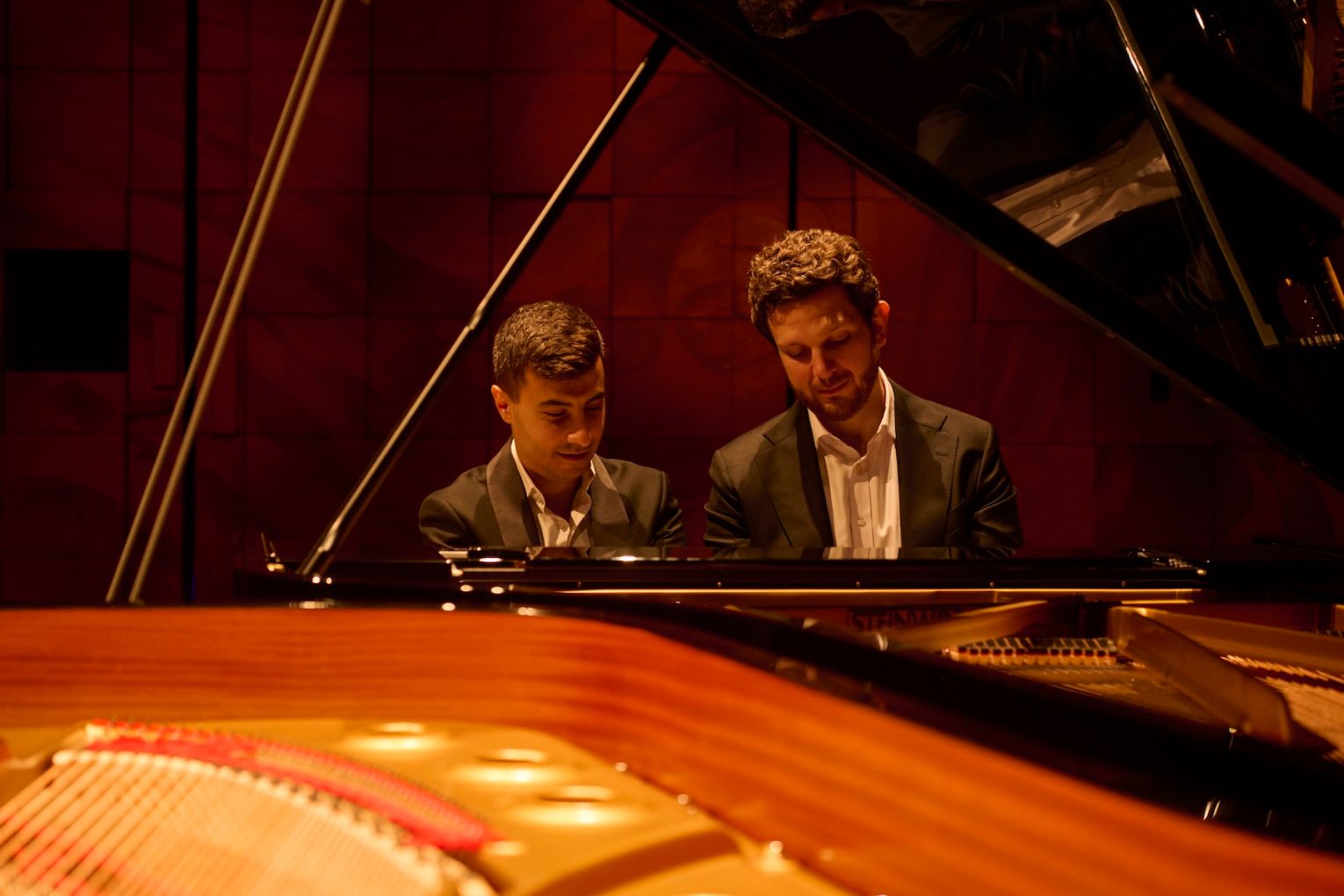
Pianist Jayson Gillham’s legal case against the Melbourne Symphony Orchestra ended, as many concertgoers will be aware, with the Federal Court ruling in favour of the MSO. The Queensland-born pianist had claimed it had unlawfully cancelled his scheduled concerto appearance in August of 2024 following statements he made in a prior recital regarding Israel’s treatment of journalists in Gaza.
Heavy controversy has accompanied the London-based pianist since that time, with the consequence that Gillham has not received work with any orchestra in Australia. That has not stopped him from coming back though. Yet his ‘Keys to life’ concert across four states may not have been the ‘victory tour’ that he envisaged.
What ‘Keys to life’ did turn out to be, though, was an opportunity to learn more about an intriguingly outspoken concert artist. On this occasion, it was Gillham the collaborating partner, not the concerto soloist. And it proved to be just as much about Iyad Sughayer, who is a Jordanian-Palestinian pianist whom Gillham met two years ago at a benefit concert for the Palestine Children’s Relief Fund in Manchester, UK.
They turn out to be rather different pianists bonded by an obvious empathy. First, one was taken by their combined beauty of sound in Debussy’s Petite Suite for four hands. Gillham took melodic duties in this work’s opening movement, ‘En Bateau’ (In a boat), acquitting himself with an elegance and discipline that reminded one of his solo playing in the Adelaide Symphony Orchestra’s Beethoven piano concerto cycle in 2019.
Meanwhile, Sughayer supplied a pictorially apt series of undulating arpeggios that suggested the movement of lapping waves. When it was his go at playing the melody, he pulled it around with the sweetest expression. Here and in later pieces in this very international program, he proved to be a sensually inclined pianist where Gillham keeps a cooler demeanour.

Mozart’s Sonata for Two Pianos in D major, K 448, is the work that these two pianists specifically most wanted to play when they met. The audience learned this when Gillham took to the microphone and explained how this work in their view is “pretty much the perfect piece for two pianos”.
One could immediately see why by the way they played it. Sailing along with the happiest of tempos, it was all given over to ‘musical conversation’ with the two pianists continually exchanging material – and adding a bit of cheeky fun at times.
They brought it wonderfully to life. Exquisite in their timing and strict in their tempos, Gillham and Sughayer showed impeccable manners. Restraint but passionate effusion as well were the order of the day. Social to its core, Mozart’s music invariably responds well to this kind of approach. “Even in situations of the greatest horror, [music] must never offend the ear but always remain a source of pleasure”, he once wrote.
Ravel’s Introduction and Allegro (originally for harp, flute, clarinet and string quartet but here arranged for two pianos), confirmed how well these two artists can work together. Never mind its charm, this piece is a real test for its perpetually fluctuating rhythms. Pursuing a subtle flow of line, their playing felt exactly right for this most self-effacing of composers.
One more piece came next before what turned out to be this concert’s most remarkable item. Khachaturian’s Three Pieces for Two Pianos (1945) are contrasting in their high raised emotion and heavy workout for the performers. And it proved to be right up Sughayer’s alley since he has just finished recording all this composer’s piano works for the Swedish BIS label. This piece stood out for its far more direct emotional force. But Sughayer was its natural fit, supplying big rhythmic and melodic power. Taking more of a back seat here, Gilham knew how to add it its grandeur.
Then it was to the premiere of Palestinian-Lebanese composer Houtaf Khoury’s Isolated for one piano four hands. One sensed there would be words to say about it, and there were. In introducing it to the audience, Gillham talked about how they had invited Khoury to write a piece for them, and how its title subsequently piqued his interest. “It was a very great challenge for me”, replied Khoury in a statement that Gilham read out. The composer talked about destruction that makes it “difficult to find peace”, and yet “there is always a way of getting out of this tunnel”.
Subscribe for updates
Khoury’s words were apolitical and mentioned nothing specific. However, it was obvious what the context of Isolated refers to from how it sounds. An elegiac and internally reflective piece, it slowly rises with closely formed chords and crushed melodic dissonances. There was no anger to be observed, only a feeling of emptiness as it reached an apex of serenity.
Reaching a whispering end, every note seemed to carry meaning. Gillham and Sughayer played it with controlled dynamics and the most carefully integrated flow.
Their performance earned appreciative applause and some ‘bravos’ from the Elder Hall audience. Two further items, Russian composer Russian composer Arensky’s Suite No. 1 for Two Pianos and Chabrier’s perennially popular España, lent this concert a generosity of spirit and a feeling that music is a uniting force that can bring people together despite whatever differences might separate them. A standing ovation seemed to support of that ideal.
Jayson Gillham and Iyad Sughayer performed ‘Keys to life’ at Elder Hall on Friday July 24
Want to see more stories from InDaily SA in your Google search results?
- Click here to set InDaily SA as a preferred source.
- Tick the box next to "InDaily SA". That's it.
Free to share
This article may be shared online or in print under a Creative Commons licence