Music review: Australian String Quartet – Interwoven
Mischievous in Haydn and towering in a quartet by Sydney composer Elizabeth Younan, the ASQ showed anything but predictability in their ‘Interwoven’ concert.
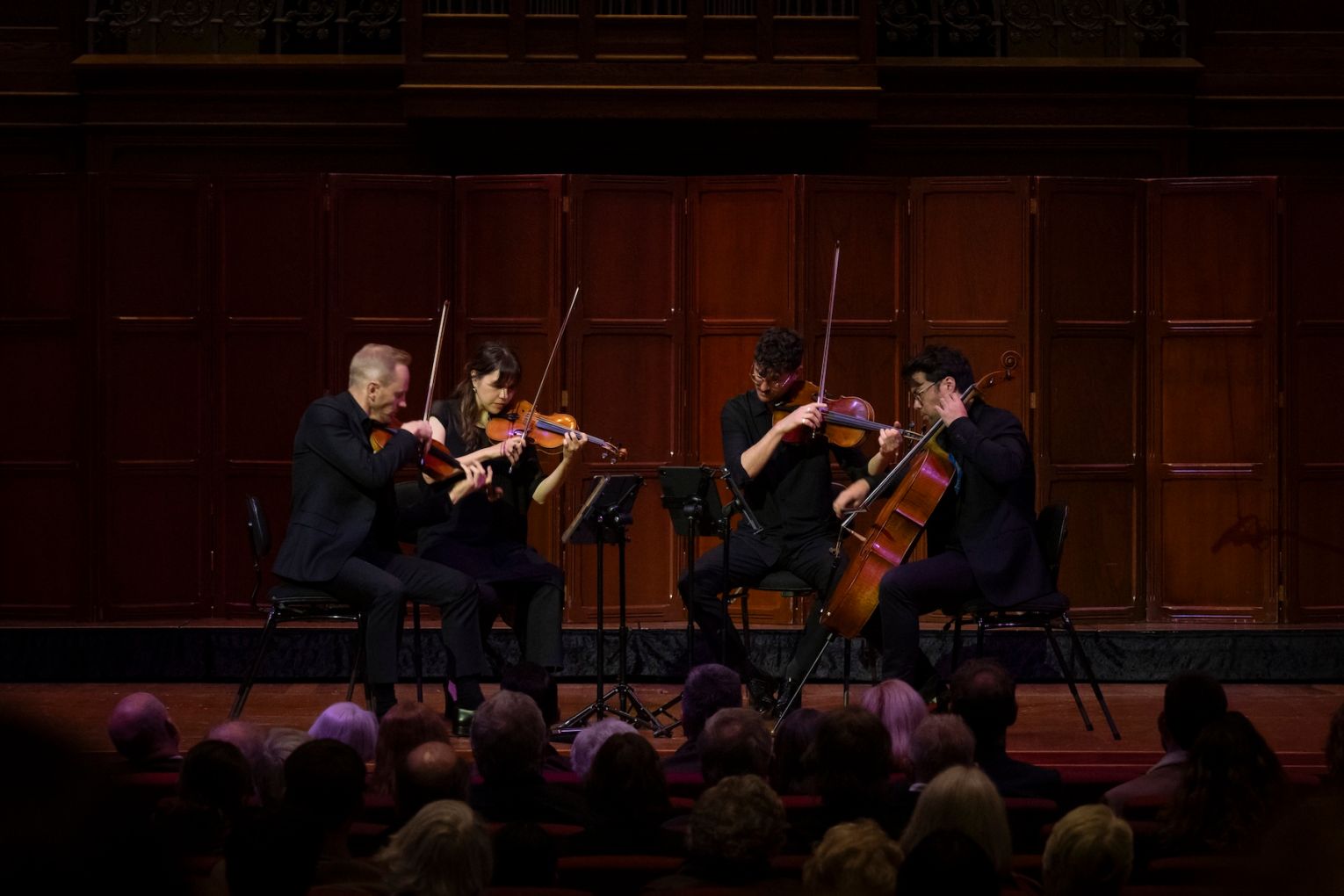
This looked like one of the ASQ’s more usual, par-for-the-course programs. First would be a student piece by the Sydney composer Elizabeth Younan, one of Haydn’s earlier quartets and a twentieth-century answer by Prokofiev, and to close a musical love letter by Clara Schumann to her ailing husband.
It proved to be anything but. None of these works came out as one might have imagined, and that seemed to come down to the singular way that the ASQ go about their craft these days. Possessed of an increasing wilfulness these days, they seem to be willing to depart from conformity in search of their own quite unexpected discoveries in the music.
Years of playing constantly together must do this. Along with just a handful of others like the Takács and Belcea Quartets they are one of the few elite fulltime string quartets around. But the ASQ’s ‘personality’ is distinctive – and it has grown more so. Along with their cheerfully relaxed manner on stage, their interpretations frequently place idiosyncrasy ahead of ironed-out perfection.
How interesting it was to hear Haydn played this way, and the six Opus 20 ‘Sun’ string quartets truly do call for it in the sense that he frees up the four players to become genuinely independent conversational partners. In String Quartet in A Major, Op.20 No.6, one particularly hears when the players constantly duck and weave around each other in its final fugal movement built on three subjects.
The ASQ let it bristle with electricity. Haydn’s music may be small in scale but what a dynamically involving piece of music it was. The renowned master of surprises, he takes Op.20 no.6 on an unusual rustic path in the preceding movement with sounds suspiciously like folk fiddling.
You might like

Dale Barltrop on first violin clearly saw this: chopping up rhythms, skating over arpeggios, and bowing hard and flat, he took great delight in all the mischievously ‘wrong’ elements Haydn incorporates into this quartet. Barltrop’s edgy sound and rush of energy was marvellous. Later the others have their turn too, as when instructs the musicians to play the Trio entirely on their bottom string with the words ‘sopra una corda’.
It was as if Haydn Haydn had wandered off from the refined extravagance of Prince Nikolaus Esterházy’s palace, where he was employed at the time, to have beer-swilling fun with the local villagers.
Not that the ASQ are the first to discover this: other quartets admit a certain roughness into Op.20 No.6. But they did it wholeheartedly, putting nicety to one side and playing with cheek and a smirk. It was delightful.
Elsewhere, this ‘Interwoven’ concert got more serious, and most surprising was the first work. Elizabeth Younan composed her first string quartet between the ages of 21 and 24 years while at the Sydney Conservatorium. Now she is at the Juilliard School studying for a DMA, having created quite a deal of interest for herself in the US.
Subscribe for updates
Entitled ‘Interwoven’ and thereby lending this concert its name, her String Quartet No.1 may be her first venture into writing for string quartet, and in it she is clearly cutting her teeth and developing her technique in the medium. However, there is enough gristle and fibre to get a top-level group such as ASQ abundantly interested in it. Unmistakeably indebted to Bartók and Shostakovich as Barltrop mentioned at the start, it nevertheless possesses a powerful, cathartic voice of its own and exhibits highly accomplished string writing.
Its mood is unrelentingly grim, but it surveys a terrain of such height that it simply cannot be ignored as a ‘student work’. What similarly impressed was the dug-in strength and technical sheen of this performance. Immensely gritty, it opened the way to further works that hopefully come from this composer.
Prokofiev only wrote two string quartets, and they come from earlier in his career when, lured by the Stalinist regime, he returned from Paris to the Soviet Union only to be caught there in even worse circumstances. His String Quartet No.2 in F Major, Op.92, finds an escape in folk music. Having relocated to North Caucasus due to the advance of Nazi troops, he took solace in the unspoilt village life he encountered there. Simple little folk dances and love ballads reverberate through this quartet.
With the ASQ’s unadorned and brutally honest performance of this work, one could appreciate and admire it. Ultimately it is not the finest Prokofiev though, sounding quite plain and one-dimensional. Bartók was much superior at assimilating folk music into his writing.
Although Clara Schumann left no string quartets, several of her instrumental works have been arranged for the medium. One is her Variations on a Theme by Robert Schumann for piano, which has been arranged by Éric Mouret. It was the next best thing to hearing what she might have done had she composed a string quartet.
It is painfully affectionate. Based on a theme from the fourth movement of Robert’s Bunte Blätter piano pieces, Op. 9, it was her way of enshrining her feelings in art. Fondly she dedicated her variations with these words: “‘For my dear husband for June 8, 1853, a weak attempt once more on the part of his Clara of old” – graciously overlooking the fact that Robert was by then sliding into insanity.
It was the most gracious and generous piece on the program, and in its few short spans of repeating melody said perhaps more than any of the previous items.
With a performance of penetrating tenderness, this concert drew to a thought-provoking end.
The Australian String Quartet performed ‘Interwoven’ at Elder Hall on Tuesday June 9
Want to see more stories from InDaily SA in your Google search results?
- Click here to set InDaily SA as a preferred source.
- Tick the box next to "InDaily SA". That's it.
Free to share
This article may be shared online or in print under a Creative Commons licence