Music review: David Elton and Friends
It was rewarding to see one of the leading trumpeters of his generation, David Elton, back on home turf and playing at his fluent best.
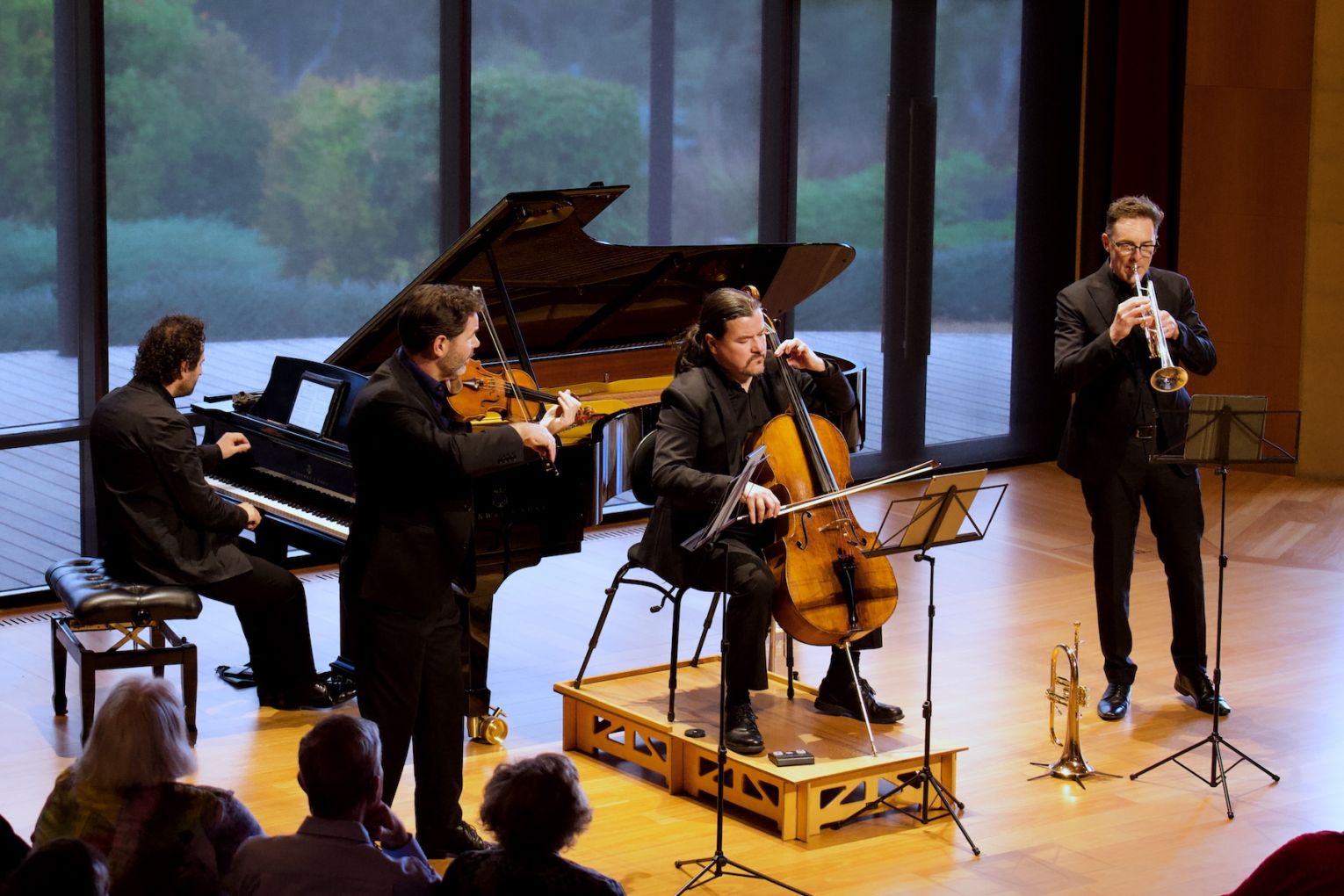
There aren’t too many brass players with the pedigree of David Elton. A good twenty years ago, he thrilled audiences here as principal trumpet in the ASO. That was before being snaffled up by the West Australian Symphony Orchestra and more recently the Sydney Symphony Orchestras. Some might also know that he was also principal trumpet in the London Symphony Orchestra for five years, and that he has guested with the New York Philharmonic, Royal Concertgebouw and the Chamber Orchestra of Europe.
Acknowledged as one of the best in the business, it was a pleasure to see him back here for a chamber music stint with some of his friends. In this one-off UKARIA appearance, Elton was joined by violinist Andrew Haveron and cellist Simon Cobcroft – both from the SSO (the latter having until recently been principal cellist with the ASO) – and Melbourne pianist Stefan Cassomenos.
It was a program that rewardingly probed many unfamiliar corners of the trumpet repertoire. There was no jazz as such, except where Kurt Weill comes up with his own unique mixture of ‘misinterpreted’ American jazz, Berlin cabaret and operetta in his Suite from The Threepenny Opera.
Banal on one level but wickedly comical on another, this suite was engrossing to hear. For his part, Elton’s playing was super clean and rhythmically neat as a pin, and all four musicians lent it an understated, sophisticated elegance. One particularly admired how they resisted the temptation to ham up this music, instead playing it ‘straight’ as if it was just another regular classical piece. So, when a couple of truly silly percussive moments do come along, as when the cellist raps the side of his instrument in time to ‘Ballad of the Easy Life’, and the violinist gives his music stand a jolly good shake in ‘Cannon Song’, it was all the more humorous.
This Kurt Weill was predictably a highlight, helped by James Ledger’s clever arrangement that trims this suite down to what resembles a small cabaret combo. Memorably, Ledger wrote it especially for Elton and Seraphim Trio back in 2013.
As a general rule, the trumpet can occupy the spotlight like few other instruments, not just for its sparkle but also for the large range of colours it can produce. Two newer pieces demonstrated this amply. ‘Altiora Peto’ is a trumpet concerto that Perth composer Lachlan Skipworth wrote in 2021, and that Elton premiered in Perth. Of uplifting lyrical beauty, it times at reminds one of Copland in its spare-texture and noble sentiment. Elton gave it wonderful melodic fluency when he switched to flugelhorn in its ‘Tranquillo’ middle movement.
American composer David Sampson wrote ‘Memories to Keep Awhile’ especially for Elton in 2014, and this is another fine piece. The composer was apparently inspired by leafing through boxes of old family photographs, and one could sense this in the intimate, uncannily vocal quality Elton brought to it. Tender moments abound in this piece, the players graciously passing melodies from one to one another. Exciting elsewhere, it charges along rhythmically like Bernstein or John Adams.
To hear the trumpet playing as an equal member of the ensemble, and not thrusting forward as can so easily happen, was revelatory. Whatever else one notices about Elton’s high calibre technique, he is first rate as a chamber musician.
Ditto for Haveron. How beautifully this violinist played – as he so often does when he visits UKARIA and Coriole. He seems to possess the ability to fully synthesise ideas before bow even touches string. And his finesse is second to none.
Subscribe for updates
Sampson’s piece had the most well-developed piano writing, and this was clearly to Cassomenos’s liking. Always a magnetic player to watch, he met all its gesturally strong content with relish.
That left two more ‘traditional’ works in this concert, both of which are in fact seldom heard: Hummel’s Trumpet Concerto in a chamber arrangement and Enescu’s Légende for trumpet and piano. Foundational in the trumpet repertoire, the Hummel could be so much more popular than it is. Elton’s tone was smoot and expressive, and although there were uncharacteristic missed notes here and there, its virtuosic finale was faultless.
Enescu also holds an important place in the trumpet repertoire with his Légende from 1906. Impressionistic like Fauré, it eschews virtuosity in favour of sonorous musicality. Ever the thinking musician, Elton was again a model in finding its mood and tonal centre. He is a master at expression and control.
It was greatly rewarding to hear this fine player again and to see him playing his best in his home town.
David Elton and Friends performed at UKARIA Cultural Centre on April 26
Want to see more stories from InDaily SA in your Google search results?
- Click here to set InDaily SA as a preferred source.
- Tick the box next to "InDaily SA". That's it.
Free to share
This article may be shared online or in print under a Creative Commons licence