Vale Rob Hirst: tribute from a best mate as Midnight Oil loses its beating heart
Contemporary music writer Sean Sennett pays tribute to his best mate, Midnight Oil drummer Rob Hirst.
Big tree down. That was the phrase that kept circling in my head in the days leading up to Rob Hirst’s passing.
It was something Jim Moginie said to me a couple of weeks earlier at Woodford Folk Festival, as we saw out 2025, when we talked about the impact Rob had had on our culture.
When I got the news yesterday that Rob was gone, the phrase felt right. Rob wasn’t just part of the Australian music landscape — he was one of the parts holding it up. When someone like that goes, you don’t just lose a musician. You lose shade, shelter, perspective.
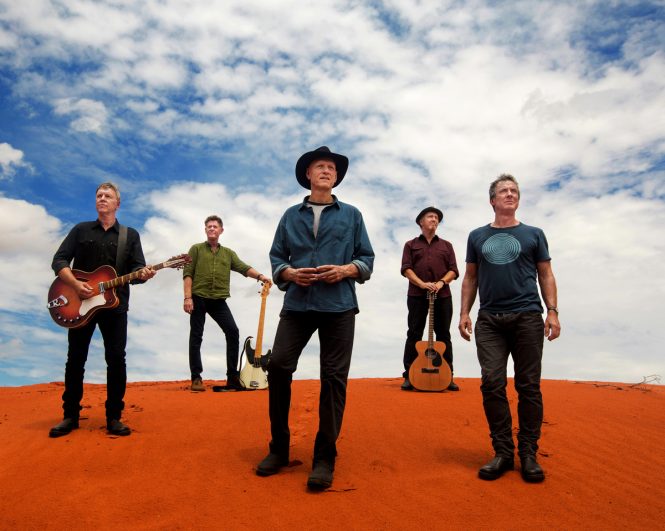
Rob left a huge footprint on Australian culture. As Midnight Oil’s drummer and co-songwriter, his songs and his playing got people to dance and to think at the same time — a rare combination in rock music, and one that defined the band’s impact.
The groove, the swing, the voice in those choruses — that was him. The beating heart of the band
Midnight Oil didn’t just soundtrack an era – they reflected on the past and tried to reshape the possibilities for our future. And Rob was central to that. The groove, the swing, the voice in those choruses — that was him. The beating heart of the band.
You might like
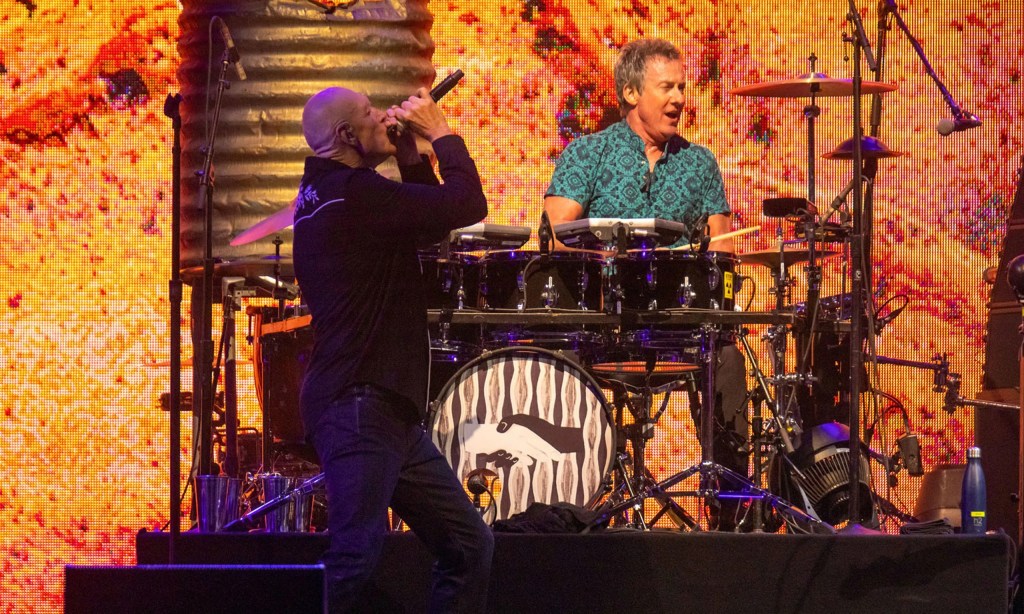
To the world, Rob Hirst was one of the great drummers: powerful, instinctive, creative and deeply musical. A drummer who could drive a band without ever flattening it. Even from behind the kit, he filled the room. You could hear him immediately — not just in the rhythms, but in the harmonies, the feel, the human pulse running through Midnight Oil’s songs.
Alongside Jim Moginie, and with Peter Garrett, Rob was a primary songwriter in a catalogue that still feels urgent and meaningful. How’s this for a CV: Beds Are Burning, The Dead Heart, Short Memory, Forgotten Years, Hercules. We could go on.
To me, Rob was a rock’n’roll comrade. A great friend to me and to my family. In fact, he was the best friend I’ve ever had, and I’ll miss him.
We met in the late 1990s at a Mushroom Music songwriting workshop at Mount Macedon. Writers were paired up each day to write a song and demo it before rotating to someone new. Rob and I were teamed together and clicked immediately.
We wrote a song (Who’s Sorry Now?) in a couple of hours, demoed it using his newly purchased Omnichord, and then spent the rest of the day talking. We spoke so much that it took us about 15 years to finally record music together — not because the interest wasn’t there, but because the hang was just as rewarding as plugging in the electric guitars.
Subscribe for updates
Rob and I spoke pretty much every week for close to 30 years. It was often about music, sometimes not at all. We talked about our projects, our kids, books, politics, the absurdities of life. And we laughed — a lot. Every conversation was punctuated with a gag.
One of Rob’s great qualities was curiosity. He was always asking questions about other people. Proper questions. He wanted to know how you were really going, what you were thinking about, what mattered to you. His concerns were bigger than himself, and that generosity shaped his friendships and his worldview. It also shaped the way he thought about Australia — fairness, responsibility, community. Those ideas ran through the music as much as any lyric.
Rob wore his stature lightly. Musicians around the world revered him — rightly so. I once introduced him to Max Weinberg from Bruce Springsteen’s E Street Band, himself one of rock’s great drummers. On meeting Rob, Max extended his hand and simply said, “You’re a great drummer.”
Eddie Vedder admired his work on the kit and loved his songs. But Rob never traded on reputation. He was far more interested in what other people were doing than in revisiting his own achievements.
He also had a habit of gently pushing people beyond their comfort zones. Rob didn’t want to drive to the lighthouse — he wanted to walk the track that led up to it, stopping to discuss the birdcalls he was hearing along the way. If there was a longer route, a harder climb, that’s the one he took. Not out of bravado, but curiosity and a desire to fully inhabit the world. I’m naturally inclined toward the easier option. Rob never was. That instinct stayed with him to the end.
Rob was diagnosed with pancreatic cancer almost three years ago — a diagnosis that usually carries a brutal prognosis. But Rob had an extraordinary will to live. Even through exhausting treatment — chemotherapy, radiotherapy, surgeries — he kept going. He kept writing songs. He kept working in the garden. He released an EP just months ago with Hamish Stewart and Jim Moginie. He talked about squeezing in trips to places he hadn’t yet seen.
I said to him only last week, “You’ve made well people look bad.” He laughed.
Eventually, Rob reached a place of acceptance. Around his 70th birthday he recognised that he’d done everything he could. He was grateful — for his family, for his grandchildren, for the life he’d lived, and for the time he’d been given. He faced the end without bitterness, surrounded by love.
Rob Hirst was a connector. He brought people together effortlessly. His friendships ran deep, and today there is a vast community feeling the same loss — family, bandmates, collaborators and generations of listeners who found meaning, movement and purpose in the music he helped create.
Big tree down, yes. But the roots run deep.
Rob was loved by so many people. I’ll miss him. We’ll all miss him. Vale, Rob.
Rob Hirst (1955–2026)
Want to see more stories from InDaily SA in your Google search results?
- Click here to set InDaily SA as a preferred source.
- Tick the box next to "InDaily SA". That's it.
Free to share
This article may be shared online or in print under a Creative Commons licence