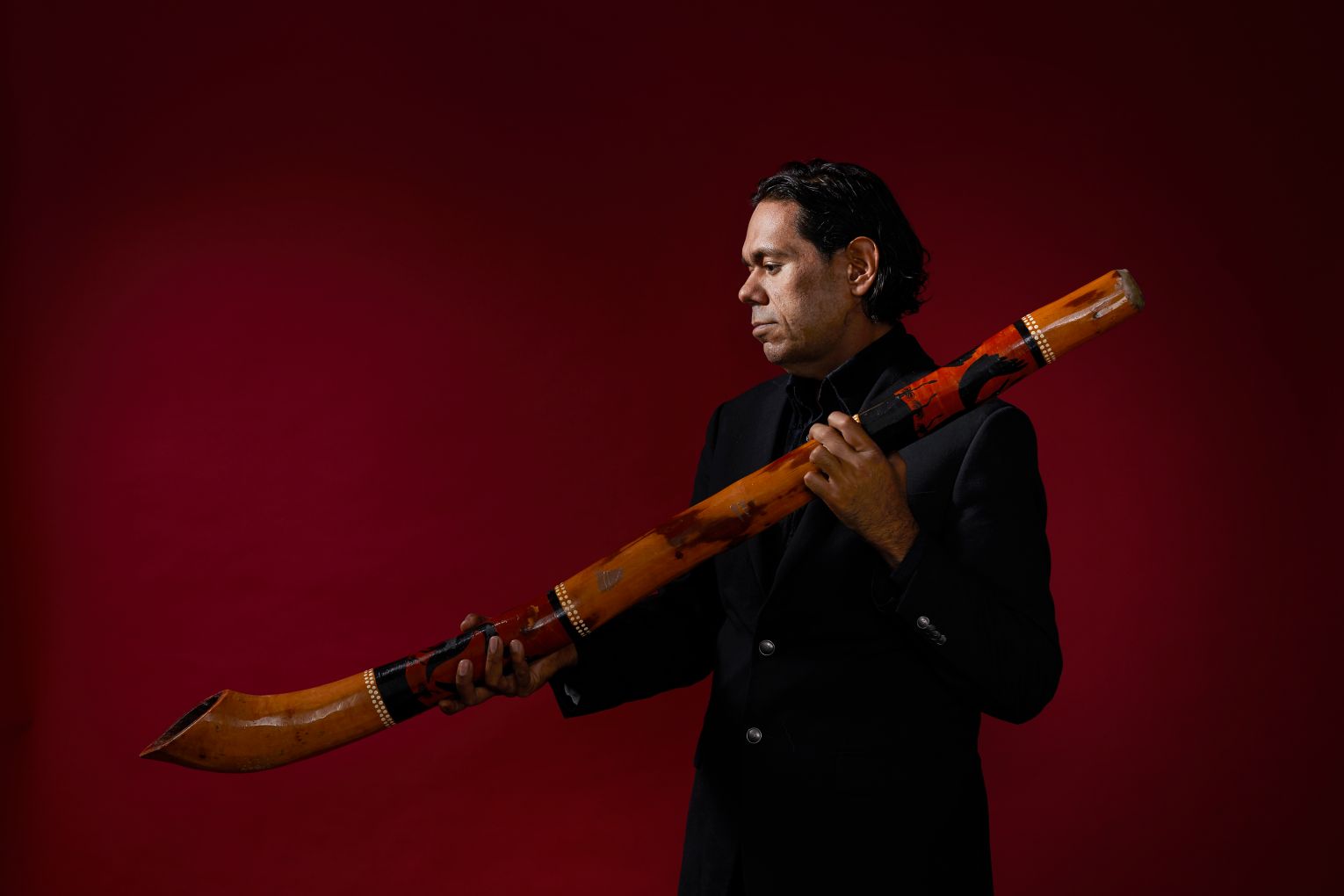
William Barton is fashionably late for our interview – and I think I know why. When he turns up at the Queensland Art Gallery Café, overlooking the Sculpture Garden, he explains that he has been walking.
Which might not be a good excuse, under normal circumstances, but I know he is a serious walker. The renowned multi-instrumentalist, composer and digeridoo (yidaki) master walks for several hours a day. It’s a practice that has, he says, enriched his life in many ways.
“You might remember me when I was 170kg,” Barton says as we chat over coffee.
“As a matter of fact, I do,” I venture. I first interviewed Barton when he was in his late teens debuting with the Queensland Symphony Orchestra. He was with his mum, Aunty Delmae Barton, a singer described as Australia’s Dreamtime opera diva.
Barton is now 44, which makes me feel old. Walking has turned his health around, but there’s more to it than that.
“I started walking to be the warrior I need to be,” Barton says. “It helps me to be able to tell my story and to develop the strength I need. It clears my mind and soul. And I believe that every day you walk you live another day longer.”
He now travels the world as one of our most admired musical ambassadors and is renowned for his collaborations. For the past couple of decades he has been a busy performer and composer in the classical world, performing with everyone from the QSO and Sydney Symphony Orchestra to the philharmonic orchestras of London and Berlin, along with taking part in historic events at Westminster Abbey, Anzac Cove and the Beijing Olympics.
You might like
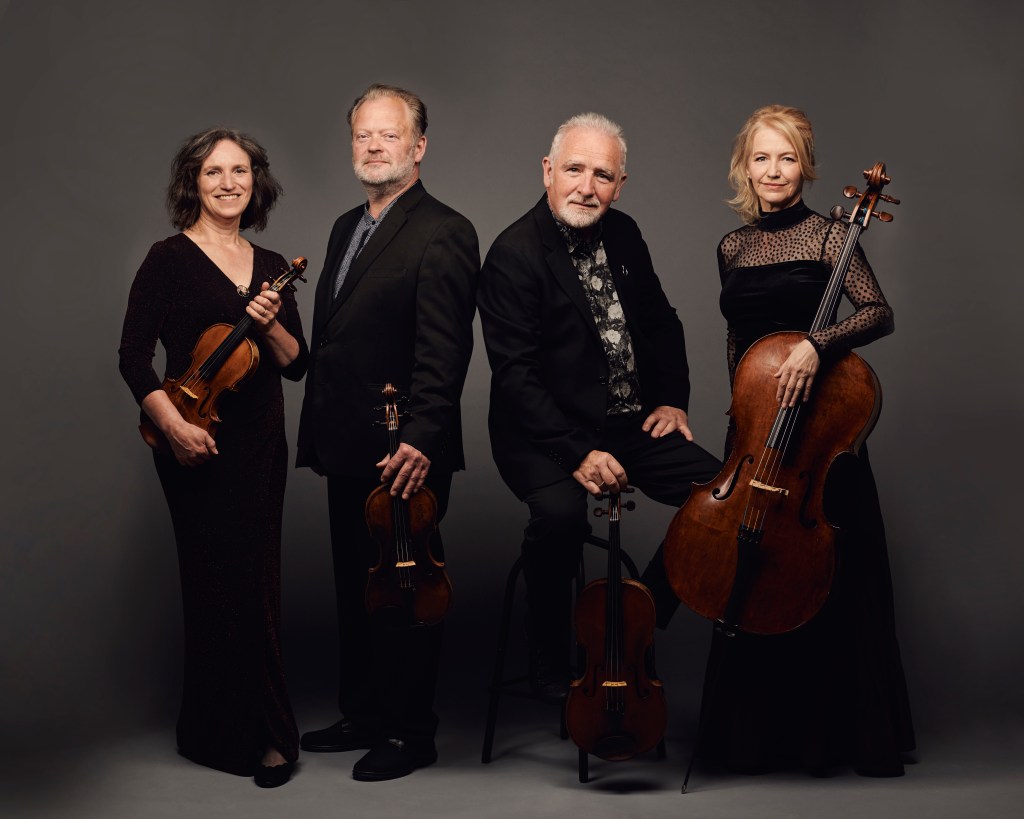
His collaborations continue, as our chat is ahead of his short national tour with the renowned Brodsky Quartet from the UK. They will get together on stage first in Melbourne then in the Concert Hall at QPAC in Brisbane on February 26. On February 28 they will play at the Adelaide Festival.
This musical conversation will pair the ancient sounds of the digeridoo with the harmonies of European chamber music.
The diverse program for these concerts will feature Peter Sculthorpe’s String Quartet No.11, Jabiru Dreaming, a work inspired by the rock formations of Kakadu National Park; Robert Davidson’s Minjerribah, referencing Queensland’s North Stradbroke Island; and Leoš Janáček’s String Quartet No.2 “Intimate Letters” – an acknowledgement of Janáček’s passionate friendship with a married younger woman, written in the last year of his life.
It is a special program for Barton in a number of ways. Firstly, he loves the Brodsky Quartet. He has played with them before and he had a long friendship with Peter Sculthorpe (Barton now lives in Woollahra in Sydney’s eastern suburbs, close to where Sculthorpe lived).
“The Brodskys also worked with Sculthorpe and that’s where our connection came,” Barton explains. “I collaborated with Peter for the last 14 years of his life. He died in 2014. I walk past his house sometimes and say hello to his spirit.”
Barton first performed a work by Peter Sculthorpe with the QSO in 2002. The work was a special, revised version of Sculthorpe’s Earth Cry, which had been updated in 1999 to incorporate the didgeridoo specifically for Barton.
Subscribe for updates
So, playing the late Australian composer’s Jabiru Dreaming this time around will be special for Barton, whose repertoire is now quite wide with much of it his own compositions. In fact, I hear something by him most days as I have my radio on ABC Classic while I work.
“You might hear too much of me,” Barton jokes. “I better get some new material out.”
His music is always inspiring and even haunting at times. One of my favourites is Kalkani, meaning Eagle in the Kalkadoon language. It is a notable vocal and instrumental work by Barton, created in collaboration with violinist Veronique Serret. His voice is poetic and otherworldly.
A proud Kalkadunga man from Mt Isa in north-west Queensland, Barton has long expanded the horizons of the didgeridoo/yidaki in the modern Australian music landscape.
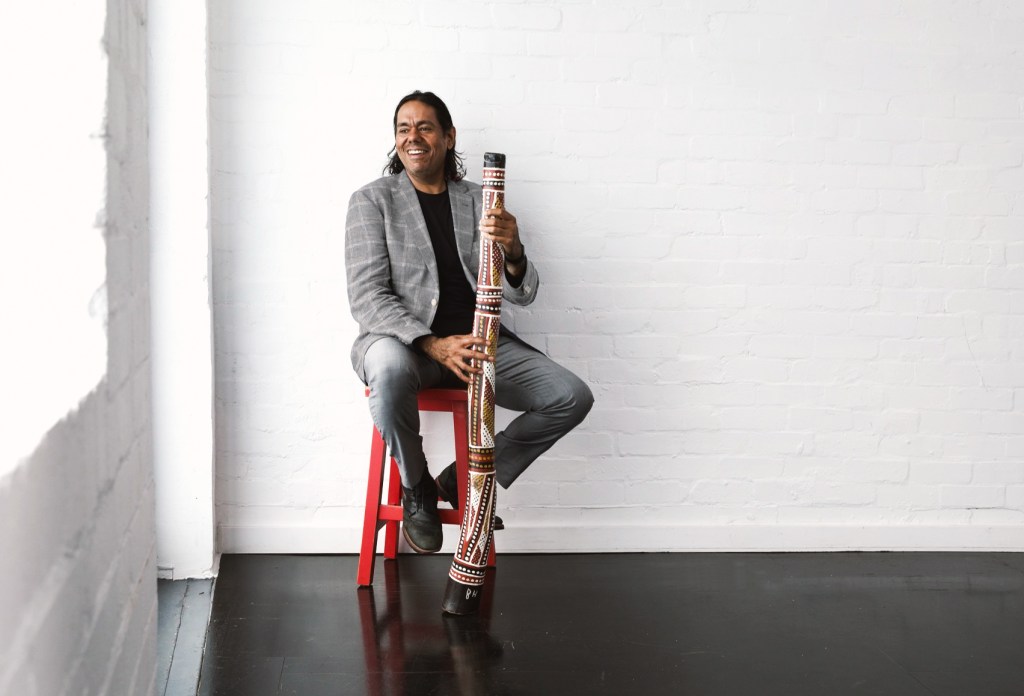
Learning the instrument from his uncle at age seven, Barton left school at age 12 to join a dance troupe in Sydney, where he danced and played the didgeridoo for the next six years. By age 15 he was touring the US before he launched his career as a soloist, a career that has taken him around the world.
He is a dignified presence in the national debate about reconciliation, without being at all political. He talks about the importance of country and of ceremony and wants to heal division.
He was at the Australian Legal Convention 2025 in Canberra and performed on the didgeridoo during the welcome reception, playing while moving from courtroom 3 down to courtroom 1 at the High Court of Australia. This marked the first time Aboriginal music had been played in the High Court, coinciding with a gathering of First Nations legal professionals. The event featured notable speakers, including Supreme Court judges and Indigenous legal experts, with proceedings focusing on Treaty and Native Title.
Brodsky/Barton collaboration is ‘tracing an arc through time and across cultures’
In his quiet way at events like this Barton gets his message across. He enjoys these special occasions and although he is now something of a superstar (my description, not his), he is still a little star struck. He seems quite chuffed as he shows me photos on his phone of him meeting the Queen and playing for Prince Charles before he was king.
His artistry lands him in some unusual situations and when it does, he is always there just playing … tall and dignified, centred on the sound of aeons wafting across concert halls and auditoriums.
Put William Barton on the program and you will fill a venue every time. Pair him with the acclaimed Brodsky Quartet and you have musical magic that will be pure gold or perhaps even a rarer metal.
The British Council is supporting the Brodsky/Barton collaboration “tracing an arc through time and across cultures” in the most wonderful way.
qpac.com.au/whats-on/2026/barton-and-brodsky
adelaidefestival.com.au/whats-on/season-2026/brodsky-quartet-with-william-barton
Want to see more stories from InDaily SA in your Google search results?
- Click here to set InDaily SA as a preferred source.
- Tick the box next to "InDaily SA". That's it.
Free to share
This article may be shared online or in print under a Creative Commons licence