Adelaide Festival review: GuoGuoHuiHui – Re-shaping Identity
Dance company GuoGuoHuiHui’s electrifying performance deconstructs and transforms folk dance into an ever-evolving form that transcends stereotypes of the collective, allowing space for the story and spirit of the individual to shine through.
Before the performance begins, Guo Rui – choreographer, dancer and co-founder of GuoGuoHuiHui – tells the audience a story. A farmer came to his school to teach the students a folk dance of the Han tradition to which Guo Rui belongs. Guo Rui demonstrates these powerful, dynamic moves on stage as he talks. But, Guo says, the farmer’s body reflects the history of his life’s labour, his shoulders hunched up near his ears, his head scrunched over to one side. Guo adjusts his movements accordingly and suddenly we see the figure of the farmer, demonstrating the movements of this traditional dance, slightly askew. We children imitated his crooked movements exactly, says Guo. The farmer praised them: “You dance with style, with flavour!”
Folk dance performances, regardless of the country from which they emerge, typically involve dancers donning the same costumes, dancing in contained stylistic forms, even wearing similar facial expressions such as a benign smile or a fierce heroic gaze. The folk dance communicates a blanketing impression of a specific culture, providing an entertaining spectacle for the audience but which subsumes each individual performing the dance in a collective and stereotypical anonymity.
But what of the stories each of these individuals carry? What to do if, despite ancestral heritage indicating a belonging to a particular ethnicity or culture, an individual was born in one city but moved to another in childhood, only to move again and again throughout life? What if they learned from multiple dance traditions other than their own, even preferring traditions other than the one ascribed to them by their heritage? What exactly is tradition? Is it static? How does it relate to memory? These are the questions that Guo Rui says absorbed him as he developed his work.
As the performance begins, the five dancers of GuoGuoHuiHui stand on an unadorned stage wearing the wardrobe of the personal, as if in rejection of uniformity: plain, casual clothing in simple, differing colours yet unified in youthful, contemporary style. While rooted to the ground they begin pulsing and writhing to the compulsive beat of contemporary house music, the rolling of shoulders and rippling of torsos echoing one another. United in rhythm while each seemingly following their own will, their formation blossoms out into mesmerising patterns as the dancers move across the stage. Together, then separate, they reflect and support one another in their movements and emotional expressions until one by one, each dancer breaks away to a solo where their movements carry distinct characteristics that are evidently rooted in a specific cultural tradition.
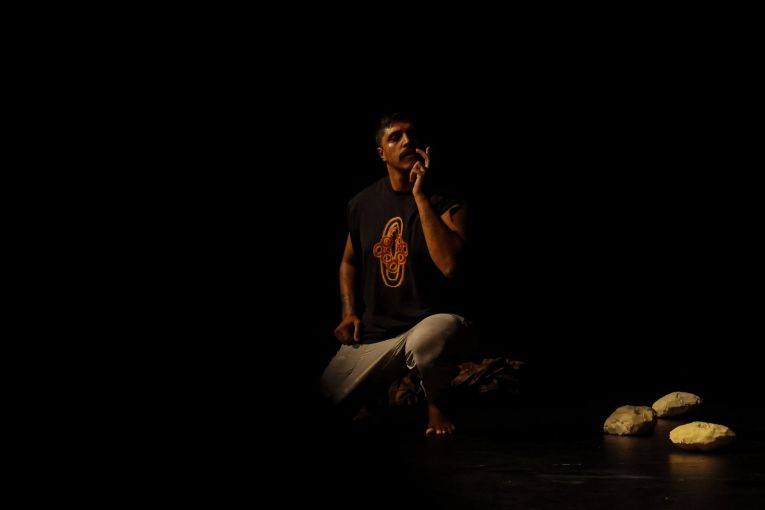

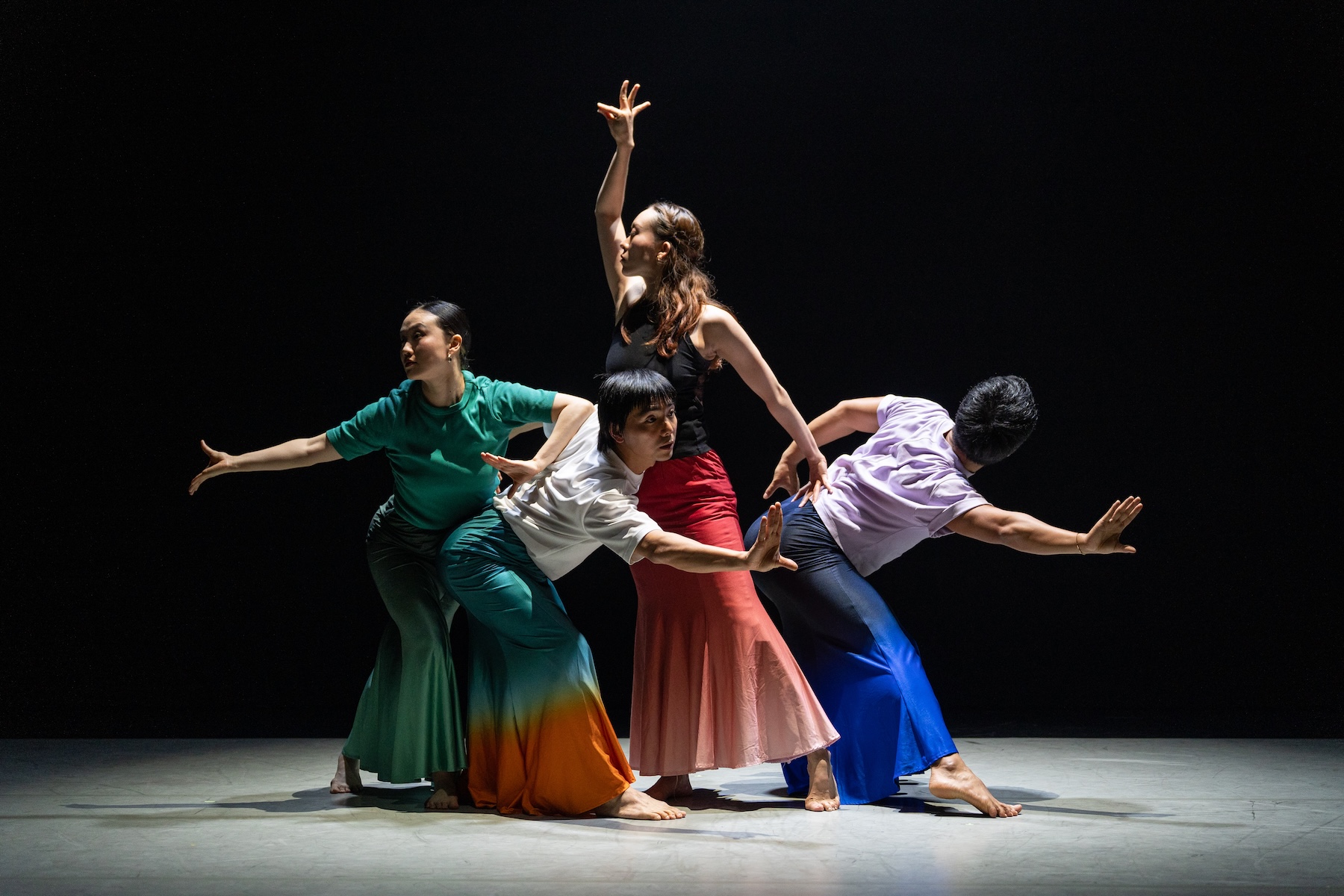
These five dancers (Guo Rui, Wu Hui, Gunika Aniva, Wang Huaili and Chen Yijie) draw their heritage from five different ethnicities that stretch across the vast landmass of the People’s Republic of China: Tibetan, Uyghur, Mongolian, Yao and Han. Each has its own distinctive dance tradition. Each dancer steps forward from the collective performance to tell their individual story. There are stories of growing up on the vast tundra before moving to a busy city, of moving to Europe to study dance, of learning the dance traditions of cultures different from their own, or training in classical ballet. Each story is topped and tailed with a dynamic solo, accompanied by music enlivened with the rhythmic beat of contemporary club electronica, yet carrying the distinctive echoes of their cultural musical tradition. Each dancer reflects their individuality, whether in emotional expression or in breakaway movements that contrast from those discernably drawn from a distinctive folk style: a flexed foot, leg outstretched and placed heel to ground, arms outstretched in heroic pose; a tilted head with beaming smile that quickly fades; the simulation of riding a horse galloping across the tundra.
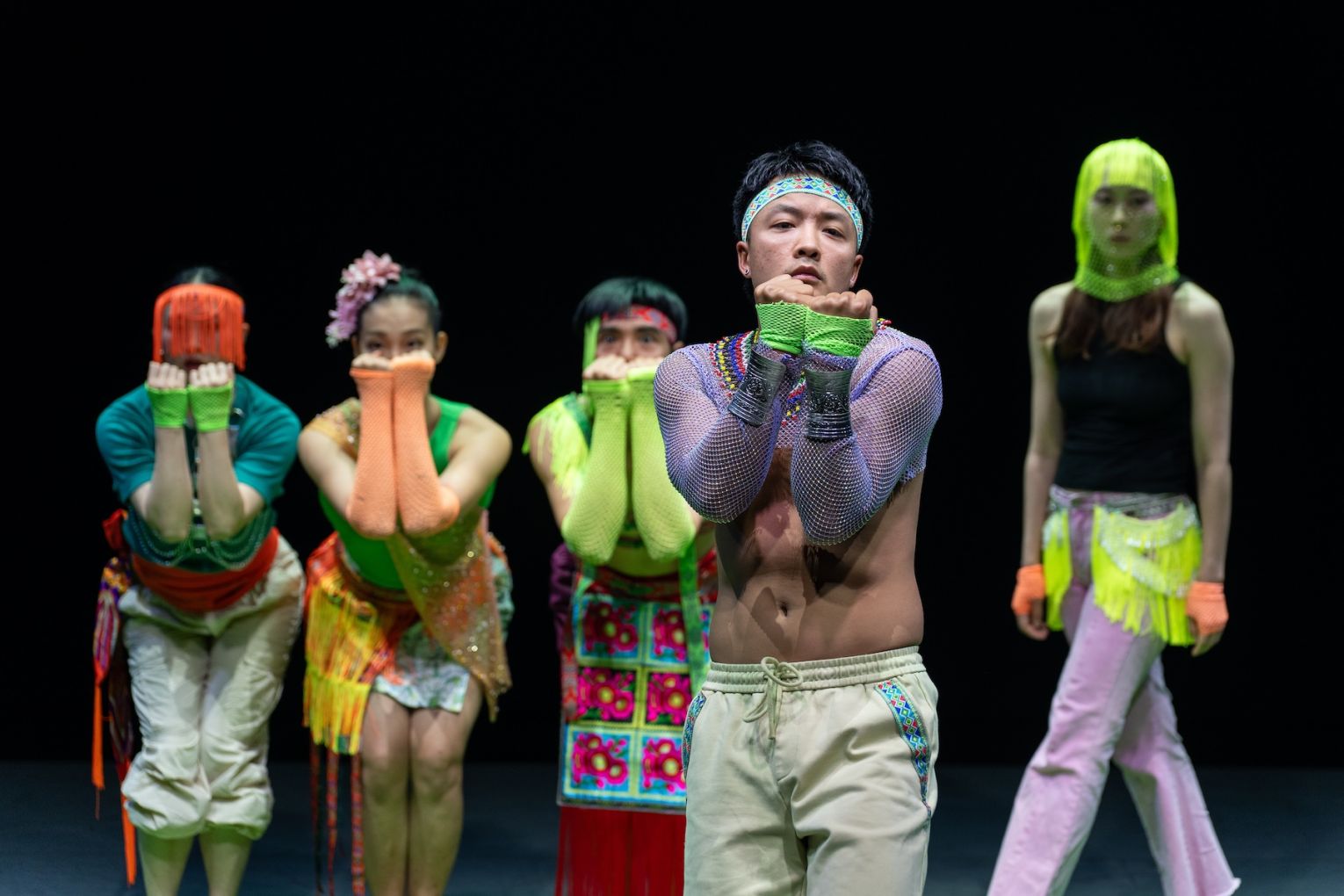
The last of personal stories is told by company co-founder and dancer Wu Hui. As her story comes to an end the other dancers, their day-to-day clothing brightened with sparkling accessories in fluorescent hues, return to the stage with a square of synthetic grass. They roll it out for Wu, who stands within it, transfixed. They adorn her with accoutrements from the various dance traditions they have drawn upon throughout the performance: a floral headdress, a sash, jewellery. But then they add items free of any ethnic anchoring: a rainbow-hued feather duster, a plastic flower, a large section of ridged, silvery tubing which they drape around her neck. Wu stands, statuesque, embodying all the dance traditions that belong to the collective until the restrictive frame of turf is rolled up and removed.
Wu steps away to join the others, the cumbersome symbols of folk dance traditions discarded and replaced with the same fluorescent, sparkling adornments worn by her companions. The stage lights dim to ultraviolet, picking out the vivid neon fluorescence of each dancer’s adornments while fading each figure into the shadows. The music morphs into a futuristic club soundscape of pounding basslines and electronic beats as the dancers circle one another in a joyful, energetic climax of individual expression, while carrying the threads of connection to their ancestral histories.
“Is change a betrayal?” the accompanying subtitles ask. Change is universal, inevitable, necessary, perhaps, for evolutionary survival. Re-shaping Identity symbolises the way change can be embraced without discarding memories, tradition or sacrificing individual identities. If change, here in the context of GuoGuoHuiHui’s exploration of ethnic dance traditions is a betrayal, then it is a mighty, bold and beautiful one.
Subscribe for updates
Re-shaping Identity is playing at the Space Theatre until March 2 as part of Adelaide Festival

Want to see more stories from InDaily SA in your Google search results?
- Click here to set InDaily SA as a preferred source.
- Tick the box next to "InDaily SA". That's it.
Free to share
This article may be shared online or in print under a Creative Commons licence