Book review: Sick Note
Olivia De Zilva’s irreverent debut poetry collection melds the language of pop and online culture with the absurdities of late-stage capitalism to explore the human costs of living in a world obsessed with productivity.
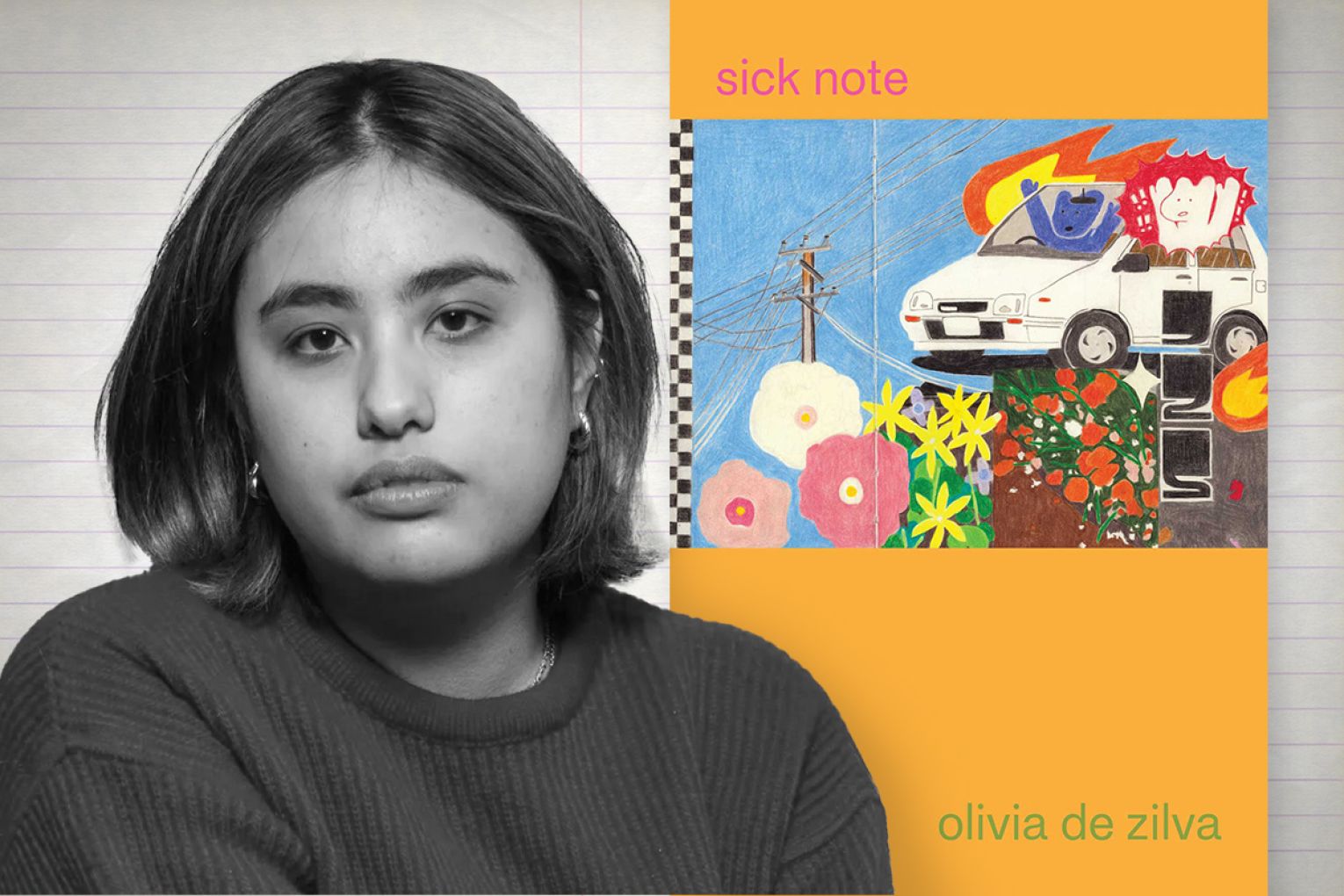
There aren’t many places where you would find Nicolas Cage and Joan Didion, Disney’s Mulan and Glenelg’s Magic Mountain, aura-farming and the Australian Tax Office all sitting together like fragments in a kaleidoscope. Mediating her world through the language of pop culture, internet slang and the bizarre minutiae of modern life, Adelaide writer Olivia De Zilva creates a subversive melange that has the addictive pace of a social media doomscroll. Using the very language she’s critiquing in an inventive and often hilarious array of original poetic forms, this work is deeply engaged with the serious business of being human in a world increasingly determined to measure our worth by productivity and conformity.
Much of the appeal of this collection lies in De Zilva’s remarkable ability to twist the language of online existence into poetry. Spam messages become a meditation on loneliness and trust, a Google search history becomes a stream-of-consciousness psychological portrait of someone struggling with unemployment. The conventions and terminology of medical notes and workplace questionnaires provide the structure and voice for poems that critique modern health care and the dehumanisation of workplaces.
In ‘Attachment styles’, the collection’s opening poem, the consequence of a troubled paternal relationship is explored using the seductive language of online quizzes. The poem is a roil of cultural references, pop-psychology and poignant personal touchstones, delivered with a pace that mimics the restless and random flow of a social media scroll.
Beneath the surface level humour of De Zilva’s outrageous mash-up of cultural references and BuzzFeed quiz-speak is a sharp satire of the sinister ways our deepest insecurities are exploited as fodder for data collection.
The relentless demands of contemporary femininity receive similar treatment in ‘This woman’s work’. The slippery model of the ‘girlboss’ rubs shoulders with the algorithmically determined bombardment of beauty standards and wellness advice in a breathless cavalcade of contradictory expectations.


Promises of easy fixes, whether aesthetic or emotional are unavoidable and De Zilva cleverly captures the quality of exhaustion generated from living within a culture and an economy that constantly reminds women they are inadequate, then offers to sell them the solution.
The collection’s title poem is one of its funniest and most incisive. Presented as a set of clinical observations, ‘Sick note’ documents a patient suffering from workplace stress, whose symptoms include being triggered by Microsoft Teams invites and referencing Kim Kardashian as an excuse for sick leave to ‘microdose on unconstricted freedom’.
In the poem’s sinister final twist, we learn the patient notes are being harvested to improve corporate efficiency. It’s part of De Zilva’s wonderfully bleak species of satire that even an employee’s inability to work can be fed back into the engines of productivity.
Throughout the collection, De Zilva’s playfulness with form, structure and voice is central to her satire. ‘Unemployed Google search’ unfolds entirely through search queries, building a revealing portrait of financial insecurity, psychological distress and attempts at distraction through screen-based media. In ‘Click yes if this applies’ the language of an institutional questionnaire gradually and poignantly mutates from bureaucratic compliance into something resembling a love poem. Yet beneath the whimsical absurdity there’s a darker level that draws parallels between our desires to be valued as workers and as humans.
Subscribe for updates
The way De Zilva uses the page is also inventive – her dizzying accumulation of references to television, music, film and social media give the poems a propulsive pace, especially when the poems are justified into solid blocks of prose, often without punctuation. Yet within these chunks, De Zilva scatters spaces that serve, if not as tiny enjambments, then as places to draw breath. The fact that these spaces do not always fall at the end of clauses or phrases give the poems an unsettled feeling – akin to the stop/start pace of a social media scroll or flow of speech when trying to articulate something just beyond reach. The effect is a kind of fractured attention, the poems continually stumbling over the pace of their own momentum.
While pop culture allusions are integral to the way the subjects of De Zilva’s poems understand themselves and navigate their experience of the world, pop culture takes on an even more heightened significance in ‘Li Shang’. This is a poem about growing up Asian in Australia and discovering the character Captain Li Shang in Disney’s animated film, Mulan, as an object of romantic desire. The poet describes him as ‘the first Chinese man I know / who doesn’t look like Chairman Mao’. Despite the deliciously irreverent humour, this poem lays bare the narrow range of representations of Asian people in the media available to an Asian Australian child. For De Zilva, the few representations available became important reference points in the formation of her identity, this poem making clear that her affection for popular culture is complicated by her awareness of its limitations.
The potency of popular culture in how we construct identity and process experience also shines through in De Zilva’s exploration of chronic illness. In ‘Genre: you are diagnosed with a chronic illness but don’t want to make a scene’, a diagnosis is filtered through the familiar conventions of television medical dramas.
The collision of medical reality with the heightened drama of medical television is funny, but it also captures the disorientation of receiving a diagnosis and having to cope without any of the neat resolution we’ve come to expect from our attractive, compassionate and incisive fictional doctors.
For all its engagement with global and online culture, Sick Note is firmly rooted in Adelaide. ‘Midnights at Fung Shing’, ‘Not an ode – but an observation of Guy Sebastian’s ‘Angels’ and ‘This is not a Melbourne poem’ are some standouts among many poems that reference De Zilva’s humorous affection for and exasperation with the peculiarities of her hometown. Where else would a defunct seaside amusement park become our own personal Vesuvius or a stolen python make the six o’clock news?
For all its manic energy and absurdity, Sick Note is a collection deeply attuned to the vulnerabilities of contemporary life. De Zilva understands how to make us laugh, and how to make that laugh leave a bruise.
Sick Note (Pink Shorts Press) is out now. Olivia De Zilva will launch Sick Note at The Wheatsheaf Hotel on Saturday October 24, with Carissa Fischer, Katerina Bryant, Ken Bolton and Walter Marsh.
Want to see more stories from InDaily SA in your Google search results?
- Click here to set InDaily SA as a preferred source.
- Tick the box next to "InDaily SA". That's it.
Free to share
This article may be shared online or in print under a Creative Commons licence