‘I wanted that dark energy’: Sharon Kernot serves up a verse thriller
The latest novel from the Adelaide author of The Art of Taxidermy redeploys the verse novel format to create a propulsive adult thriller exploring the fractured consciousness of its insomniac protagonist.
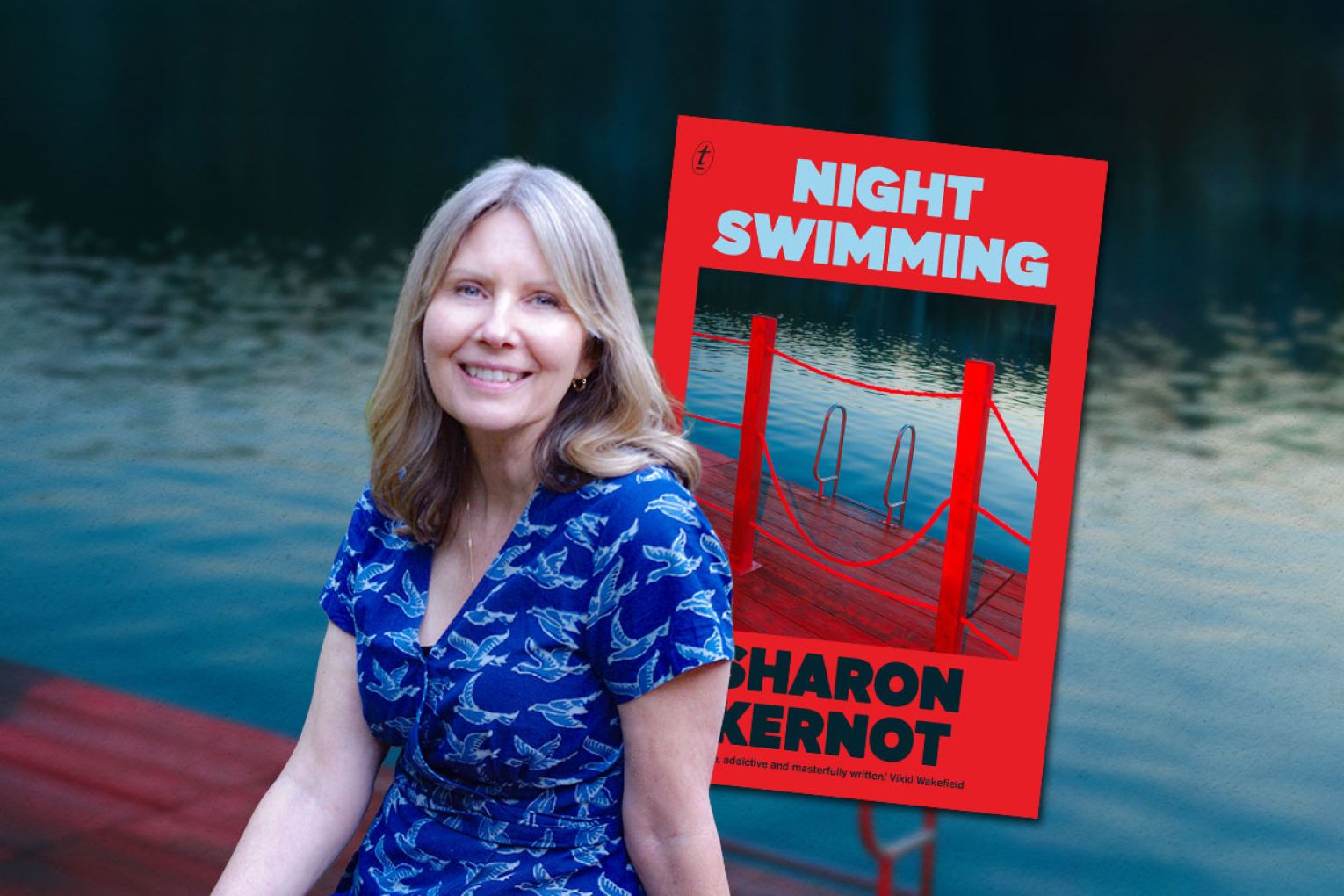
Over a decade ago, Sharon Kernot had an idea that refused to leave her alone.
It began with a chance meeting at her workplace. Someone from Kernot’s past appeared across the counter and the author realised that her role gave her access to an uncomfortable amount of information about the person standing in front of her.
“This is interesting,” Kernot recalls thinking. “I could actually use this information if I wanted.”
That unsettling thought became the seed of Night Swimming, Kernot’s first verse novel for an adult readership, and a tense psychological thriller that explores trauma, insomnia, memory and obsession through the eyes of a deeply unreliable protagonist.
The novel follows January Clare Colson, whose life has been shaped by the drowning death of her best friend years earlier. Sleepless, medicated and increasingly consumed by the past, she becomes fixated on a man connected to those events. As desire, memory and revenge become entangled, the reader is left questioning what is real and what is the product of January’s sleep-deprived imagination.
"I didn’t feel like anyone would want to read a whole novel right inside her head for that whole period of time. It was too overwhelming.
"
Kernot tells InReview that the idea behind Night Swimming first emerged as a short story, then an 8000-word stream-of-consciousness draft. Neither worked.
“I liked the idea, and I liked where this character could go,” Kernot says. “But I didn’t feel like anyone would want to read a whole novel right inside her head for that whole period of time. It was too overwhelming.”
You might like


The breakthrough came when she turned to verse.

“As soon as I did, she was no longer Clare. She was January Clare Colson. She was an insomniac and she had this backstory and everything started to come together.”
The white space of poetry gave both the writer and the reader room to breathe. And it allowed Kernot to inhabit January’s fractured consciousness without trapping the novel inside it.
That fractured consciousness is central to the book’s appeal. January is vulnerable and compelling, but never completely trustworthy. Her memoires shift and blur. Sleep deprivation distorts her perceptions. And readers are left constantly reassessing what they think they know.
Kernot deliberately embraces that uncertainty.
“I wanted that ambiguity,” she says. “I wanted that tension. I wanted the stakes to be high all the time and for the character to not really know what was going on and to not really be in control.”
The novel’s treatment of insomnia is particularly convincing because it draws on Kernot’s lived experience: the author endured chronic insomnia for 18 years before undergoing intensive treatment through a sleep clinic.
“I know what it’s like to not sleep,” she says. “I know what it’s like to feel like you’re going mad because you haven’t slept for several days in a row.”
That experience is woven through the novel’s woozy atmosphere. January moves through a world where the boundaries between waking, dreaming and memory become increasingly unstable. The effect is unsettling and immersive, drawing readers into the protagonist’s state of exhausted uncertainty.
Subscribe for updates
But Night Swimming is not only a novel about sleep. At its heart are questions that have long preoccupied Kernot in her previous award-winning verse novels: trauma, grief, shame and the ways people carry these feelings through their lives.
“I’ve worked in the community sector for over 20 years,” she says. “I’ve worked in child protection, mental health, financial counselling and student advocacy. All my work is with people one-on-one in crisis situations.”
“I’m interested in trauma, how people react to it. Grief and shame and all those very human emotions and how they manifest in our lives.”
While Night Swimming marks Kernot’s move into adult fiction, it also continues her long engagement with the verse novel. Readers may know her from The Art of Taxidermy and Birdie, both of which were published as young adult novels despite originally being conceived for broader audiences.
The attraction of this form for Kernot lies partly in its compression. Rather than thinking in chapters, Kernot thinks in scenes.
“What I focus on when I’m writing a verse novel is to write the poems as little scenes,” she says. “I’m just trying to think of the story scene by scene by scene.”
Where Kernot excels is balancing the qualities of poetry with the demands of narrative.
“A poem can be a very static thing,” she explains. “Whereas when you’re reading a novel, it’s got that forward momentum.”
For Kernot, each poem must function like a miniature chapter, carrying enough emotional and narrative weight to propel the reader forward while still retaining the density and music of poetry.
Her influences include Dorothy Porter, whose verse novels she discovered while studying at Adelaide University, as well as Steven Herrick, Irish writer Sarah Crossan and UK authors Louisa Reed and Max Porter.
“I just fell in love with verse novels,” she says. “I thought, how on earth are they doing this?”
That question eventually generated a writing practice she has made her own and with Night Swimming, has produced an unusual result – a psychological thriller told in propulsive verse where insomnia creates suspense, and the waking world can’t be trusted. It’s a novel that explores what happens when obsession takes hold and reality begins to feel unstable.
For Kernot, the story may have taken years to find its final form, but once she found the right voice, the novel finally became what she’d imagined all those years earlier: dark, unsettling and with an energy that was impossible to ignore.
“I wanted to tap into that dark energy,” she says, “so that it propelled the story forward.”
Night Swimming (Text Publishing) is out now.
Want to see more stories from InDaily SA in your Google search results?
- Click here to set InDaily SA as a preferred source.
- Tick the box next to "InDaily SA". That's it.
Free to share
This article may be shared online or in print under a Creative Commons licence