Book review: Nostalgic Adelaide
One of South Australia’s best known and most celebrated poets, Geoff Goodfellow records a personally anchored combination of cultural memoir, historical archive and sociopolitical taking-stock in this functionally subtitled new collection.
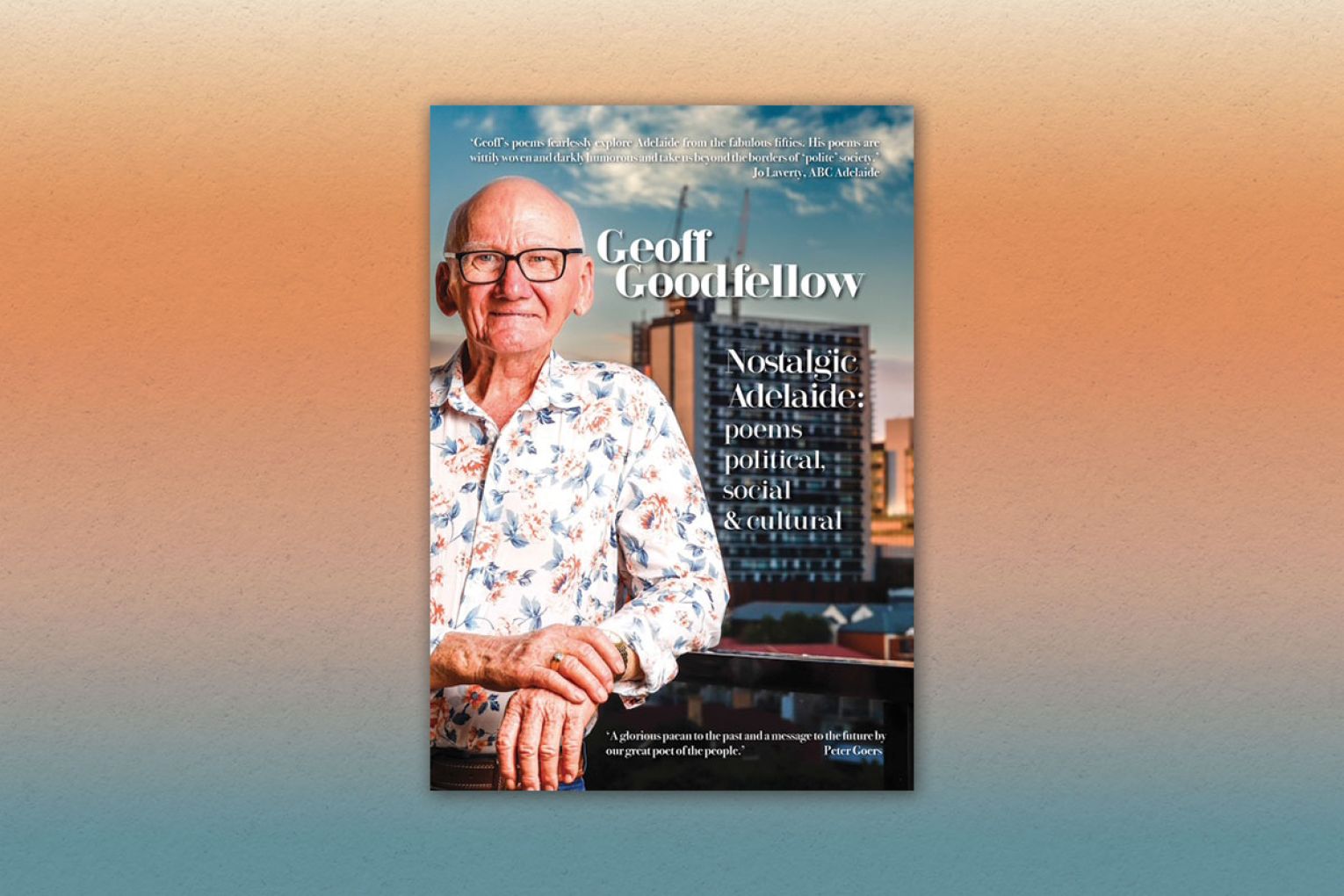
Recounted almost entirely in the poetic first-person, this tour of Geoff Goodfellow’s memories and experience over seven decades observantly immersed in Adelaide’s collective dynamics and working-class suburbs does trade in various aspects of nostalgic recollection. There is the straightforward litany of narrative references – to locations and lived processes, consumer products and mechanical parts, sporting triumphs and the era’s rock’n’roll soundtrack – which will evoke sentimental recognition especially in readers whose formative years share the same attachments of period and place.
In ‘As a Child’ for instance, Goodfellow tells us how “people drove Holden cars made in Woodville / when you learnt as a lad how to tune / a Zenith carburettor”, and continues to map the everyday world of his boyhood through declarative lines describing their family washing machine “made by Simpson Pope / at Beverly & Dudley park” with its “wringers & levers” or the “Hills Hoist rotary clothes line / sent out as a kit from a factory at Edwardstown” and his mother “in the kitchen with her Green & Gold / cook book chopping lamb & veggies for an Irish stew / to go in her pressure cooker from Castalloy at North Plympton”.
Although it can certainly work to elicit a kind of decorative nostalgia through casual engagement with the text – flipping through pages to spot each what, where and when we ourselves remember – such specificity also acts in more substantive ways. Against a sense of fragmentation and disconnection brought on by an increasingly dehumanised, algorithmically driven neoliberal world, Goodfellow points to a tangible social fabric which – although still rife with prejudice and inequality – was, at least, more obviously rooted in everyday examples of public solidarity and rapport.
Indeed, this is one of the book’s recurring themes. Marx once envisioned human life free of narrow specialisation, in which individuals might fish in the afternoon, rear cattle in the evening and criticize art (or poetry) after dinner. In the same spirit, Goodfellow’s opening poem takes Australian Rules Football as his starting point for a lamentation of “what has been lost” in terms of localised and less “corporate” communal milieus. His memories of “watching Ken Eustice rove / around the oval in a guernsey on a Saturday / then roam around his car yard on Main North Road / in a tee-shirt from Monday to Friday” are contrasted with proliferating signals of social atomisation and exploitation, which recur with gathering force throughout the collection: “ice cooked in backyard kitchens / by opportunists quick to score an earn”; systemic unemployment and precarious casualisation; big box superstores and pubs “packed with pokies”; unaffordable housing; and more that leave most living “in hope” and Goodfellow “really starting to think we’ve lost the game”.
You might like
Nostalgic Adelaide isn’t all looking back, though – and later poems that move into second-person address, sliding us back into the present of this city and Goodfellow’s life, serve up muscled metaphors and a sense of future focused persistence. Deploying football once again as symbolic device, ‘On with the Game’ celebrates Port Adelaide’s “mighty club” with a mixture of reminiscence and the energised pragmatism that embraces rebirth: “you are an old fish / that needs filleting”, he writes with what reads as a wry and ambiguously satirical smile.
Goodfellow has always dealt in layers of perspective and concern that can arrive unexpected for those focused only on the schematics of his life, work and reputation. Here, well into his seventies, he again presents a mix of the playful and acerbic. Poems about an aging couple sitting together, removing their dentures on the late-night train. Or the author himself as a “freckle-faced four-year-old” suffering the strap for holding a pencil in his left hand.
There are reflections on continuing battles with cancer, intergenerational trauma and systemic injustice, always connected back to his own human measure. Like the case of Derek Bromley, South Australia’s longest serving Indigenous prisoner, who Goodfellow finds it “difficult to imagine” has “spent nearly half my lifetime catching / his reflection in a sheet of stainless steel / each morning to shave”. Goodfellow’s work consistently reflects on the many ways and reasons people are, or become, or are made, outsiders – and that the connections between us are what matter.
Nostalgic Adelaide (Em Dash Publishing) will be launched as part of South Australia’s History Festival on Sunday May 10 at North Adelaide Community Centre, details here.
Want to see more stories from InDaily SA in your Google search results?
- Click here to set InDaily SA as a preferred source.
- Tick the box next to "InDaily SA". That's it.
Free to share
This article may be shared online or in print under a Creative Commons licence