Book review: The Minstrels
In her new book The Minstrels, celebrated South Australian author Eva Hornug explores the collision of First Nations culture and settler colonialism, and how language can provide more than simple signifiers, but rituals of connection and respect.
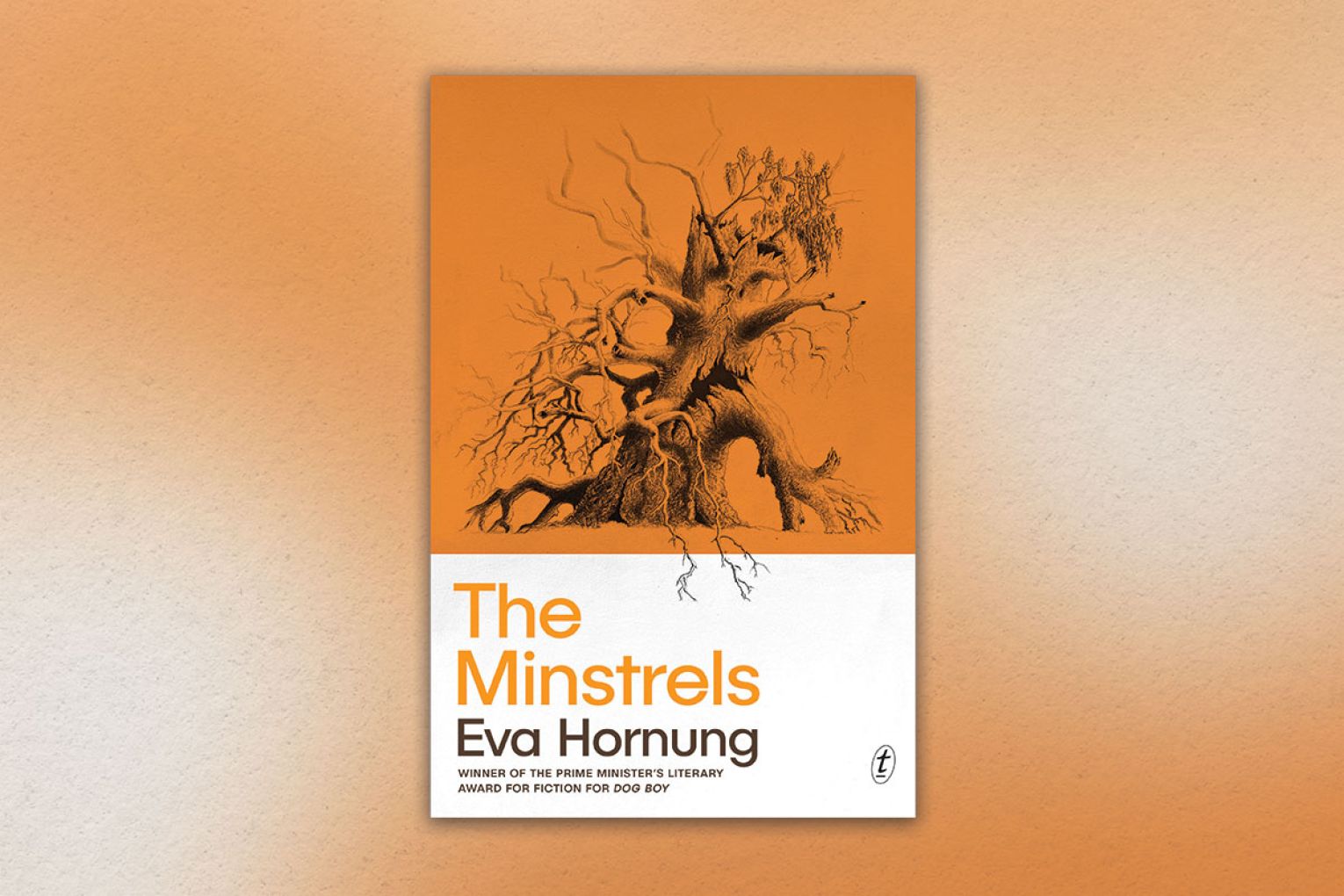
It’s been ten years since Eva Hornung’s extraordinary Dog Boy, originally published in 2009, was reprinted as a Text Classic, with an introduction by Booker prize-winning author Yann Martel (Life of Pi), and nine years since Text put out her last novel, The Last Garden. So it’s fair to say fans have been waiting, wondering if the celebrated South Australian writer can pull off another prize-winning book as good as the last two. Let me backtrack here and state that Hornung used to publish under the surname Sallis, and those books did remarkably well – particularly her debut novel Hiam, which won the 1997 Vogel Literary Award – but I don’t think it’s unfair to say Dog Boy changed more than her alphabetical positioning on bookstores’ shelves. Her latest novel, The Minstrels, proves that Hornung remains a force in Australia’s literary landscape.
Before we meet Gem, the book’s protagonist, we meet the chasm and pool that’ll be central to the book’s plot, and will give the book its title. With fable-like language, the Minstrels “sings and sighs with a sound signature all of its own. It draws us to speak, to inscribe ourselves”. And so it is the location of a breaking – emotionally for Gem and physically for her brother, Will. But it’s not until page 111 that the breaking happens, and the narrative begins a true trajectory. In the book’s skilful early pages, Hornung builds the character of Gem patiently and with some cheek, while painting colourful pictures of her family dynamic and the farm where she grows up and the community surrounding it and, vitally, the Minstrels. There’s a long description of a mice infestation that seems to have not much to do with where we, as readers, want to go, but in Hornung’s deft telling, we’re already there. It’s Gem’s world, not just her story, that makes The Minstrels the book that it is, and it’s this swelling of introduction that makes the first section’s climax all the more explosive, fully investing us and preparing us for section two, where Gem’s world expands even more, despite her near-hermit status.
Set in a time and place not unfamiliar but also unplaceable, a lot happens in The Minstrels, so much that the storyline meanders in the way the river that leads to and away from the Minstrels does. Gem becomes a farmer, rigorously self-reliant. She meets the eccentric Uncle Jim, a local First Nations Elder who “shook hands with her from a distance, skin touch tentative, faintly unwilling” and he becomes a teacher of language to Gem, changing the course of her life and enriching her relationship with the land.

“Her tongue wrestled with sounds it had never tried to make, her ears strained to discriminate between vowels that of necessity looked the same on the page and her face contorted as she struggled. Trees she had seen since childhood, noticed only when they dropped limbs and changed dramatically, now reached out towards her for their old names, seeming changed, charged with some new and uncomfortable identity. Ngawarla.”
She has a run-in with some young vegan activists and befriends the one she nicknames Little Bull. She kills sick animals. She plants trees in spiral patterns. She uses a scalpel to bring a baby boy into the world. Gem’s world is rich and always surprising.
Taking place over a lifetime spent, the novel is vast, proving a single setting can provide as much adventure as a person will ever need. As she writes about learning the originary language of the land – which Hornung herself has spent much of her adult life doing – “Every bird, valley, shadow, peak, lizard, cloud, weather cell, star; everything on her farm had a name”. And an energy. And a point of connection. Also something Hornung proves: a woman can choose to distance herself from her parents, siblings, aunts and uncles, can choose to not partner and not have children, and still give and feel love in abundance. True, Gem’s connection to land and animals is pivotal to her coping with past trauma and to her mere existence, but the value of human connection cannot be underestimated.
Yes, The Minstrels lives up to its predecessors, and it could very well become another Text Classic.
The Minstrels (Text Publishing) by Eva Hornung is out now
Want to see more stories from InDaily SA in your Google search results?
- Click here to set InDaily SA as a preferred source.
- Tick the box next to "InDaily SA". That's it.
Free to share
This article may be shared online or in print under a Creative Commons licence