Budget papers reveal lasting impacts of Middle East war
While the government tightens its belt amid an inflation surge, a worst-case scenario would see Australia just narrowly avoiding a recession. Read about the potential impact on the economy.
Lingering conflict in the Middle East could cause Australia’s economy to briefly contract and unemployment to spike to pre-pandemic levels, Treasury warns in the nation’s fiscal blueprint.
While Treasurer Jim Chalmers said Australia was well placed to weather headwinds blowing in from the Strait of Hormuz as he released his fifth budget on Tuesday night, he acknowledged households and businesses could be hit hard by a prolonged war.
Under a severe downside scenario prepared by Treasury boffins for the budget, oil prices were assumed to rise from about $US104 a barrel to as high as $US200 a barrel, with corresponding price increases for other commodities like fertiliser.
In that scenario, Australia’s economy would only narrowly avoid a recession – which is two consecutive quarters of negative growth – but still shrink in the September quarter.
Annual GDP growth would fall from 2.6 per cent currently to 1.25 per cent in 2026/27, 0.5 per cent lower than forecast in Treasury’s base case.
Yearly inflation would peak at around 7.25 per cent in December and unemployment would hit five per cent in 2027/28.
“Price pressures stemming from the conflict are expected to broaden in the coming months, as price increases for petroleum-dependent products are passed through supply chains,” the budget warned.
That would have significant consequences for households and businesses already reeling from three straight Reserve Bank rate hikes.
Higher cost pressures will squeeze business margins and threaten viability, the budget warned.
Dr Chalmers said Australia was better placed and better prepared than most countries to deal with the global crisis.
“As Australians, we confront these serious challenges together from a position of strength,” he said in a speech in Parliament House.
Economists warned that a budget spending splash could further exacerbate inflation, already at 4.6 per cent, by adding to the demand at a time when the economy is already supply-constrained.
You might like

Dr Chalmers touted his government’s efforts to drive down real spending growth, which is now forecast to fall from 4.3 per cent in the current financial year to 1.3 per cent in 2026/27 and 0.7 per cent in 2027/28.
”We are playing a helpful rather than a harmful role in the fight against inflation,” he told reporters.
Still, the fall in real spending growth is largely due to a surge in inflation.
Payments as a percentage of GDP are set to rise to 26.8 per cent in 2026/27, which is the highest ratio since 1987, excluding the COVID-19 pandemic.
At the centre of the savings package are sweeping cuts to the runaway National Disability Insurance Scheme, which will save $37.8 billion over the five years from 2025/26, with program spending falling from $56.1 billion in 2026/27 to $55.1 billion the following year.
Despite the underlying budget deficit improving by $8.5 billion since the December mid-year update to $28.3 billion in 2025/26, the fiscal bottom line is projected to remain in the red until 2034/35.
This is a year earlier than the previous budget forecast, largely as a result of the NDIS reforms.
But aged care, defence and hospital payments to the states are expected to grow faster over the medium term than they were projected to in December.
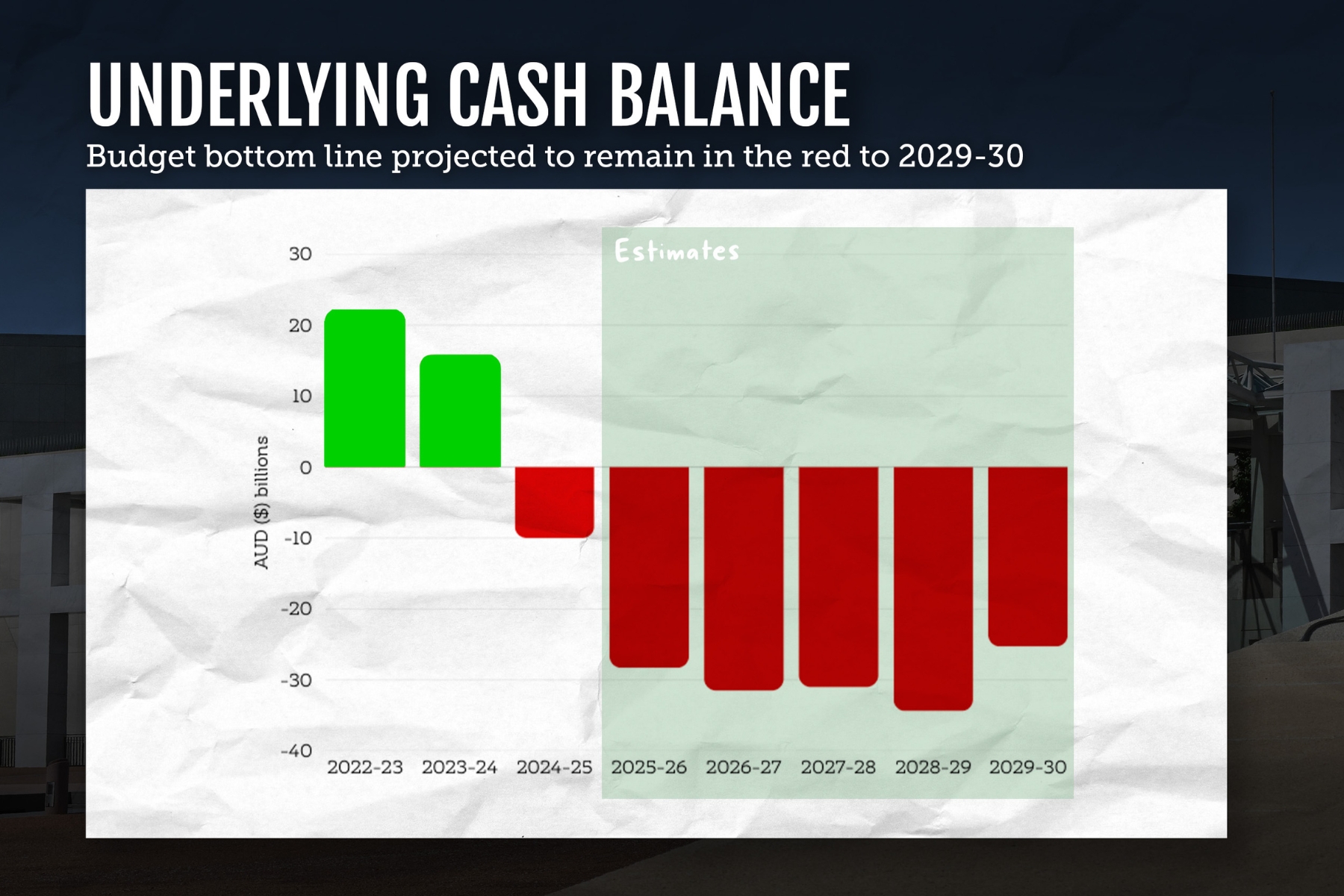
However, “off-budget” spending continued to increase, with the headline deficit climbing from $47.9 billion this financial year to $64.1 billion in 2026/27.
The government’s net policy decisions since December improved the cumulative bottom line by $8.2 billion, but most of the improvement is projected to happen in 2029/30.
Government decisions, including $2.55 billion for fuel excise cuts, are estimated to make the deficit $5.3 billion worse off in 2025/26 and $6.5 billion worse off in 2026/27.
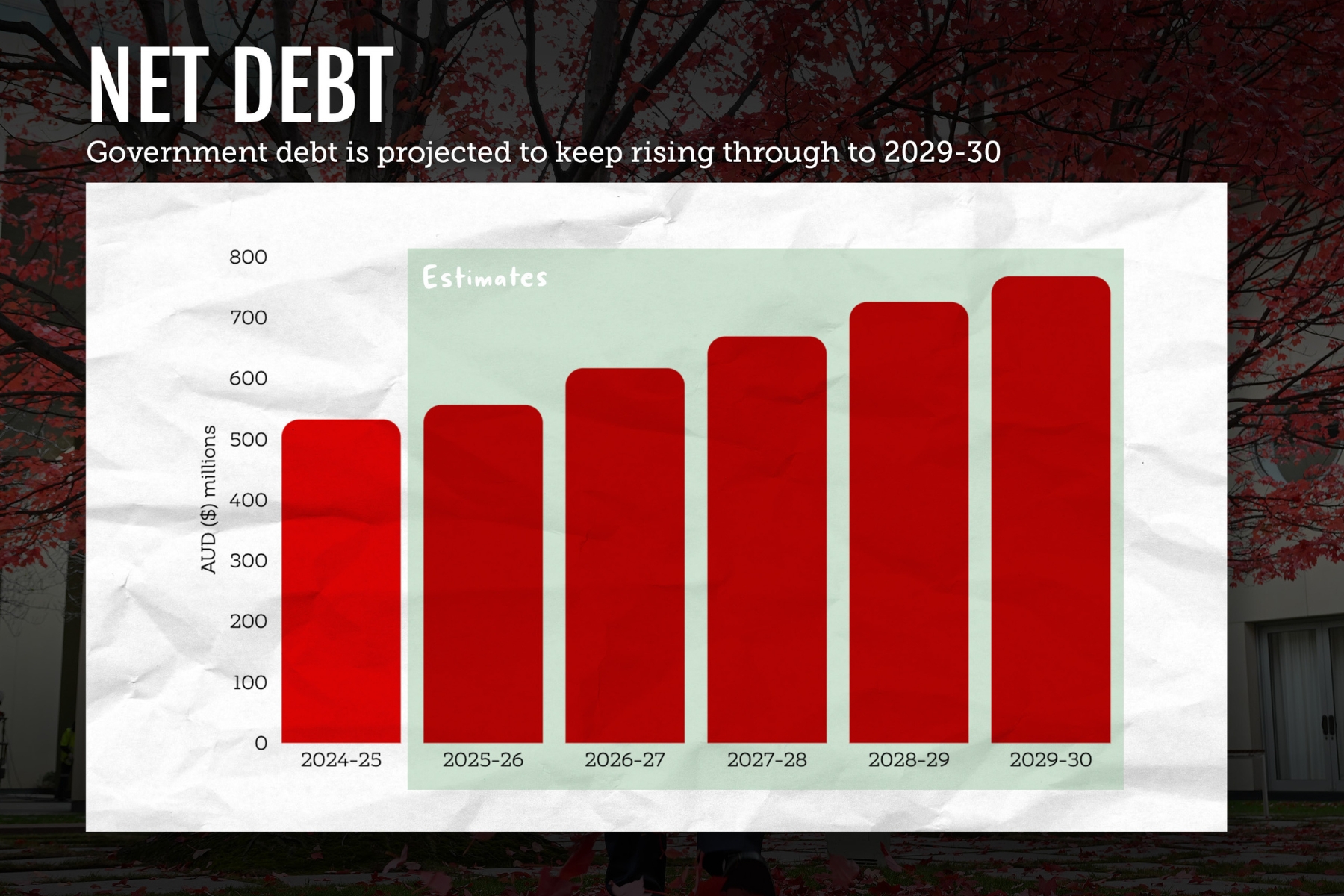
Gross debt is expected to finally exceed $1 trillion in 2026-27, while net debt is expected to hit $616 billion, or just under one-fifth of GDP.
The 2026/27 federal budget outlines how Labor expects its key parameters to play out over the next four years.
DEBT
Taxpayers will be on the hook for $1.1 trillion in gross debt, as measured by government borrowings, in the new financial year.
This equates to about $39,700 for every person in Australia, based on a population of 27.7 million people.
At the same time, interest payments on government securities are set to total $27.7 billion in 2026/27.
Net debt – which offsets the positive financial impact of certain government assets – looks a little better.
It will hit $616.6 billion in 2026/27, before rising over the next three years to $767.8 billion.
Stay informed, daily
BUDGET POSITION
The underlying cash balance for this 2025/26 financial year is likely to be $42.1 billion.
Then it’s another sea of red for the next four years.
However, the deficit is expected to fall gradually and potentially reach balance in 2034/35.
The deficit forecasts below compare to the 2025/26 year.
2026/27 – $31.5 billion ($35.7b)
2027/28 – $31.0 billion ($37.2b)
2028/29 – $34.4 billion ($36.9b)
2029/30 – $25.3 billion (not available)
Total deficit over the next four years: $150 billion
ECONOMY
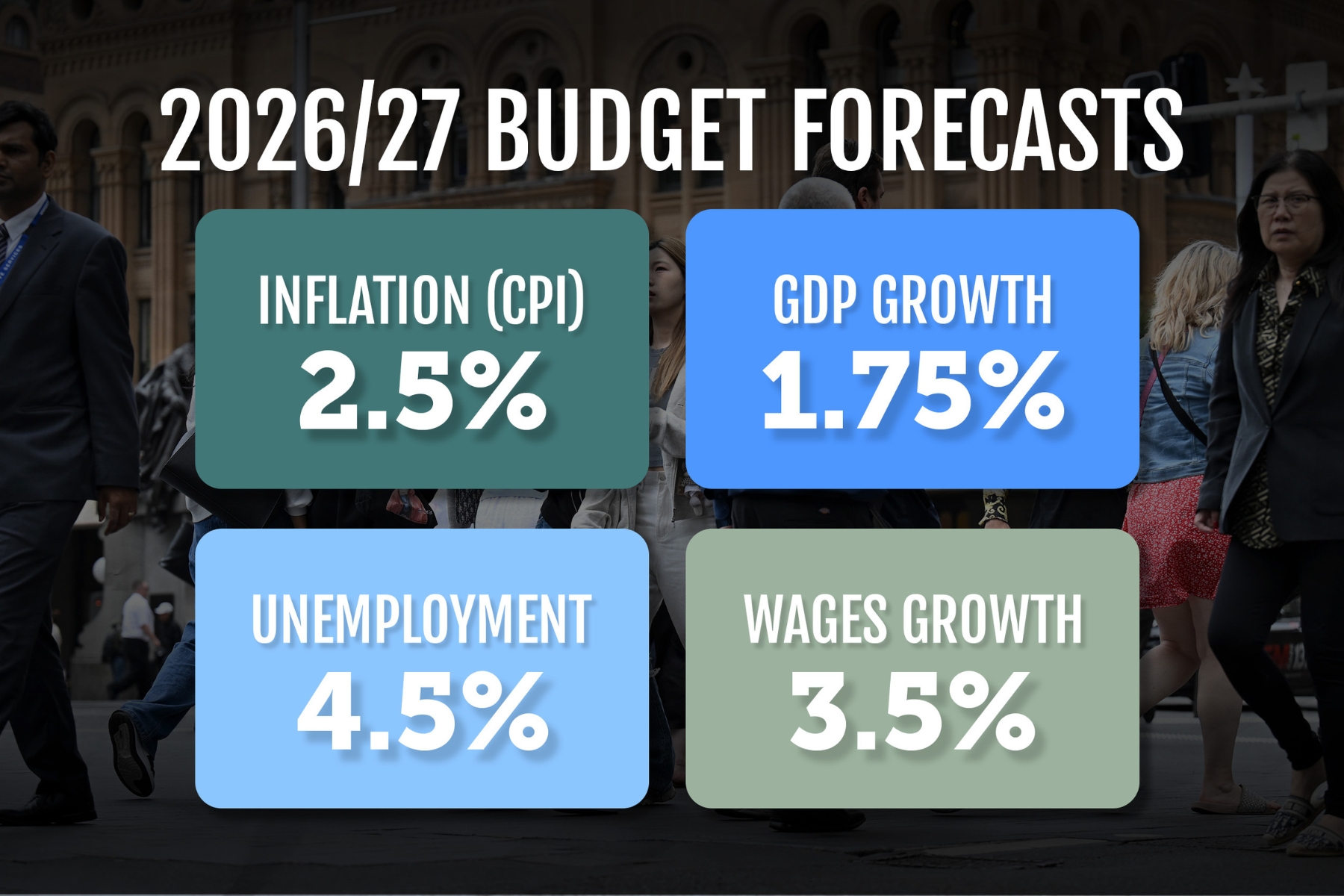
The economy will falter due to the Middle East crisis, slowing to a 1.75 per cent growth pace in 2026/27, down from an estimated 2.25 per cent this financial year.
Here’s how real gross domestic product, or economic output, will fare:
2026/27 – 1.75pct (2.5pct)
2027/28 – 2.25pct (2.75pct)
2028/29 – 2.5pct (2.75pct)
2029/30 – 2.5pct (n/a)
INFLATION
Australia’s last reading on inflation, for the month of March, was 4.6 per cent.
The consumer price index is expected to spike to five per cent in the middle of this financial year.
It should then ease to 2.5 per cent in 2026/27, where it will stay for the next three years.
Treasury has a worst-case scenario that would see inflation peaking above seven per cent, if the price of crude oil jumps to $US200 a barrel and doesn’t drop fast enough.
2026/27 – 2.5pct (2.5pct)
2027/28 – 2.5pct (2.5pct)
2028/29 – 2.5pct (2.5pct)
2029/30 – 2.5pct (n/a)
JOBS
Ahead of the budget, economists were concerned the crisis could hit the jobs market, with businesses laying off workers in bigger numbers.
But the outlook for actual jobs growth is positive, due to robust business investment.
Here’s how the unemployment rate, which is currently at 4.3 per cent, looks over the next four years.
2026/27 – 4.5pct (4.25pct)
2027/28 – 4.5pct (4.25pct)
2028/29 – 4.5pct (4.25pct)
2029/30 – 4.25pct (n/a)
Want to see more stories from InDaily SA in your Google search results?
- Click here to set InDaily SA as a preferred source.
- Tick the box next to "InDaily SA". That's it.