Fears for Limestone Coast water amid fracking ban repeal and mining plan
Farmers in the state’s South East fear a proposed strip mining project could impact soil and water quality as the government’s removal of a ban on fracking rings alarm bells.

Fears are rising amongst farmers and wine growers in the South East of the state this week over two announcements they are concerned will impact their ground water and soil.
Agriculturalists in the state’s South East were worried that the region’s highly productive farmland and vital underground water source could be impacted by the state government yesterday announcing they would remove a ban on fracking.
At the same time, protests by wine growers and the timber industry over a contentious strip mining project were gaining momentum.
Livestock SA CEO Gillian Fennell told InDaily she was concerned for the Limestone Coast aquifer.
“There’s always the potential for something to go horribly wrong,” she said.
“I feel for the farmers who thought they had certainty around this issue.
“The Limestone Coast is quite arid. Farmers rely heavily on these underground aquifers. The entire agriculture industry, not just livestock but also wine grapes, everything that grows down there relies very heavily on those underground water sources which is why they are so anxious.”
An announcement that the government planned to lift the fracking ban on the Limestone Coast saw newly elected One Nation MP Jason Virgo gatecrash a state government public meeting in Mount Gambier on Thursday night, where he told Premier Peter Malinauskas that his party would reject legislation that overturned a hard-fought moratorium put in place by the Marshall Liberal government in 2018.
“Ensuring sovereign capabilities doesn’t just mean energy security, it also means food security,” Virgo told InDaily.
“The farming community in the South East fought hard and long against fracking on their land and One Nation is going to back them all the way.”
Without the support of either One Nation or the Liberal Party, Labor’s bill is set to fail in the upper house.
You might like


Malinauskas said the lifting of an eight-year ban on controversial underground fracking was needed to help find new resources to address the current fuel and gas crisis.
Fracking processes have been controversial over fears they could affect underground water sources but it is currently permitted everywhere in South Australia except for the South East where its dominant industries are farming and winemaking.
The ban on fracking – a process for extracting gas from the ground that involves pumping chemicals and water into the ground to fracture rock – was won after intense lobbying by the South East community.
Proposed strip mining project raises red flags
The reversal of the fracking ban comes as an Adelaide mining company pushes ahead with preparatory works for its proposed rare earth strip mining project in the state’s South East near the border of Victoria.
Adelaide-based mining company Australian Rare Earths is set to start pilot-scale processing of rare earth minerals next month after joining the Federal Government’s critical minerals hub in Sydney.
The company, listed on the Australian Stock Exchange, hopes to prove it is capable of extracting critical minerals out of Limestone Coast clay as it progresses its plans to eventually establish a mine near Koppamurra.
It has already spent more than $20 million on preparatory work and is yet to receive a mining licence, but a pre-feasibility study – to be released publicly later this year – should hurry that process along, CEO Travis Beinke said.
The Department for Energy and Mining has already approved the company’s Scoping Report, which defines the scope of detailed assessments relating to groundwater, surface water, soils, vegetation, heritage, air quality, rehabilitation and community engagement.
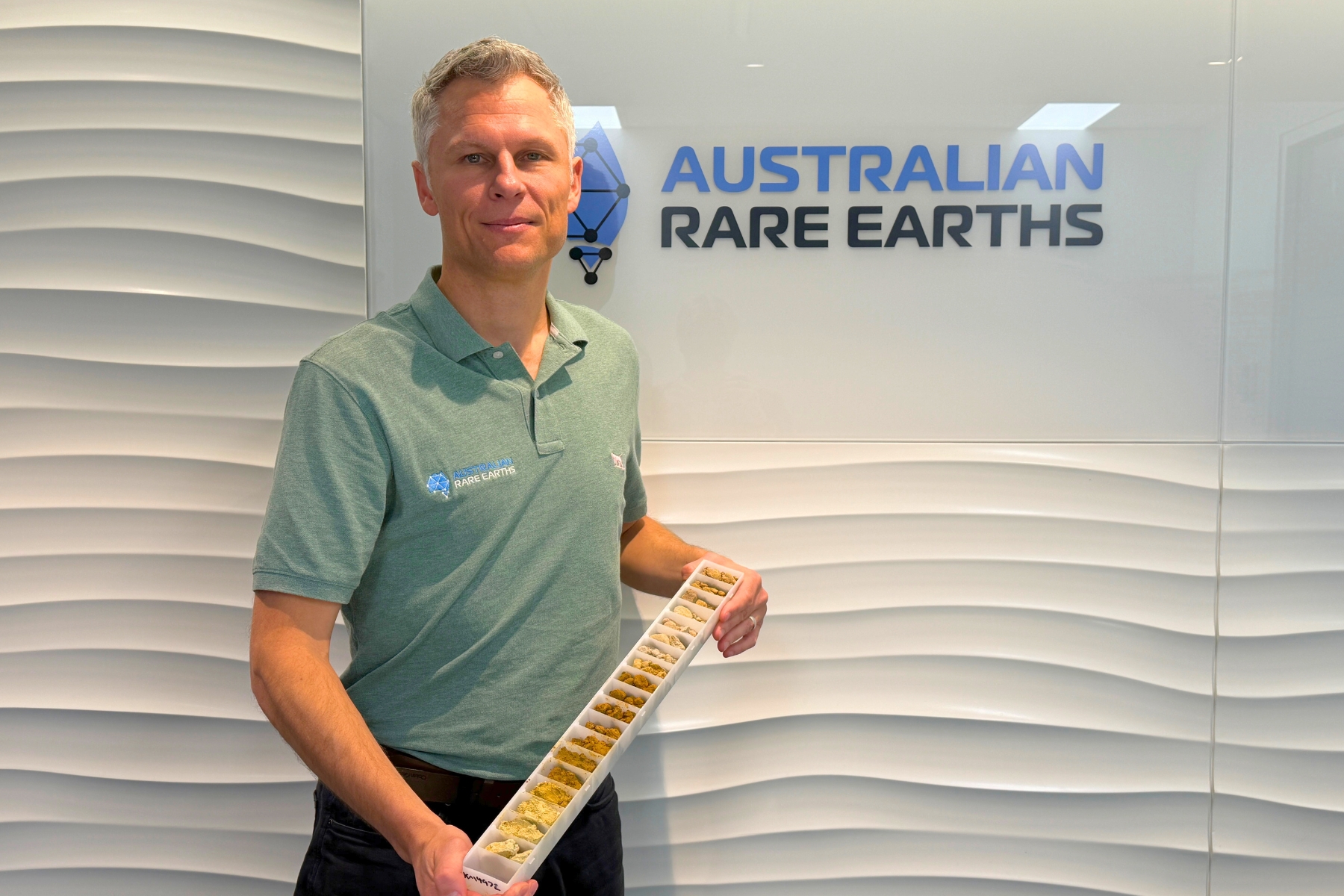
China has a near-Monopoly on the sector, controlling about 90 per cent of the global processing and production capacity of rare earths.
Beinke said this needed to change.
“China has really built out a stranglehold on the supply chain over the last three decades, pretty much controlling everything from mine supply through to final product,” said Beinke, the former group manager for investor relations at OZ Minerals before that company was swallowed by BHP in a $9.6 billion deal.
“There has been a realisation in the West that there’s an opportunity to diversify our supply chains and reduce reliance on China, given the geopolitical tensions that have been playing out.
"To do that, we need new rare earth mines to come into production, as well as building out the downstream part of the supply chain."
The company has 10 exploration leases on the Limestone Coast, and more than 6000 holes have been drilled at an average depth of 10 metres across the land.
Stay informed, daily
But the mining will involve disturbing prime Limestone Coast farming land.
South Australian Forest Products Association CEO Nathan Paine, who was today named the new chief executive of ForestrySA, told InDaily he was worried the project would have an impact on soil quality.
“We’re planting a seedling that will put roots down a significant depth, and that means we have to rely on not just the carbon in the soil, but the structure of the soil itself,” Paine said.
“The very nature of strip mining activities means that you are disturbing all of that soil.
“That is a significant concern for industry because from an investment perspective, if you’re spending the money to plant the tree today, you want to know that it’s not going to be prematurely harvested tomorrow.”
The region’s wine growers were also concerned, particularly for the quality of the underground water.
In a letter to Plan SA, seen by InDaily, the executive officer of the Limestone Coast Grape & Wine Council Dr Edward Cavanagh said growers were “fatigued, confused and ultimately suspicious about the Australian Rare Earths Koppamurra project”.
“The first major concern we have is for water,” the letter reads.
“We think that giving a green light to this kind of project, without a proper understanding of its thirst for water, sends an unfortunate message to growers and producers in our industry who have been taking active steps towards more responsible water usage in recent years.
“Arguably, what is the biggest problem when it comes to water is not the pressure on the resource that the proposed mines will apply, but the potential for irreparable damage to be incurred to our delicate limestone geology through the methods of acid mine drainage.”
Beinke said rehabilitation of the landscape was at the centre of the proposed mining project, and pointed to a trial the company did from 2022 to 2024.
“Because of the nature of the rare earth deposit and how we’re going to mine it, it actually provides us with a great opportunity to continue progressive rehabilitation of the mining area so that we only ever impact one farmer for a short period of time before the land is actively rehabilitated and handed back,” Beinke said.
An AR3 spokesperson said,”We believe farming and rare earths mining can exist in the South East with mutual benefits that will see both industries thrive for decades to come.
“AR3 will only lodge an application to mine once we are completely satisfied we can operate in an environmentally sustainable and economically viable way. We believe we can do this and we’re looking at how we may be able to improve soil productivity in some areas.
“Early engagement in the Koppamurra Project has allowed us to ascertain feedback from key stakeholders which has informed the scope of environmental, economic and social assessments we are now undertaking.
“The forestry industry, along with other local industries, was represented on our initial Koppamurra Landholder Reference Group and is now part of the formalised Community Consultative Committee which is the forum for sharing project information with key stakeholders.”
Australian Rare Earths has discovered that the Limestone Coast clay, which sits just above the layer of limestone, contains the four key magnet rare earths: Praseodymium, Neodymium, Terbium and Dysprosium.
These rare earths are turned into magnets and are essential in the fabrication of most modern technologies.
To get to these rare earth metals, Australian Rare Earths plans to use the heap leaching method. This involves digging up layers of the earth – typically about 10 metres deep – piles of which are then processed and turned into a ‘mixed Earth oxide’.
This white powder is then shipped from the site and sold to international markets, where buyers will use a separator to extract the individual rare earth elements.
In April, the company prepared and transported 30 tonnes of blended bulk ore to the ANTSO pilot facility.
Want to see more stories from InDaily SA in your Google search results?
- Click here to set InDaily SA as a preferred source.
- Tick the box next to "InDaily SA". That's it.