Theatre review: Till the Stars Come Down
Holden Street Theatres begin their repertory season with a confronting but also warmly comic production. An unravelling family drama is set on the single day of an English Midlands wedding, charting the morning bridal women’s rituals through to the last reproachful, drunken moves on the dance floor.
The title of Beth Steel’s captivatingly inter-connected family saga is drawn from a 1936 poem by W.H Auden, Death’s Echo:
The desires of the heart are as crooked as corkscrews
Not to be born is best for man:
The second-best is a formal order,
The dance’s pattern ; dance while you can.
Dance, dance , for the figure is easy,
The tune is catching and will not stop;
Dance till the stars come down from the rafters;
Dance, dance till you drop.
Perhaps, in 23 BCE, Horace’s carpe diem was even more succinct: “Seize the day, pluck the day, trusting as little as possible in the next one.”
With wry compassion and bawdy candour, Steel’s 2024 play reveals inter-generational lives of noisy hedonism and quiet desperation. There are open declarations of affection (and secrets and lies) for three sisters, their husbands and children, navigating the social changes and economic disappointments of post-Brexit working class England.

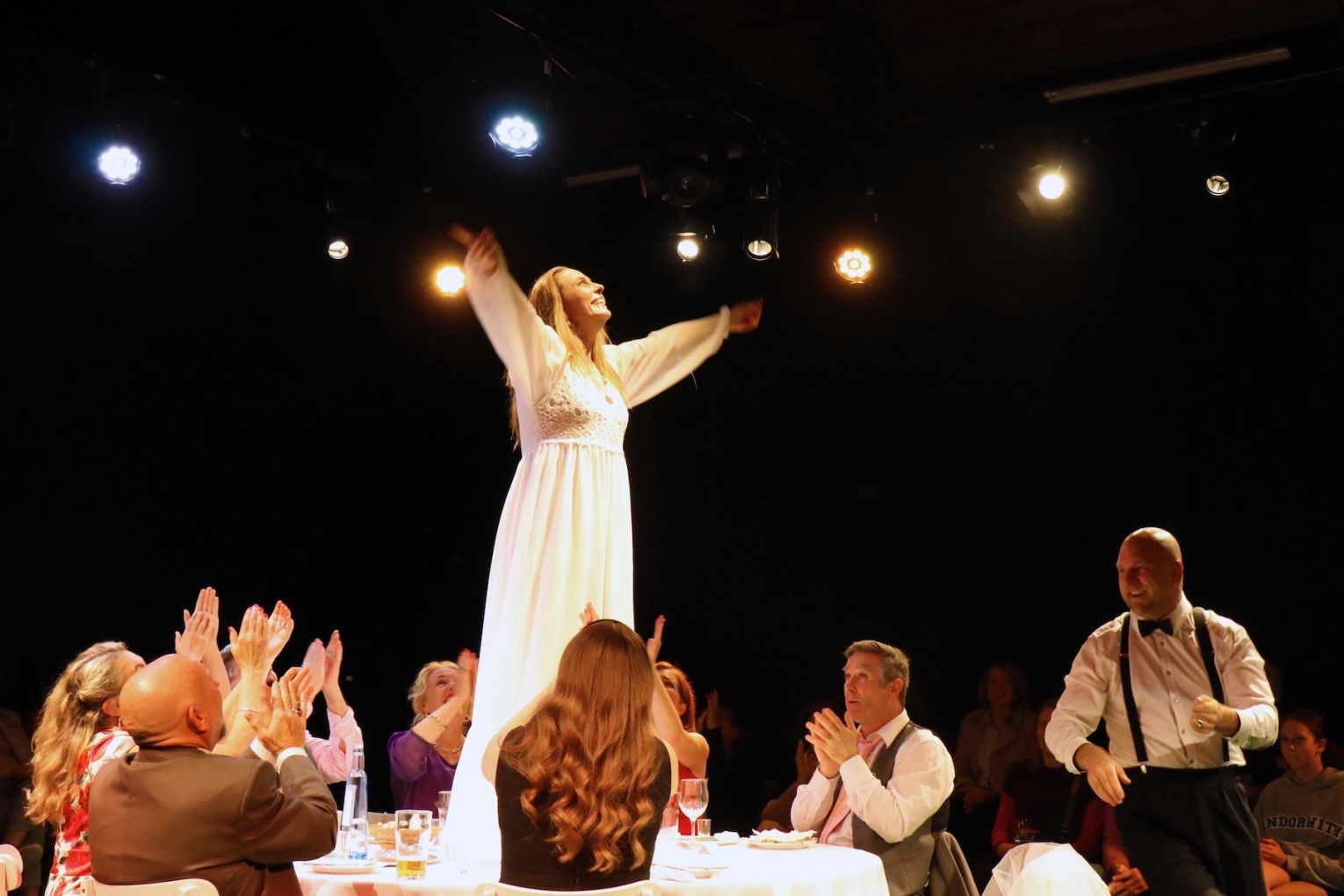
It is Sylvia and Marek’s wedding day, and the older sisters are in a flurry of nuptial organisation. Thrice-married Maggie has come back to Nottinghamshire while Hazel, married to John, mother of two daughters Leanne and Sarah, has never left. Their widowed father, Tony is the bewildered patriarch and drop-ins arrive – Aunty Carol and her husband Pete, who we discover is Tony’s long and bitterly estranged brother.
Filled with Northern banter and cheery dialect the play opens with all manner of backstory and secret bridesmaid business. Steel’s text is rich in detail and sudden shifts of emotion and tone. Over two hours (often fuelled by alcohol and resentment) sibling rivalries and forbidden yearnings are revealed. Grudges dating back to the miners’ strikes of the 1980s, unresolved grief for a lost mother, and the hostile, casual racism towards Marek the Polish groom, all bubble to the surface.
In the confines of The Studio at Holden Street director and designer Nick Fagan has brought this turbulent and unpredictable script into an excellent and fully engaging production. Simply lit by Martin Smith, the minimal staging – in the (square) round – lays down a floor of artificial turf with a scattering of outdoor chairs, a serving trolley and a wedding table placed on a slow-moving revolve. There is also a circular string of pin-lights marking the emotional hotspot for the cavalcade of dramatic encounters – laughter, gossip, nostalgia, as well as feuds, confessions, exasperation, and dread.
This ambitious and demanding text has delivered some vivid and memorable performances. Michelle Nightingale as Maggie plays a key role as the sister who has left under a cloud, admirably struggling with conflicts between loyalty to family and her unnurtured heart. It is a crucial and affecting performance.
Krystal Kave does well as Sylvia the bride caught between family bigotry and the legitimate feelings of Marek (exuberantly and perceptively played by Spencer Scholz). Jo St Clare contributes mischievous and intoxicated comedy as Aunty Carol. Blurting secrets, full of sexual gusto, and disinhibited commentary, she triggers much of the dramatic disarray – to the chagrin of Steve Turner as husband Pete. His set piece, late in the play, where he explains the movement of the spheres by directing characters (designated as sun, moon, and various planets) to interconnect, is one of many inventive moments in Beth Steel’s assured text.
Subscribe for updates
Brendan Cooney is suitably reserved and diffident as Tony, the father of the bride and lonely widower, bemused by his daughters, and desolate at the brothers’ rift. We see him with granddaughters, Leanne (Laura Lines ) and Sarah (Millie Fagan) and his reminiscence (with an extremely tipsy Carol) of the night they won the Tarzan and Jane contest, is another shrewd vignette.
Brant Eustace carries the role of John, the emotionally frozen, socially alienated husband of Hazel, with a convincing sense of desolation. He delivers cruel jibes and is weary with his declining life for most of the play. And so his scene with Maggie, when he declares his wish to claim back his life, to dance till the stars come down from the rafters, is central to the play.
As is Martha Lott’s Hazel. She is raucous, often vulgar, outspoken, racist, and resentful of the rise of European migrants (like Marek) thriving in a Britain no longer British. This is Steel’s portrait of Midlands discontent, but it is also of a woman still alive to her emotions and drives, sharply brought into focus in Martha Lott’s rendering.
Lott has a knack of taking abrasive, aggrieved woman characters – Albee’s Martha, the mother in her own play, The Debate – and giving them meaning by capturing their perspectives, gripes, and deep sadness. Her final speeches – as the three sisters fall from drunken laffs into primal screaming, and then her poignant desperate plea to John – leave us with an admiration, not only for the strength of the text, but for this terrific production on a rainy Tuesday night in Adelaide.
Till the Stars Come Down continues at Holden Street Theatres until June 13
Want to see more stories from InDaily SA in your Google search results?
- Click here to set InDaily SA as a preferred source.
- Tick the box next to "InDaily SA". That's it.
Free to share
This article may be shared online or in print under a Creative Commons licence