Music review: Australian String Quartet – Voyager
In its ‘Voyager’ concert, the Australian String Quartet’s wonderfully finessed playing offered fresh perspectives in Bartók and that most challenging of Beethoven’s late works, his monumental Grosse Fuge.
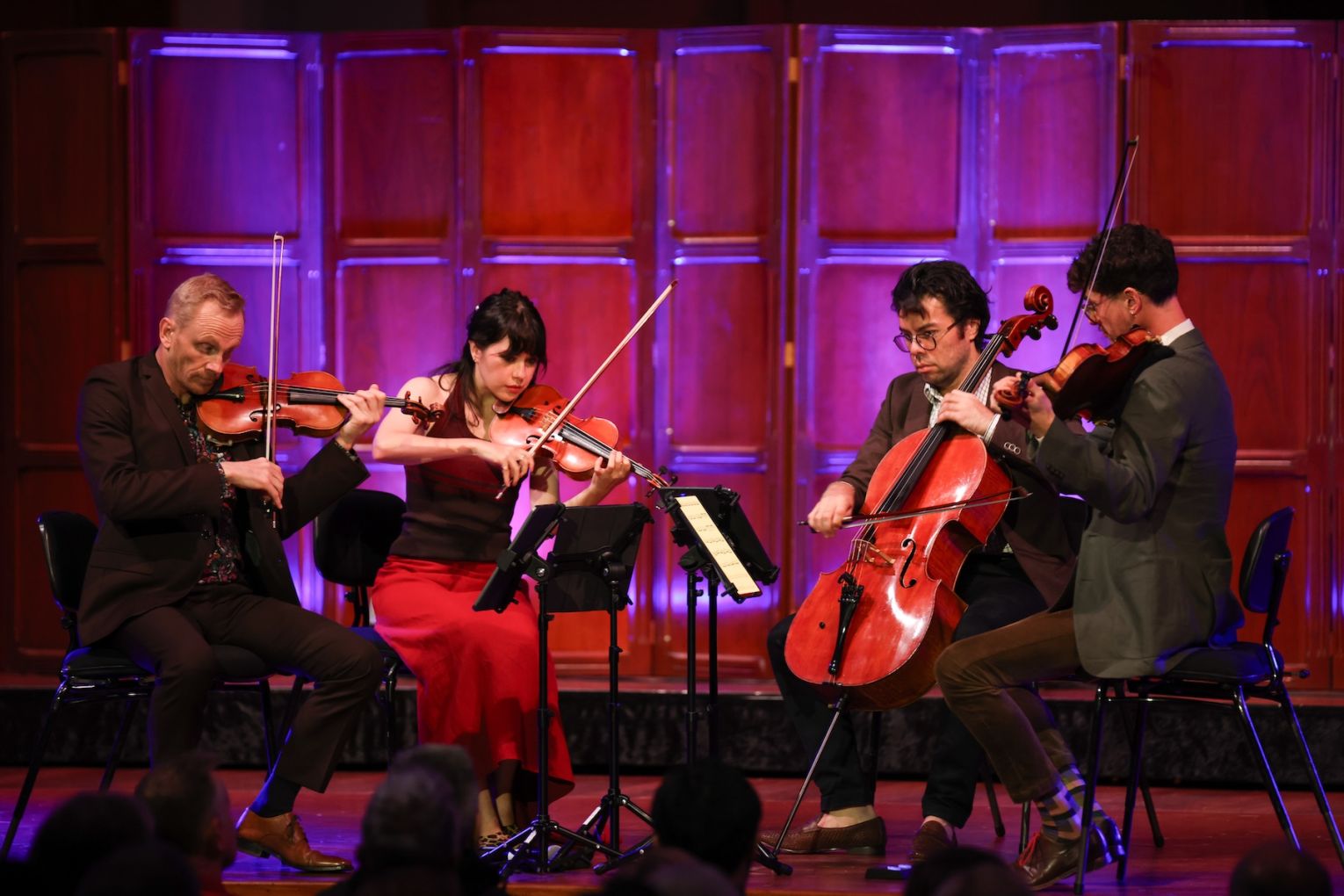
It sure was one of their grittier programs. Bartók’s Fourth String Quartet is amongst the toughest of his six quartets to listen to, and Garth Knox’s Satellites pushes contemporary string techniques to an extreme. Topping them both, however, Beethoven’s Grosse Fuge still stands as one of the most brutally demanding pieces in the entire repertoire.
Fancy hearing all three works in the same concert – yet the Australian String Quartet can again be praised for its uncompromising stance. Consistently, they settle on works of true substance without feeling the need to flesh out their programs with concessional ‘filler’ type pieces.
What particularly stands out about the ASQ these days, however, is their sound. With Dale Barltrop as first violinist, they have evolved a highly skilled sense of ease, an élan, that makes music of any genre fall beguilingly on the ear.
One heard this first in the piece by Garth Knox. Satellites (2015) begins with sharp-edged pizzicato snaps that, together with a multitude of other effects, illustrate the sound of an orbiting satellite randomly being hit by space junk. His piece is entertainingly ‘pictorial’ in the way it achieves this with zinging, banging and pitting sounds achieved by the cleverest plucking and bowing techniques. It is fascinating to watch and hear. Knox is himself a master viola player, and few composers can exploit extended string techniques as convincingly as he does.
The fastidious accuracy of the ASQ in Satellites was amazing. They did in fact perform this piece at UKARIA while Knox was here during the 2025 Adelaide Festival. This time they played it with the same high precision in Elder Hall concert. It is truly a fun piece, and the best part was right at the end when the players swipe their bows through the air, producing a feint whooshing noise – no music, just a sound preciously close to silence.
You might like

The composer who most expanded the quartet in the 20th century was of course Bartók. Just one example of this was the snap pizzicato (henceforth called the ‘Bartók pizzicato’) which imparts a real twang to plucked notes. This and his entire sonic lexicon from sul ponticello to glissando effects are present in his String Quartet No. 4 (1928).
Just to say again, this work can sound brutal. Heavy in its use of ‘secundal’ harmonies, built on major and minor second intervals, its dissonances can sound particularly abrasive. However, Barltrop and his colleagues have a special way of making things seem effortless and natural. One could immediately admire the sonic precision of Bartók’s textures. In an unexpected way, his Fourth Quartet sounded beautiful – hardly a word one would have expected to use.
It is not as if the ASQ smoothed everything over. Driving rhythm felt like a continual flexing of energy rather than a chopped-up series of notes. Melody was present and there to enjoy. Michael Dahlenburg’s eloquent solo cello in the central third movement was especially wonderful.
Once you hear Bartók played like this it is hard to go back.
Subscribe for updates
In Beethoven’s String Quartet in B-flat Major, Op.130, the ASQ took the decision to perform this work with its original last movement. This is increasingly how it is done by other groups. Otherwise, one usually hears the famous Grosse Fuge performed on its own due to its weight and complexity – which to this day make it mountainously challenging for players and listeners alike.
One of the most perplexing decisions Beethoven ever made was to jettison the Grosse Fuge, publish it separately (as Op. 133) and compose a shorter, more accessible finale to finish off this quartet. But he did so with reluctance at the urging and financial incentive of his publisher. Furious and insulted, Beethoven agreed to the swap only because he was so worried about falling into debt.
This was a most lucid performance that fully laid bare the uniqueness of Op. 130. The first five movements are themselves a singular design, being a bewildering series of psychological states more than separate movements as such, from terse to the inwardly searching.
Interestingly, the ASQ treated the whole of this quartet as a flow of in-the-moment experiences. This allowed for genuinely affectionate touches in the first movement’s lyrical parts; and when the tempo suddenly races away in the short Presto second movement (breathlessly only two minutes long), they lent this a smooth ferocity rather than blunt-nosed power.
In the third movement, the interaction between all four instruments sounded conversational, as though the players were engaged in a fictional dialogue. With almost total deafness tormenting him in the last months of his life, Beethoven was deprived of all such social pleasures, so this movement carries the deepest irony.
Further jollity is dashed in the Alla danza tedesca fourth movement. Ostensibly this is a simple country dance, but it turns into a grotesque parody with oddly lopsided rhythms. Following this, sorrow fell doubly hard in the sorrowful Cavatina that is Op. 130’s emotional centre.
One felt all this.
Finally, the Grosse Fuge did not sound bolted on, as it so often can, but rather a continuation of this quartet’s whole unconventional ground plan. Fugal subjects (there are two) bobbed up in different guises in a totally predictable unfolding of ‘controlled chaos’. Heavy tendentiousness was gone, and one felt glad about that.
Some may prefer a more robust approach, but this exceptionally insightful performance lacked nothing and gained everything.
The Australian String Quartet performed Voyager on October 23 at Elder Hall
Want to see more stories from InDaily SA in your Google search results?
- Click here to set InDaily SA as a preferred source.
- Tick the box next to "InDaily SA". That's it.
Free to share
This article may be shared online or in print under a Creative Commons licence