Music review: Lucas and Arthur Jussen
Admired since they were plucky young boys, brothers Lucas and Arthur Jussen are two fabulous pianists who seem to merge into one persona.
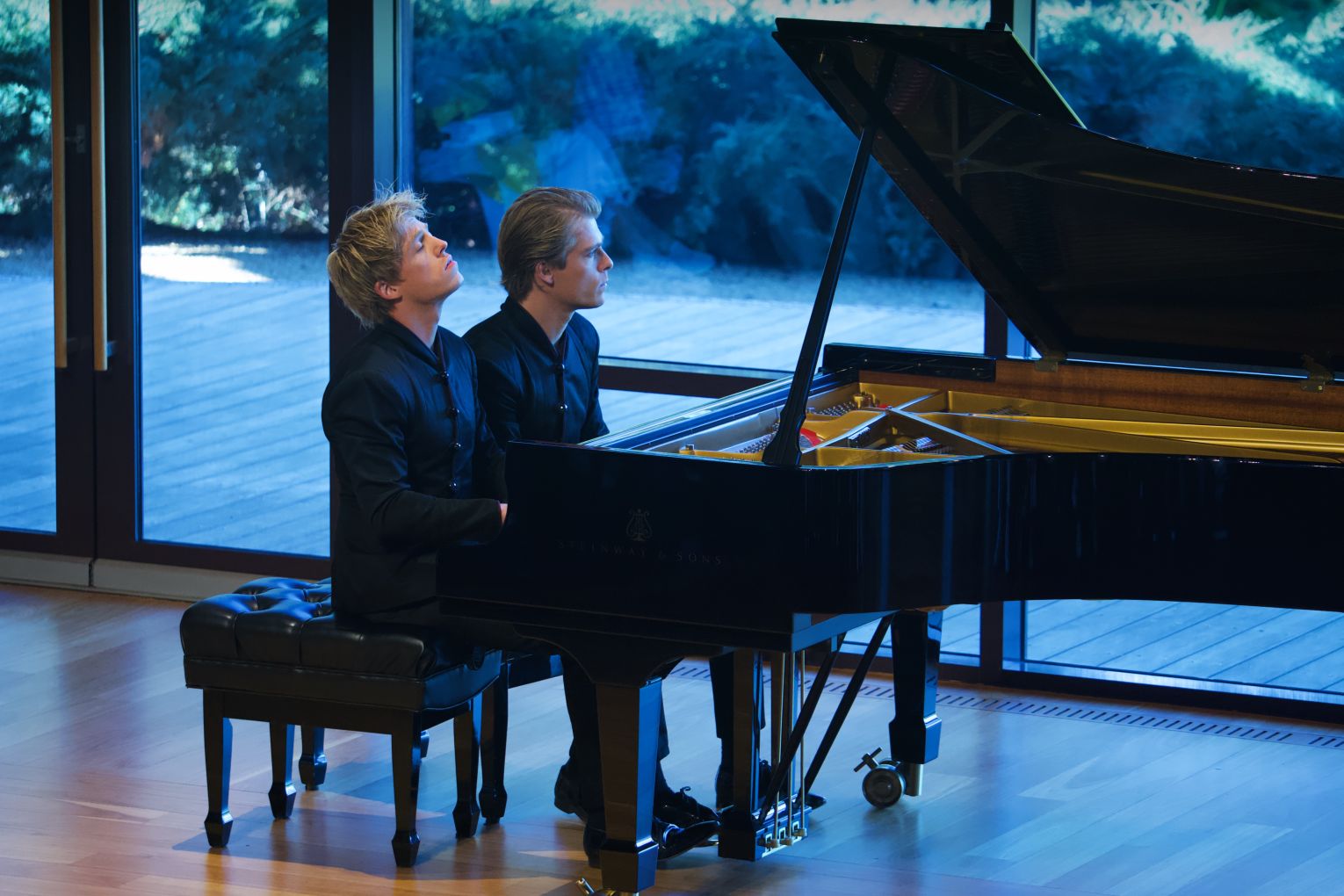
Years ago, Dutch brothers Lucas and Arthur Jussen captured public interest at the ages of 10 and 13 when they performed Mozart’s Concerto for Two Pianos, K. 365, with the Netherlands Radio Chamber Philharmonic. Unbelievably, they were still at school when they soon signed to Deutsche Grammophon, and since those early days these smart, perky boys have gone on to earn a worldwide reputation. Undoubtedly, charismatic good looks have played their part, but what draws special attention is their deep pianism and an ability to synchronise with uncanny accuracy. Observers frequently remark on how Lucas and Arthur appear to play not as two pianists, but as one.
Their first visit to Adelaide afforded a chance to see what all the interest is about. Their program was a big one, culminating in Stravinsky’s Rite Spring. This version for four hands piano was Stravinsky’s own arrangement of his ballet music, predating his famous orchestral score by a few months. Almost as famously, Stravinsky and Debussy played it through ahead of the premiere with the latter declaring that it was “like a beautiful nightmare”. Quite whether the same thing might happen a century-plus later at UKARIA remained to seen; but first up was a clutch of four-hands piano works by Mozart, Schubert and Mendelssohn upon which the Jussen brothers have furthered their reputation.
They were fast out of the blocks with Mozart’s Sonata for Four Hands in D, KV. 381. This early gem had pace, vivacity and strong dynamics. Most of all, one noticed how liberated in spirit these boys were (of course they’re young men now): playing from memory, they seemed to channel all their energy into momentary sensation. This sonata felt alive and liberated. Melodic line was clean, direct and pleasingly devoid of any artificiality. When they came down to a softer level, it felt especially right.
The scorecard was looking good. They play Mozart well, with youthful exuberance. Then it was to Schubert’s Fantasie in F minor, D. 940. A favourite amongst amateur pianists, it is not a technically hard piece but does require utmost feeling and a singer’s judgement of phrase. The two pianists absolutely must breathe together. Lucas and Arthur gave it a poetically lovely performance, direct in movement but pliant in expression. The remarkable thing was how every nuance of timing felt identical between these two pianists.
The same happened in Mendelssohn’s Andante and Allegro Brilliant for Four Hands. Timing is clearly their ace card. Never were there any momentary hesitations or split-second deviations. Twenty fingers must coordinate well in this demanding technical showpiece, but all was race-car smooth and swift. One particularly admired how seamlessly they exchanged melody, and how at times one brother would lean back elegantly behind the other to avoid their hands becoming entangled.
The Jussens are magnetic to watch, and their artistry is direct and disciplined. They play excitingly forward on the rhythm, and with exceptional clarity.
These ingredients boded well for Stravinsky in the second half. Nothing had really prepared one’s ears for their account of Rite of Spring. It felt new: a total re-conception of this work and divorced from any aural memory of the familiar orchestral score. That opening bassoon melody transformed into a sort of gestural wriggling of energy against a suspended feeling of time. Then it steadily unleashed and stridency set in. Those jolting rhythms in ‘Dance of the Young Maidens’ were amazingly propulsive and clean. By ‘Games of the Rival Tribes’ this performance was intoxicating, and by ‘Dance of the Earth’ completely engulfing.
Musically, it was all there: the monumental architecture, intense colour, and merciless power of this music forced one to take breath. But we were only halfway through: ‘The Sacrifice’ was yet to come, with all its mystery and savagery. One felt thrown ever deeper into Stravinsky’s paganistic enactment of renewal through the sacrifice of a young virgin. A more riveting ‘Sacrificial Dance’ was beyond imagining. With its unrelenting percussive force, it was as if one had stepped into some kind of alluring hallucination. The Rite’s “beautiful nightmare” was reborn.
This was above all a young man’s vision of Stravinsky’s breathtaking music: he was their age – around 30 – when he composed it. Various fine duo pianists have played Rite for four hands, but this time was different. Careful thought had gone into its pacing and gradual accumulation of energy, but on top of that was also the Jussen brothers’ incredible precision and elan. Without question also, playing again without music was a factor: an elite achievement in itself to commit Stravinsky’s giant score to memory, this performance possessed supreme connectedness and totality.
Subscribe for updates
All that remained at the end was a nod to Bach by way of an utterly calm performance of ‘Gottes Zeit ist die allerbeste Zeit (‘God’s time is the very best time’) from his Actus tragicus. The sacrifice was done. All was laid to rest.
What an incomparable event this was.
Lucas and Arthur Jussen played at UKARIA Cultural Centre on August 30
Want to see more stories from InDaily SA in your Google search results?
- Click here to set InDaily SA as a preferred source.
- Tick the box next to "InDaily SA". That's it.
Free to share
This article may be shared online or in print under a Creative Commons licence