Music review: Nicholas Altstaedt and Thomas Dunford
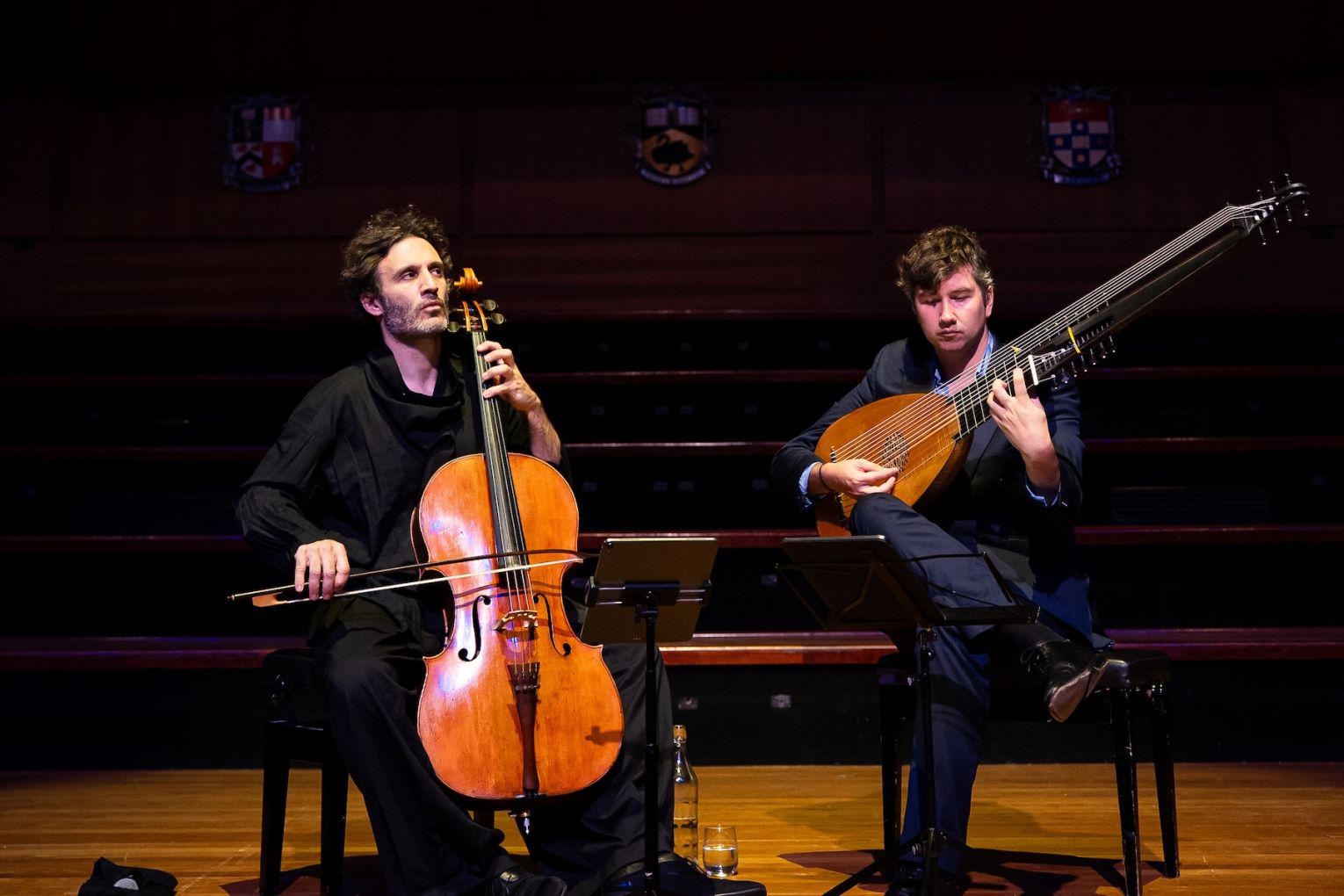
Cellist Nicolas Altstaedt has elevated the cello suites of Bach through his lifetime of exploration with this music. His concert with the equally phenomenal lutenist Thomas Dunford was one of the year’s highlights.
As many have known from his previous appearances to Adelaide, Nicolas Altstaedt is one of the most progressive cellists out there today. Memorably, he appeared barefoot and accompanied by a pair of dancers from Australian Dance Theatre in Bach’s Cello Suites Nos 1 and 5 when he curated the annual UKARIA 24 (now Chamberfest) in 2018 – it was one of that venue’s most stunningly original concert weekends. Another of Altstaedt’s bolder moves on that occasion was to have a visual artist join on stage to paint watercolours while he and violinist Vilde Frang played Bach’s Two-Part Inventions.
Eight years later, we find the German-French cellist to be a more spiritually centred and internally thoughtful musician. When he plays Bach these days, it is to witness a person who has spent a lifetime exploring the cello’s sound world and developing a language that brings the listener right into the centre of Bach’s music.
There were new discoveries at every turn in this quite incredible Musica Viva touring concert, not least because Altstaedt was partnered by one of the world’s finest lutenists, the American Thomas Dunford. On paper, the partnership of cellist and lutenist might have looked implausible. In historical, terms these two instruments do not coincide well. Virtually no music is specifically written for this combination. While the lute persisted beyond its heyday in the Renaissance into the early Baroque era, the cello was slow to develop a place of its own until later. Indeed, Bach’s six cello suites were foundational in transforming the instrument into a fully capable solo voice.
The great delight of hearing Altstaedt and Dunford perform together was to see them escape from the shackles of musicological history, reinvent all the rules, and play Bach in the light of their spiritual and ‘scientific’ rediscovery of his music.
Some words first about their instruments might be in order, because it was fascinating to see how they accomplished this eclipsing but at times strange concert. Altstaedt is not a ‘Baroque’ musician like some others out there. Clearly, he is well informed on period performance practice technique on not only the early cello but more particularly on viola da gamba. His bowing style is so very ‘gamba’ in its articulate lightness, feathery touch, and clean draw of sound. One could not be completely sure, but in this concert, he appeared to have strung his 1749 Guadagnini cello with metal, not gut: the glint of light shining from its four strings indicated this. Yet one thing could be certain. Altstaedt’s bowing was highly unconventional for a cellist: his hand was positioned right up the shaft of the bow and loosely held just like a gamba player does it.
Meanwhile, Dunford has gone about his separate self-invented solutions on the lute with equal thoroughness. Actually, it is an archlute that he plays, its long neck extending right out to accommodate a spectacular set of bass strings. It looks like a Jimmy Page experiment, but his instrument is basically historically truthful. One did notice, however, that Dunford chooses to string it with single courses, not in pairs tuned in octaves. This is apparently to create a clearer, more focused tone. So, a certain amount of historical accuracy is discarded when these musicians partner up. But it hardly matters because they are crack hot.
To be sure, this was no regular ‘early music’ concert. First, it was Marin Marais and Forqueray in music originally written for viola da gamba, and then it was Bach. Later came Arvo Pärt and Duparc.
But let’s get on with the core of it. Tantalisingly, cello was entirely absent in Bach’s Cello Suite No. 1, BWV 1007. Dunford played it on lute. The significant fact here is that Bach actually arranged one of his cello suites for lute (No. 5), which in a sense gives permission to do this with the others. Dunford’s playing was smooth, mellow and infinitely beguiling. With no nail noise or buzzing on frets, he was able to give phrases vocal-like air and shape. Gazing out across the hall and letting his fingers do their work, it is like he thinks the music anew, freed from the constrictions of notation and technique. It feels free.
In the second half it was Altstaedt’s turn in Bach’s Cello Suite No. 5, BWV 1011. Beginning with a low C that sounded not like a note but a deep breathy utterance, he proceeded to spin out the most amazing distillation of this music. One became conscious of his brushing of notes, his fluctuations of speed and exploratory direction through this work’s six movements. It was artistry of the highest order. What he was doing departed radically from anything one might have heard, but it all miraculously made sense: Altstaedt finds a new way through Bach that is intimately founded on Baroque principles yet modern in its thought process.
Subscribe for updates
It doesn’t need long statements to say how wonderful their playing was. These two spiritually aligned musicians have landed on a very different and special place.
At the end of it, some will still want to hear Marin Marias and Antoine Forqueray played on their rightful instrument, the viola da gamba. However, both these musicians have an unchallengeable integrity and techniques that are incredibly highly developed. It all puts paid to any questions over what may be ‘right’ or ‘wrong’.
It was a privilege and profound pleasure to hear them play.
Musica Viva presented Nicholas Altstaedt and Thomas Dunford at Adelaide Town Hall on August 18
Want to see more stories from InDaily SA in your Google search results?
- Click here to set InDaily SA as a preferred source.
- Tick the box next to "InDaily SA". That's it.
Free to share
This article may be shared online or in print under a Creative Commons licence