Music review: Australian String Quartet with Julian Smiles
Playing Schubert’s String Quintet felt like a long-awaited dream for the ASQ and cellist Julian Smiles.
For almost three decades, two groups used to share a commanding place in Australia’s string quartet scene. They were the Goldner String Quartet, which began in Sydney in 1995 but decided to call it a day just recently in late 2024, and the Australian String Quartet, which began 10 years earlier in Adelaide and is of course still as busy as ever.
For chamber music watchers, it was fun to play ‘quartet sports’ by comparing these two wonderful groups. Generally, the Goldners were admired for cultivating a richer sound and focusing on core repertoire, whereas the ASQ were more athletic and exploratory in taking on contemporary music – even if their personnel at times changed at an alarming rate.
Apparently only once did these two marvellous groups ever join on stage. This was at the (now defunct) Huntington Estate Music Festival in 2019 for Jakub Jankowski’s String Octet, in which the musicians recreated a wild party scene from Goethe’s Walpurgis Night’s Dream – complete with spoken text.
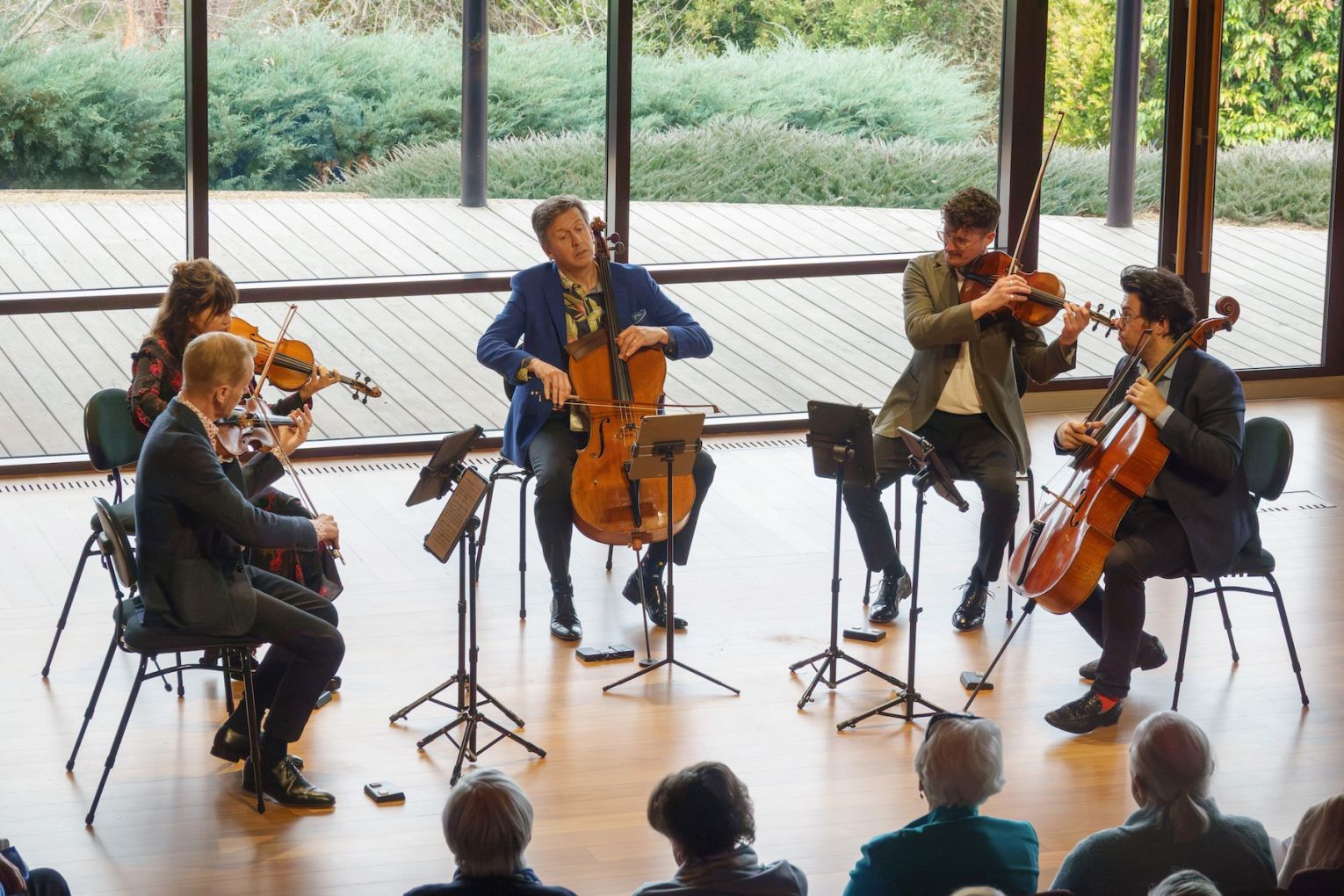
The next best thing was to have one of the Goldner Quartet’s renowned members, cellist Julian Smiles, team up with the ASQ at UKARIA for one of the pinnacles of the chamber music repertoire at UKARIA, namely Schubert’s Quintet in C, D. 956.
First though was a work that lies the pointiest end of quartet music. Samuel Adams’s String Quartet No. 3, ‘Alma’, was composed two years ago to mark the tenth anniversary of the Amsterdam-based Alma Quartet. To some extent, it continues the post-minimalist aesthetic of his celebrated father, John Adams, but simultaneously it shows novel influences of electronic music in the sound world it creates – Sam Adams is known for this.
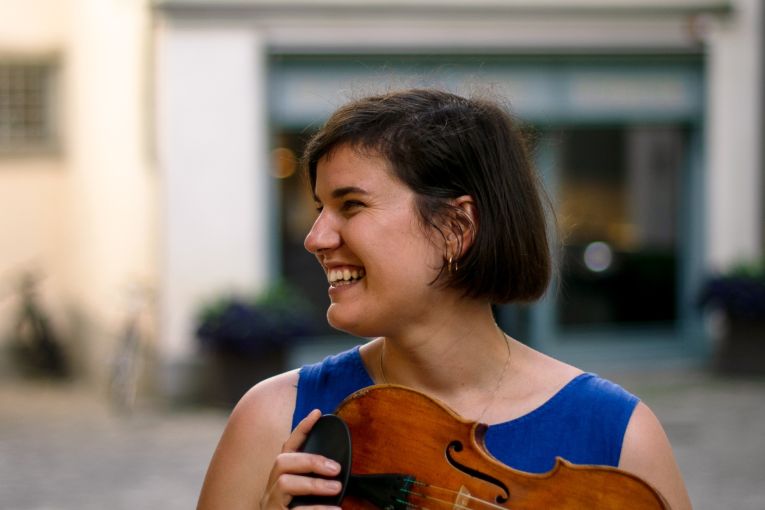

One could hear this right away in the first movement’s tightly woven flat sonorities and whippy dynamics. All four instruments are bunched up in a subtly changing, fluctuating ‘sound mass’ that gradually subdivides rhythmically, minimalist-style. Unity gives way to sharp contrast in its highly virtuosic second movement, in which two ideas collide head-on. The ASQ provided the closest lens into this music, resolving its details with precision and letting loose with fiercest energy. If one thought this work by Samuel Adams would serve just as an opener, one was completely wrong. It made a tremendous impact.
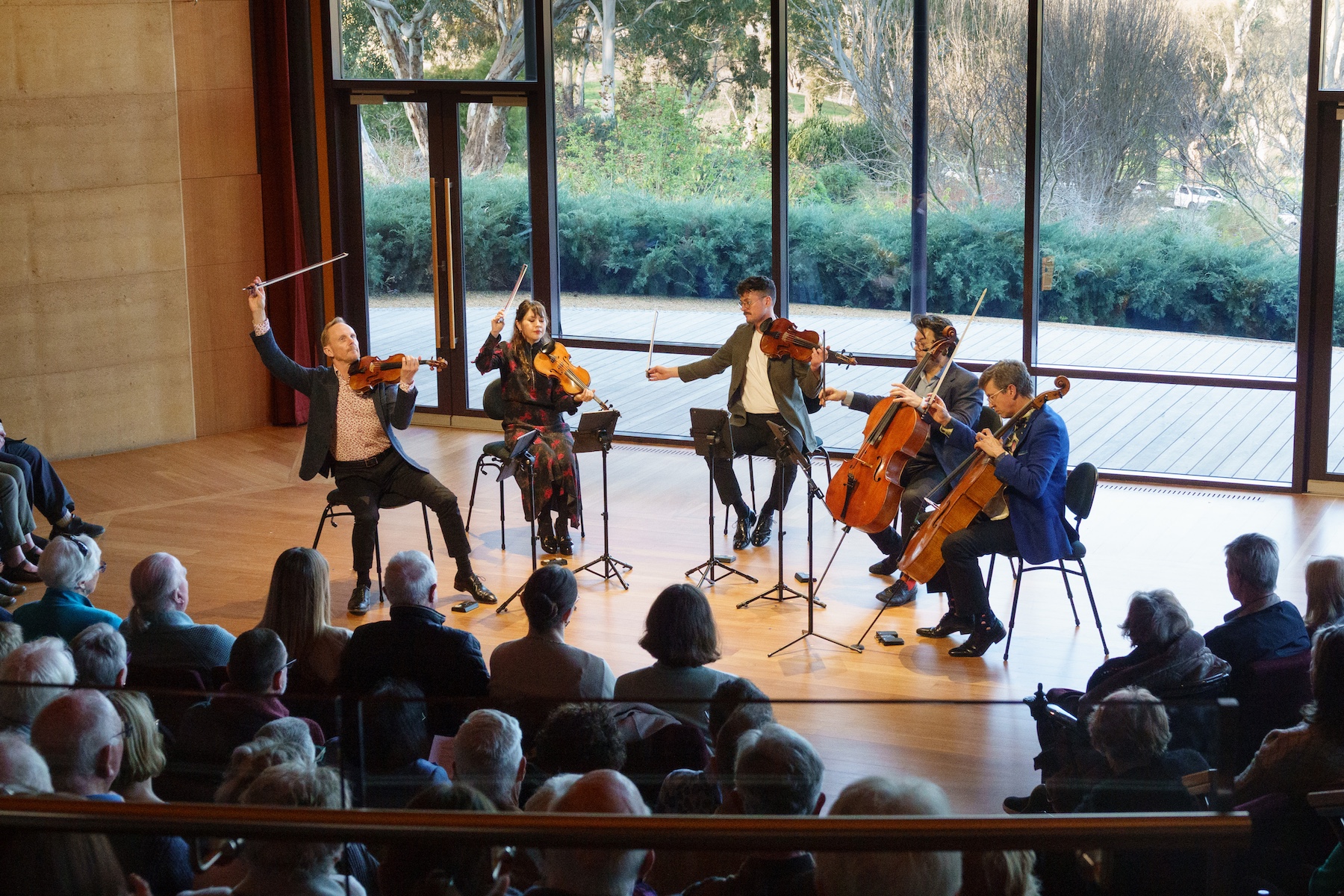
Yet attention naturally fell on what followed. First, Smiles joined the quartet to play Tchaikovsky’s Andante Cantabile, arranged for cello and strings: one of the composer’s most memorable melodies, it actually comes from his String Quartet No. 1, Op. 11, and is frequently lifted out of context in versions for almost any conceivable instrument. But this arrangement was made by Tchaikovsky himself.
Taking a central position that split the ASQ in half, Smiles was the absolute focus of this performance. To be true, Tchaikovsky gives almost nothing to the other players – just whispers of harmony – but the solo cello melody was so mellow and beautifully shaped here that it turned into pure song. Smiles is a big player, meaning that even with this hushed melody his presence commanded every shred of attention.
Schubert’s Quintet in C, D. 956, is a miraculous work in so many ways. It shouldn’t even happen that doubling up on cellos might work due to a resulting imbalance: when Mozart and Beethoven wrote for five string instruments, they instead chose two violas. Schubert, however, turns everything on its head by sometimes thinking orchestrally and other times using novel voice pairings that only this combination can achieve.
One sensed that all five musicians have longed to play this work. And rather than coming to it via an architected plan, their performance spoke all about consensual music-making, which we might say is the heart and soul of Schubert. One noticed particularly their restraint. As the two ‘choirs’ of instruments answered each other, one high and the other lower down, the Quintet took on a delicate pensive quality: all five musicians were holding back and listening to each other, allowing space to develop in the work’s exquisite vocality.
Subscribe for updates
Rather than pushing forward and thickening up the tone, there was an expansive feeling of repose. At the same time, Smiles was able to draw out the full resonant power of his instrument (an 1827 Lorenzo Ventapane cello) when the bottom line called for it, as happens dramatically in the first movement’s development and in the Adagio’s heartbeat-like throbbing pizzicato.
This sublime music – which Thomas Mann described in his novel Doctor Faustus as a farewell to humanity – received a performance of masterly control and insight. Again, their sense of effortlessness and weightlessness made it so, and a sure knowledge that overplaying this Quintet can kill it.
An event to look out for is ASQ’s Barossa Weekend of Music on September 18-20. Joined by singer Parvyn Kaur Singh and multi-instrumentalist Josh Bennett, they will perform at various venues in and around Tanunda.
Australian String Quartet with Julian Smiles performed at UKARIA on August 16
Want to see more stories from InDaily SA in your Google search results?
- Click here to set InDaily SA as a preferred source.
- Tick the box next to "InDaily SA". That's it.
Free to share
This article may be shared online or in print under a Creative Commons licence