Music review: Attacca Quartet
New York group Attacca Quartet go out on a limb in pursuit of the new, but this celebrated group’s debut performance at UKARIA was spellbinding.
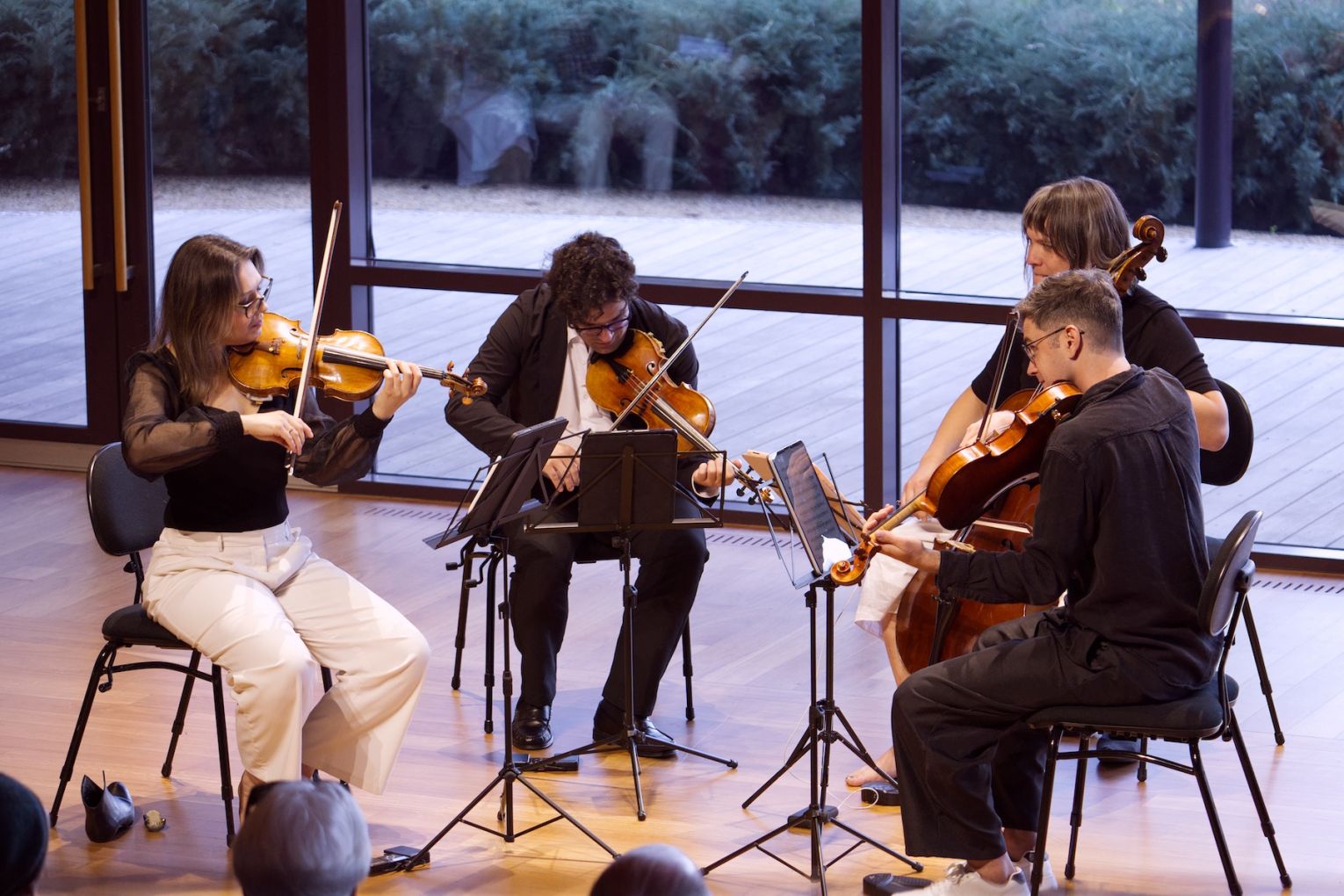
For more than two decades, Attacca Quartet have been lauded for their versatility and pushing boundaries. These days many string quartets carry the tag of ‘innovative’, and recently we’ve witnessed two of the world’s best at UKARIA, namely Brooklyn Rider and Leonkoro. However, Attacca Quartet belong to a unique category, and their debut appearance in Adelaide generated much curiosity: hosts of string quartet followers were clearly curious to see what this Grammy award-winning group from New York is like.
Because they step right outside the familiar in string quartet playing, Attacca can provoke deep questioning, or even outright offence. But the interesting thing to note is that, far from causing grief, this is something the group actively seems to strive towards: to be disruptive. ‘Deal with it’ might be their motto – although in fact their guiding musical philosophy is instead reflected by the Italian musical term attacca, meaning to keep playing without pause.
To be true, not all that Attacca come up with is entirely new, and that’s chiefly because this string quartet has been at it for a long time now, and so many other groups have picked up from them in terms of sound, look and manner. Kronos Quartet remain the true originals in terms of crossing into new territory and wrenching a centuries-old medium into the modern age, but Attacca have since gone further. They’ve done it by moving into indie-pop and onstage theatrics – as this concert witnessed.
It was spellbinding. In terms of virtuosity and sheer range of sound, this foursome is pretty much in a league by itself. And if one could suffer a series of bumps and bruises along the way, their performances produced showers of ecstasy.

Straightway in Caroline Shaw’s Entr’acte, one noticed an emboldened, even proprietorial sense of freedom in this oft-performed piece – written by a celebrated composer with whom Attacca has frequently collaborated and scored two Grammys. This piece’s whispery, flowing lines possessed restraint and beauty. Not quite what one may have expected. Phrases were left hanging in the air, leaving prolonged resonances and a sense of mystery as to what might lie ahead. Shaw has said Entr’acte plays surreal tricks on the imagination after the manner of Alice’s Looking Glass. It sounded like this.
Indeed, this concert became one giant but beautiful trick. Moving seamlessly into Benkei’s Standing Death by Kronos Quartet’s cellist, Paul Wiancko, all four players combined in delicate cascading pizzicatos followed by an onslaught of nouveau sound effects including bow bouncing, hand taps and fierce shredding. By now there were theatrics too: grimaces, head shaking, and swinging limbs – predominantly from the group’s cellist, Andrew Yee. This is Attacca’s signature look, to be seen in all their videos. Ramping up several notches was Radiohead’s ‘2+2=5’ as arranged by the group’s violist, Nathan Schram: its powerfully throbbing, asymmetrical beat and whiny melody quickly turned this concert into something akin to a rock show.
A certain amount of head scratching does occur, though, when this group tackles ‘standard repertoire’. It’s because the results can come across as anything but standard. Ravel’s String Quartet made an appearance in truncated and perplexing form: its first movement was given a vaporous performance. Bookended by the Radiohead and another item by Shaw (the last movement of her forest-inspired piece The Evergreen) the French composer’s first definitive masterpiece felt squashed and lost. One could admire the elan and subtle shading Attacca gave it – one of this group’s surprises, again, was how they can switch into serenity.
Yet it had to be said: their Ravel felt peculiar, very of-the-moment and interestingly improvisational, but lacking a sense of structural direction. Ravel demands coherence above all, even if he subverts form in the interests of colour and unconventional harmony.
One sensed that in Beethoven’s String Quartet No. 15, Op. 132, Attacca’s genre-blending aesthetic might lead them into more dangerous territory. Faith was on their side largely by now, though: the whole reason why a group like this exists is to shake things up and find new answers.
Subscribe for updates
Appearing barefoot in the second half, first violinist Amy Schroeder and cellist Lee already signalled that unconventionality was on the way. And it was. Metronomic regularity was out the window for starters. That itself might be no bad thing in other composers, but in Beethoven it comes at the cost of coherence. Attacca Quartet were very free with the notation, transforming Op. 132 into a sequence of moods rather than a unity. It was so interesting to hear.
Their performance called to mind how critics initially viewed Beethoven’s late quartets as “utterly vague, entirely chaotic”, speculating that his deafness was to blame. One became acutely conscious in this performance of how Beethoven moves into the strangest territory. Magnified dynamics against the sweetest playing from Schroeder – she really is wonderfully lyrical with Beethoven – created something truly disconcerting. The famous ‘Heiliger Dankgesang’ slow movement was a moment to take stock. Quiet and hushed, its melody followed natural contours, and its chords were exquisitely weighted. Hard as it is to say, these late quartets can get buried in gravitational seriousness, and gratefully this did not happen. Attacca’s performance was entirely self-invented, and even if flawed in its disjointedness, it spoke with courage.
Attacca probably gave audiences the year’s most invigoratingly different concert. This group’s daring is to be celebrated.
Attacca Quartet performed at UKARIA Cultural Centre on August 2
Want to see more stories from InDaily SA in your Google search results?
- Click here to set InDaily SA as a preferred source.
- Tick the box next to "InDaily SA". That's it.
Free to share
This article may be shared online or in print under a Creative Commons licence