Music review: Andrea Lam
Widely admired in the ABC TV show The Piano, Andrea Lam revealed the full panoply of her capabilities in a solo recital at UKARIA.
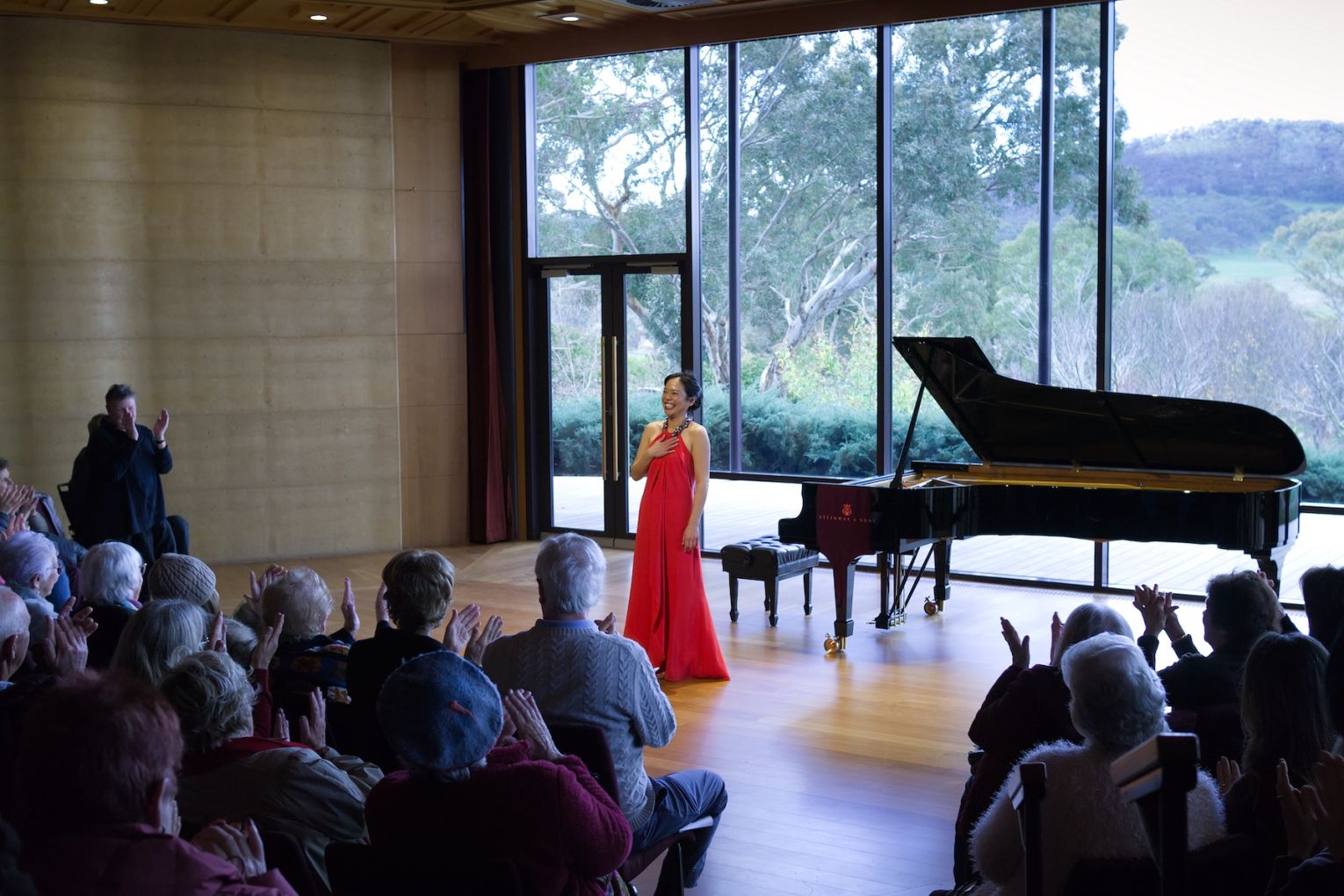
Well known as co-host with Guy Sebastian in ABC TV’s series The Piano and for her weekly radio program The Art of the Piano on ABC Classic, Andrea Lam is intriguing when she steps into the role of performer herself. And it comes with more than a few surprises.
The Sydney-born musician has played several times at UKARIA, once with the Australian String Quartet in works by Bridge and Schumann in 2024, and before that in the 2023 Adelaide Festival’s Chamber Landscapes in an eclectic combination of chamber works by Chausson, Crumb and Paul Schoenfield.
But this time she was on her own and playing – amongst other works – one of the very pinnacles of the repertoire, Schubert’s Piano Sonata No. 20 in A, D. 959.
As she walks on stage, Lam’s endearing personal manner is the first thing one notices. She speaks with a friendly warmth that connects straightaway with her audience, sharing words about how nature, song and dance are the threads in her program.
Glidingly elegantly into ‘The Maiden and the Nightingale’ from Goyescas by Spanish composer Enrique Granados, connections immediately come into being.
You might like

This charming piece brings to life the vibrant landscapes of Francisco Goya, and at the very end it directly imitates birdsong in trills high up on the keyboard. Lam’s performance was melodically rounded, soft-touched and restful. Time felt stilled, and already she had her audience at ease and transported.
Lam spoke elsewhere about how she values improvisation and how Alberto Ginastera pursues a course of spontaneous invention in his Suite de danzas Criollas. His source of inspiration in these five little pieces is a nostalgic casting back to Argentinian folk tradition. One could definitely hear this too, in a performance that ranged from the languid to the excitingly dissonant.
For Lam, improvisation is clearly about creating that in-the-moment feeling, and she does it so well. As it were she plucked each melody out of the air, hanging on just enough before moving on to the next. Subtly free with time, music seemed to escape out of its confines and merge with imagination. This turns out to be the most distinctive aspect of her playing.
It was interesting next to hear her play the Aria from Bach’s Goldberg Variations, because this likewise responded well to her interpretative approach. Lam’s Bach is both well-structured but nuanced in its handling of line. Again, she was discovering new things – which for repertoire as familiar as this is itself an exceptional achievement.
Subscribe for updates
Pairing the Bach with a new work by Melbourne composer Melody Eötvös was a good idea. Composed specifically for Lam, Bachram quotes the Baroque master’s name in musical letters (B-A-C-H, where B represents B-flat and H represents B-natural), and it’s a voluptuously expressive piece that, in Lam’s hands, brought out the full sound of UKARIA’s Steinway. One admired the resonances she developed in this.
Bigger mountains lay ahead. Chopin’s Ballade No. 1 in G minor and Schubert’s penultimate piano sonata are of course heartland piano territory, and interpretation of these two composers takes on mightier challenges. Here again though, Lam had secrets to share.
Chopin is so often the victim of ‘big pianism’ whereby the intimate side of his piano music can become overtaken by epic virtuosity. Likewise, Schubert’s music can suffer when it is loaded up with structural weight and dramatic power.
Neither situation arose with Lam. Her performances exhibited restraint yet expressive freedom within a full sense of the music’s architecture. In the Chopin ballade, improvisational discoveries of ‘the moment’ made this work sound different but compelling. She took time with melody, allowing it to roam and properly develop. Ballade No. 1 sounded unexpectedly dreamy – and the more satisfying for it. Simultaneously, it had strength: Lam has plenty of technique to make sure about that.
Thankfully, Schubert’s Piano Sonata No. 20 in A, D. 959, also escaped the jaws of conventional pianism. In her introductory words about this work, Lam spoke about how Schubert is foremost a composer of song and that this is reflected in his piano music. One suspects Lam was a singer at some point in her life: in any case, her Schubert possesses a most beautiful singing line. Discovering each new phrase was like opening out a flower, fragrant and soft in tone – brittle attack was nowhere to be encountered in this concert.
There is a human quality about Lam’s playing, and it all stems from her ability to communicate and share.
Andrea Lam played at UKARIA Cultural Centre on July 26
Want to see more stories from InDaily SA in your Google search results?
- Click here to set InDaily SA as a preferred source.
- Tick the box next to "InDaily SA". That's it.
Free to share
This article may be shared online or in print under a Creative Commons licence